Key Stats for Upstart Stock
- Current Price: $28.05
- Target Price (Mid): ~$113
- Street Target: ~$40
- Potential Total Return: ~301%
- Annualized IRR: ~38% / year
Now Live: Discover how much upside your favorite stocks could have using TIKR’s new Valuation Model (It’s free) >>>
What Happened?
Upstart Holdings (UPST) trades at $28.05, down about 60% over the past year, and its own credit models are flashing caution: on September 3, the Upstart Macro Index held at 1.50, meaning the macro environment is pushing defaults roughly 50% above the company’s long-run baseline. The puzzle is that the same company just posted record contribution profit, its best operating quarter yet, and today CEO Paul Gu takes the stage at the Goldman Sachs Communacopia conference to argue the recovery is durable.
Shares sit a third below where they started 2026, near multi-year lows, even as August originations grew 57% year over year to $1.34 billion and the balance sheet leaned less on Upstart’s own capital than it has in nearly two years.
The Metric Management Wants You to Watch
Second-quarter revenue reached $364.71 million, up 41.75% year over year, and the company returned to GAAP profitability with net income of $16.5 million, up 195% from $5.6 million a year earlier. Contribution profit hit an all-time high of $193 million. Adjusted EPS of $0.57 beat the Street’s $0.55. The stock barely moved on the print, rising 0.40% the next session, because one quarter was never going to settle a debate this old.
At his August Bank of America fireside chat, Gu pointed to one number. “We got to record contribution profits in Q2 that surpassed Q4 of 2021 back when the macro conditions were much more generous,” he said. That comparison strips out the rate-and-default backdrop, which is far harsher now than in 2021, and isolates operating progress. Contribution profit is the fee income left after direct acquisition and servicing costs, and it funds everything else the company builds. The engine was core personal loans, Upstart’s highest-margin product, which grew faster in Q2 than in the prior three quarters combined.
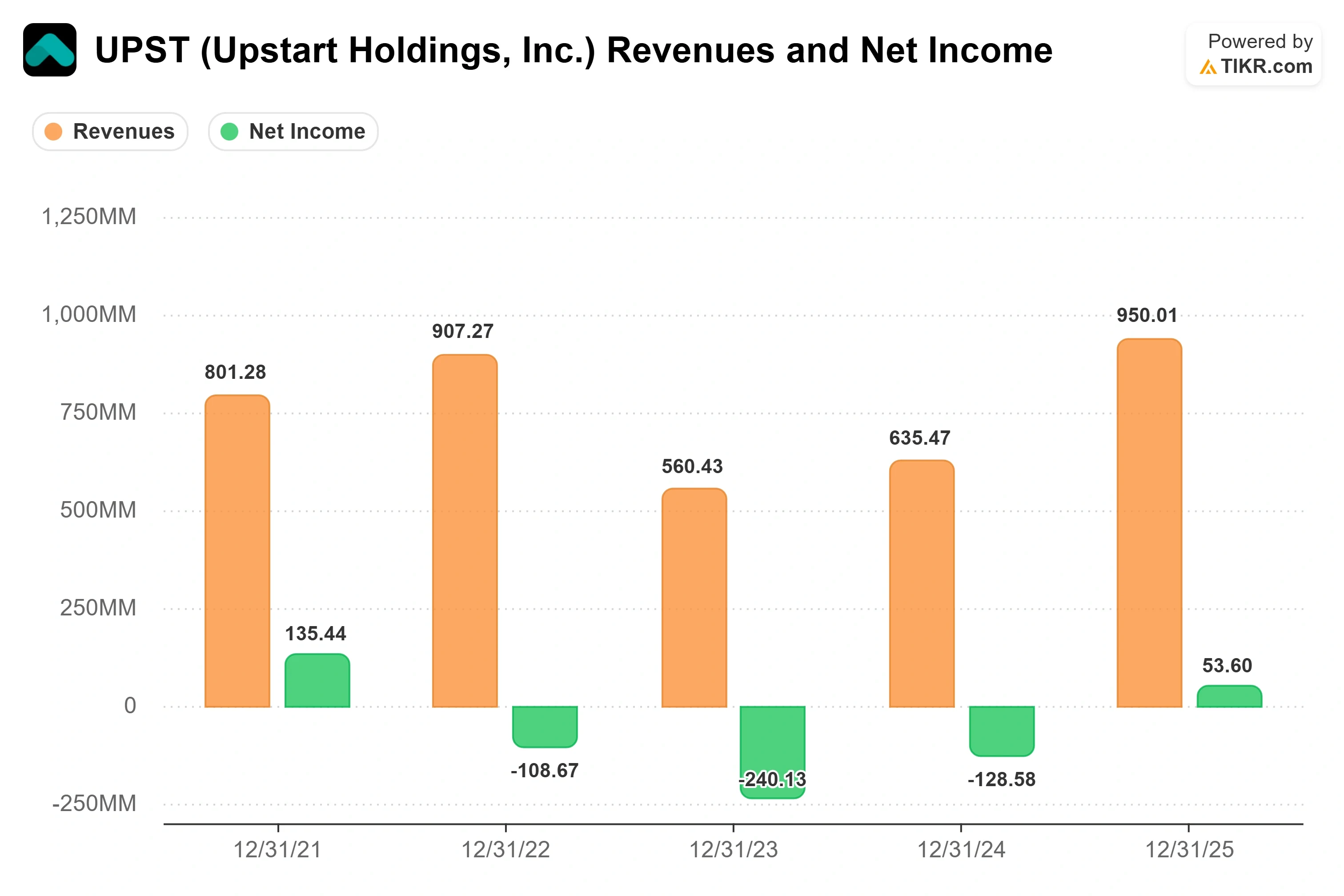
See historical and forward estimates for Upstart stock (It’s free!) >>>
Why the Funding Story Broke the Old Bear Case
For years, the loudest knock was that growth forced Upstart’s own equity onto the balance sheet, exposing it to the kind of credit blowup that broke the stock in 2022. Q2 answered directly: originations rose 23% sequentially, about $760 million, funded mostly with third-party capital, and balance-sheet loans fell to roughly 5.9% of total outstanding, the lowest in nearly two years.
On July 29, Upstart announced an agreement for Castlelake-managed funds to purchase up to $4 billion of its loans over as long as 24 months, its largest program with that partner yet. These are pre-committed purchases of loans that do not yet exist, which lets Upstart scale volume without scaling its own risk. Gu also said the company has enough capital to open Upstart Bank early next year, unlocking cheaper deposit funding, though that charter is still pending and not yet approved.
Upstart trades near 9.1x next-twelve-month earnings, below SoFi at roughly 25x and Dave at about 19x. Wall Street is split: as of September 4, the 15 analysts covering the stock break down to 6 Buys, 1 Outperform, 6 Holds, 1 Underperform, and 1 Sell, with a mean target near $40. The discount would be fair if the profitability were a fluke, but the fee-revenue growth rate is unlike anything in that peer group, and a stream compounding at this pace rarely stays that cheap.
Gu was candid that the elevated UMI cost the company a guidance raise: “If not for the rise in UMI, I think we probably would have landed in a pretty different spot on guidance.” He was equally candid on the other open question, operating leverage, conceding operating costs grew more than 30% over the past year before adding that the growth rate slows sharply from here. At 1.50, the index is elevated but still below its 1.68 peak from 2024.

See how Upstart performs against its peers in TIKR (It’s free!) >>>
TIKR Advanced Model Analysis
- Current Price: $28.05
- Target Price (Mid): ~$113
- Potential Total Return: ~301%
- Annualized IRR: ~38% / year

See analysts’ growth forecasts and price targets for Upstart stock (It’s free!) >>>
TIKR’s mid-case scenario points to a target near $113, about 301% total return and roughly a 38% annualized return realized over the next 4.3 years. Two revenue drivers carry it: the reacceleration in high-margin core personal loans, and the shift of Auto and HELOC from loss-making to contribution-profitable, which management expects by the end of 2026 after expanding those margins 61 percentage points in a single quarter. The margin driver is operating leverage: with OpEx growth slowing, contribution gains fall to the bottom line, and the mid-case models net income margin climbing toward the low 30s later this decade.
The primary risk is the macro. Because Upstart underwrites to the UMI at origination, a sustained climb back toward 1.68 would pressure loss rates and the growth algorithm at once. The upside: a credit tailwind arrives as the funding base turns durable and the bank charter clears, letting volume and margin inflect together. The downside: a rising UMI while new products stall short of profitability, leaving the core to carry a multiple that no longer looks cheap if growth fades.
Conclusion
The next real test is November 10, when Upstart reports Q3. Watch two things: whether Auto and HELOC actually cross into contribution-profitable territory on schedule, turning management’s promise into proof, and the UMI trend through the quarter. Readings holding at or below 1.50 keep the growth math intact; a move toward 1.60-plus would hand the bears their case that this rebound is macro-borrowed rather than earned.
See what stocks billionaire investors are buying so you can follow the smart money with TIKR.
Should You Invest in Upstart?
The only way to really know is to look at the numbers yourself. TIKR gives you free access to the same institutional-quality financial data that professional analysts use to answer exactly that question.
Pull up Upstart, and you’ll see years of historical financials, what Wall Street analysts expect for revenue and earnings in the quarters ahead, how valuation multiples have moved over time, and whether price targets are trending up or down.
You can build a free watchlist to track Upstart alongside every other stock on your radar. No credit card required. Just the data you need to decide for yourself.
Analyze Upstart on TIKR Free →
Looking for New Opportunities?
- See what stocks billionaire investors are buying so you can follow the smart money.
- Analyze stocks in as little as 5 minutes with TIKR’s all-in-one, easy-to-use platform.
- The more rocks you overturn… the more opportunities you’ll uncover. Search 100K+ global stocks, global top investor holdings, and more with TIKR.
Disclaimer:
Please note that the articles on TIKR are not intended to serve as investment or financial advice from TIKR or our content team, nor are they recommendations to buy or sell any stocks. We create our content based on TIKR Terminal’s investment data and analysts’ estimates. Our analysis might not include recent company news or important updates. TIKR has no position in any stocks mentioned. Thank you for reading, and happy investing!