Key Takeaways for FIS Stock as of September 2026
- YTD Slide: FIS stock has fallen 36% since the start of the year, a 49% annualized decline that steepened sharply after an Aug. 4 guidance cut.
- Analyst Split: The Street’s current call on FIS stock stands at 9 buys, 4 outperforms, and 14 holds, with the $50 mean target sitting 20% above the price.
- Model Upside: TIKR’s mid-case model values FIS stock at $70 by December 2030, implying 68% total return and 13% annualized.
- Target Cuts: Wells Fargo and TD Cowen cut their targets this quarter.
Why FIS Stock’s 36% Year-to-Date Slide Accelerated After the August Guidance Cut
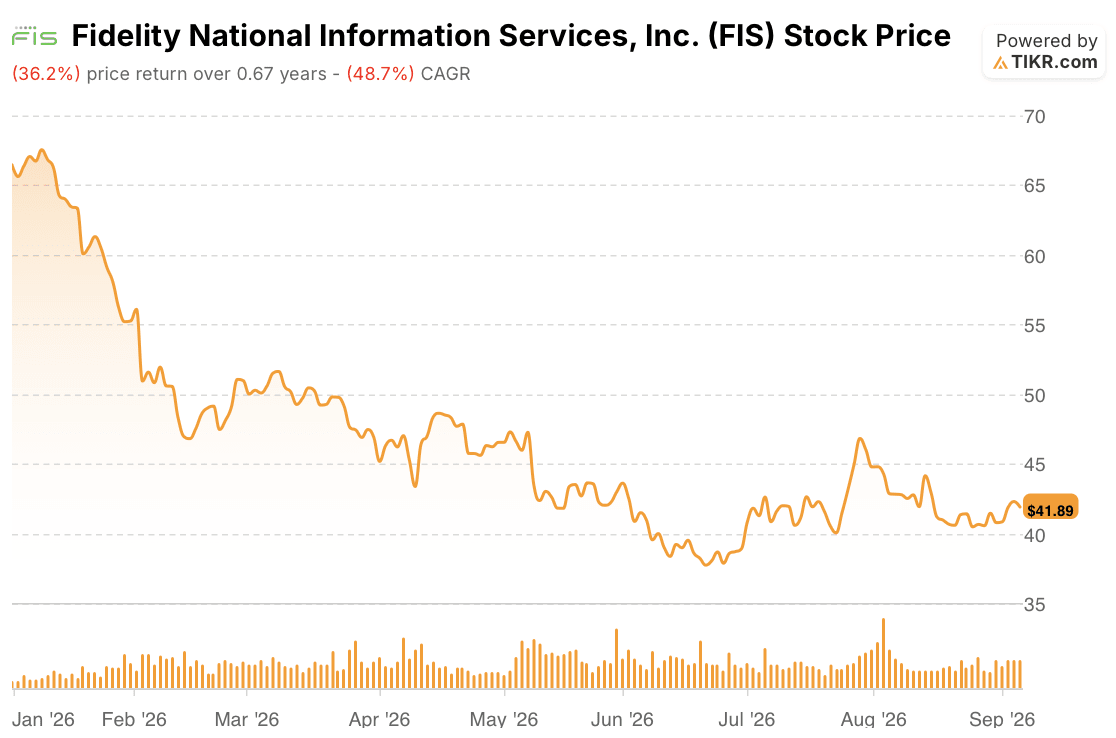
Fidelity National Information Services (FIS) stock has dropped 36% since the start of January, a 49% annualized decline that has erased more than a third of its value in eight months. The slide came in two distinct legs. FIS stock closed 2025 at $66, then fell to $47 by the end of the first quarter, a 29% drop before management said a word about 2026 guidance. A second leg took the stock to $39 by June 30. It has since clawed back to $42, still down 36% for the year.
That first leg tracked a broader repricing of legacy payments processors, not anything specific to FIS. Investors spent early 2026 worried that Visa’s push into issuer processing through its Pismo platform would erode FIS stock’s position with large banks, even as the price-to-earnings multiple on FIS stock contracted at a 27% annualized pace over the trailing year.
The second, sharper leg had a clear trigger. On August 4, FIS cut its 2026 adjusted earnings guidance to $6.15 to $6.24 a share from $6.22 to $6.32, and trimmed its revenue outlook to $13.63 billion to $13.70 billion from $13.77 billion to $13.85 billion. Third-quarter guidance came in below Wall Street’s numbers too, with revenue seen at $3.41 billion to $3.44 billion against a $3.51 billion estimate. Shares fell as much as 10% in premarket trading that morning, and management temporarily paused share buybacks and tuck-in acquisitions to preserve flexibility.
The culprit was Capital Markets, where full-year revenue growth guidance dropped to 3% to 3.5% from 5.5%, a 225 basis point cut. CEO Stephanie Ferris did not blame the market for it on the Q2 earnings call: “No, we think this is on us. We don’t see any trends in market that are changing here… the miss is on us. It’s not a market condition.” That admission matters more than the number itself, because it separates a demand problem the model would need to worry about from an execution problem the model can underwrite.
FIS stock’s 36% slide, then, is a story about a sector already skeptical of legacy processors meeting a company that handed it a concrete reason to stay that way.
Fiserv’s Own Collapse Shows FIS Stock’s Problem Isn’t Unique
FIS stock did not fall in isolation. Two days after FIS cut its own outlook, rival Fiserv slashed its 2026 adjusted earnings forecast to $7.20 to $7.40 a share from $8.00 to $8.30 and cut its revenue outlook to flat or down 1%, from prior guidance of 1% to 3% growth.
Fiserv shares fell nearly 12% on the news, extending a decline that has left the stock down almost 20% for the year after a 68% collapse in 2025. Activist investor Jana Partners has since pushed Fiserv to review its entire portfolio and refresh its board. The pattern across both companies tells the same story: the market has stopped extending legacy payments processors the benefit of the doubt on execution, which is exactly the doubt FIS stock’s August guidance cut confirmed rather than dispelled.
Wall Street Finally Cuts Its FIS Stock Target to Match the Price
The Street’s current read on FIS stock stands at 9 buys, 4 outperforms, 14 holds, 1 no opinion and 1 underperform. The mean target sits at $50, 20% above the current $42 price.

A year ago, the mean target stood at $88 against an $81 price, an 8% premium. As FIS stock cratered toward $39 by June 30, analysts cut the target far more slowly than the price fell, and the gap ballooned to 50% upside. That gap has narrowed sharply since, not because the stock recovered much, but because targets finally caught down.
Wells Fargo cut its target to $46 from $58 in late August and downgraded the stock to equal weight. TD Cowen cut its target to $53 from $58 a day later. Coverage has actually widened slightly, from 22 analysts publishing targets a year ago to 23 now, so this isn’t thinning interest. It’s a chorus catching up to a price it had been slow to believe.
TIKR Puts FIS Stock’s Fair Value at $70, Far Above the Street
TIKR’s mid-case model values FIS stock at $70 by December 2030, implying a 68% total return from the current price of $42, or 13% annualized.

That return would put FIS stock well ahead of the mid-single-digit growth typical of legacy payments processors, and more than triple the 20% upside the Street’s own mean target implies.
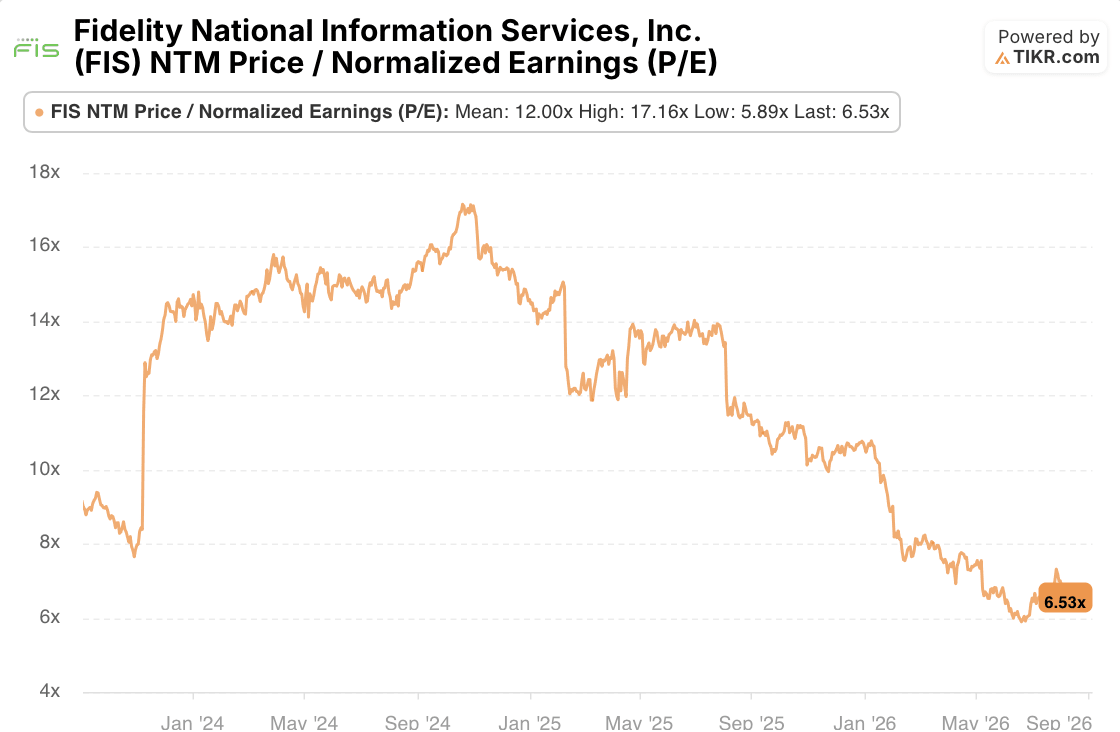
The starting multiple backs that up: FIS stock trades at 6.53x next-twelve-month earnings now, barely half the 13.85x it carried in mid-2025, so the model is leaning on a re-rating back toward where the stock traded before the selloff, not on multiple expansion into new territory.
The model is underwriting Ferris’s own framing of the Capital Markets miss as an execution problem, not a demand problem, while assuming Banking and Payments, carried by the Total Issuing integration, keep compounding underneath it. That combination is what makes the current price look like a reaction to one segment’s miss rather than a verdict on the whole franchise.
Should You Invest in Fidelity National Information Services, Inc.?
The only way to really know is to look at the numbers yourself. TIKR gives you free access to the same institutional-quality financial data that professional analysts use to answer exactly that question.
Pull up Fidelity National Information Services, Inc. stock and you’ll see years of historical financials, what Wall Street analysts expect for revenue and earnings in the quarters ahead, how valuation multiples have moved over time, and whether price targets are trending up or down.
You can build a free watchlist to track Fidelity National Information Services, Inc. alongside every other stock on your radar. No credit card required. Just the data you need to decide for yourself.
Access Professional Tools to Analyze FIS stock on TIKR for Free →
Looking for New Opportunities?
- See what stocks billionaire investors are buying so you can follow the smart money.
- Analyze stocks in as little as 5 minutes with TIKR’s all-in-one, easy-to-use platform.
- The more rocks you overturn… the more opportunities you’ll uncover. Search 100K+ global stocks, global top investor holdings, and more with TIKR.
Disclaimer:
Please note that the articles on TIKR are not intended to serve as investment or financial advice from TIKR or our content team, nor are they recommendations to buy or sell any stocks. We create our content based on TIKR Terminal’s investment data and analysts’ estimates. Our analysis might not include recent company news or important updates. TIKR has no position in any stocks mentioned. Thank you for reading, and happy investing!