Key Stats for Dell Stock
- Current Price: $524.14
- Target Price (Mid): ~$660
- Street Target: ~$564
- Potential Total Return: ~26%
- Annualized IRR: ~5% / year
Now Live: Discover how much upside your favorite stocks could have using TIKR’s new Valuation Model (It’s free) >>>
What Happened?
Dell Technologies (DELL) closed at a record $524.14 on September 4, and days later S&P Dow Jones Indices confirmed the stock will enter the S&P 100 at the open on Monday, September 21. That promotion caps a year in which shares have climbed about 316%, lifting Dell’s market value to roughly $339 billion. The index change is the kind of milestone that arrives after the big money has already been made, which is why it makes buyers nervous.
Anyone buying here is paying a record price for a stock that has more than quadrupled off its January low, right as index funds are set to add it on September 21. The S&P 100 tracks the roughly 100 largest US companies, and Dell qualified because its market cap tripled, not because an analyst blessed the valuation. Dell’s own investor relations materials show a business compounding faster than the market modeled a year ago. That inclusion creates a pocket of one-time, price-insensitive demand that says nothing about whether $524 is a good entry. Dell moves up alongside Palo Alto Networks, Arista Networks, and SanDisk, while Nike, Honeywell Aerospace, Simon Property Group, and Colgate-Palmolive drop out. Old-economy staples are being swapped for networking, storage, and AI hardware, and the earnings behind that swap are the reason Dell earned the seat.
The Quarter That Earned the Seat
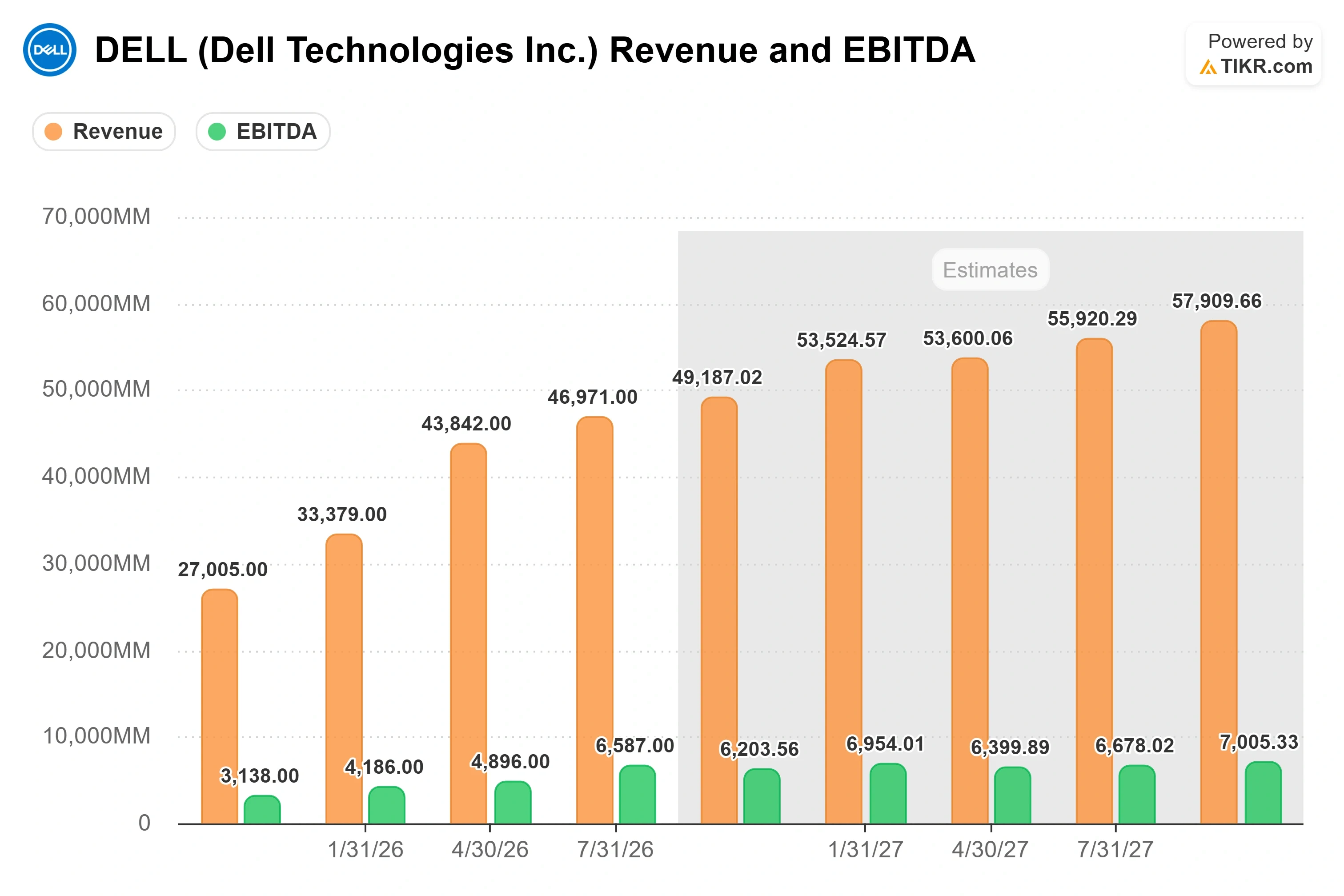
On September 1, Dell reported fiscal Q2 2027 revenue of $47 billion, up 58%, and adjusted earnings per share of $7.04, up 203% and well ahead of the roughly $4.92 consensus. Shares jumped 15.81% the next session, then added another 4.9%. The Infrastructure Solutions Group drove it, with revenue up 89% to a record $31.8 billion and operating margin of 15%, up 620 basis points. Dell booked a record $60.9 billion in AI server orders and exited with a $95 billion AI backlog, while traditional servers grew 122% and storage returned to growth at 26%.
Vice Chairman and COO Jeffrey Clarke told analysts that inference demand “is past training and is pure demand on our industry,” and he sized the total opportunity at more than $1 trillion through 2030 as AI grows to an estimated 75% of all data center demand. That is a forward-looking scenario built on Dell’s assumptions, not a booked number, and it should be read that way. But it explains why demand is broadening well past GPUs, and Dell sells the whole rack. Management raised full-year guidance by $25 billion to $192 billion in revenue, with adjusted EPS near $25.50, and lifted its AI server revenue target to about $74 billion, three times last year. Wall Street chased it, with post-print targets clustering at $600 from Citi, Bank of America, and Mizuho, and JPMorgan reaching $635, all above the TIKR Street mean near $564.

See historical and forward estimates for Dell stock (It’s free!) >>>
The Number the Bulls Have to Explain
GAAP free cash flow fell to $986 million, missing the Street estimate by about 77% and down 68% from the prior quarter, as Dell built inventory and financing receivables to serve surging demand. Cash from operations came in at $2.2 billion against a $5.2 billion estimate. A business growing revenue 58% while free cash flow shrinks is not a contradiction in a supply-constrained ramp, because Dell is funding the working capital to convert that $95 billion backlog. But it is the single figure a buyer at a record high should watch, because the bull case assumes it reverses as shipments catch up to orders.
Dell trades at about 18.6 times next-twelve-month earnings, which is not demanding for a company that the model sees growing EPS in the high teens, and its NTM P/E sits below storage peers Seagate at 23.7 times and Western Digital at 23.3 times. That discount is arguably justified by Dell’s thinner hardware margins. The harder question is the premium the stock now commands over its own history, because the P/E has expanded as the multiple re-rated alongside earnings.
See how Dell performs against its peers in TIKR (It’s free!) >>>
TIKR Advanced Model Analysis
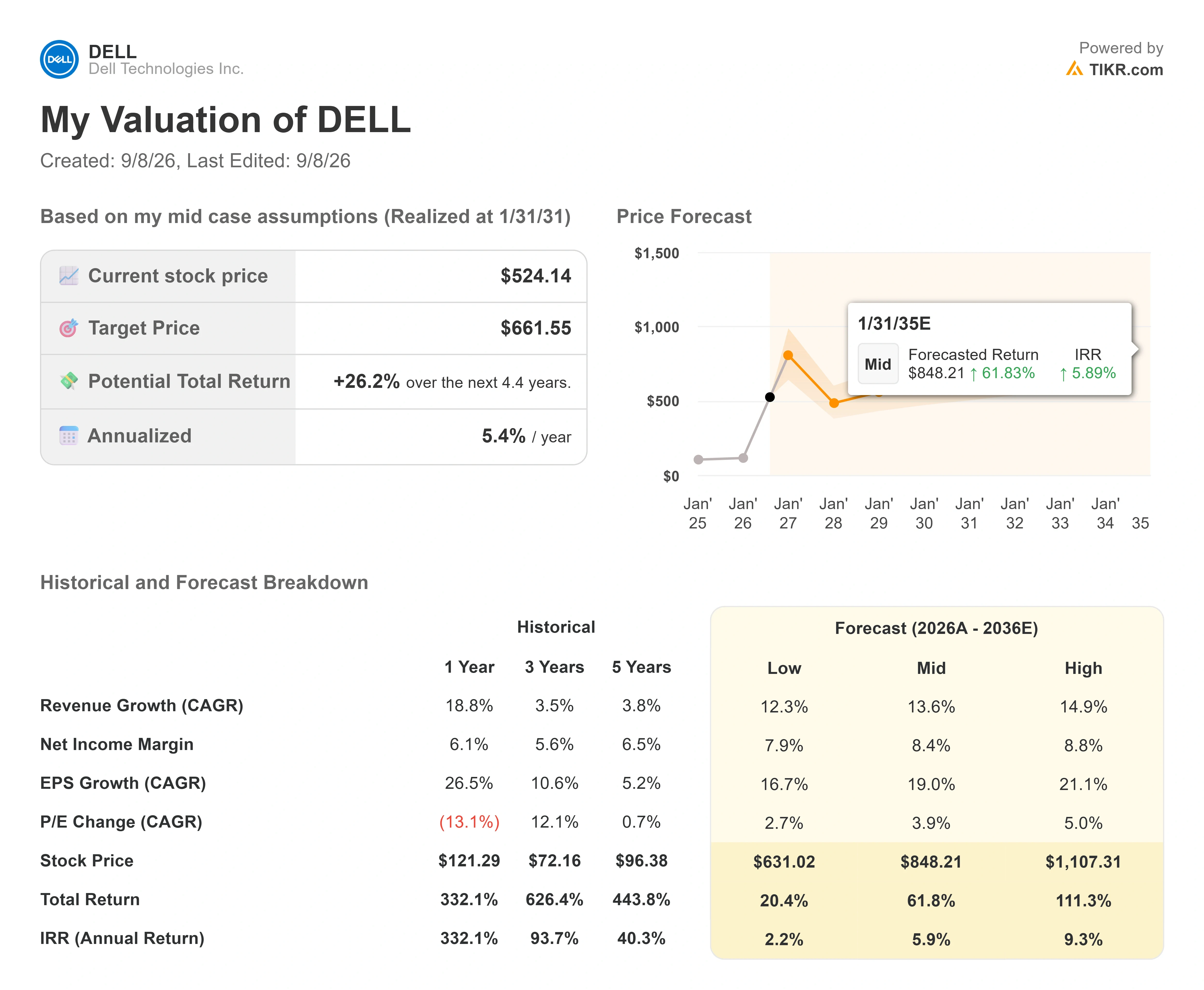
- Current Price: $524.14
- Target Price (Mid): ~$660
- Potential Total Return: ~26%
- Annualized IRR: ~5% / year
See analysts’ growth forecasts and price targets for Dell stock (It’s free!) >>>
Using the mid-case, TIKR’s model puts fair value near $660, about 26% above the current price, or roughly a 5% annualized return over the forecast horizon. The engine is revenue growth of about 14% compounded, driven by two things: conversion of the $95 billion AI backlog into ISG revenue, and broadening server and storage demand as enterprises modernize aging data centers. The margin driver is Dell IP storage mix, which management called the single biggest contributor to operating margin outside of scale, as higher-margin Dell-owned products displace partner IP. The primary risk is free cash flow: if working capital keeps absorbing cash or a large customer pauses, the earnings-to-cash gap widens and the multiple compresses.
The upside case is that Dell sustains double-digit growth with expanding storage margins and the backlog converts cleanly, pushing shares toward the high-case near $1,100. The downside is that AI order growth slows or component inflation squeezes margins, and a hardware business re-rates back toward its historical multiple. At $524, buyers are paying for the base case to hold, not for a bargain.
Conclusion
The S&P 100 debut on September 21 will add a burst of passive buying, but it settles nothing about value. Free cash flow does. Dell reports fiscal Q3 on approximately December 1, and the market will watch whether operating cash flow recovers from the $2.2 billion trough toward the double-digit billion pace the full-year guide implies. A clear rebound, with the backlog still converting and ISG margins holding near 15%, confirms the cash dip was a timing artifact of the ramp. Another quarter of cash lagging earnings, and the record close starts to look like the risk rather than the reward.
See what stocks billionaire investors are buying so you can follow the smart money with TIKR.
Should You Invest in Dell?
The only way to really know is to look at the numbers yourself. TIKR gives you free access to the same institutional-quality financial data that professional analysts use to answer exactly that question.
Pull up Dell, and you’ll see years of historical financials, what Wall Street analysts expect for revenue and earnings in the quarters ahead, how valuation multiples have moved over time, and whether price targets are trending up or down.
You can build a free watchlist to track Dell alongside every other stock on your radar. No credit card required. Just the data you need to decide for yourself.
Looking for New Opportunities?
- See what stocks billionaire investors are buying so you can follow the smart money.
- Analyze stocks in as little as 5 minutes with TIKR’s all-in-one, easy-to-use platform.
- The more rocks you overturn… the more opportunities you’ll uncover. Search 100K+ global stocks, global top investor holdings, and more with TIKR.
Disclaimer:
Please note that the articles on TIKR are not intended to serve as investment or financial advice from TIKR or our content team, nor are they recommendations to buy or sell any stocks. We create our content based on TIKR Terminal’s investment data and analysts’ estimates. Our analysis might not include recent company news or important updates. TIKR has no position in any stocks mentioned. Thank you for reading, and happy investing!