Key Stats for DELL Stock
- Past week performance: +14.9%
- 52-week range: $110 to $535
- Valuation model target price: $667
- Implied upside: 27.2% over 2.4 years
Build your own AI growth assumptions for Dell inside TIKR’s Guided Valuation Model (It’s free) >>>
AI Orders Are Piling Up Faster Than Dell Can Ship Them
Dell (DELL) shares surged roughly 15% this week after the company posted one of its strongest quarters on record and raised guidance twice over in a single report. Revenue for fiscal Q2 2027 jumped 58% year over year to $47.0 billion, easily topping Wall Street estimates. Non-GAAP earnings per share more than tripled to $7.04, and investors reacted immediately once the scale of AI demand became clear.

The real story sits inside the Infrastructure Solutions Group, where revenue climbed 89% to $31.8 billion. AI-optimized server revenue alone doubled to $16.4 billion, and Dell booked a record $60.9 billion in new AI orders during the quarter. That pushed the company’s AI backlog to $95 billion, more than double where it started the year, spread across more than 6,500 customers. Traditional servers and networking also grew 122%, so this was not a one-product story.
Management responded by lifting full-year revenue guidance by $25 billion to $192 billion and raising AI server revenue guidance to $74 billion. Full-year non-GAAP EPS guidance now sits at $25.50, up sharply from where it started the year.
Dell Vice Chairman and Chief Operating Officer Jeff Clarke told investors on the earnings call that the pipeline continued to grow sequentially and remains multiples of the backlog. Demand is broadening beyond hyperscalers into sovereign governments and large enterprises, which gives the growth story more legs than a single customer segment.
If Dell can keep converting that backlog into shipped hardware without supply constraints choking margins, the current rally has room to extend into next year.
Turn Dell’s guidance raise into your own price target (It’s free) >>>
Is Dell Stock Still Undervalued After the Rally?
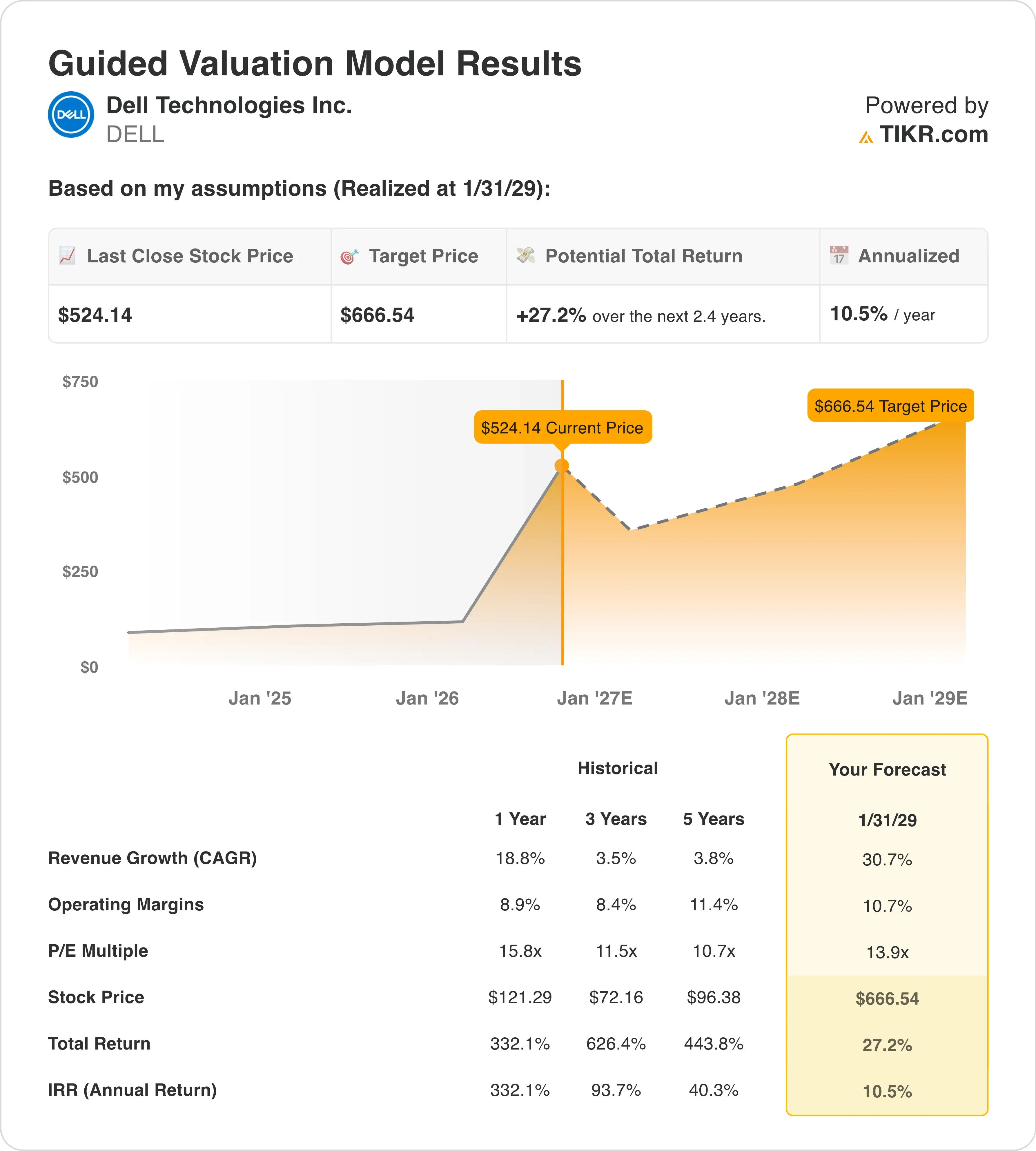
Under valuation model assumptions realized through 1/31/29, the stock is modeled using:
- Revenue Growth (CAGR): 30.7%
- Operating Margins: 10.7%
- Exit P/E Multiple: 13.9x
Based on these inputs, the model estimates a target price of $667, implying 27.2% total upside from the current share price and a 10.5% annualized return over the next 2.4 years.
That annualized return lands in the moderately attractive range under most valuation frameworks, and it comes despite Dell stock already climbing sharply this year. The market is pricing in continued AI hardware demand, but Dell’s core business still carries thin margins compared to software peers, so the multiple assigned to it matters enormously. Operating margins near 11% look reasonable relative to Dell’s own five-year average, but they are far below what pure AI infrastructure specialists command.
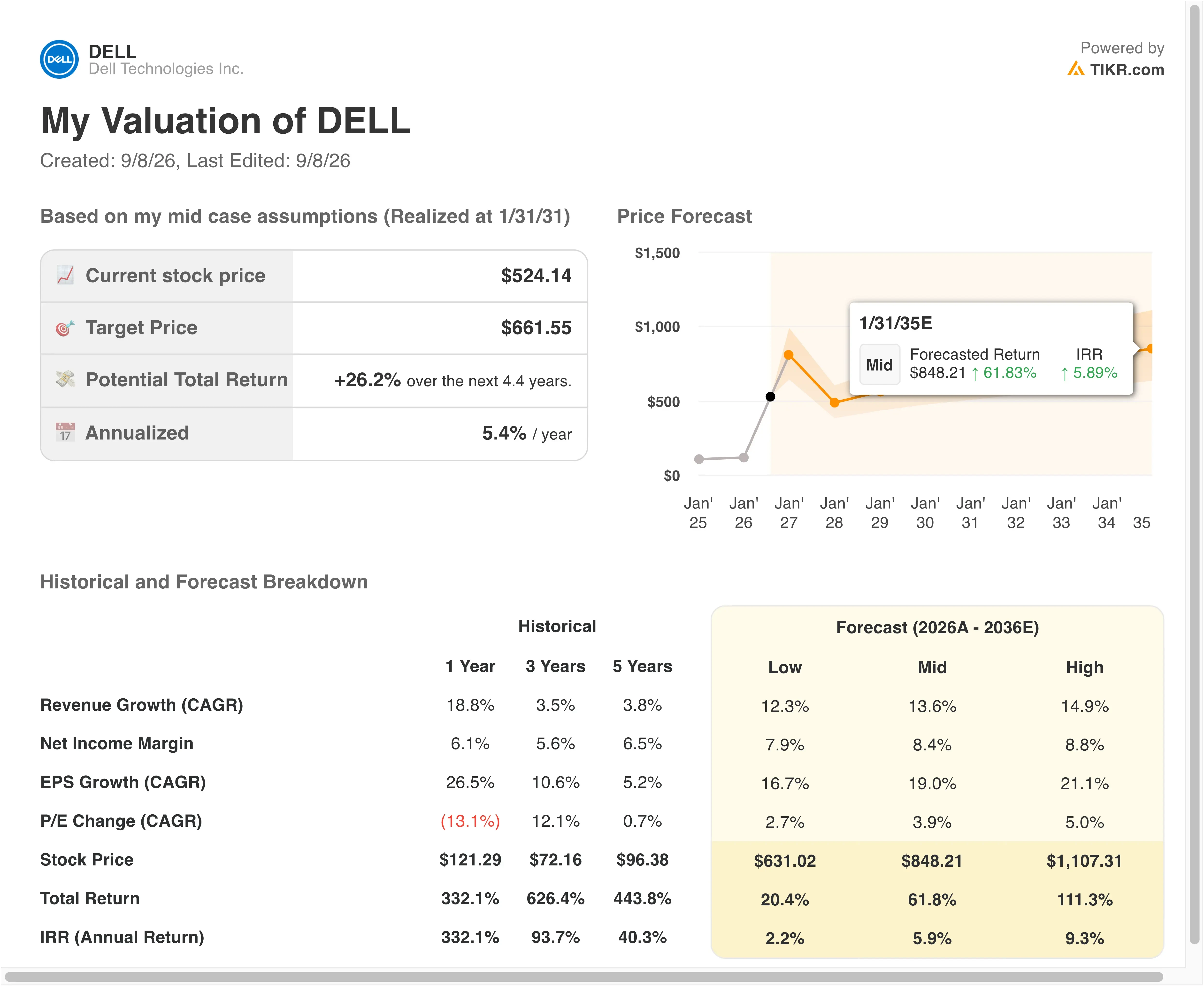
Revenue growth of 30.7% reflects the AI server ramp more than the legacy PC and storage business, which continues to grow at a slower, low-single-digit pace. Because AI hardware sales carry lower margins than Dell’s traditional enterprise products, the mix shift explains why operating margins are not expanding as fast as revenue. Investors weighing whether Dell is still cheap after this week’s move should focus less on the headline growth rate and more on whether margin expansion follows as the AI backlog converts to revenue.
Compare Dell’s margin trajectory against its peers (Free with TIKR) >>>
How Dell Stacks Up Against HPE and Super Micro
Dell’s closest publicly traded rival in enterprise AI infrastructure is Hewlett Packard Enterprise (HPE), which recently raised its own fiscal 2026 revenue growth guidance to a range of 34% to 37% after posting a 40% revenue jump last quarter. HPE trades at a steep premium versus its own history, and its AI backlog of roughly $16 billion is a fraction of Dell’s $95 billion figure, though HPE’s networking business carries richer margins thanks to its Juniper acquisition.

Super Micro Computer (SMCI) sits at the other end of the spectrum. It trades at a forward P/E near 10x, well below Dell’s roughly 19x forward multiple, while analysts expect Super Micro’s fiscal 2026 revenue to grow around 48%. Super Micro’s cheaper valuation reflects real risk, including thinner margins and a smaller customer base than Dell’s, but it shows the market is not simply rewarding growth alone. Dell’s scale and diversified revenue mix across servers, storage, and PCs give it staying power that smaller AI hardware pure-plays lack.
Taken together, Dell looks positioned between HPE’s steadier, lower-growth profile and Super Micro’s higher-risk, cheaper valuation. Its $95 billion backlog gives it more visibility into future revenue than either competitor currently offers, which helps justify why investors rewarded the stock so strongly this week.
What’s Driving DELL Stock Going Forward?
The most important catalyst ahead is simply converting backlog into recognized revenue without running into supply constraints. Dell has already flagged that memory and component shortages remain a risk, and any delay in fulfilling the $95 billion in orders could push expected revenue into later quarters. Investors will be watching Q3 results closely, since Dell has guided to $49 billion in revenue and $6.50 in non-GAAP EPS for the period.
Beyond near-term execution, Dell’s expanding customer base matters just as much as the dollar figures. Management noted that its AI customer count surpassed 6,500 during the quarter, with more than 3,300 added over just the past three quarters. That diversification across neocloud operators, sovereign governments, and large enterprises reduces Dell’s dependence on any single buyer, which was a lingering concern earlier in the AI infrastructure buildout.
Capital returns are also worth watching. Dell returned a record $4.3 billion to shareholders through buybacks and dividends this quarter, supported by $8.1 billion in adjusted free cash flow. As long as AI server demand holds and Dell keeps its balance sheet disciplined, the combination of backlog conversion and shareholder returns gives the stock multiple ways to work even after this week’s sharp move higher.
Estimate a company’s fair value instantly (Free with TIKR) >>>
Should You Invest in Dell Technologies?
The only way to really know is to look at the numbers yourself. TIKR gives you free access to the same institutional-quality financial data that professional analysts use to answer exactly that question.
Pull up DELL, and you’ll see years of historical financials, what Wall Street analysts expect for revenue and earnings in the quarters ahead, how valuation multiples have moved over time, and whether price targets are trending up or down.
You can build a free watchlist to track DELL alongside every other stock on your radar. No credit card required. Just the data you need to decide for yourself.
Analyze DELL stock on TIKR Free→
Disclaimer:
Please note that the articles on TIKR are not intended to serve as investment or financial advice from TIKR or our content team, nor are they recommendations to buy or sell any stocks. We create our content based on TIKR Terminal’s investment data and analysts’ estimates. Our analysis might not include recent company news or important updates. TIKR has no position in any stocks mentioned. Thank you for reading, and happy investing!