
Key Stats for TEAM Stock
- Past week performance: -5.4%
- 52-week range: $56 to $199
- Valuation model target price: $213
- Implied upside: 12.5% over 2.8 years
Model Atlassian’s own AI monetization curve with TIKR’s Guided Valuation Model (It’s free) >>>
A Strong Quarter Meets a Cautious Market
Atlassian (TEAM) shares fell about 5% this week, a pullback that looks more like digestion than a reaction to bad news. The collaboration software company posted a genuinely strong fiscal Q4, with revenue up 28% to $1.77 billion and non-GAAP earnings per share up 91% to $1.87. Cloud revenue, the segment investors care about most, reaccelerated to 31% growth and reached $1.21 billion for the quarter.
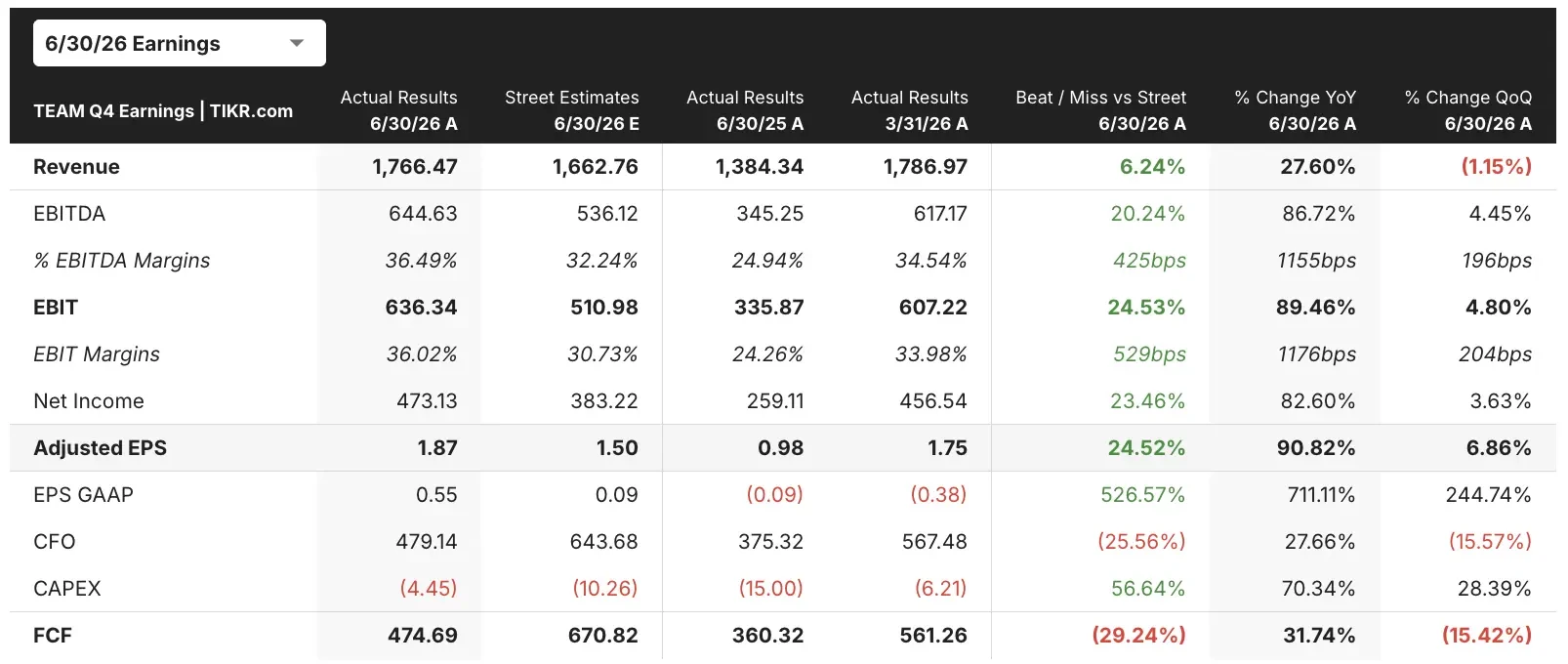
What stands out beneath the headline numbers is remaining performance obligations, or RPO, which measures contracted revenue not yet recognized. RPO jumped 44% year over year to $4.82 billion, a signal that enterprise customers are signing bigger, longer contracts. Atlassian also crossed into GAAP profitability during the quarter, a milestone the company has been working toward for years.
AI adoption is becoming the company’s biggest growth lever. CEO and co-founder Mike Cannon-Brookes told investors on the earnings call that Atlassian is firing across all of its strategic priorities. Rovo, the company’s AI assistant, is now used by more than 80% of the Fortune 500, and customers who adopt it are growing annual recurring revenue at more than twice the rate of those who do not. The Service Collection also surpassed $1 billion in ARR, with more than 60% of its use cases now outside traditional IT departments.
If Atlassian’s cloud momentum and RPO growth continue at this pace, this week’s pullback may prove to be a buying opportunity rather than a warning sign.
Explore Atlassian’s cloud growth trajectory (It’s free) >>>
Is TEAM Stock Undervalued?
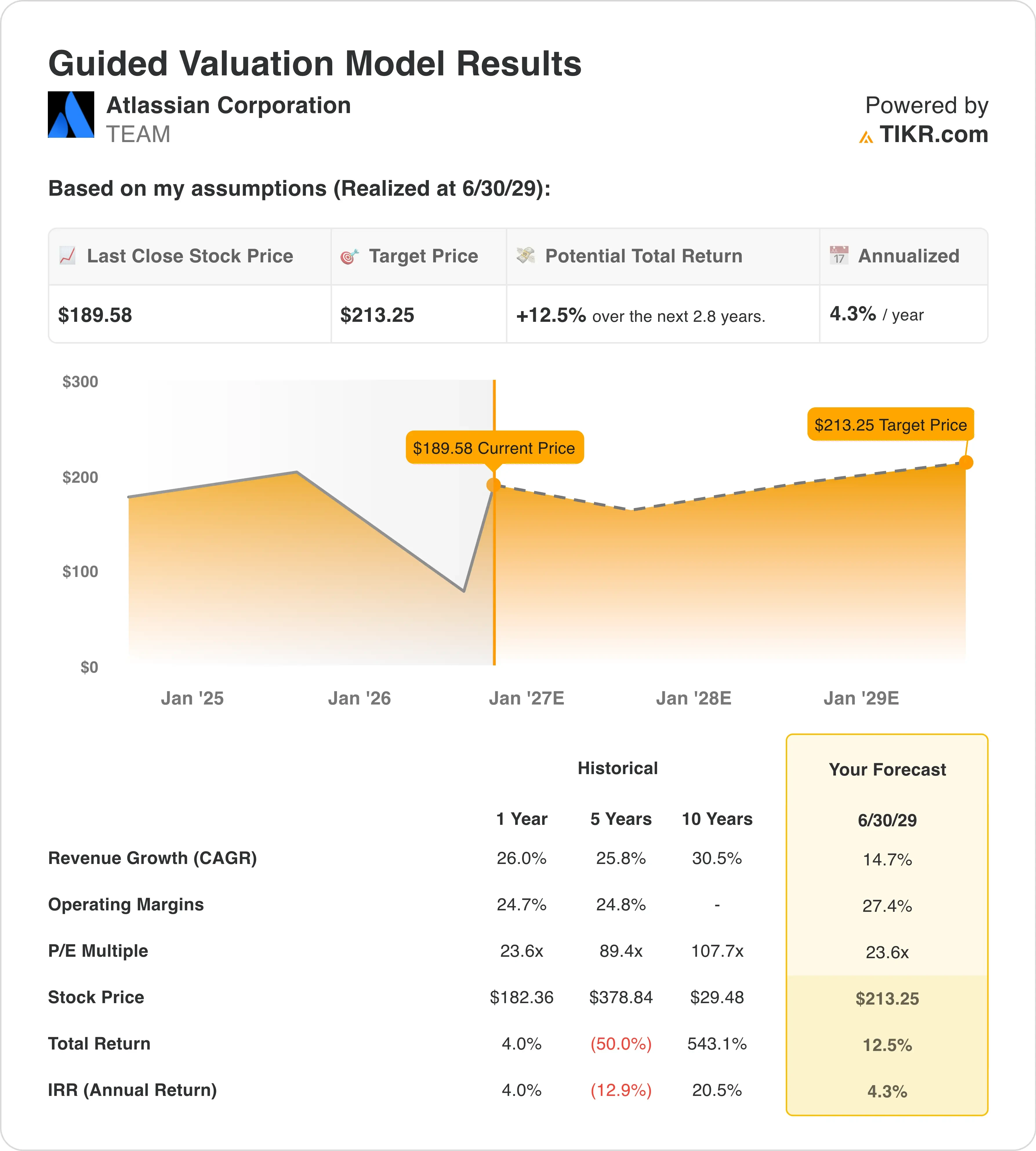
Under valuation model assumptions realized through 6/30/29, the stock is modeled using:
- Revenue Growth (CAGR): 14.7%
- Operating Margins: 27.4%
- Exit P/E Multiple: 23.6x
Based on these inputs, the model estimates a target price of $213, implying 12.5% total upside from the current share price and a 4.3% annualized return over the next 2.8 years.
That 4.3% annualized figure sits near the low end of what most investors consider attractive, and it explains some of the market’s hesitation despite a genuinely strong quarter. Atlassian still trades at a premium multiple relative to slower-growing software peers, so the stock needs sustained revenue acceleration to justify further upside. The good news is that cloud growth reaccelerating to 31% suggests the migration story is not finished, and enterprise customers spending over $3 million annually grew more than 50% year over year.
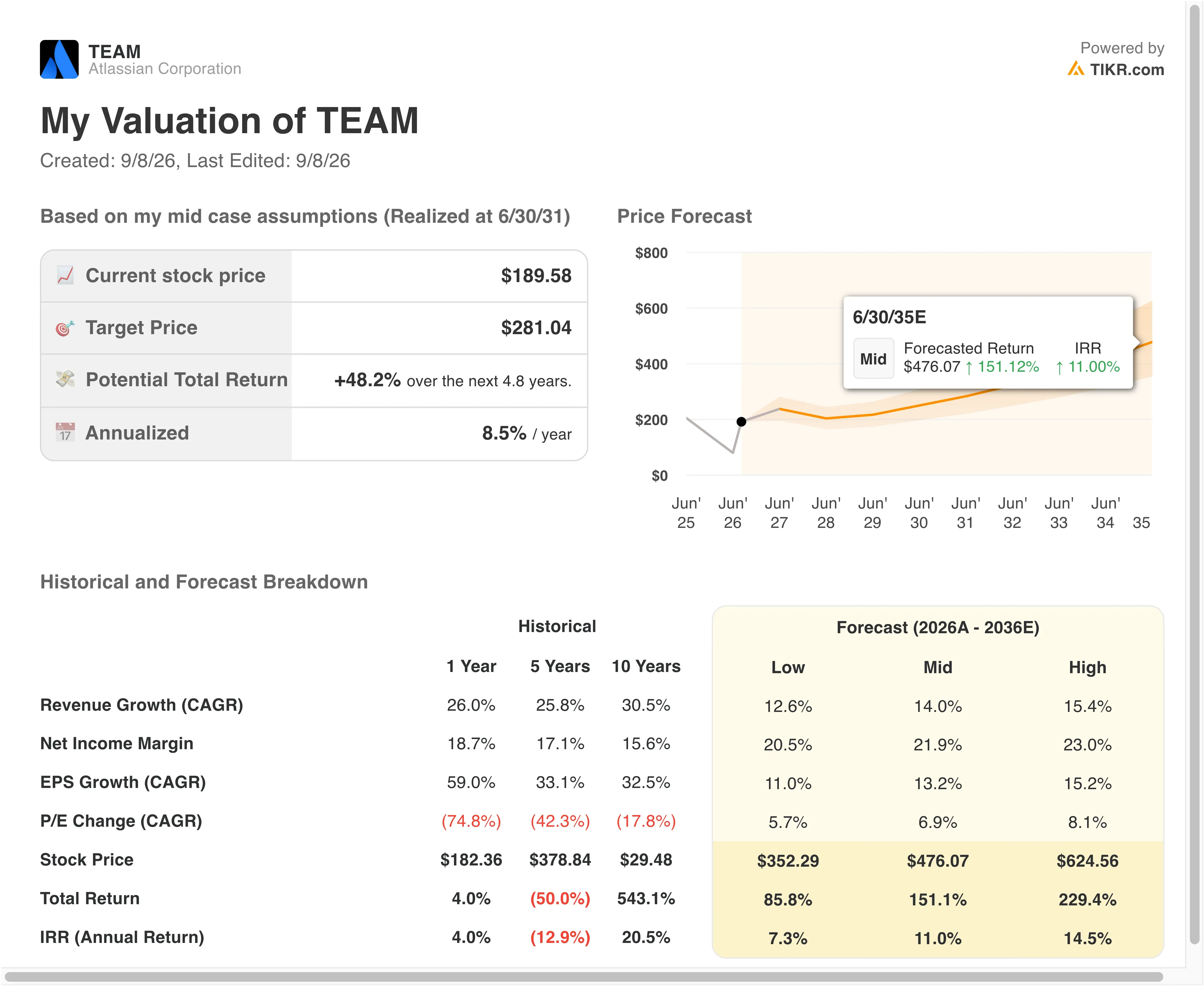
Margins are also moving in the right direction, with operating margins forecast near 27%, well above where the company sat just a few years ago. Because Atlassian still faces stiff competition from both larger platforms and faster-growing niche players, the multiple compression baked into this valuation model reflects real uncertainty about how durable that growth rate proves to be over the next several years.
Estimate a company’s fair value instantly (Free with TIKR) >>>
Atlassian Versus the Productivity Software Field
Atlassian’s most direct rival in project management software is monday.com (MNDY), which trades at a much cheaper 14.6x forward 2027 earnings while analysts expect its revenue to grow around 19.5% next year, faster than Atlassian’s guided range. monday.com achieved GAAP profitability earlier than Atlassian and posts higher gross margins near 90%, though it remains roughly a quarter of Atlassian’s revenue scale and lacks the same developer lock-in that makes Jira the industry standard for software issue tracking.
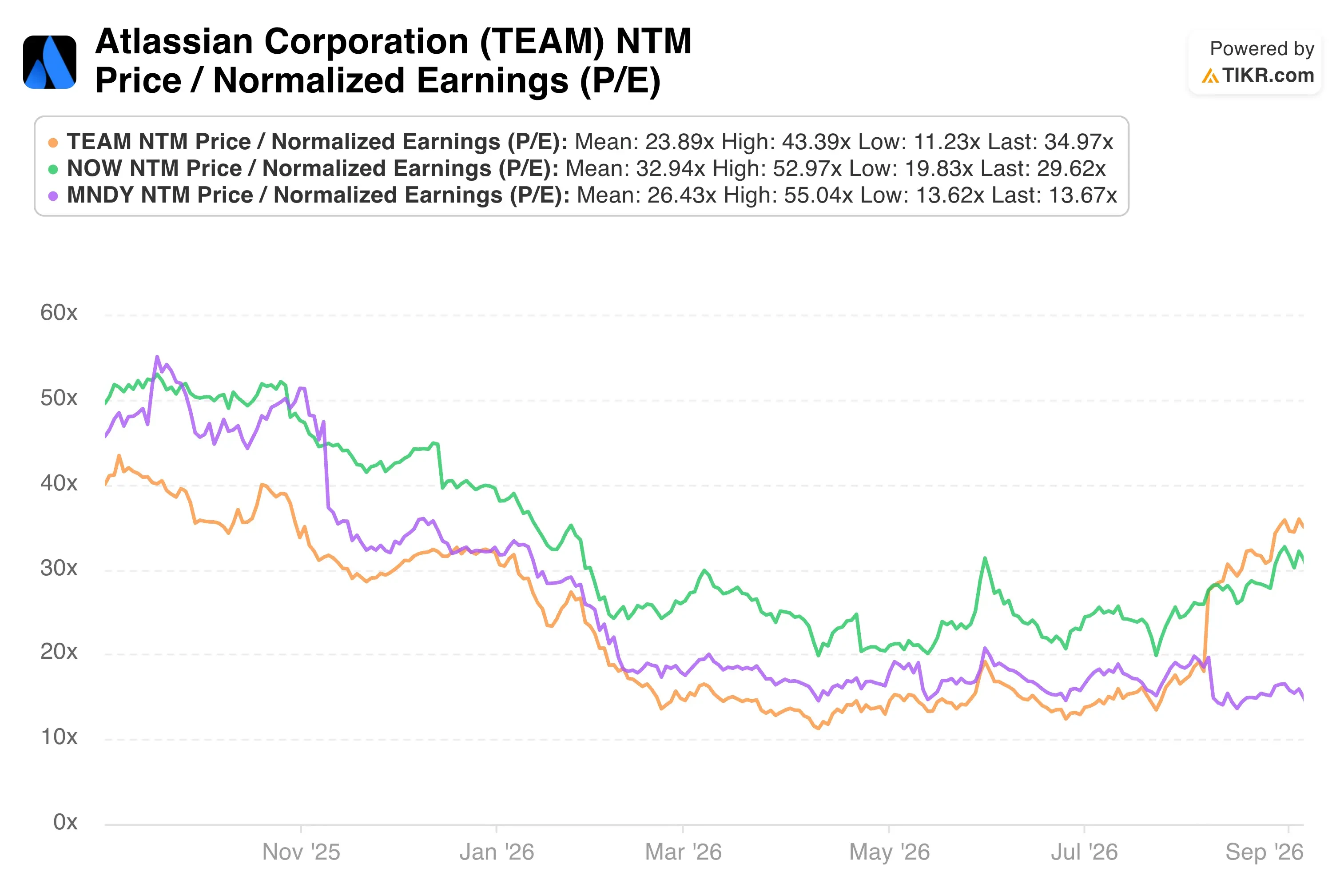
ServiceNow (NOW) sits at the other end of the comparison, trading at a far richer multiple in the 50x to 90x forward earnings range while growing subscription revenue around 22% annually. ServiceNow’s advantage is consistent profitability, with a positive return on equity where Atlassian’s has recently been negative, but its stock has fallen sharply this year despite that growth, a reminder that a strong topline alone does not guarantee a stable share price.
Atlassian sits between these two rivals, offering faster margin improvement than ServiceNow’s steadier profile and a stronger enterprise moat than monday.com’s faster but narrower growth. That positioning is exactly why this week’s RPO and cloud numbers matter so much for the long-term thesis.
What’s Driving TEAM Stock Going Forward?
The clearest near-term catalyst is FY27 guidance, where Atlassian has already pointed to 6.5% GAAP operating margin for the first quarter and 4.5% for the full year, both meaningful steps up from prior years. Management’s willingness to guide subscription ARR growth to 18%, described as prudent given macro uncertainty, suggests the company is choosing conservatism over hype after a run of beat-and-raise quarters.
AI monetization remains the biggest swing factor. Rovo-assisted actions grew 50% sequentially last quarter, and the Teamwork Collection, which bundles AI credits with core products, is driving both upgrades and seat expansion. Because customers using the bundled Teamwork Collection carry four to five times more paid seats than those on standalone products, every percentage point of adoption growth has an outsized effect on revenue.
Enterprise deal activity is the other thread worth watching closely. Atlassian posted record Q4 deal activity at the $1 million, $3 million, and $5 million contract tiers, with the $5 million cohort growing more than 70% year over year. As long as that enterprise momentum continues alongside AI-driven expansion, Atlassian has a credible path back toward the higher end of its valuation range.
Track Atlassian’s next earnings catalysts (Free with TIKR) >>>
Should You Invest in Atlassian?
The only way to really know is to look at the numbers yourself. TIKR gives you free access to the same institutional-quality financial data that professional analysts use to answer exactly that question.
Pull up TEAM, and you’ll see years of historical financials, what Wall Street analysts expect for revenue and earnings in the quarters ahead, how valuation multiples have moved over time, and whether price targets are trending up or down.
You can build a free watchlist to track TEAM alongside every other stock on your radar. No credit card required. Just the data you need to decide for yourself.
Analyze TEAM stock on TIKR Free→
Disclaimer:
Please note that the articles on TIKR are not intended to serve as investment or financial advice from TIKR or our content team, nor are they recommendations to buy or sell any stocks. We create our content based on TIKR Terminal’s investment data and analysts’ estimates. Our analysis might not include recent company news or important updates. TIKR has no position in any stocks mentioned. Thank you for reading, and happy investing!