Key Stats for Broadcom Stock
- Current Price: $368.56
- Target Price (Mid): ~$1,020
- Street Target: ~$530
- Potential Total Return: ~177%
- Annualized IRR: ~28% / year
Now Live: Discover how much upside your favorite stocks could have using TIKR’s new Valuation Model (It’s free) >>>
What Happened?
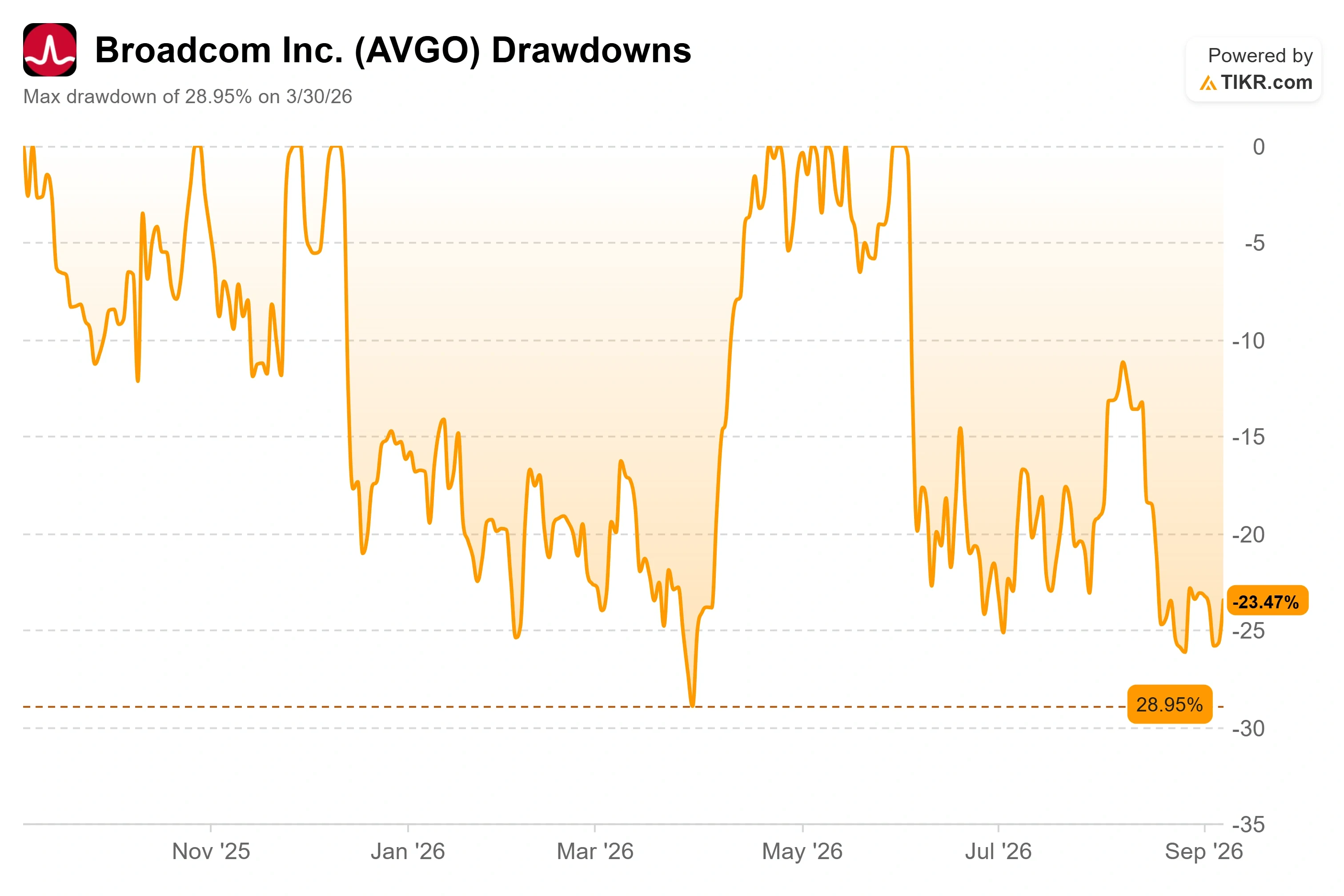
Broadcom (AVGO) just posted the best quarter in its history and laid out a plan to reach $230 billion in AI revenue by fiscal 2028, yet the stock is up only single digits in 2026 and trades roughly 25% below its June high of $495. That is the puzzle investors keep circling. The AI story keeps getting bigger while the share price refuses to follow.
On September 8, CEO Hock Tan sat down with Goldman Sachs analyst Jim Schneider at the Communacopia + Technology Conference and, rather than repeat the September 2 earnings script, explained what actually stands between Broadcom and that $230 billion number.
The Bottleneck Is Power
Tan has guided AI revenue to double to roughly $115 billion in fiscal 2027 and double again to about $230 billion in fiscal 2028. At the conference, he called those figures supply-constrained, and he was specific about which supply. Chips and memory are the parts Broadcom can largely lock in, with wafers and substrates secured for 2027 and 2028 being locked now.
The harder constraint sits outside the fab. What is less deterministic, Tan said, is a power site where electricity exists, but the facility to house and run the chips does not. Building that readiness for 2028 means starting construction now, and much of it turns on permitting and construction pace rather than equipment customers can simply order. Broadcom’s forecast is therefore gated by grid buildout and construction timelines that neither the company nor its customers fully control.
See historical and forward estimates for Broadcom stock (It’s free!) >>>
Why the Market Still Will Not Pay Up
Fiscal Q3 revenue reached a record $29,591 million, up 85.5% year over year, with adjusted earnings of $3.32 per share and a record 67.91% operating margin. AI semiconductor revenue hit $16.7 billion. The results beat, and the stock still fell about 3% the next day.
The fear has a name: customer concentration. On August 19, Marvell disclosed an expanded custom-chip agreement with Google tied to a warrant covering up to $12.2 billion in stock purchases, and Broadcom shares dropped roughly 5% that morning. Google is Broadcom’s largest and longest-standing custom-silicon customer, so any sign of it diversifying suppliers lands hard. Schneider put that concern to Tan directly, and Tan leaned on technical depth rather than reassurance. He pointed to Broadcom’s lead in high-speed interconnect and in advanced packaging that stitches multiple dies into one chip, with the current generation placing four dies together and a path toward eight, an approach he framed as substituting for the end of Moore’s Law. Those, he said, are the moats a rival must overcome. Bank of America has argued that Marvell work targets peripheral chips that attach to the TPU, while Broadcom keeps the core compute, though that read is not a settled outcome.
Shares trade at about 21 times next-twelve-month earnings, below AMD, near 46 times, and Marvell near 41 times, and above NVIDIA, closer to 19 times. For a company holding some of the sector’s most durable multi-year contracts, that mid-pack multiple reads more like unresolved doubt about concentration than a verdict on the business. With the stock down about 25% from its June high, a good deal of that doubt already looks priced in.
The Economics Tan Says Favor Broadcom’s Customers
The most revealing stretch was Tan’s math on where AI value accrues. Global inference token costs run around $200 billion a year, he estimated, against roughly $150 billion in model revenue. Split that pool, and closed frontier models generate about three-quarters of the revenue while open-weight players, despite producing more than half the tokens, capture far less. Value flows to whoever keeps improving intelligence, and that concentrates spending among the frontier labs Broadcom builds for.
That matters because Broadcom serves only six custom-silicon customers, all frontier model developers. Two lack the cash flow to fund their own compute, which is why Broadcom helped create a financing vehicle with Apollo and Blackstone, starting with roughly $35 billion for over 20 gigawatts of capacity. Tan was direct that the structure is not circular financing, since Broadcom provides residual guarantees rather than cash, and the underlying demand exists independently.

See how Broadcom performs against its peers in TIKR (It’s free!) >>>
TIKR Advanced Model Analysis
- Current Price: $368.56
- Target Price (Mid): ~$1,020
- Potential Total Return: ~177%
- Annualized IRR: ~28% / year

See analysts’ growth forecasts and price targets for Broadcom stock (It’s free!) >>>
Revenue drivers: AI semiconductor scaling, where management guides revenue to double in each of the next two years toward $230 billion, plus the VMware software base layered on top
Margin driver: mix and operating leverage, with high-margin software holding operating margin near record levels as lower-margin custom silicon grows
The upside is that Broadcom converts its power-gated pipeline on schedule and holds its share at its frontier-lab customers. The primary risk is what the market fears: that customers like Google shift more custom-silicon work to rivals faster than the market expands, pressuring share and margins. The model assumes revenue compounds around 27% and net margin holds near 55%, both inside management’s guided trajectory rather than beyond it.
Conclusion
The next hard checkpoint is the fiscal Q4 report, expected after market close on December 9. Management guided Q4 AI semiconductor revenue to $21.7 billion, up 236% year over year, so anything at or above that keeps the doubling narrative on track. A soft print, or any hint that power-site delays are slipping 2027 revenue, would tell you the constraint Tan described is starting to bite. Watch the AI revenue line and the fiscal 2027 commentary.
See what stocks billionaire investors are buying so you can follow the smart money with TIKR.
Should You Invest in Broadcom?
The only way to really know is to look at the numbers yourself. TIKR gives you free access to the same institutional-quality financial data that professional analysts use to answer exactly that question.
Pull up Broadcom, and you’ll see years of historical financials, what Wall Street analysts expect for revenue and earnings in the quarters ahead, how valuation multiples have moved over time, and whether price targets are trending up or down.
You can build a free watchlist to track Broadcom alongside every other stock on your radar. No credit card required. Just the data you need to decide for yourself.
Analyze Broadcom on TIKR Free →
Looking for New Opportunities?
- See what stocks billionaire investors are buying so you can follow the smart money.
- Analyze stocks in as little as 5 minutes with TIKR’s all-in-one, easy-to-use platform.
- The more rocks you overturn… the more opportunities you’ll uncover. Search 100K+ global stocks, global top investor holdings, and more with TIKR.
Disclaimer:
Please note that the articles on TIKR are not intended to serve as investment or financial advice from TIKR or our content team, nor are they recommendations to buy or sell any stocks. We create our content based on TIKR Terminal’s investment data and analysts’ estimates. Our analysis might not include recent company news or important updates. TIKR has no position in any stocks mentioned. Thank you for reading, and happy investing!