
Key Stats for Booking Holdings Stock
- Current Price: $180.30
- Target Price (Mid): ~$356
- Street Target: ~$239
- Potential Total Return: ~97%
- Annualized IRR: ~17% / year
Now Live: Discover how much upside your favorite stocks could have using TIKR’s new Valuation Model (It’s free) >>>
What Happened?
Booking Holdings (BKNG) closed at $180.30 on September 8, down 6.72% on a day the S&P 500 barely moved, swept up in a travel-sector selloff after gasoline futures spiked on renewed Middle East tensions. The tape was macro noise. The more useful thing happened hours earlier, when CEO Glenn Fogel sat on stage at Citi’s Global TMT Conference and dismantled the exact fear that has kept this stock cheap all year.
Booking now trades at roughly 16 times next-twelve-month earnings, per TIKR, near the low end of its 52-week range and well under its own five-year forward average of about 20 times. The market’s two worries are the Middle East drag on long-haul travel and the idea that AI chatbots will eventually route travelers around online travel agencies. Fogel spent his Citi appearance arguing the second fear misreads what actually protects this business.
“Almost No Proprietary Data of Any Kind”
Asked what proprietary data defends Booking’s role in discovery, Fogel gave a startling answer for a CEO: “I’ve been here 27 years. There’s almost no proprietary data of any kind.” His point was that the moat was never a hoard of data an AI could scrape. It is the working relationship with partners, the live and accurate inventory, and the trust that money is safe and problems get fixed, coordinated globally in a way he argued no rival matches.
If the edge were a static database, a large language model with an API could threaten it. Because the edge is execution and a two-sided marketplace, the AI question becomes who deploys it best, and Booking is deploying it aggressively. Fogel described running five parallel AI efforts at once, including two greenfield teams told to “pretend you’re not part of the company and start something fresh,” one led by KAYAK founder Steve Hafner. He called AI “a prediction machine” that should flag a rainy museum day and rebook your itinerary before you notice. On the cost side, he said AI has already driven a double-digit reduction in customer-service costs while satisfaction rose.
See historical and forward estimates for Booking Holdings stock (It’s free!) >>>
The Loyalty Engine Partners Pay For
In Q2 2026, reported August 4, revenue grew 8% to $7.35 billion and adjusted EPS rose 15% to $2.54, both ahead of consensus, with adjusted EBITDA margin at 36% and $3.6 billion of free cash flow, per TIKR. Room nights rose 5% to 325 million and gross bookings 9% to $51 billion, per Booking’s earnings release.
What makes the growth durable is a loyalty program that the hotels help fund. Level 2 and Level 3 Genius members are now more than 30% of active customers and a high-50% share of room nights, both up year over year. The economics work because a hotel near 65% occupancy earns almost pure profit on one more filled room, so it will subsidize the discount that fills it. “It’s by the hotel,” Fogel confirmed when asked who pays. He was equally blunt about the gap left to close: ask a European where to rent an apartment in Nice and they say Booking.com instantly, but almost no American names Booking for a beach home in the Hamptons. Fixing that U.S. supply hole, he said, is “just grinding away.”
Cheaper Than Airbnb, Higher Returns Than Either Peer
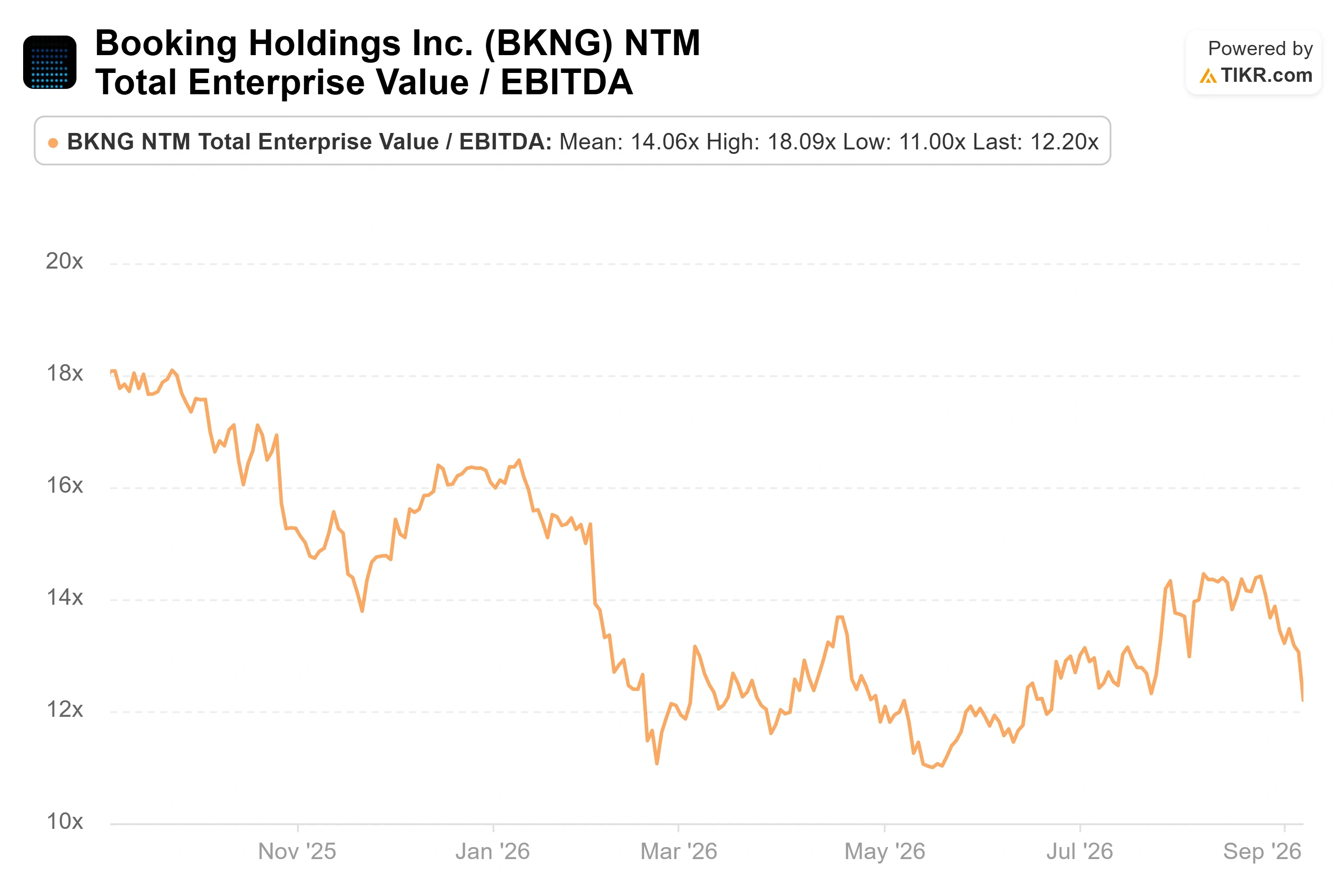
Booking trades at 16.18x NTM P/E and 12.20x NTM EV/EBITDA, per TIKR. Airbnb sits far higher at 31.16x forward earnings on a much smaller revenue base. Expedia is cheaper on earnings at 12.28x but runs structurally thinner margins, and Marriott fetches 26.64x while carrying real estate Booking does not. On gross margin near 87% and a return on invested capital close to 97%, Booking pairs the best financial profile in the group with a below-average P/E.
The discount is real, and it coexists with genuine reasons for caution. Room-night growth has cooled from 9% to 5%, and a decelerating grower earns a lower multiple than it once did. The September 8 fuel scare is a reminder that the macro can stay noisy longer than a valuation gap takes to close. The question is whether that justifies a trough multiple on a business still compounding earnings at a mid-teens rate.

See how Booking Holding performs against its peers in TIKR (It’s free!) >>>
TIKR Advanced Model Analysis
- Current Price: $180.30
- Target Price (Mid): ~$356
- Potential Total Return: ~97%
- Annualized IRR: ~17% / year

See analysts’ growth forecasts and price targets for Booking Holdings stock (It’s free!) >>>
Using the mid-case assumptions, TIKR’s model values Booking near $356 per share by the end of 2030, an implied total return of around 97%, and roughly 17% annualized. The case rests on two revenue drivers and one margin driver:
- Revenue driver 1: mid-single-digit room-night growth, around 8% a year, as domestic and regional travel offsets soft long-haul demand.
- Revenue driver 2: a rising mix of higher-margin connected-trip and B2B bookings.
- Margin driver: the transformation program raised to about $650 million in annual run-rate savings by the end of 2027, lifting net income margin toward 30%.
The primary risk is that prolonged Middle East disruption keeps long-haul travel weak, stalling room-night growth near the low end and holding the multiple down. The upside, in one line: a faster travel normalization lets earnings and the multiple expand together, lifting the model’s high case above $760. The downside, in one line: a lasting geopolitical overhang leaves Booking compounding earnings while stuck near a trough multiple.
Conclusion
Q3 2026 earnings land in late October, and management guided room nights to grow 3% to 5% with revenue and adjusted EBITDA each up 4% to 6%, all assuming Middle East disruption persists. A print at the high end with U.S. room nights still growing in the high single digits would confirm domestic strength can carry the platform and that the September fuel scare was noise. A room-night number below 3%, or any crack in the direct-booking mix, would say the bears were early rather than wrong.
See what stocks billionaire investors are buying so you can follow the smart money with TIKR.
Should You Invest in Booking Holdings?
The only way to really know is to look at the numbers yourself. TIKR gives you free access to the same institutional-quality financial data that professional analysts use to answer exactly that question.
Pull up Booking Holdings, and you’ll see years of historical financials, what Wall Street analysts expect for revenue and earnings in the quarters ahead, how valuation multiples have moved over time, and whether price targets are trending up or down.
You can build a free watchlist to track Booking Holdings alongside every other stock on your radar. No credit card required. Just the data you need to decide for yourself.
Analyze Booking Holdings on TIKR Free →
Looking for New Opportunities?
- See what stocks billionaire investors are buying so you can follow the smart money.
- Analyze stocks in as little as 5 minutes with TIKR’s all-in-one, easy-to-use platform.
- The more rocks you overturn… the more opportunities you’ll uncover. Search 100K+ global stocks, global top investor holdings, and more with TIKR.
Disclaimer:
Please note that the articles on TIKR are not intended to serve as investment or financial advice from TIKR or our content team, nor are they recommendations to buy or sell any stocks. We create our content based on TIKR Terminal’s investment data and analysts’ estimates. Our analysis might not include recent company news or important updates. TIKR has no position in any stocks mentioned. Thank you for reading, and happy investing!