Key Stats for Seagate Stock
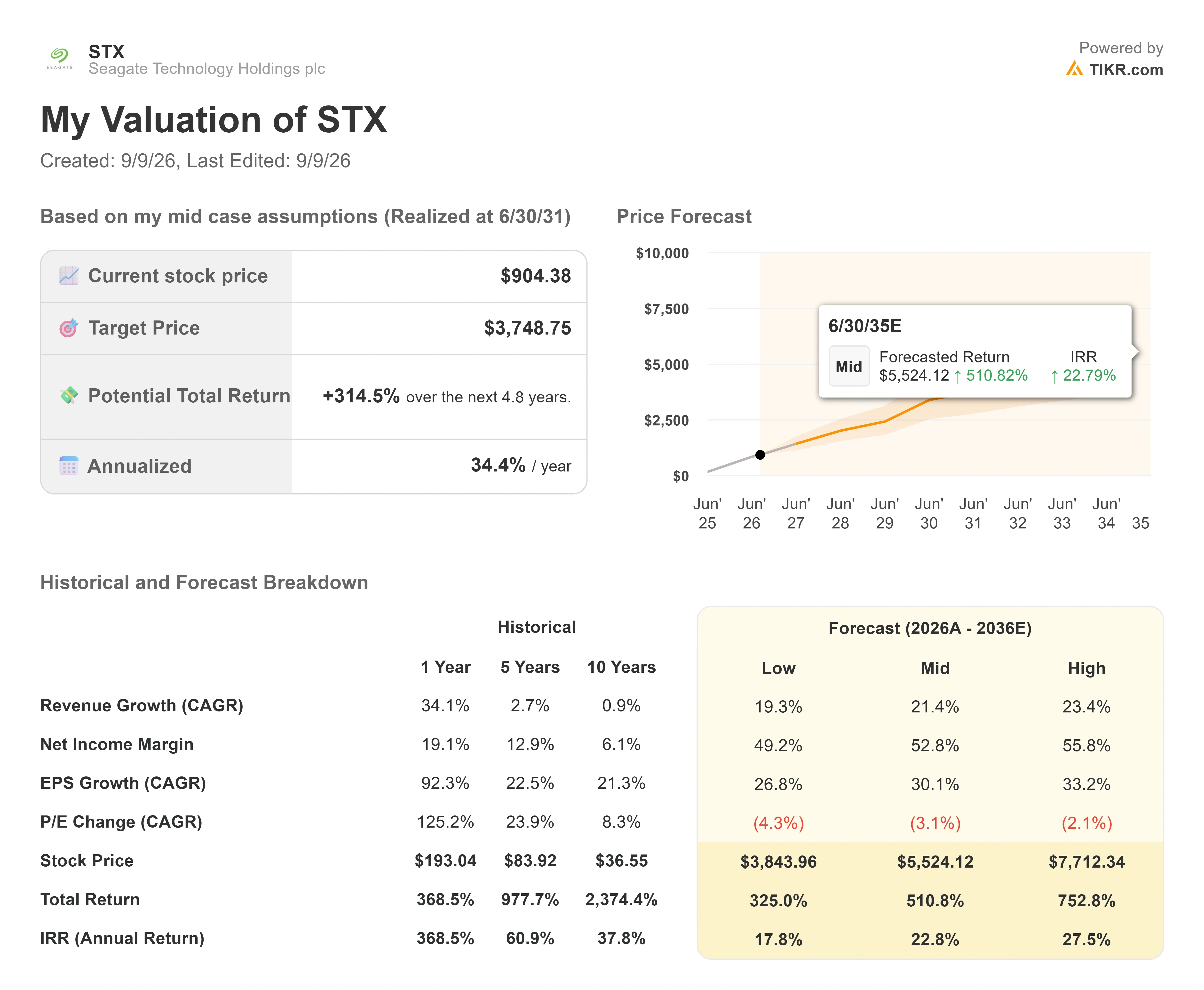
- Current Price: $904.38
- Target Price (Mid): ~$3,749
- Street Target: ~$1,125
- Potential Total Return: ~315%
- Annualized IRR: ~34% / year
Now Live: Discover how much upside your favorite stocks could have using TIKR’s new Valuation Model (It’s free) >>>
What Happened?
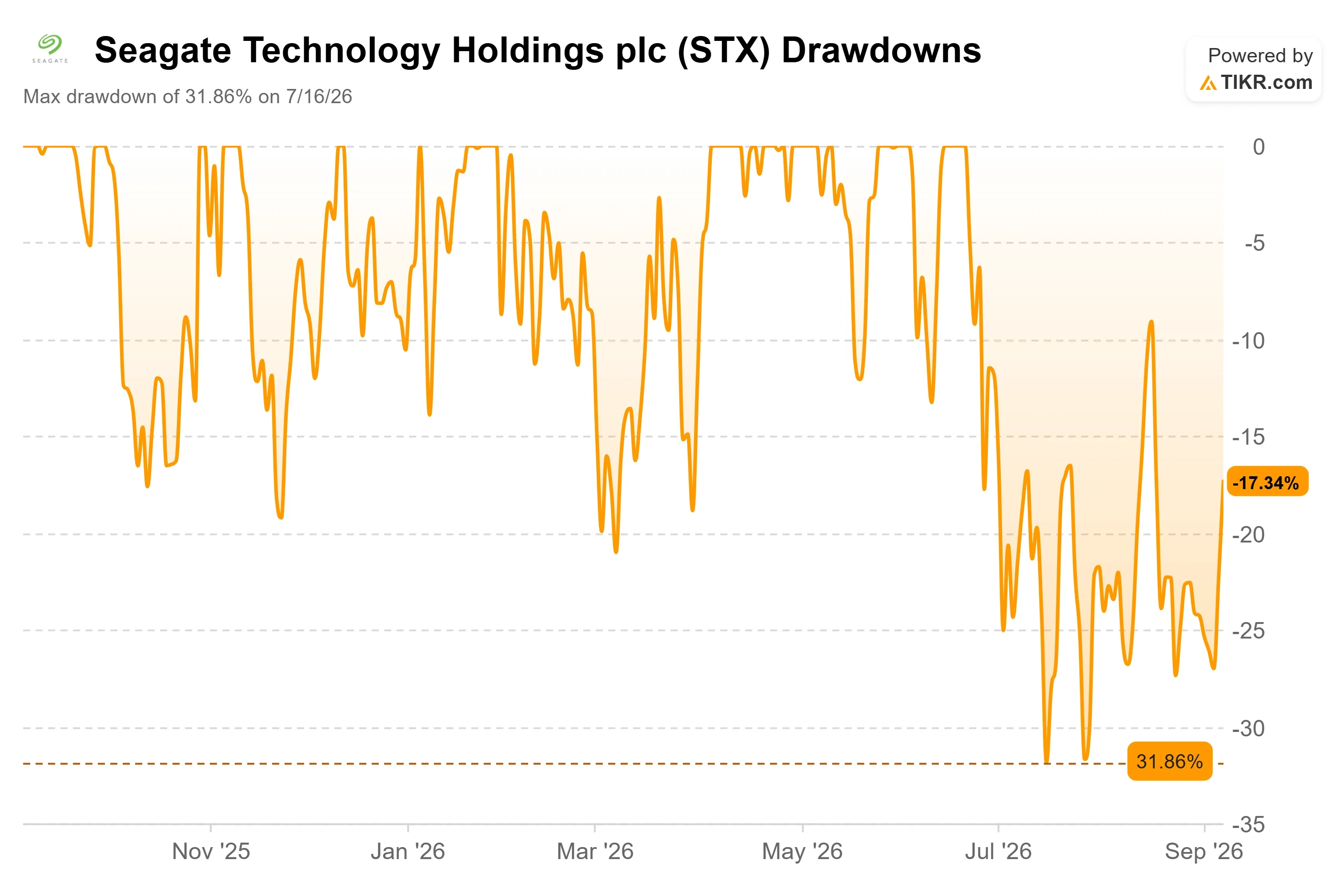
Seagate Technology Holdings (STX) closed at $904.38 on September 8, up 6.49%, recovering much of a two-month slide. There was no Seagate news behind the move. The whole memory and storage group rallied together as money rotated back into AI-infrastructure names, and Seagate rode the tide after a round trip that carried it from a June closing high near $1,093 down under $800 in early September and back to $904. Even after the bounce, the stock sits about 20% below its highs. For a name up more than 200% in 2026, that leaves one uncomfortable question live: is it too late?
That question usually gets answered with the multiple, and on that basis, the stock looks stretched. But the multiple is not the interesting part of Seagate right now. The interesting part is how far out management can already see demand, because the length of that runway is what decides whether today’s price is early or late.
The Demand Is Booked Further Out Than the Market Prices
On the fiscal Q4 call, CEO Dave Mosley said the vast majority of nearline exabytes are now allocated into calendar 2028, and that customers are pushing to go further: “many are actively seeking to extend planning horizons through 2029 and beyond.” Data-center demand now runs about 90% of exabyte shipments, and pricing for all of calendar 2027 is already contracted on configuration and terms. That is a different setup than the boom-and-bust cycle the market spent a decade pricing this stock for.
Two newer demand vectors sit on top of that base, and neither is in the current numbers yet. The first is the way agentic AI uses storage. Seagate’s white paper with SK hynix argues that extending key-value cache, the context an AI agent reuses across interactions, across memory, SSD, and hard-drive tiers, lets customers retain more context without recomputing it, which pulls demand toward high-capacity drives.
The second is physical AI. Mosley framed robotics and autonomous vehicles less as hardware and more as a data problem: “when people say physical AI to me, I think it’s a lot more about the data,” largely unstructured video that machines learn from repeatedly. Both are early. Neither is priced. If either lands, the mid-20% exabyte growth Seagate already guides becomes a floor rather than a ceiling.
See historical and forward estimates for Seagate stock (It’s free!) >>>
The Engine Behind the Margins
A booked runway only matters if the company can serve it profitably, and Seagate’s answer is a deliberate choice not to build. Mosley put it plainly: “we’re not really increasing the box count. We are working really hard to get the heads and media inside the boxes to be able to go up in the technology capability to get exabytes out.” Holding drive units roughly flat while capacity per drive climbs is what drove gross margin to a record 52.7% in June, a 13th straight quarter of expansion, and pushed incremental gross margins above 60%.
The mechanism is the HAMR-based Mozaic platform, which stores more data on each disk. HAMR products exited fiscal 2026 at about 40% of the nearline run rate. The second-generation Mozaic 4, up to 44 terabytes per drive, is ramping at the two largest cloud providers, with half of HAMR exabytes expected on it by year-end and a 5-terabyte-per-disk platform due to qualify in late 2027. Each transition lifts terabytes per unit against a roughly flat cost base, which is the whole reason margins keep climbing.
What the Price at $904 Requires
STX trades near 25x NTM P/E and about 20x NTM EV/EBITDA, a premium to rival Western Digital near 9x NTM EV/revenues against Seagate’s 11x, with Dell and NetApp near 19x forward earnings. For a business that the market always treated as cyclical, that is a full price, and it leaves little cushion if hyperscaler order patterns shift or NAND encroaches on nearline workloads. After the July blowout, one analyst set a Street-high $1,400 target, but the same run has drawn steady insider selling: CEO Mosley sold 30,000 shares at $816.28 on September 1 under a pre-scheduled 10b5-1 plan, with a filing to sell up to 90,000 more. Those sales are routine diversification on a fixed calendar, though the optics of the whole team trimming into a record run color the mood.
A buyer at $904 is not betting on a cheap stock or a further rerating. They are betting the booked demand, and the two new vectors on top of it extend the runway past what a 25x multiple already assumes.
See how Seagate performs against its peers in TIKR (It’s free!) >>>
TIKR Advanced Model Analysis
- Current Price: $904.38
- Target Price (Mid): ~$3,749
- Potential Total Return: ~315%
- Annualized IRR: ~34% / year
See analysts’ growth forecasts and price targets for Seagate stock (It’s free!) >>>
TIKR’s mid-case model, realized in June 2031, points to a fair value around $3,749 per share, a total return near 315%, and roughly 34% annualized over the next 4.8 years. That mid case sits well above the Street’s ~$1,125 mean target, a gap driven by the model’s longer horizon and its assumption that contracted pricing holds rather than fading. The two revenue drivers are nearline exabyte growth in the mid-20% range from the HAMR roadmap, and pricing gains on uncommitted volume where demand runs ahead of supply. The margin driver is operating leverage on a flat unit-cost base as the Mozaic mix shifts up.
Notably, the model itself assumes the multiple contracts slightly each year, so the return is carried by earnings growth, not further rerating. The upside is that contracted demand holds, the KV-cache and physical-AI vectors add exabytes that the model does not yet count, and pricing keeps climbing. The downside is that a stock near 25x earnings has little cushion, and a single quarter that breaks the sequential-growth trend would compress earnings and multiple together.
Conclusion
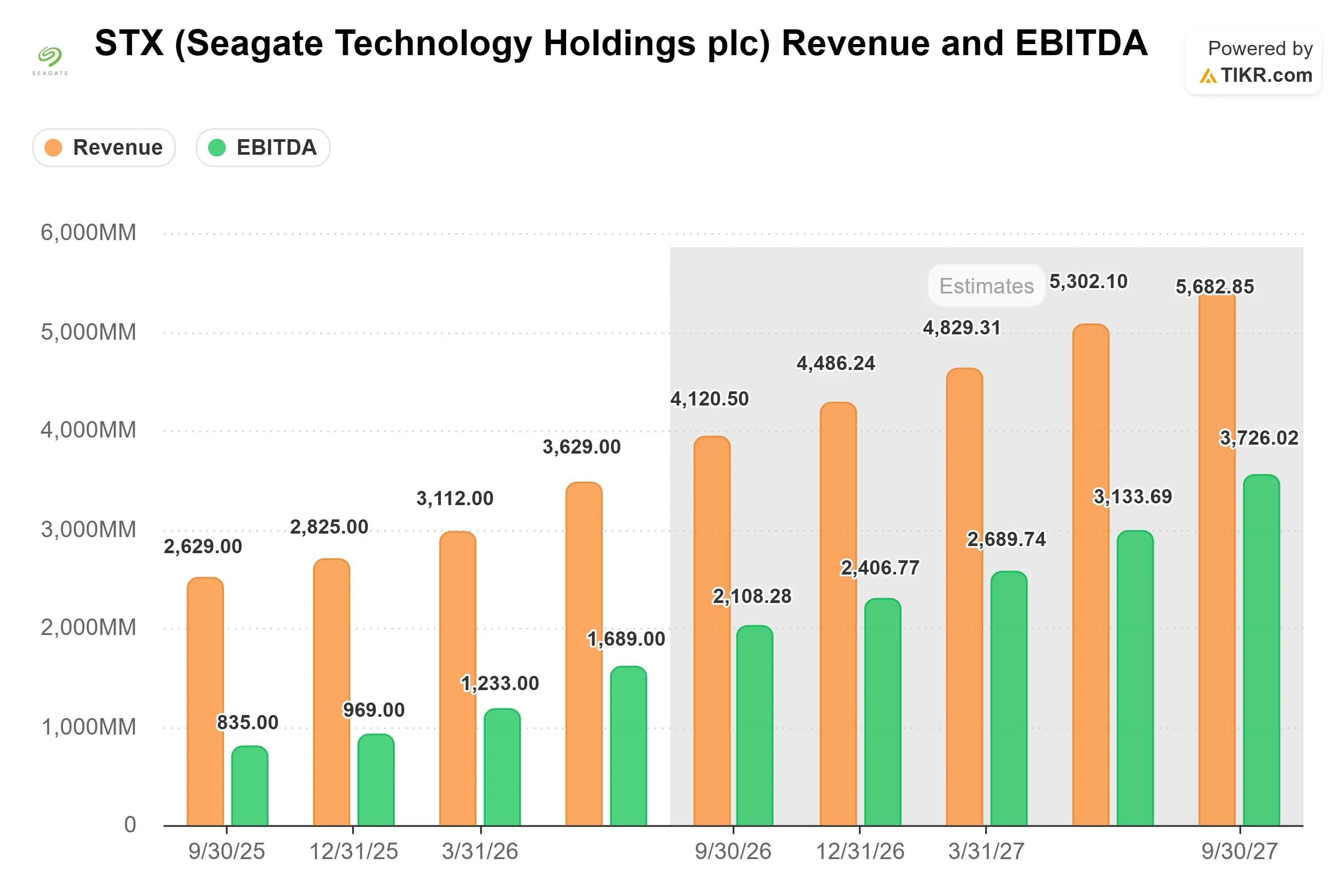
The report arrives with the September quarter, which Seagate reports around October 27. Management guided revenue to $4.1 billion and EPS to $7.30 at the midpoint. Hit both, with another sequential step up in gross margin off the record 52.7%, and the demand-runway argument holds, and the premium earns its keep. Miss on revenue, or show the first gross-margin figure in 14 quarters that fails to expand, and a stock priced for continuation has far to fall before it finds support. Late is not the same as wrong, and the October print will say which one this is.
See what stocks billionaire investors are buying so you can follow the smart money with TIKR.
Should You Invest in Seagate?
The only way to really know is to look at the numbers yourself. TIKR gives you free access to the same institutional-quality financial data that professional analysts use to answer exactly that question.
Pull up Seagate, and you’ll see years of historical financials, what Wall Street analysts expect for revenue and earnings in the quarters ahead, how valuation multiples have moved over time, and whether price targets are trending up or down.
You can build a free watchlist to track Seagate alongside every other stock on your radar. No credit card required. Just the data you need to decide for yourself.
Analyze Seagate on TIKR Free →
Looking for New Opportunities?
- See what stocks billionaire investors are buying so you can follow the smart money.
- Analyze stocks in as little as 5 minutes with TIKR’s all-in-one, easy-to-use platform.
- The more rocks you overturn… the more opportunities you’ll uncover. Search 100K+ global stocks, global top investor holdings, and more with TIKR.
Disclaimer:
Please note that the articles on TIKR are not intended to serve as investment or financial advice from TIKR or our content team, nor are they recommendations to buy or sell any stocks. We create our content based on TIKR Terminal’s investment data and analysts’ estimates. Our analysis might not include recent company news or important updates. TIKR has no position in any stocks mentioned. Thank you for reading, and happy investing!