Key Stats for Amazon Stock
- Current Price: $249.91
- Target Price (Mid): ~$584
- Street Target: ~$282
- Potential Total Return: ~134%
- Annualized IRR: ~20% / year
- Earnings Reaction: (5.55%) on February 5, 2026
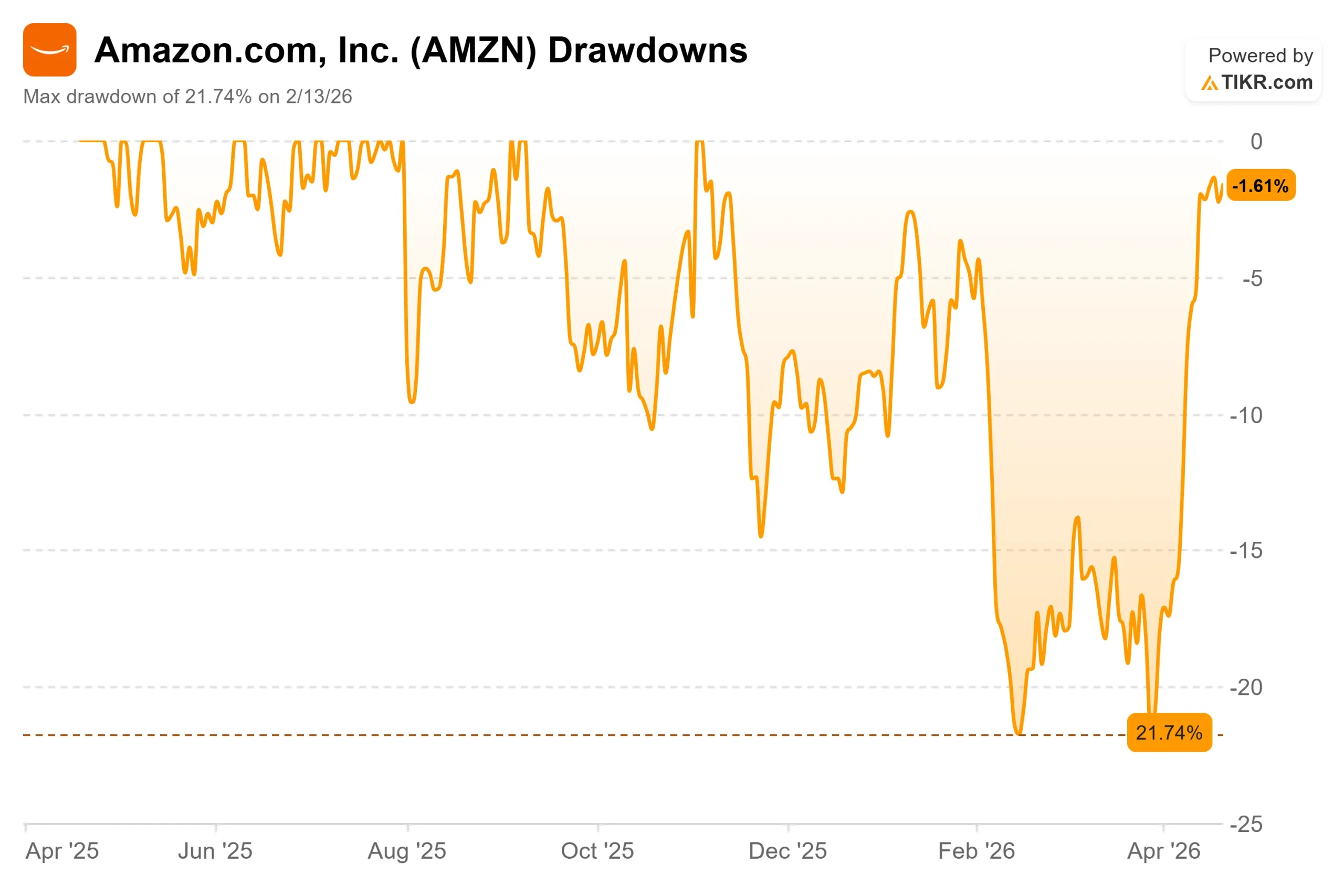
- Max Drawdown: (21.74%) on February 13, 2026
Now Live: Discover how much upside your favorite stocks could have using TIKR’s new Valuation Model (It’s free) >>>
What Happened?
Amazon (AMZN) stock has spent most of 2026 split between investors who believe the AI spending cycle is about to pay off and those who think the cash drain arrives first. Shares hit a max drawdown of 21.74% on February 13, 2026, after the Q4 2025 earnings report disclosed a $200 billion capital expenditure plan for 2026, far exceeding prior Wall Street estimates.
The stock fell 5.55% on the day. It has since recovered, and this week two of the Street’s most-watched analysts publicly endorsed the move.
Bank of America raised its Amazon price target to $298 from $275, and KeyBanc raised theirs to $325 from $285, both ahead of Q1 earnings on April 29. The central thesis at both firms, AWS (Amazon Web Services, the company’s cloud division), is reaccelerating, and the market has not fully priced it in.
Those upgrades landed the same week Amazon announced a major expansion of its Anthropic partnership. Amazon agreed to invest up to $25 billion in Anthropic, on top of the $8 billion already deployed, with Anthropic committing to spend more than $100 billion on AWS technologies over the next 10 years, including Amazon’s custom Trainium AI chips. This mirrors the structure of the OpenAI partnership Amazon announced in February, under which Amazon is investing $50 billion in OpenAI alongside a $100 billion cloud commitment.
Both deals function less like venture bets and more like contracted revenue secured before capacity is even deployed.
The context for all of this is CEO Andy Jassy’s April 9 shareholder letter, where he disclosed for the first time that AWS’s AI revenue crossed a $15 billion annualized run rate in Q1 2026.
“We’re not investing approximately $200 billion in capex in 2026 on a hunch,” Jassy wrote. “We’re not going to be conservative in how we play this. We’re investing to be the meaningful leader, and our future business, operating income, and free cash flow will be much larger because of it.”
The stock rose roughly 5% on the letter. Q1 earnings on April 29 are the first hard test of whether that confidence is justified.
See historical and forward estimates for Amazon stock (It’s free!) >>>
Is Amazon Undervalued Today?
At $249.91, Amazon trades at 13.15x NTM EV/EBITDA and 32.28x NTM P/E per TIKR. Neither multiple looks cheap on the surface. But the standard earnings lens distorts the picture for a company that is deliberately front-loading a multi-year investment cycle.
The operating business is healthier than the free cash flow line suggests. Amazon generated $139.5 billion in cash from operations in 2025, per TIKR, but LTM free cash flow was $41.6 billion, as capex surged to $128.3 billion, per TIKR.
With 2026 capex guided near $200 billion, NTM free cash flow is projected to be negative per TIKR. The near-term cash drag is real. What changes the argument is the revenue already contracted against that capacity.
AWS generated $128.7 billion in 2025 revenue with $45.6 billion in operating income (a 35.4% segment margin) per TIKR’s segments data. The contracted backlog stood at $244 billion at year-end, up 40% year-over-year, per Amazon’s Q4 2025 earnings call. AWS grew 24% in Q4 2025 per the same release, its fastest pace in 13 quarters. Per Bank of America’s research note, the firm estimates Q1 2026 AWS growth at 28%, ahead of Street consensus near 25%.
A result in that range would confirm the acceleration is holding.
Advertising adds a second high-margin engine. Amazon’s Q4 2025 advertising revenue reached $21.3 billion, growing 22% year-over-year, per Amazon’s Q4 2025 earnings release.
Together, AWS and advertising are structurally lifting Amazon’s profit margins well above its retail roots. TIKR consensus estimates project 2026 revenue at around $808 billion, with EBITDA margins expanding from 23.7% in 2025 toward roughly 26% in 2026.
The risks are concrete. Amazon has acknowledged active discussions with vendors about pricing tied to Chinese import tariff changes. For a retail segment running mid-single-digit operating margins, meaningful cost increases have limited places to go.
The $11.6 billion Globalstar acquisition, announced April 14, adds further complexity: direct-to-device satellite services are not expected to deploy commercially until 2028, making this a multi-year story on a 2026 balance sheet.

See how Amazon performs against its peers in TIKR (It’s free!) >>>
TIKR Advanced Model Analysis
- Current Price: $249.91
- Target Price (Mid): ~$584
- Potential Total Return: ~134%
- Annualized IRR: ~20% / year

See analysts’ growth forecasts and price targets for Amazon stock (It’s free!) >>>
The TIKR mid-case model prices Amazon at around $584 by December 31, 2030, implying approximately 134% total return and around 20% annualized IRR. The two revenue drivers are AWS and advertising, with total revenue projected by TIKR consensus to grow from $717 billion in 2025 toward approximately $1.23 trillion by 2030 at an 11.3% CAGR. The margin driver is net income expanding from 10.8% in 2025 toward approximately 15% by 2030 per TIKR, as the capex cycle peaks and depreciation growth moderates against a higher revenue base.
The primary risk is duration: if the $200 billion capex commitment extends past 2026, the free cash flow recovery the model assumes in 2027 and 2028 gets pushed out. AWS growth slipping below 20% at the April 29 print would be the clearest early warning sign. On the upside, if AWS holds at or above 28% and the Anthropic and OpenAI commitments begin converting to visible revenue ahead of schedule, the TIKR model’s margin assumptions look conservative rather than generous. Return on invested capital improving as installed capacity monetizes is the mechanism that makes the 2030 target credible.
Conclusion
The number to watch at Amazon’s April 29 earnings report is AWS revenue growth. Q1 2025 AWS revenue was $29.3 billion per Amazon’s Q1 2025 earnings release. A print at or above 28% year-over-year validates the BofA and KeyBanc theses and supports TIKR’s margin expansion path. A slip below 22% reopens every capex concern the market raised in February.
Amazon is mid-transition from retailer to AI infrastructure utility. The TIKR mid-case suggests investors who hold through the capex peak are compensated well, at around 20% annualized through 2030.
See what stocks billionaire investors are buying so you can follow the smart money with TIKR.
Should You Invest in Amazon?
The only way to really know is to look at the numbers yourself. TIKR gives you free access to the same institutional-quality financial data that professional analysts use to answer exactly that question.
Pull up Amazon, and you’ll see years of historical financials, what Wall Street analysts expect for revenue and earnings in the quarters ahead, how valuation multiples have moved over time, and whether price targets are trending up or down.
You can build a free watchlist to track Amazon alongside every other stock on your radar. No credit card required. Just the data you need to decide for yourself.
Looking for New Opportunities?
- See what stocks billionaire investors are buying so you can follow the smart money.
- Analyze stocks in as little as 5 minutes with TIKR’s all-in-one, easy-to-use platform.
- The more rocks you overturn… the more opportunities you’ll uncover. Search 100K+ global stocks, global top investor holdings, and more with TIKR.
Disclaimer:
Please note that the articles on TIKR are not intended to serve as investment or financial advice from TIKR or our content team, nor are they recommendations to buy or sell any stocks. We create our content based on TIKR Terminal’s investment data and analysts’ estimates. Our analysis might not include recent company news or important updates. TIKR has no position in any stocks mentioned. Thank you for reading, and happy investing!