
Key Stats for Boeing Stock
- Current Price: $225.08
- Target Price (Mid): ~$1,273
- Street Target (Mean): ~$266
- Potential Total Return (Mid): ~466%
- Annualized IRR (Mid): ~45% / year
- Earnings Reaction (Q4 2025): -1.21% (January 27, 2026)
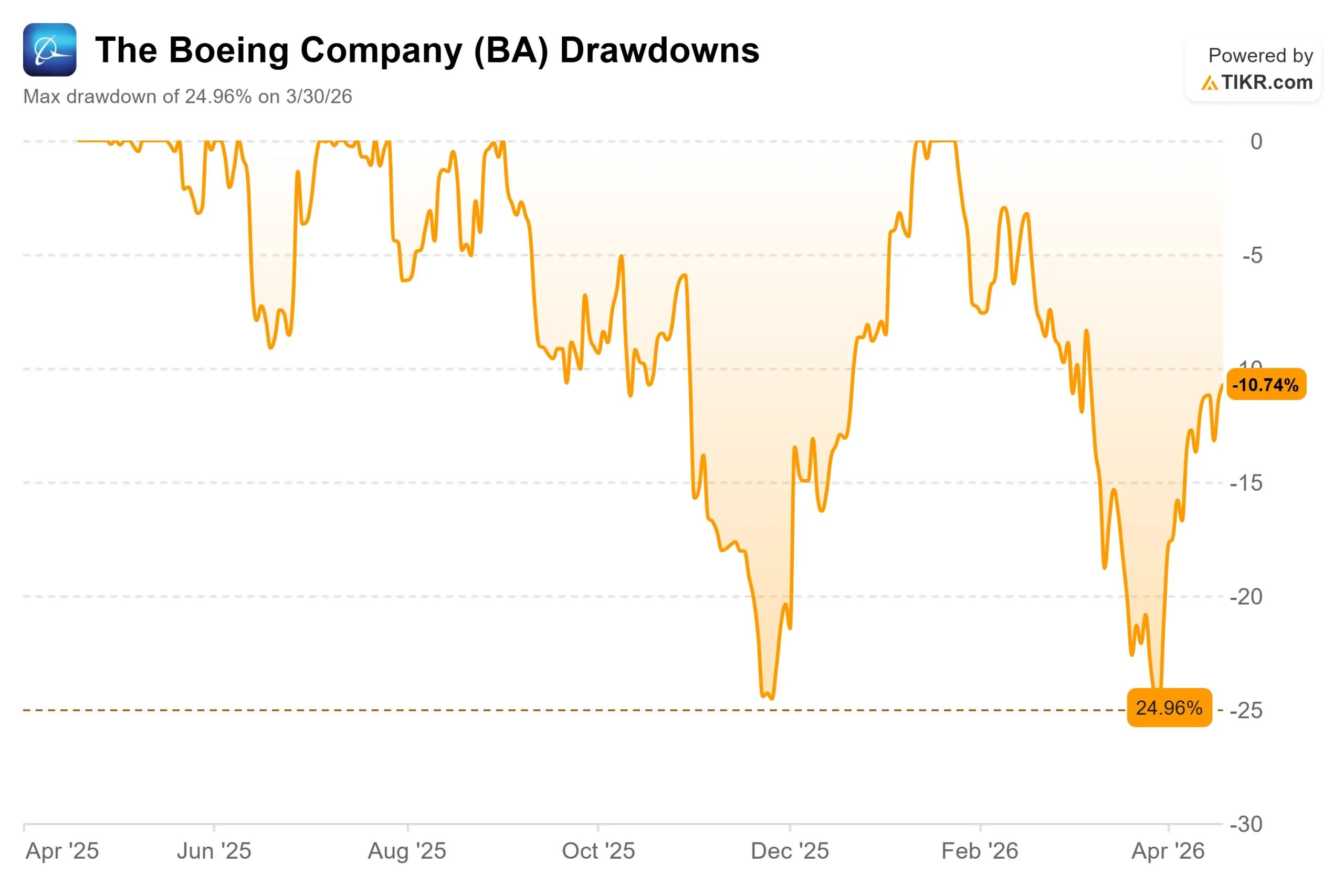
- Max Drawdown: -24.96% (March 30, 2026)
Now Live: Discover how much upside your favorite stocks could have using TIKR’s new Valuation Model (It’s free) >>>
What Happened?
Boeing (BA) reports Q1 2026 earnings on April 22, with analysts expecting a loss of $0.69 per share on revenue of $21.97 billion.
That loss estimate frames a debate investors have been stuck in for years: is Boeing genuinely recovering, or producing less-terrible numbers on a cost structure that still doesn’t work?
At $225.08, BA sits 11% below its 52-week high of $254.35. The stock fell 1.21% on January 27 when Boeing reported Q4 results because, despite Q4 revenue of $23.9 billion, earnings were dominated by a $9.6 billion gain on a one-time asset sale, even as full-year 2025 deliveries reached 600 commercial aircraft, the highest annual total since 2018.
The production story has since strengthened. Boeing delivered 143 commercial aircraft in Q1 2026, beating Airbus’s 114, the first quarterly delivery win over its European rival since approximately Q1 2019. The 737 MAX alone accounted for 114 of those 143 handovers
“We made significant progress on our recovery in 2025 and have set the foundation to keep our momentum going in the year ahead,” said Kelly Ortberg, Boeing President and CEO, in the company’s Q4 2025 earnings release filed with the SEC.
Tuesday’s call tests whether that foundation is showing up in cash.
See historical and forward estimates for Boeing stock (It’s free!) >>>
Is Boeing Undervalued Today?
Boeing’s NTM EV/EBITDA sits at around 43x per TIKR’s Multiples page.
That looks steep, but it reflects depressed near-term earnings, not an inflated enterprise value. Boeing’s Commercial Airplanes segment posted a $7.1 billion operating loss in 2025 and Defense, Space & Security posted a $128 million operating loss, per TIKR’s Segments data. As those losses narrow with volume, the multiple compresses even if the stock holds steady.
The gap to peers is wide but explainable.
Per TIKR’s Competitors page, RTX trades at around 19x NTM EV/EBITDA, Lockheed Martin at around 14x, and General Dynamics at around 15x. Boeing’s premium is entirely a function of its depressed earnings base, not a richer business.
The path beyond ~$266 runs through free cash flow. LTM levered FCF has turned positive at around $1.8 billion per TIKR’s Multiples page, the first materially positive reading in years. Per TIKR’s Estimates page, consensus projects FCF scaling to around $2.1 billion in 2026, around $6.2 billion in 2027, and over $10 billion in 2028. Those numbers require Boeing to keep executing without disruption, which is exactly what tomorrow will begin to confirm or deny.
One potential catalyst not in those estimates: Bloomberg reported in March 2026 that Boeing is negotiating an order for up to 500 737 MAX jets from Chinese carriers, with Reuters noting the news sent BA shares up 3.7%. The deal remains unconfirmed. Trump has said the summit with Xi will take place May 14 and 15, where a Boeing order could feature in trade discussions.
For context, China once made up roughly 25% of Boeing’s order book but currently represents about 2%. Any confirmed order would be a material upside event, but investors should treat it as optionality, not a baseline.
The risk is straightforward. LTM EBITDA is still negative $3.2 billion per TIKR’s Multiples page, and LTM net debt stands at $27.7 billion per TIKR’s Overview page. That leverage only unwinds if free cash flow compounds without interruption. Boeing conducted inspections and rework on roughly 25 737 MAX aircraft in March after discovering a wiring defect, a reminder of how quickly production friction can surface.

See how Boeing performs against its peers in TIKR (It’s free!) >>>
TIKR Advanced Model Analysis
- Current Price: $225.08
- Target Price (Mid): ~$1,273
- Potential Total Return: ~466%
- Annualized IRR: ~45% / year

See analysts’ growth forecasts and price targets for Boeing stock (It’s free!) >>>
The TIKR mid-case uses a revenue CAGR of around 8% from 2025 through 2030. The two drivers are the 737 MAX production ramp and 787 Dreamliner scaling toward its output ceiling. The margin driver is operating leverage as Commercial Airplanes’ losses narrow toward breakeven. The model assumes net income margins recover to around 4% by 2030.
The downside risk is execution: a new Defense charge, a 737 MAX 10 certification delay, or another quality disruption extends the profitability timeline and pressures a stock already priced on recovery expectations. The upside doesn’t require China or a new airplane program. Boeing needs to deliver around 500 planes this year, contain defense losses, and certify the MAX 10 on schedule. If those things happen, the Street’s ~$266 consensus target looks conservative relative to the TIKR model.
The gap between ~$266 and ~$1,273 is the market demanding proof in the form of sustained cash generation. April 22 begins to answer that.
Conclusion
Watch CFO Jay Malave’s free cash flow commentary tomorrow. The company’s full-year guidance is $1 billion to $3 billion. Any sign Q1 is tracking toward that range means deliveries are converting to cash. That single variable separates a confirmed recovery from another quarter of better units without the financials to back them up.
Boeing has a $682 billion backlog, a 737 MAX line outpacing Airbus for the first time in seven years, and a potential China mega-deal that could surface at the May 14-15 Trump-Xi summit. At $225.08, the stock prices are at real execution risk. April 22 starts to answer whether that risk is fairly valued.
See what stocks billionaire investors are buying so you can follow the smart money with TIKR.
Should You Invest in Boeing?
The only way to really know is to look at the numbers yourself. TIKR gives you free access to the same institutional-quality financial data that professional analysts use to answer exactly that question.
Pull up Boeing, and you’ll see years of historical financials, what Wall Street analysts expect for revenue and earnings in the quarters ahead, how valuation multiples have moved over time, and whether price targets are trending up or down.
You can build a free watchlist to track Boeing alongside every other stock on your radar. No credit card required. Just the data you need to decide for yourself.
Looking for New Opportunities?
- See what stocks billionaire investors are buying so you can follow the smart money.
- Analyze stocks in as little as 5 minutes with TIKR’s all-in-one, easy-to-use platform.
- The more rocks you overturn… the more opportunities you’ll uncover. Search 100K+ global stocks, global top investor holdings, and more with TIKR.
Disclaimer:
Please note that the articles on TIKR are not intended to serve as investment or financial advice from TIKR or our content team, nor are they recommendations to buy or sell any stocks. We create our content based on TIKR Terminal’s investment data and analysts’ estimates. Our analysis might not include recent company news or important updates. TIKR has no position in any stocks mentioned. Thank you for reading, and happy investing!