Key Stats for Carvana Stock
- Current Price: $73.41
- Target Price (Mid): ~$130
- Street Target: ~$83
- Potential Total Return: ~77%
- Annualized IRR: ~14% / year
Now Live: Discover how much upside your favorite stocks could have using TIKR’s new Valuation Model (It’s free) >>>
What Happened?
Carvana (CVNA) trades at $73.41, and the reason it has gone nowhere for weeks sits entirely outside the company. In mid-August, The Wall Street Journal reported that federal prosecutors and the SEC are investigating billionaire Mark Walter, who holds a minority stake in Carvana, over financial dealings that have nothing to do with used cars. As CNBC noted in its coverage, the stock fell more than 7% on back-to-back days on fears he might have to sell.
The business just posted record profitability and, on September 1, extended a key partnership that quietly widens its margins. The share price, meanwhile, is hostage to an investigation into someone who does not run the company.
The Selling Pressure Has Nothing to Do With the Cars
Walter, the CEO of Guggenheim Partners and controlling owner of the LA Lakers, indirectly owns about 8% of Carvana’s Class B stock, roughly 4% of the whole company, a stake worth around $2 billion. The Journal’s report described an investigation into whether financial relationships were concealed while more than $20 billion moved through insurers he controls. Investors worried a cash crunch could force him to dump the stake.
Neither Walter nor his businesses has been charged with any crime or found liable for any penalty, and the investigation targets him, not Carvana. And the forced-sale fear eased on August 19 after reporting showed his Carvana shares were pledged to Citigroup as collateral, which makes a quick sale harder. The overhang is real and unresolved. But when the weight on a stock is about who owns it rather than how it operates, the fundamentals eventually win, provided they hold.

See historical and forward estimates for Carvana stock (It’s free!) >>>
Record Profit, With One Honest Caveat
In Q2, reported July 29, revenue grew 52% year over year to $7.376 billion, and retail units rose 38% to 197,325, in a used-car market that shrank over the same stretch. Adjusted EBITDA hit a record $769 million. Management crossed a $3 billion adjusted EBITDA run rate for the first time and, also for the first time, issued full-year guidance, setting adjusted EBITDA at $2.7 to $3.0 billion.
The caveat, and the reason shares dipped after the print, is per-unit profit. EBITDA margin was 10.4%, down about two points from a year earlier, and the guidance midpoint of $2.85 billion sat below the roughly $2.99 billion the Street wanted. What the market missed is a structural tailwind CFO Mark Jenkins spelled out at the J.P. Morgan Automotive Conference on August 12. The FTC has pushed dealers to fold doc and dealer fees into their advertised prices, and Jenkins noted that Carvana “has never charged doc or dealer fees,” so as rivals raise headline prices to comply, Carvana’s pricing looks structurally more attractive. He framed it as a long-term benefit to demand and profitability alike.
Where the Margin Expansion Actually Comes From
Jenkins was blunt about the levers that turn today’s 10.4% margin into the company’s 13.5% long-term target, and he ranked them. First is overhead leverage: a large fixed base of technology, corporate, and facilities costs that is underused and can absorb far more units. Second is advertising, which he said runs “several hundred dollars” per unit lower in Carvana’s mature markets than company-wide, implying a long runway as newer markets age. Then comes network density in logistics and AI-driven cost takeout in customer care and title work.
Jenkins pointed out that Q2 net income grew “approaching 70%,” far faster than EBITDA, as lower interest and depreciation costs compounded the operating gains. That was helped by an August refinancing: a $1.66 billion Term Loan B replaced 9% notes due 2030 and cut annual cash interest by about $45 million, with net debt now near 1.0x EBITDA.
On September 1, Root announced it had extended its exclusive embedded insurance partnership with Carvana to at least August 2028, after selling more than 200,000 policies in under four years through a three-click checkout. Finance and insurance are the high-margin dollars stacked on top of each car, and a locked-in insurance attach is exactly the recurring, capital-light revenue that lifts margins as volume climbs. Jenkins’ regional data reinforced the volume side: in the third of the country where Carvana expanded reconditioning capacity most, sales grew “almost 55%,” tightly tracking that added production.
Carvana still commands a steep premium, and it earns one. Shares trade near 36x forward earnings against about 22x for CarMax and 9x for AutoNation, though on EV/EBITDA the gap narrows to roughly 17x versus CarMax’s 29x. A retailer growing units 38% in a shrinking industry, with a production flywheel and an asset-light insurance and finance stack, is not a traditional dealer.

See how Carvana performs against its peers in TIKR (It’s free!) >>>
TIKR Advanced Model Analysis
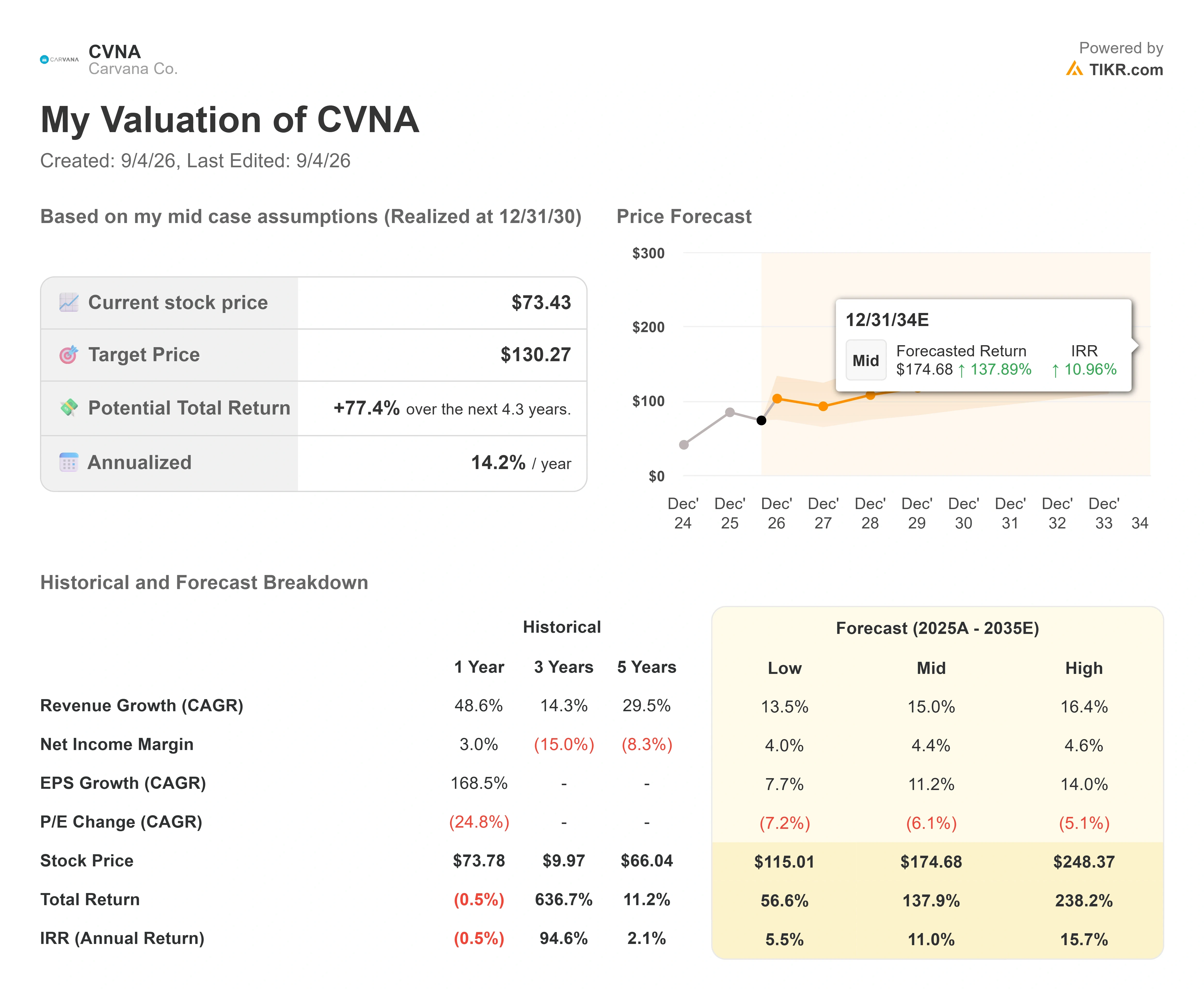
- Current Price: $73.41
- Target Price (Mid): ~$130
- Potential Total Return: ~77%
- Annualized IRR: ~14% / year
See analysts’ growth forecasts and price targets for Carvana stock (It’s free!) >>>
The two revenue drivers are continued retail unit growth from the production-capacity flywheel and rising ancillary revenue per vehicle from finance and the extended Root attach. The model assumes revenue compounds around 15% a year, well below Carvana’s recent 38% unit pace, so the target leans on margins, not top-line heroics. The margin driver is operating leverage, with net income margin widening toward roughly 4% to 5% as fixed costs spread across more units.
The primary risk is the mirror image of that assumption. If per-unit economics keep slipping, from fuel, rate pass-through, or reconditioning costs at newly integrated sites, the expansion never arrives and the multiple compresses. Upside: capacity scales, gross profit per unit stabilizes, and the ancillary stack lifts margins faster than expected, taking the high case toward $248. Downside: the Walter overhang forces messy selling or margins stall, and the stock stays stuck in the $70s while the story is re-proven quarter by quarter.
Conclusion
The next real test is Q3, expected in late October. Watch retail units and adjusted EBITDA per unit together: good looks like units still growing north of 30% with margin holding at or above 10.4%, proof Carvana can scale volume without bleeding per-car profit. Bad looks like margin slipping again while management points back to costs. The margin question is genuine, and only the print can answer it. The Walter investigation is the separate wild card, and it runs on a legal clock that no earnings report can reset.
See what stocks billionaire investors are buying so you can follow the smart money with TIKR.
Should You Invest in Carvana?
The only way to really know is to look at the numbers yourself. TIKR gives you free access to the same institutional-quality financial data that professional analysts use to answer exactly that question.
Pull up Carvana, and you’ll see years of historical financials, what Wall Street analysts expect for revenue and earnings in the quarters ahead, how valuation multiples have moved over time, and whether price targets are trending up or down.
You can build a free watchlist to track Carvana alongside every other stock on your radar. No credit card required. Just the data you need to decide for yourself.
Analyze Carvana on TIKR Free →
Looking for New Opportunities?
- See what stocks billionaire investors are buying so you can follow the smart money.
- Analyze stocks in as little as 5 minutes with TIKR’s all-in-one, easy-to-use platform.
- The more rocks you overturn… the more opportunities you’ll uncover. Search 100K+ global stocks, global top investor holdings, and more with TIKR.
Disclaimer:
Please note that the articles on TIKR are not intended to serve as investment or financial advice from TIKR or our content team, nor are they recommendations to buy or sell any stocks. We create our content based on TIKR Terminal’s investment data and analysts’ estimates. Our analysis might not include recent company news or important updates. TIKR has no position in any stocks mentioned. Thank you for reading, and happy investing!