Key Stats for Palantir Stock
- Current Price: $182.53
- Target Price (Mid): ~$1,275
- Street Target: ~$192
- Potential Total Return: ~600% (mid case, over ~4.3 years)
- Annualized IRR: ~57% / year
Now Live: Discover how much upside your favorite stocks could have using TIKR’s new Valuation Model (It’s free) >>>
What Happened?
Palantir Technologies (PLTR) closed at $182.53 on September 3, up 7.71%, one day after Michael Burry told the market the stock could eventually be worth less than a quarter of what it is today. The rebound rode a broad software rally that session, with the iShares Expanded Tech-Software ETF up about 4% as Treasury yields eased, but Palantir nearly doubled the sector’s move on its own catalyst: an expanded alliance with PwC US. The session retraced almost all of the prior day’s near-6% drop.
Burry, still short and holding puts, published a piece titled “Palantir: An Accounting” arguing the company behaves more like a consultancy than a software business. The market answered by buying a partnership with no disclosed contract value. Underneath both reactions sits the strongest quarter in the company’s history.
The Quarter Neither Side Disputes, and the Number Burry Attacks
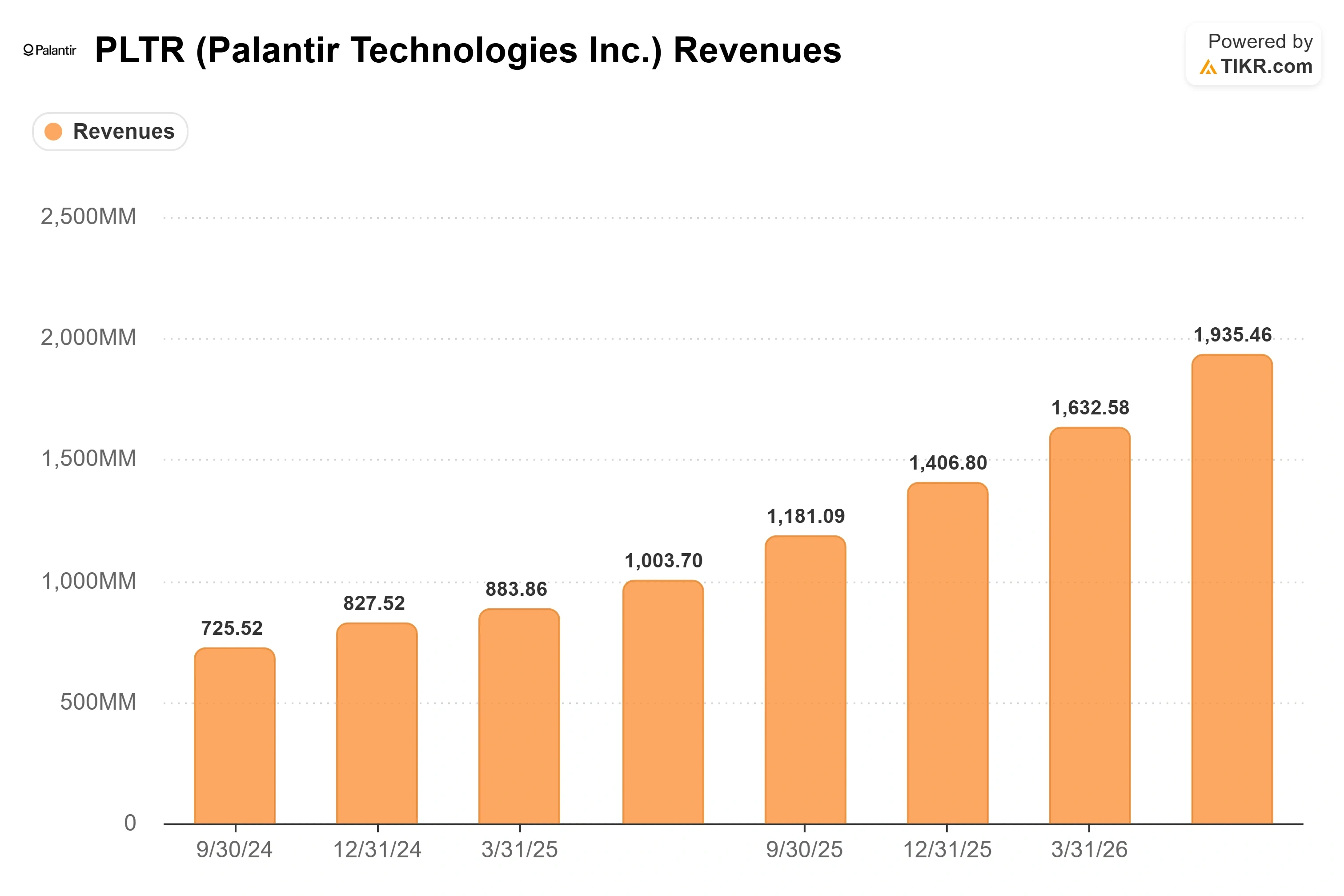
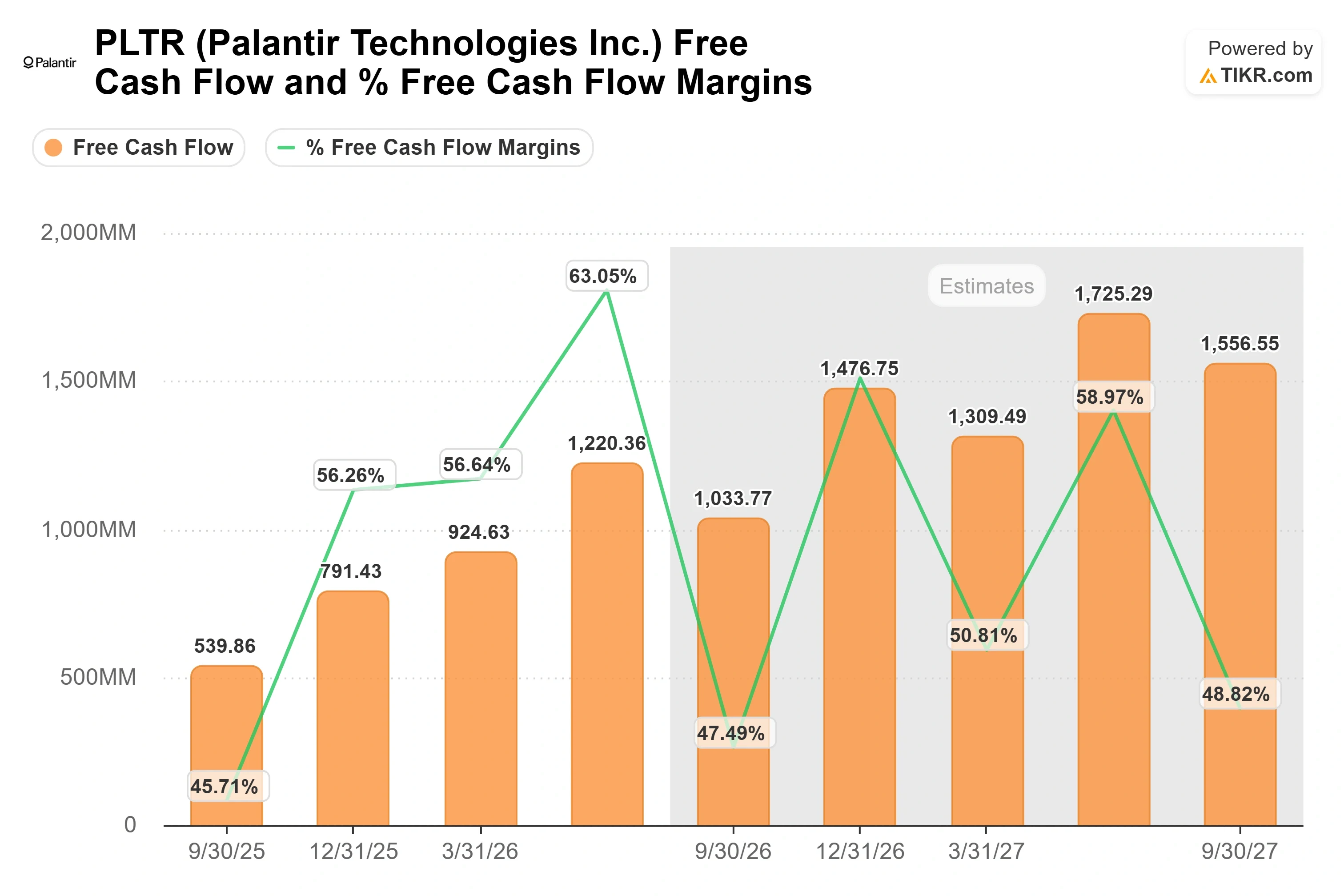
The Q2 2026 facts, reported August 3, are not in question. Revenue grew 93% year over year to $1.935 billion, the highest rate Palantir has posted as a public company. U.S. commercial revenue accelerated to 149%, U.S. government grew 90%, and the company produced $1.22 billion in adjusted free cash flow at a 63% margin. Its Rule of 40 score reached 155%, where anything above 40% is considered healthy. Management raised full-year guidance to $8.154 billion at the midpoint, the largest full-year raise in company history, and the FY2026 consensus on TIKR now sits near $8.19 billion, up from $7.72 billion at the June 30 snapshot.
Burry’s case is not that the growth is fake. It is that the quality behind it is weaker than the multiple implies. His central exhibit is accounts receivable, which he says rose to $1.49 billion at June 30 from $1.04 billion at the end of 2025, growing faster than revenue in nine of the last twelve quarters. He flagged that one customer holds 27% of receivables while no customer generates more than 10% of revenue, and argued the deferred-revenue ratio near 32% resembles Accenture more than a subscription business. His conclusion, disclosed through his Substack and X posts rather than a regulatory filing, is that the market cap, roughly $438 billion today, could fall below $100 billion. The “channel stuffing” language is his interpretation, and Palantir has not responded publicly.
A company channel-stuffing its way to growth does not usually convert 63% of revenue into free cash flow. Palantir’s $1.22 billion in adjusted FCF and $1.216 billion in cash from operations are hard to fake through billing timing. The receivables concentration is a real risk to watch, but the cash generation is the fact that keeps the bull case standing.
See historical and forward estimates for Palantir stock (It’s free!) >>>
Why the Sovereignty Pitch Has Buyers, Not Just Believers
The PwC alliance validates the argument Alex Karp has pressed all year. The deal centers on an AI-native platform built on Foundry and AIP that PwC says can execute transactions up to 50% faster while cutting one-time costs by up to 45%. No revenue figure was attached, and with the whole software complex green that session, the alliance was a tailwind on top of the sector move rather than the entire reason for it.
That validation speaks to what Karp calls “AI sovereignty,” the idea that enterprises should own the data, logic, and model weights that define their business rather than rent them from a frontier lab. On the call, he put the stakes bluntly: “You are paying for the right for them to migrate your IP, your know-how, your expertise to their model so that they can build a competitive business that doesn’t require your business.” That line is the commercial engine behind a net dollar retention rate of 157%, up 700 basis points in a quarter, as customers that once used only Foundry migrate across the full stack.
It also answers Burry’s “just a consultant” charge. CTO Shyam Sankar described a Silicon Valley bake-off in which a frontier lab and its deployment team lost a ticketing-automation contract to Palantir’s forward-deployed engineers: “Same customer, same time line, same models. The only difference was AIP and Palantir’s unique FDE tradecraft, and it was determinative.” A pure consultancy does not win head-to-head against the labs on their own models.
Against its software peers on the TIKR Competitors page, the premium is not subtle. Microsoft trades at 9.82x NTM revenue, ServiceNow at 8.62x, and Oracle at 6.54x, against Palantir at 42.37x. Palantir is not expensive relative to software; it is in a different pricing universe. Whether that gap holds depends on whether 90%-plus U.S. growth is a durable advantage or a demand spike that rivals like Google, now entering the government AI market, eventually compress.
See how Palantir performs against its peers in TIKR (It’s free!) >>>
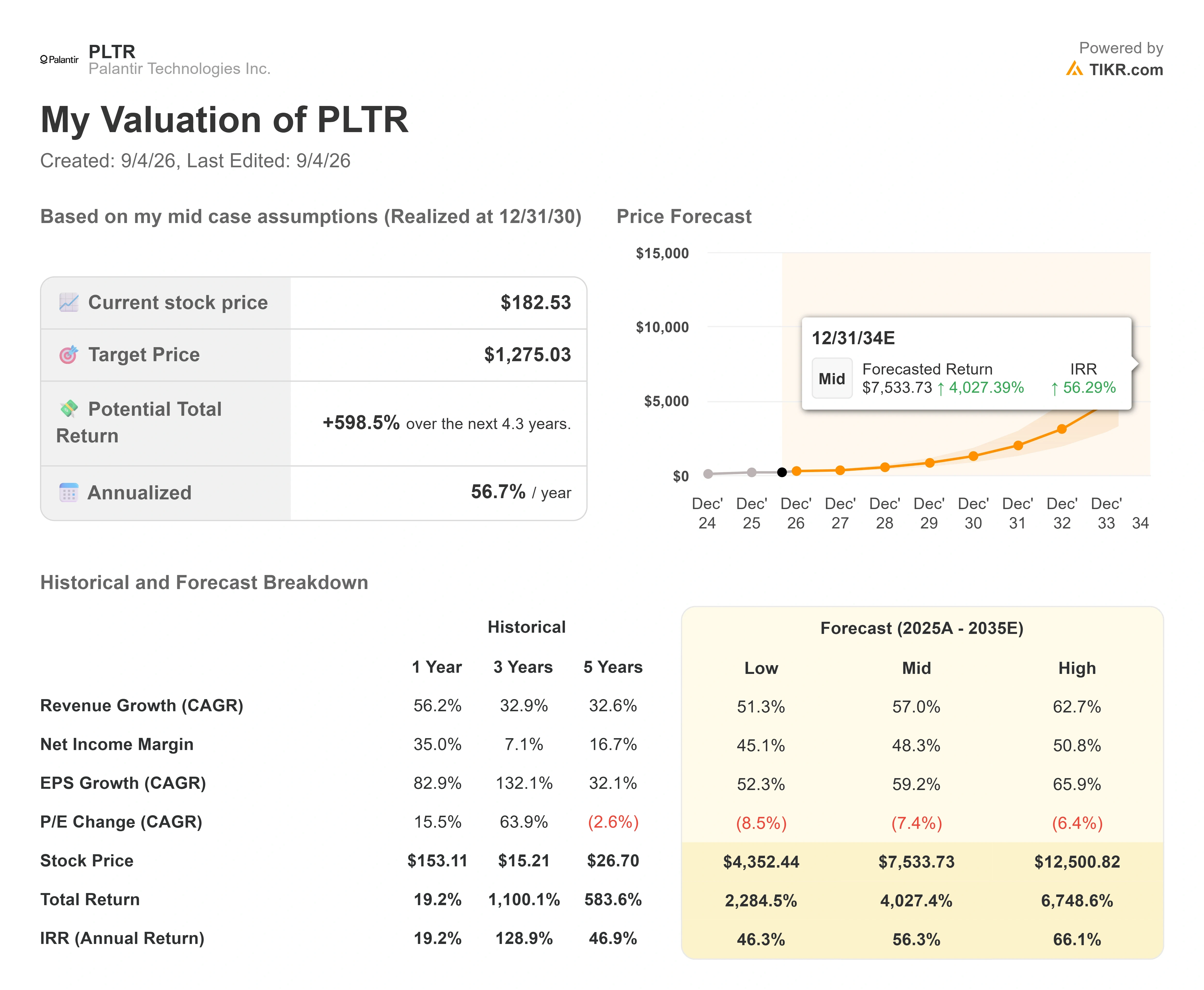
TIKR Advanced Model Analysis
- Current Price: $182.53
- Target Price (Mid): ~$1,275
- Potential Total Return: ~600%
- Annualized IRR: ~57% / year
See analysts’ growth forecasts and price targets for Palantir stock (It’s free!) >>>
Put in the same units as Burry’s warning, that $1,275 target implies a market capitalization near $3 trillion by 2030, against roughly $438 billion today and the below-$100 billion Burry says is coming. The two scenarios sit almost thirty times apart. This is one scenario built on stated assumptions, not a forecast the company has endorsed, and a $3 trillion Palantir would rank among the largest companies in the world. The target rests on two revenue drivers: continued U.S. commercial adoption of AIP as customers move from pilots to production, and government expansion led by programs like Maven, which William Blair in late August flagged as tracking toward $1 billion in annual recurring revenue. The margin driver is operating leverage, with net income margin modeled toward the high-40s percent range as revenue outpaces hiring and cloud costs.
The primary risk is the one Burry is pressing: multiple compression. At 42x forward revenue, a free cash flow yield under 1% leaves no cushion if growth slows. The upside case sees sovereign AI demand compounding as enterprises refuse to hand their data to frontier labs, holding revenue growth above 50% for years. The downside case sees competition and a rate-driven selloff in high-multiple names compress the multiple faster than earnings grow, exactly what drove the stock to a 48% drawdown in June before this rally began.
Conclusion
The debate resolves on one number, and the next report is expected around November 9, though the company has not yet confirmed the date. Watch U.S. commercial revenue and the receivables line together. If commercial holds above roughly 130% growth while receivables growth finally slows toward the pace of revenue, the bull case tightens, and Burry’s central exhibit weakens. If receivables keep outrunning revenue while growth decelerates, the consultant comparison gets louder, and the multiple becomes harder to defend. Everything else, the PwC headlines and the sovereignty rhetoric included, is noise until that print settles which side read the same quarter correctly.
See what stocks billionaire investors are buying so you can follow the smart money with TIKR.
Should You Invest in Palantir?
The only way to really know is to look at the numbers yourself. TIKR gives you free access to the same institutional-quality financial data that professional analysts use to answer exactly that question.
Pull up Palantir, and you’ll see years of historical financials, what Wall Street analysts expect for revenue and earnings in the quarters ahead, how valuation multiples have moved over time, and whether price targets are trending up or down.
You can build a free watchlist to track Palantir alongside every other stock on your radar. No credit card required. Just the data you need to decide for yourself.
Analyze Palantir on TIKR Free →
Looking for New Opportunities?
- See what stocks billionaire investors are buying so you can follow the smart money.
- Analyze stocks in as little as 5 minutes with TIKR’s all-in-one, easy-to-use platform.
- The more rocks you overturn… the more opportunities you’ll uncover. Search 100K+ global stocks, global top investor holdings, and more with TIKR.
Disclaimer:
Please note that the articles on TIKR are not intended to serve as investment or financial advice from TIKR or our content team, nor are they recommendations to buy or sell any stocks. We create our content based on TIKR Terminal’s investment data and analysts’ estimates. Our analysis might not include recent company news or important updates. TIKR has no position in any stocks mentioned. Thank you for reading, and happy investing!