Key Stats for Thermo Fisher Scientific Stock
- 52-Week Range: $385 to $644
- Current Price: $493
- Street Mean Target: $612
- Street High Target: $750
- Analyst Consensus: 19 Buys / 5 Outperforms / 3 Holds
- TIKR Model Target (Dec. 2030): $770
Thermo Fisher Scientific Stock Falls 7% on a Quarter That Beat on Every Line
Thermo Fisher Scientific (TMO) entered 2026 as a company executing ahead of plan, reporting Q1 adjusted EPS of $5.44 against a Street estimate of $5.24, on revenue of $11.01 billion that came in around 1% above consensus.
The stock fell anyway.
Shares dropped roughly 7% in the session following the April 23 print, continuing a pattern that has defined TMO’s past year: a business outperforming a market that is not yet willing to give it credit.
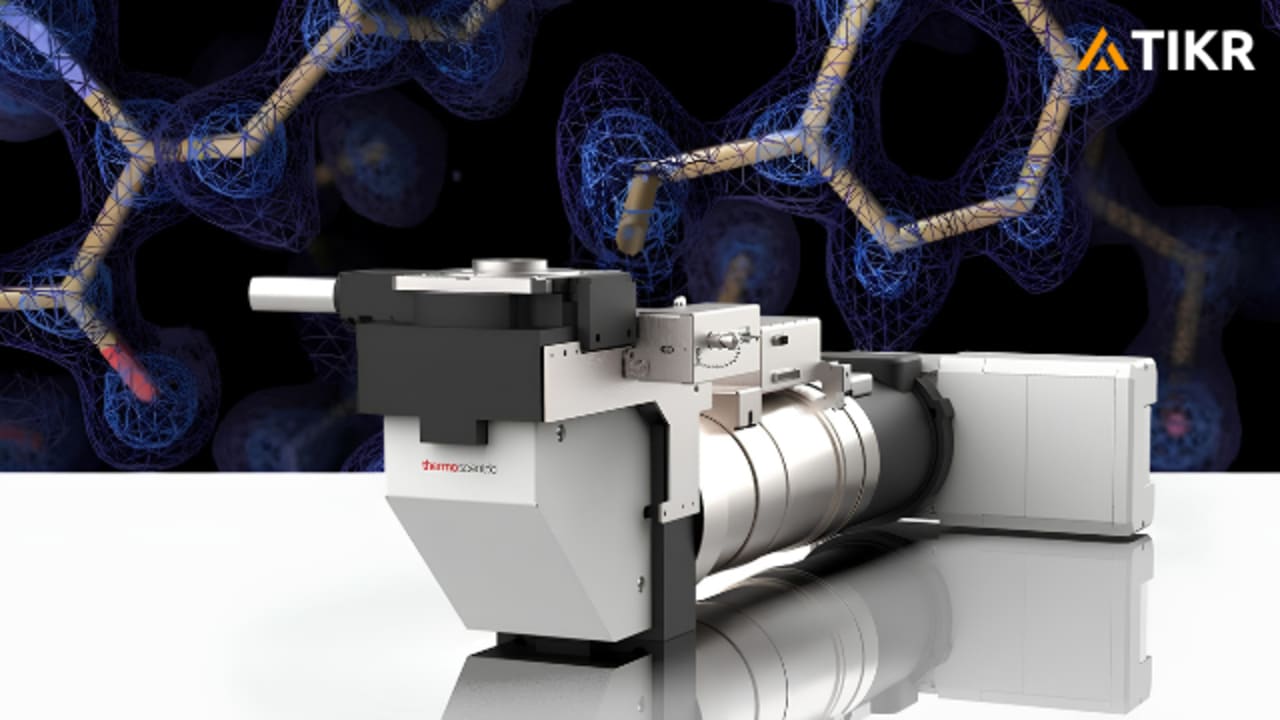
The company is the world’s leading life sciences infrastructure platform, generating around $45 billion in annual revenue across four operating segments: Life Sciences Solutions (bioproduction, research reagents), Analytical Instruments (mass spectrometry, electron microscopy), Specialty Diagnostics (transplant, immunodiagnostics), and Laboratory Products and Biopharma Services (clinical research, pharma manufacturing services, channel distribution).

Revenue grew 6.2% year over year in Q1, with around 1% organic growth and roughly 3 percentage points of contribution from acquisitions.
The headline organic number sounds soft, but management flagged two mechanical suppressors: one fewer selling day in Q1 cost approximately 1 percentage point of organic growth, and pharma services revenue is seasonally backend-loaded, costing approximately another point in the quarter.
The segment doing the heaviest lifting was Laboratory Products and Biopharma Services, which reported 7% reported revenue growth and 4% organic growth, driven by the clinical research business and the research and safety market channel.
CEO Marc Casper said on the Q1 call: “Our revenue grew 6% to $11.01 billion. Adjusted operating income grew 6% to $2.4 billion. Q1 adjusted operating margin was 21.8%, and we grew adjusted EPS by 6% to $5.44 per share.”
The quarter also absorbed the impact of the Clario acquisition, which closed March 24 and contributed around $30 million of revenue and $0.01 of adjusted EPS in Q1 alone.
Clario, acquired for approximately $9 billion, is a market leader in digital endpoint data solutions and has supported over 30,000 clinical trials globally, with its technology used in around 70% of medicines approved by the FDA and EMA over the past decade.
The rationale is not complexity for its own sake: Clario gives Thermo’s clinical research business the proprietary data infrastructure to compete on AI-enabled trial design, site selection, and patient enrollment at a scale no generalist CRO can replicate.
Management raised full-year revenue guidance to a range of $47.3 billion to $48.1 billion, representing 6% to 8% reported revenue growth, and raised adjusted EPS guidance to a range of $24.64 to $25.12, representing 8% to 10% growth.
In late April, Thermo also announced the sale of its microbiology business to private equity firm Astorg for approximately $1.075 billion, a deliberate portfolio pruning that frees capital for higher-growth deployment.
The divestiture, expected to close in the second half of 2026, will reduce adjusted EPS by $0.15 in the first full year post-close, a manageable dilution given the capital redeployment optionality it creates.
At its May 20 Investor Day, management committed to a 7% organic revenue CAGR long term, with the trajectory moving from 3% to 4% in 2026 through 3% to 6% in 2026 to 2027, and returning to 7% as market conditions normalize in 2028 and beyond.
Analysts Hold a Strong Buy on TMO Stock Despite the Selloff
The analyst community is not treating the Q1 pullback as a thesis problem.

Of the 27 analysts covering Thermo Fisher Scientific stock at the current period, 19 carry Buy ratings, 5 carry Outperform ratings, and 3 hold a Hold, with zero Underperforms or Sells.
The Street mean target sits at $612, implying around 24% upside from the current price of $493.
The Street high target stands at $750, a figure that implies roughly 52% upside from current levels.
That conviction sits against a backdrop of genuine analyst caution about the recovery timeline: Jefferies called the issue “sluggish underlying demand growth and no clear signs yet of inflection,” while J.P. Morgan noted end-market improvement “seems more gradual than initially hoped.”
The unresolved tension in analyst models is not the business quality; it is the pace at which U.S. academic and government demand recovers, and whether China’s biopharma upswing offsets continued softness in its industrial and government segments.
Thermo’s management guided for “greater stability” in U.S. academic end markets over the year but was explicit that conditions would not return to normal levels in 2026.
The forward EBITDA picture, where the thesis actually lives, shows consensus projections of around $2.90 billion for Q2 2026, growing to around $3.17 billion in Q3 2026 and approximately $3.61 billion exiting the year in Q4 2026, representing EBITDA growth of around 10%, around 13%, and approximately 14% year over year respectively.
That is not the profile of a company in structural difficulty.
EBITDA margins were 24.58% in Q1 2026 versus 24.57% in Q1 2025, essentially flat despite tariff headwinds and the early dilution from Clario, and the forward consensus projects margins expanding sequentially through the year.
The case for TMO stock being undervalued rests precisely on this: the market is pricing in the near-term drag from end-market softness without pricing in the compounding value of what Clario, the NVIDIA partnership, and the AI-in-drug-development cycle will do to Thermo’s competitive position over the next three to five years.
J.P. Morgan’s overweight and $600 target, Morgan Stanley’s overweight and $670 target, and Jefferies’ reinstated buy at $600 all reflect the same core view: TMO is experiencing cyclical softness in a structurally improving end market, and the current price does not reflect the recovery.
The catalyst to watch is Q2 organic growth: management guided for approximately 3% organic growth in Q2, which implies the selling-day and pharma-services timing headwinds are normalizing, and Analytical Instruments face a materially easier comparison given Q2 2025 was disrupted by tariff-related demand hesitation.
Is Thermo Fisher Scientific Stock Undervalued in 2026? The TIKR Model Says Yes
TIKR’s base case values Thermo Fisher Scientific at approximately $770 by December 2030, implying around 56% total return from the current price of approximately $493, or roughly 10% annualized over the next 4 and a half years.

If revenue grows at approximately 5% annually through the forecast period, net income margins expand toward approximately 21%, and EPS compounds at around 9% per year, the TIKR model produces a stock price near $1,049 by December 2034, representing roughly 113% total return and approximately 9% annualized.
If growth comes in at the lower end of the model range, around 4% revenue CAGR with margins near 20%, the low case produces a stock price of approximately $831 by the same period, still implying around 69% total return, or roughly 6% annualized.
If the combination of AI-accelerated drug development demand, U.S. biopharma reshoring, and continued bioproduction outperformance drives growth toward the high-case assumptions, around 5% revenue CAGR with margins near 22%, the TIKR high case reaches approximately $1,298, implying around 164% total return and roughly 12% annualized.
Thermo Fisher Scientific stock appears to be undervalued at current levels. The Street mean target of $612 implies a 24% upside on the near-term consensus alone, and the TIKR model’s mid-case target of $770 reflects a more complete picture of what a 7% long-term organic CAGR, AI-enabled margin expansion, and $70 billion in deployed M&A capital since 2012 is worth.
Is Thermo Fisher Scientific stock a buy right now?
The analyst consensus is strongly bullish: 19 Buys and 5 Outperforms among 27 analysts, a Street mean target of $612, and zero Sell ratings.
The company beat Q1 EPS by $0.20, raised full-year adjusted EPS guidance to $24.64 to $25.12, and closed the $9 billion Clario acquisition.
The TIKR base case targets approximately $770 by December 2030, implying around 56% total return.
The key variable is the pace of end-market recovery in U.S. academic and government demand.
Should You Invest in Thermo Fisher Scientific Inc.?
The only way to really know is to look at the numbers yourself. TIKR gives you free access to the same institutional-quality financial data that professional analysts use to answer exactly that question.
Pull up Thermo Fisher Scientific Inc. stock and you’ll see years of historical financials, what Wall Street analysts expect for revenue and earnings in the quarters ahead, how valuation multiples have moved over time, and whether price targets are trending up or down.
You can build a free watchlist to track Thermo Fisher Scientific Inc. alongside every other stock on your radar. No credit card required. Just the data you need to decide for yourself.
Access Professional Tools to Analyze TMO stock on TIKR for Free →