Key Stats for HPQ Stock
- Today’s Performance: 8%
- 52-Week Range: $18 to $30
- Valuation Model Target Price: $31
- Implied Upside: 14%
Analyze your favorite stocks like HP Inc. with TIKR (It’s free) >>>
What Happened?
HP Inc. stock rose about 8% today, recently trading near $27 per share, as investors warmed back up to a PC hardware story that had been pressured by weak device demand, print softness, and rising memory costs. The rally came after HP showed that AI PCs, premium notebooks, and the Windows 11 upgrade cycle are becoming bigger parts of the earnings story, giving the market a clearer reason to look past near-term margin pressure.
The stock moved higher because HP beat earnings and revenue expectations, led by a stronger recovery in its Personal Systems segment, which includes PCs and workstations. HP reported revenue of $14.4 billion, up 9% year over year, and non-GAAP EPS of $0.86, while Personal Systems revenue rose 13% to $10.2 billion and Printing revenue was flat at $4.2 billion. That mattered because stronger AI PC adoption, premium PC demand, and Windows 11 upgrades gave investors more confidence that HP can grow earnings even as Dell Technologies, Lenovo, and Apple compete for the same commercial and premium device demand.
This week, HP’s earnings call added more support to the move, with AI PCs rising from more than 35% to 44% of shipment mix as more customers shift AI work toward local devices instead of relying only on the cloud. Interim CEO Bruce Broussard said, “We continue to believe the future of AI is hybrid,” as HP highlighted new AI PCs, workstations, and edge-computing tools built for lower latency, stronger privacy, and better control over AI workloads. CFO Karen Parkhill also said HP now expects full-year non-GAAP EPS of $2.90 to $3.10 and free cash flow of $2.8 billion to $3 billion, while memory and storage costs are expected to keep rising in the second half of fiscal 2026.
Analyst updates reinforced the rally, although Wall Street’s tone stayed mixed. JPMorgan set its target at $26, Citigroup moved to $25, UBS set its target at $26, Morgan Stanley set its target at $19, Wells Fargo moved to $20, Barclays set its target at $19, and BofA Securities set its target at $18. The updates helped validate the earnings rebound, but the cautious targets show HP still needs to prove that AI PCs, premium mix, and Windows 11 demand can translate into durable earnings growth while memory costs pressure margins.

Value HP Inc. instantly (Free with TIKR) >>>
Is HPQ Undervalued?
Under valuation assumptions, the stock is modeled using:
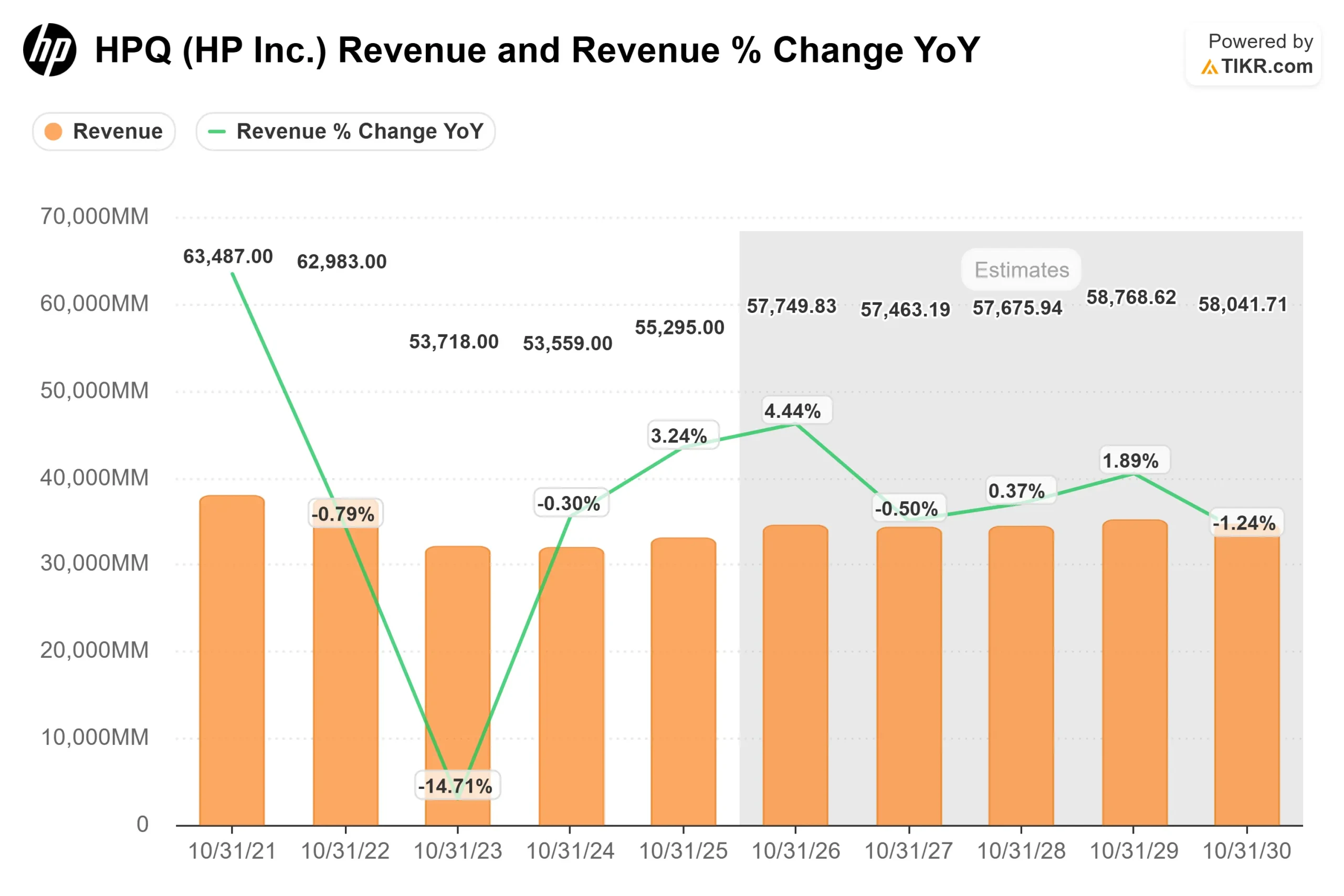
- Revenue Growth: 1%
- Operating Margins: 7%
- Exit P/E Multiple: 9x
Revenue growth is expected to stay modest, but HP does not need a major top-line acceleration for the stock to work if AI PCs, commercial refresh demand, and disciplined pricing keep Personal Systems moving in the right direction.
The bigger swing factor is margin control, because higher memory and storage costs can pressure profitability even when revenue beats expectations.
See analysts’ growth forecasts and price targets for HP Inc. (It’s free) >>>
Printing remains important because it supports cash flow, but the stronger investment case depends on PCs carrying more of the growth while management protects earnings through cost control, premium product mix, and higher services and subscription attach.
Based on these inputs, the model estimates a target price of $31, implying about 14% total upside, which suggests HP Inc. looks modestly undervalued at current prices.
At current levels, HP Inc. appears undervalued, but performance in 2026 will likely depend on whether AI PC adoption and the Windows 11 refresh create durable earnings growth instead of a short-term demand bump.
How Much Upside Does HPQ Stock Have From Here?
Investors can estimate HP’s potential share price, or what any stock could be worth, in under a minute using TIKR’s New Valuation Model tool.
All it takes is three simple inputs:
- Revenue Growth
- Operating Margins
- Exit P/E Multiple
From there, TIKR calculates the potential share price and total returns under Bull, Base, and Bear scenarios so you can quickly see whether a stock looks undervalued or overvalued.
If you’re not sure what to enter, TIKR automatically fills in each input using analysts’ consensus estimates, giving you a quick, reliable starting point.