Key Takeaways
- Disney lifted its fiscal 2026 buyback target from $7 billion to at least $9 billion, but CFO Hugh Johnston said the increase is funded largely by leftover OpenAI-deal cash and A&E Networks sale proceeds, not fresh operating cash flow.
- Free cash flow turned negative $2.28 billion in fiscal first quarter 2026, yet Disney still repurchased $2.03 billion of stock that same quarter.
- Buybacks across the first three quarters of fiscal 2026 total $7.25 billion, already ahead of the $5.73 billion of free cash flow generated over the same stretch.
- Weighted average diluted shares fell from 1.79 billion to 1.74 billion in three quarters, a faster pace of reduction than the prior two years combined.
- Entertainment segment operating margin climbed from 5.9% to 14.0% over the last four reported quarters, genuine evidence behind management’s double-digit streaming margin claim.
Disney’s Buyback Outgrew Its Own Cash Flow
Disney (DIS) raised its fiscal 2026 buyback target from $7 billion to at least $9 billion, but CFO Hugh Johnston said on the Q3 2026 earnings call the increase is funded “largely” by leftover cash set aside for the OpenAI deal and proceeds from the A&E Networks sale, not fresh operating cash flow.

Free cash flow actually turned negative $2.28 billion in fiscal first quarter 2026, the worst quarter in two years of reported data, and Disney still spent $2.03 billion buying back stock that same quarter. Across the first three quarters of fiscal 2026, Disney repurchased $7.25 billion of stock while generating $5.73 billion of free cash flow over the same stretch, a gap of roughly $1.5 billion. Capital expenditure over those same three quarters totaled $6.77 billion, tracking toward the roughly $9 billion of Experiences capex Johnston guided to for the full year.
None of this is illegal or even unusual for a company sitting on one-time sale proceeds. It does mean the buyback pace this year is not simply a function of the underlying business throwing off more cash than before.
DIS Stock: Fewer Shares, Smoother EPS Optics
Weighted average diluted shares outstanding fell from 1.82 billion in fiscal fourth quarter 2024 to 1.74 billion in fiscal third quarter 2026, and the pace of reduction has visibly picked up this year alone: 1.79 billion in fiscal first quarter 2026, 1.77 billion in the second, 1.74 billion in the third. A shrinking share count flatters per-share growth even when the profit line itself is not compounding cleanly, and Disney’s profit line has not been clean.
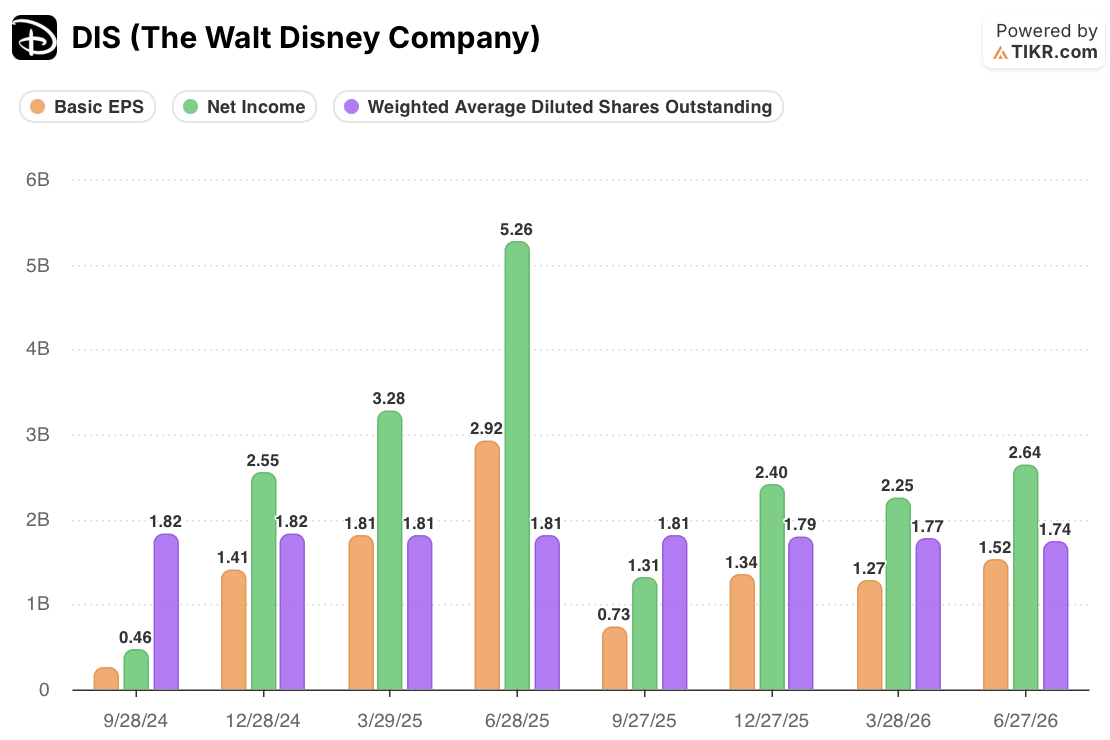
A one-time gain pushed basic EPS to $2.92 in fiscal third quarter 2025, then a charge cut it to $0.73 just one quarter later. Fiscal second quarter 2026 EPS of $1.27 fell roughly 30% from the year-ago quarter’s $1.81, a period that overlaps with the roughly 1,000 positions Disney eliminated in April 2026. None of that swing shows up in the adjusted EPS figure management repeats on every call. Fiscal third quarter 2026 adjusted EPS of $2.06 beat the $1.86 estimate, even as GAAP basic EPS of $1.52 that same quarter sat well below the year-ago print, a comparison distorted by the one-time gain in the base period. The adjusted number is the cleaner read of operating performance, but it is also the number a shrinking share count quietly helps.
Disney’s Margin Story Underneath Looks Real
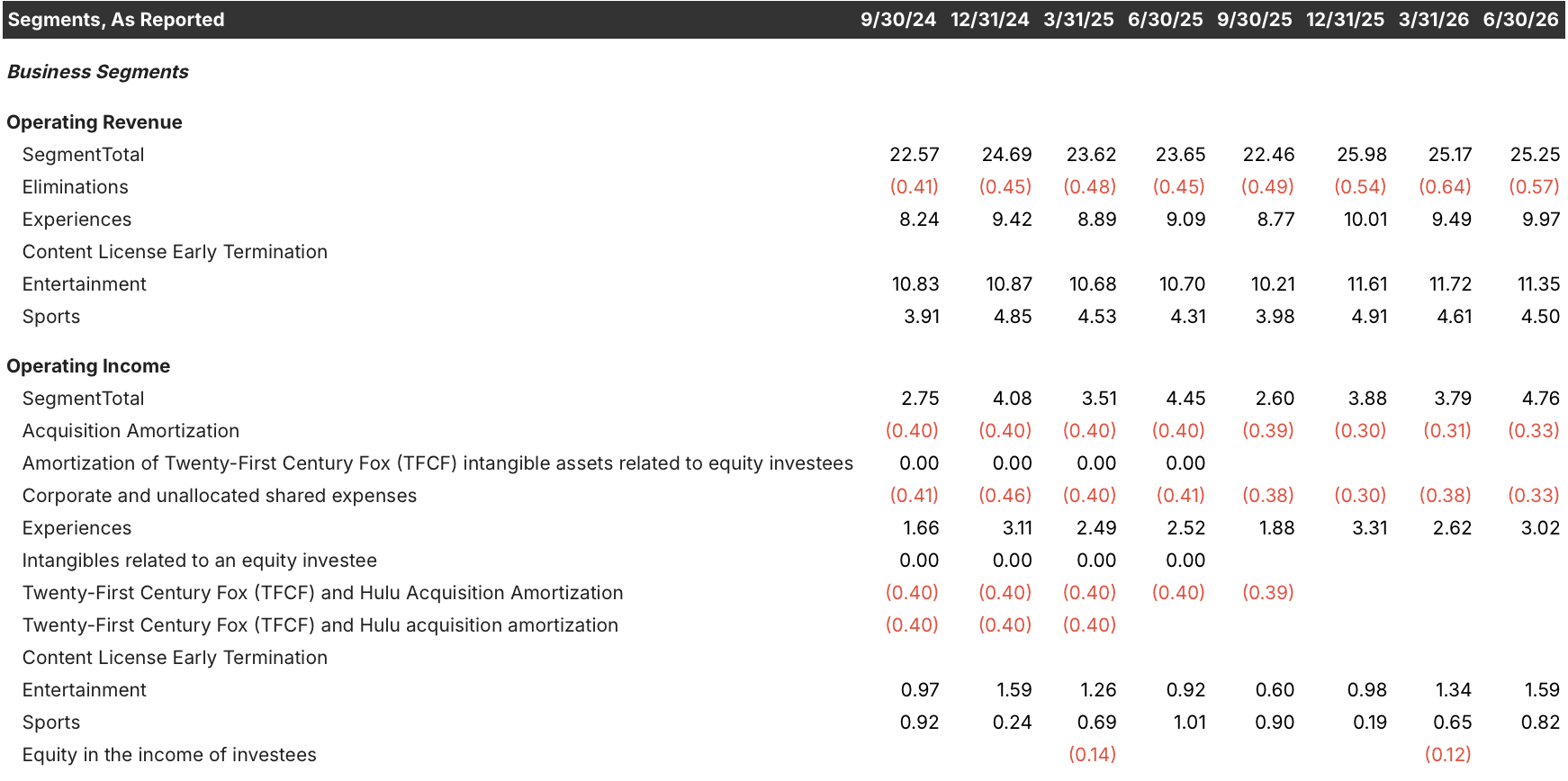
The segment data complicate a purely skeptical read, though. Entertainment segment operating margin, which folds together streaming, linear networks, and the film studio, climbed from 5.9% in the September 2025 quarter to 8.4%, then 11.4%, then 14.0% in the June 2026 quarter, four straight quarters of improvement and well above the 8.6% posted in the year-ago June 2025 quarter.
That is not identical to the 13% direct-to-consumer margin Johnston cites separately, since Entertainment also carries a linear TV business in structural decline and a film slate that swings quarter to quarter, but the direction is consistent: something inside that segment is genuinely getting more profitable, not just being relabeled.
That context changes how to read Johnston’s September 9 comment that Disney will stop chasing further margin gains and instead prioritize absolute operating income dollars, saying the company is “not looking to go backwards… or below double digits.” With margin still rising through the most recent reported quarter, that reads more like a company redirecting from a position of demonstrated improvement than one papering over stalled progress.
DIS Stock’s Real Test Comes When the Cushion Runs Out
Both threads are true at once, and that is the actual investment question. The operating improvement inside Entertainment looks real and recent, which supports the case that Disney’s streaming business has crossed a genuine profitability threshold rather than a manufactured one.
But the smooth, double-digit per-share growth investors are being shown this fiscal year is not solely a function of the underlying business compounding faster. It is also a function of a buyback that has outspent organic free cash flow by design, funded by proceeds that will not recur once the A&E and OpenAI cash is spent.
Once that cushion is gone, either the buyback has to shrink back toward what recurring free cash flow actually supports, or free cash flow needs to catch up to the $9 billion pace Disney has already committed to. The fiscal fourth quarter call in November, when the buyback is no longer topped up by one-time proceeds and the $100 million tariff refund that boosted Experiences segment operating income, not revenue, by roughly 4 percentage points of the quarter’s year-over-year growth is fully behind the company, is the cleaner test of whether fiscal 2027’s promised double-digit EPS growth comes from the business or from an ever-smaller denominator
Should You Invest in The Walt Disney Company?
The only way to really know is to look at the numbers yourself. TIKR gives you free access to the same institutional-quality financial data that professional analysts use to answer exactly that question.
Pull up DIS stock and you’ll see years of historical financials, what Wall Street analysts expect for revenue and earnings in the quarters ahead, how valuation multiples have moved over time, and whether price targets are trending up or down.
You can build a free watchlist to track The Walt Disney Company alongside every other stock on your radar. No credit card required. Just the data you need to decide for yourself.
Access Professional Tools to Analyze DIS stock on TIKR for Free →
Looking for New Opportunities?
- See what stocks billionaire investors are buying so you can follow the smart money.
- Analyze stocks in as little as 5 minutes with TIKR’s all-in-one, easy-to-use platform.
- The more rocks you overturn… the more opportunities you’ll uncover. Search 100K+ global stocks, global top investor holdings, and more with TIKR.
Disclaimer:
Please note that the articles on TIKR are not intended to serve as investment or financial advice from TIKR or our content team, nor are they recommendations to buy or sell any stocks. We create our content based on TIKR Terminal’s investment data and analysts’ estimates. Our analysis might not include recent company news or important updates. TIKR has no position in any stocks mentioned. Thank you for reading, and happy investing!