Key Takeaways
- Microsoft CEO Satya Nadella said on the 20VC podcast that most AI token usage will be commodity usage, and that Copilot already runs on a lot of cheaper models.
- Cheaper models protect Microsoft’s margins as AI usage grows, because the company earns most of its profit from the apps where tokens get spent.
- Gross margin slipped from 69.8% in fiscal 2024 to 67.9% in fiscal 2026, while capital spending climbed to $116 billion, and commodity pricing could make that spending harder to earn back.
- The Oct. 28 report will show whether Microsoft Cloud’s gross margin holds near 65%, as management guided.
Microsoft (MSFT) CEO Satya Nadella has a blunt prediction about where AI usage is headed, and it’s bad news for anyone counting on top-dollar pricing for frontier models.
On a new episode of the 20VC podcast, Nadella said “there will always be a market for frontier.” But:
“I think predominantly token usage will be commodity token usage.”
When he was asked whether that means open source, he said it could be open-weight models or cheap closed ones, because “there will be lots of price competition.” Then he pointed to his own product. Inside Copilot, he said, “we use a lot of closed source cheaper models.”
That’s quite a statement coming from OpenAI’s longtime partner.
TIKR tracks 57 analysts on Microsoft. How many say “Buy”?
See the full breakdown of Buy, Hold, and Sell ratings on Microsoft, along with Wall Street’s revenue and earnings estimates, all in one place. More than 500,000 investors use TIKR to research stocks like this one. See Microsoft’s Analyst Ratings
Cheap tokens are good for Copilot
Microsoft’s Productivity and Business Processes segment, home to Office and Microsoft 365, earned 54.0% of the company’s operating income in fiscal 2026 (the year to June). Every Copilot answer costs Microsoft compute. So the cheaper the model behind it, the more of each seat’s price Microsoft keeps.
And that cost has been showing up. Microsoft’s gross margin has slipped for two years in a row, from 69.8% in fiscal 2024 to 67.9% in fiscal 2026.
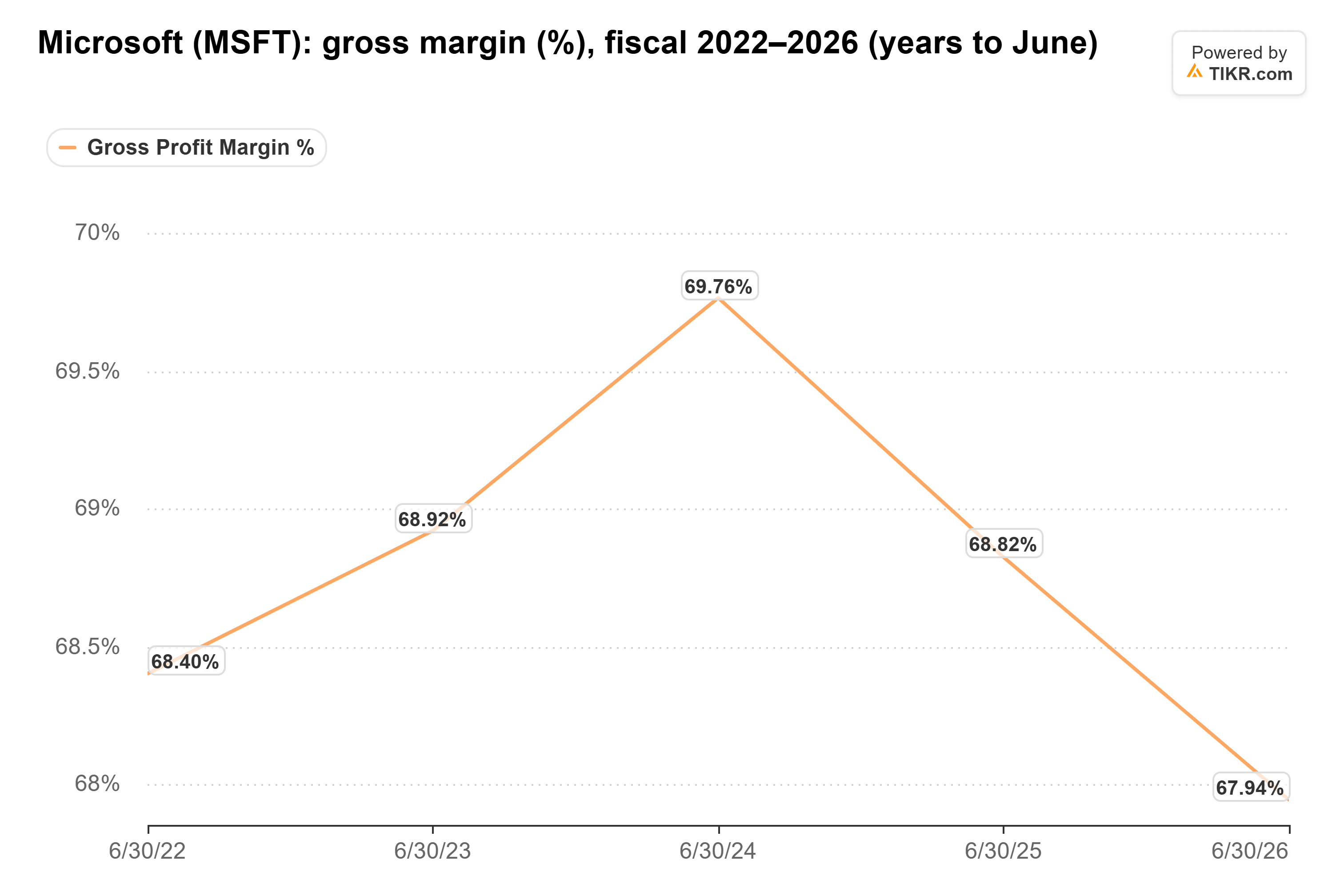
It’s still sliding, too. Microsoft Cloud’s gross margin fell from 68% in the September 2025 quarter to 65% in the June 2026 quarter.
Cheaper models are Microsoft’s fix. On its fiscal fourth-quarter call, management said its own MAI models cut GPU costs 89% in a Dynamics 365 feature and up to 84% in PowerPoint. Nadella doesn’t plan to give those models away, either. He called them “licensed weights” and said he wants to build “a simple, straightforward software business.”
Plus, Microsoft has kept a lid on everything else. Operating expenses rose 7% in fiscal 2026 while revenue rose 18%, so operating margin climbed to 46.8% from 45.6% even as gross margin fell.
Azure sells the tokens too
Of course, Microsoft also sells tokens. Azure rents out the computing power they run on, and Nadella sees that market getting more crowded: “every day you wake up and you say, wow, there’s more competition in every layer of the stack.” He named silicon and the systems that run it, along with models and apps.
Commodity tokens mean commodity pricing for that capacity, and Microsoft has spent heavily to build it. Capital spending climbed from $23.9 billion in fiscal 2022 to $116 billion in fiscal 2026.
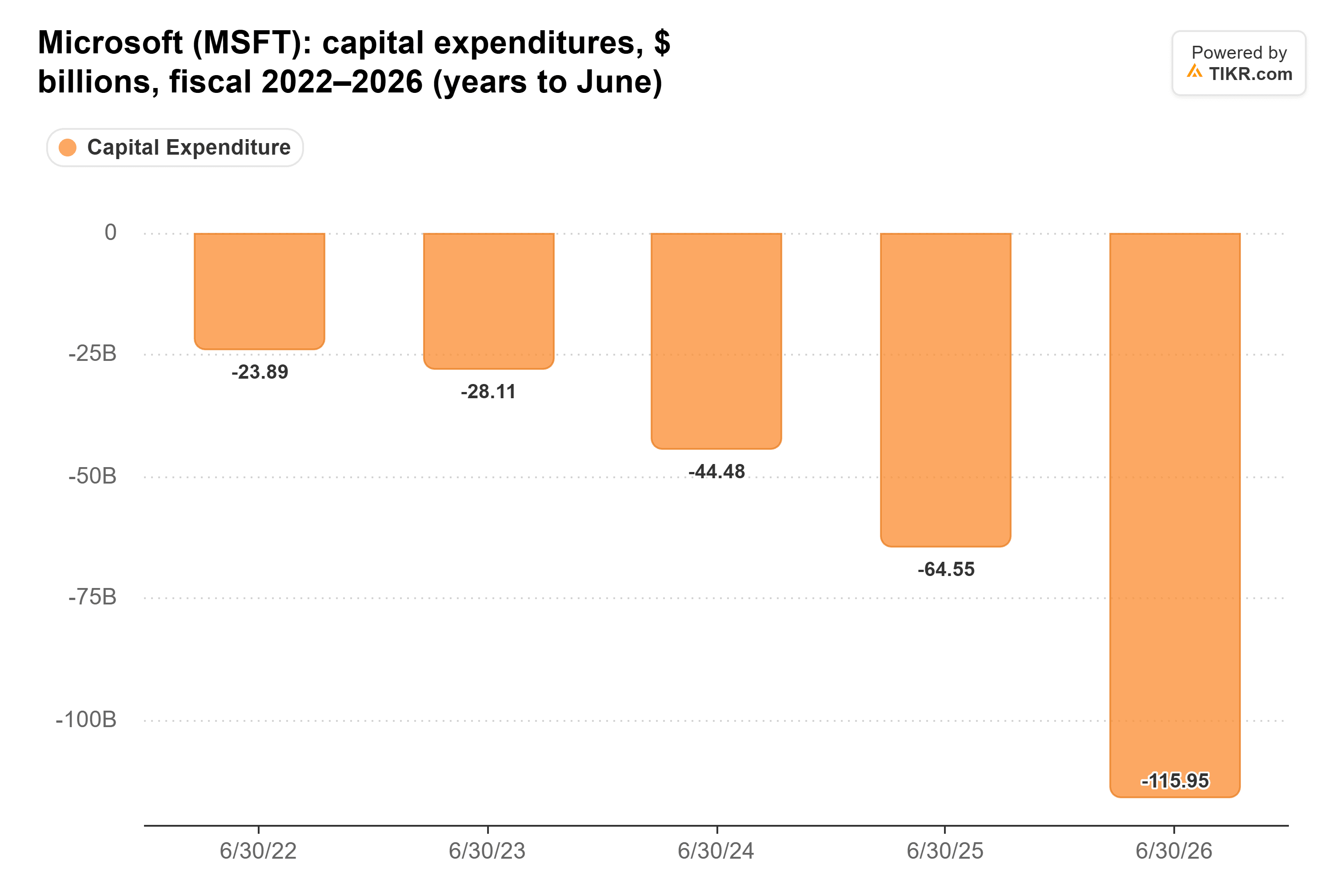
And analysts expect $193.7 billion in fiscal 2027. If the price of a token keeps falling, every one of those dollars has to work harder to earn its keep.
Contracts soften the blow. Microsoft’s commercial remaining performance obligations hit $678 billion at June 30, 2026, up 84%, and up 25% excluding OpenAI. OpenAI made up about 45% of that backlog at the end of 2025, so the Copilot strategy matters here too. Microsoft’s own apps can make money without leaning on OpenAI’s priciest models.
Microsoft comes out ahead if Nadella is right
My take: Microsoft is on the right side of cheap AI. It owns the apps where most tokens get spent, so falling prices should show up as better margins on Copilot. Meanwhile, its backlog gives Azure years of contracted demand while pricing shakes out.
The capex is the part I’d watch. Microsoft reports fiscal first-quarter results on Oct. 28, and management guided Microsoft Cloud’s gross margin to hold roughly steady at 65%. If it holds, that’s the first sign the cheaper models are doing their job. If it slips again, Azure’s pricing may be falling faster than Copilot’s costs.
So what is Microsoft stock actually worth?
TIKR lets you forecast the future price of any stock in less than a minute. Just enter a few assumptions into TIKR’s valuation model and see what Microsoft could be worth. Start from Wall Street consensus estimates, or adjust the inputs to reflect your own view of the business. It’s free to use.
Disclaimer:
Please note that the articles on TIKR are not intended to serve as investment or financial advice from TIKR or our content team, nor are they recommendations to buy or sell any stocks. We create our content based on TIKR Terminal’s investment data and analysts’ estimates. Our analysis might not include recent company news or important updates. TIKR has no position in any of the stocks mentioned. Thank you for reading, and happy investing!