Key Takeaways
- Michael Burry said Ken Griffin’s warning that GPU rental prices would go “into freefall” if supply ever passed demand is “obvious to most with a working brain cell.”
- The mechanism is real: in Nvidia’s last downturn, in fiscal 2023, its gross margin fell to 56.9% from 64.9%.
- A glut would cut into Nvidia’s and AMD’s sales, but CoreWeave would feel it first: its operating margin was -0.3% in 2025.
- Rental prices still point to shortage, while consensus has Nvidia’s revenue more than tripling over two fiscal years, to $692 billion.
Michael Burry doesn’t think Ken Griffin’s warning on GPU prices needs much debate.
On Monday, the investor best known for betting against housing before 2008 responded on X to a post summing up Griffin’s bear case on AI chips. His answer took one line: “This is obvious to most with a working brain cell.”
The timing is touchy. Nvidia (NVDA) fell about 4% in last Thursday’s AI selloff, and the biggest cloud companies update their spending plans this week.
Griffin made his case last week on Bloomberg Talks. The Citadel CEO pointed back to the telecom buildout of 2000: “We built more fiber than we had demand for, and the price of telecommunications just went straight down.”
He sees the same risk for AI chips: “if we reach a point where the provisioning of GPUs exceeds demand for GPUs, marginal pricing will actually go into freefall.”
Once a GPU is installed, renting it out for another hour costs its owner very little. So in a glut, owners cut prices to keep their chips busy. Griffin said that “really upends all the investment assumptions that people are working with today.” A glut would reach Nvidia and Advanced Micro Devices (AMD) through their customers’ orders, and it would hit CoreWeave (CRWV) directly, since GPU rentals are its revenue.
Burry has a point. Nvidia has already been through a version of this.
TIKR tracks 62 analysts on Nvidia. How many say “Buy”?
See the full breakdown of Buy, Hold, and Sell ratings on Nvidia, along with Wall Street’s revenue and earnings estimates, all in one place. More than 500,000 investors use TIKR to research stocks like this one. See Nvidia’s Analyst Ratings
Nvidia’s last downturn shows how fast pricing goes
Gross margin is the clearest measure of what scarcity is worth to Nvidia. The last time its sales stalled, in fiscal 2023 (the year ended January 2023), revenue was flat at $27.0 billion and gross margin fell to 56.9% from 64.9%.
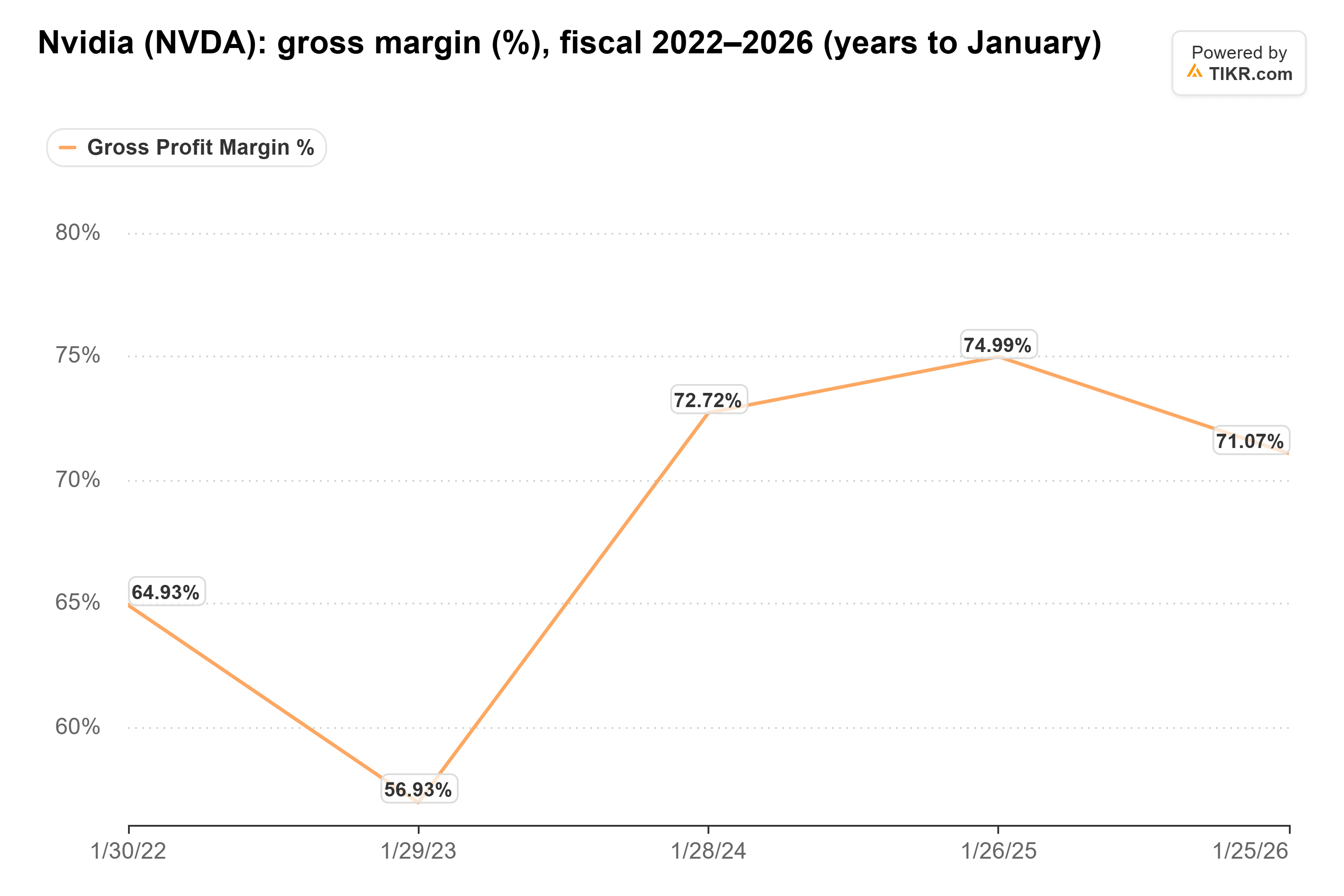
It has stayed above 70% since then, and in the quarter ended July 2026 it was 75.0%.
Wall Street’s estimates assume the shortage lasts. Consensus has Nvidia’s revenue more than tripling in two years, from $216 billion in fiscal 2026 to $692 billion in the year ending January 2028, and then $903 billion the year after.
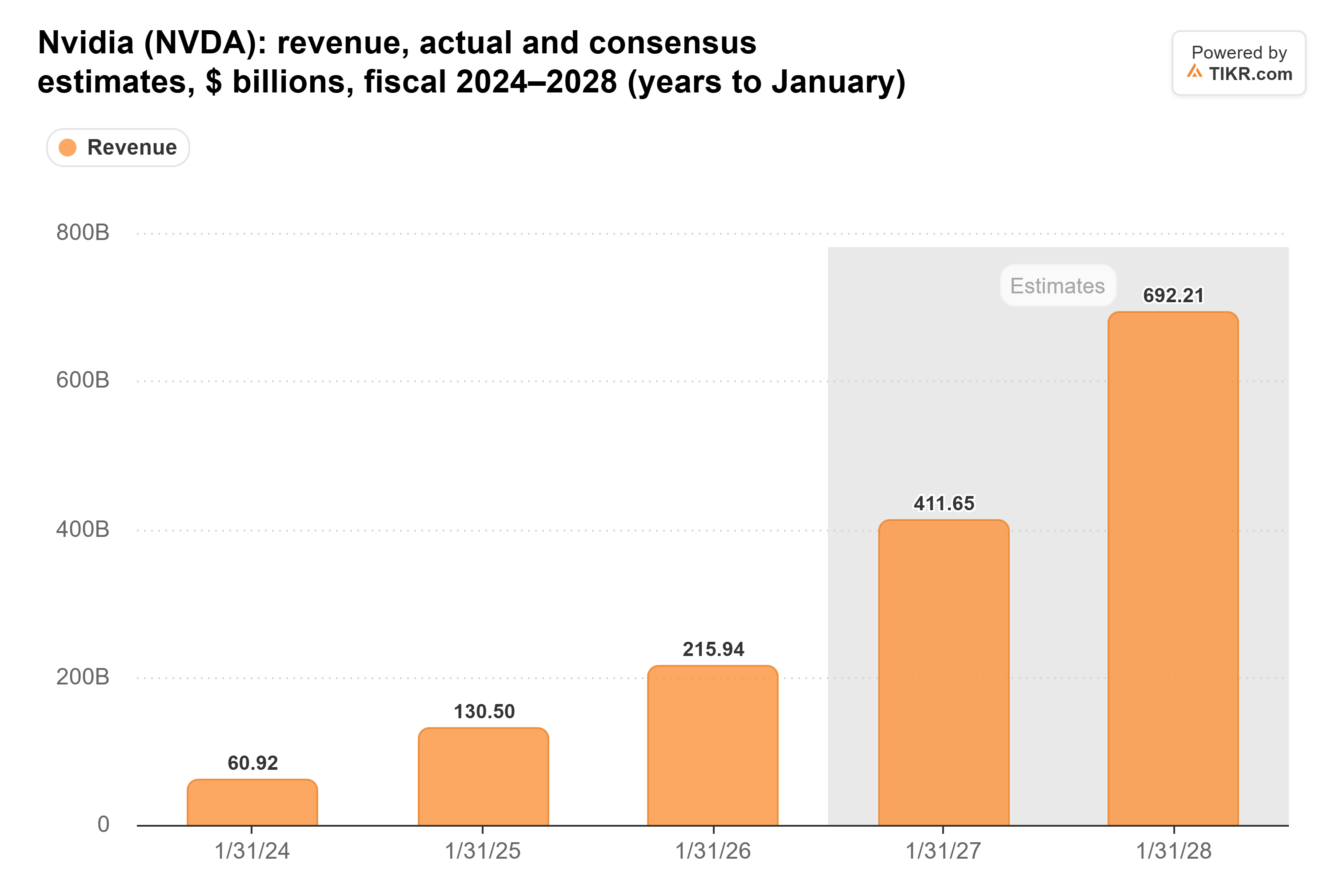
Burry’s post gives analysts no new reason to cut those numbers. Falling rental prices would, because buyers stop ordering chips they can’t rent out at a profit.
Every price still says shortage
For now, rental prices are going the other way. Social Capital pointed out on X that renting an H100 costs 45% more than it did in December. That’s despite the chip going on sale in 2022, with two newer generations out since.
Social Capital’s Chamath Palihapitiya gave the reason: “Power is the binding constraint.”
Chips that can’t get power can’t create a glut. So nobody can put a date on Griffin’s freefall yet.
CoreWeave has the least room for error
If prices do turn, the first place it would show is the margins of the companies that rent out the chips. CoreWeave’s operating margin went from 16.9% in 2024 to slightly negative in 2025.
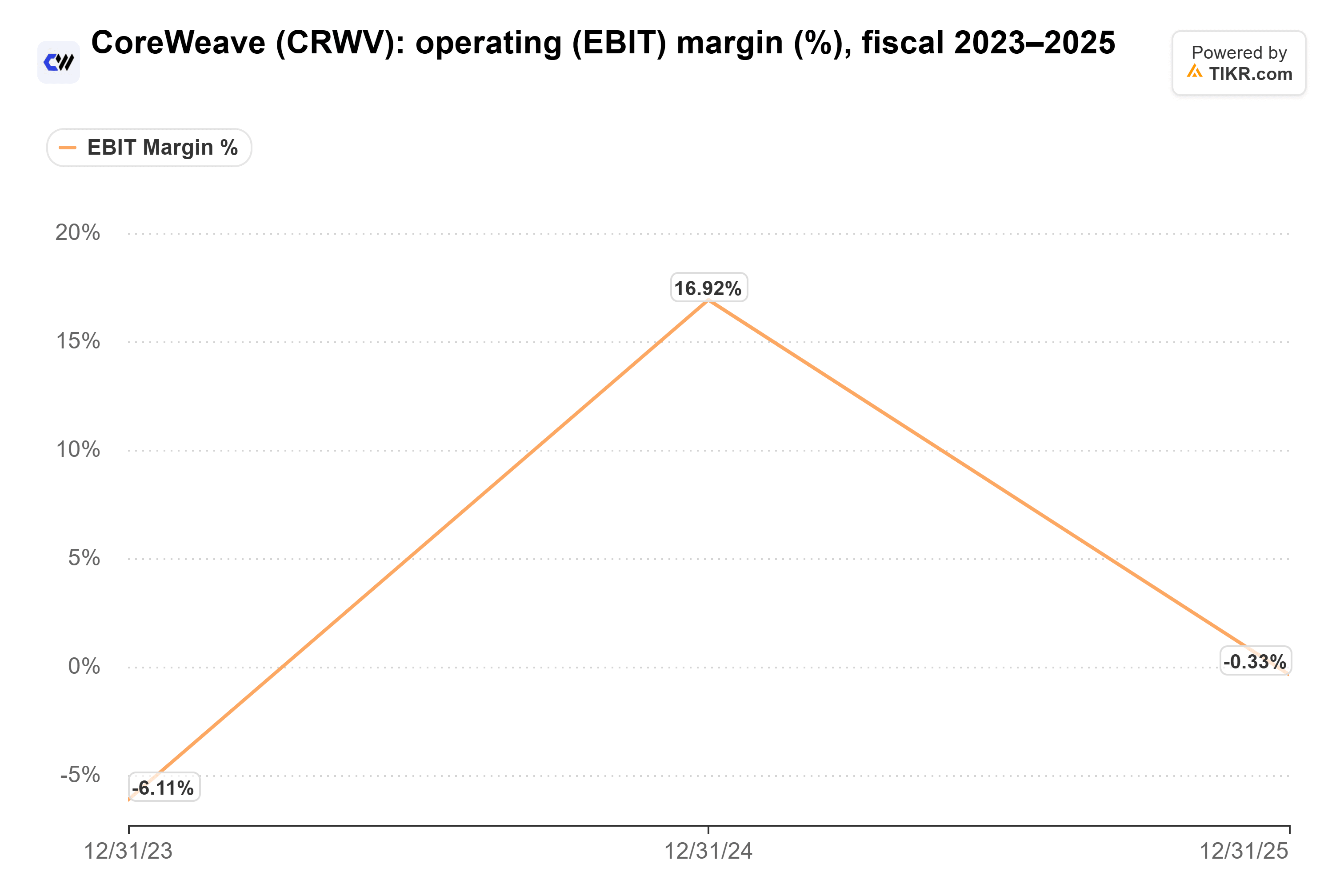
And that was before the H100’s 45% price jump since December.
Blackstone President and COO Jon Gray, whose firm has done chip financing with CoreWeave, told Bloomberg Talks that the neoclouds’ main business is “quite good.” The catch, in his words: “you’ve got to deliver that compute.” Doing that takes debt, equity, data centers and power. Host Dani Burger noted that yields on some of CoreWeave’s debt have reached 15%.
A renter that can’t cover its costs stops ordering chips. That’s the demand Nvidia and AMD are selling into.
The risk is real, and it starts with the renters
Burry is right that Griffin’s mechanism is “obvious.” Nvidia’s fiscal 2023 shows how fast pricing breaks once supply catches up. And each quarter, more of the market depends on the shortage lasting: CoreWeave’s debt, the hyperscalers’ spending, and estimates that have Nvidia’s revenue tripling.
My take: the glut isn’t here, and power limits make it hard to see one coming soon. But CoreWeave has the least room for error if it does, and Nvidia’s estimates leave no room for one at all.
Of course, the hyperscalers’ spending updates come first this week, and then Nvidia reports on Nov. 17. Any sign that the biggest buyers are slowing down would make Griffin’s scenario a lot easier to date.
So what is Nvidia stock actually worth?
TIKR lets you forecast the future price of any stock in less than a minute. Just enter a few assumptions into TIKR’s valuation model and see what Nvidia could be worth. Start from Wall Street consensus estimates, or adjust the inputs to reflect your own view of the business. It’s free to use.
Disclaimer:
Please note that the articles on TIKR are not intended to serve as investment or financial advice from TIKR or our content team, nor are they recommendations to buy or sell any stocks. We create our content based on TIKR Terminal’s investment data and analysts’ estimates. Our analysis might not include recent company news or important updates. TIKR has no position in any of the stocks mentioned. Thank you for reading, and happy investing!