Key Takeaways
- AI data center tenants now demand more than $5 million a day in penalties when capacity arrives late, up from about $1 million earlier this year, according to The Information.
- Those penalties mean CoreWeave’s $104.2 billion backlog protects its debt less than the headline number suggests.
- CoreWeave expects third-quarter interest expense of $860 million to $940 million and adjusted operating income of $200 million to $260 million, which leaves little room to pay penalties.
- Nebius and IREN have fallen nearly as hard as CoreWeave this month, and CoreWeave’s Nov. 12 results will show whether its new capacity is coming online on time.
CoreWeave (CRWV) stock has lost 41% since Oct. 6 (through Friday’s close), and the other neoclouds haven’t done much better. IREN (IREN) is down 40% and Nebius Group (NBIS) is down 36%.
Most of that selling has been about debt. This weekend added a new worry: the contracts themselves.
The Information reported that AI data center tenants now demand penalties of more than $5 million a day when developers fail to deliver power and facilities on time. Earlier this year the going rate was about $1 million.
Venture investor Chamath Palihapitiya put it bluntly: “The liquidated damages clauses of the contracts between neoclouds and their offtakers will be the final boss battle.”
CoreWeave would rather not have that fight right now.
TIKR tracks 42 analysts on CoreWeave. How many say “Buy”?
See the full breakdown of Buy, Hold, and Sell ratings on CoreWeave, along with Wall Street’s revenue and earnings estimates, all in one place. More than 500,000 investors use TIKR to research stocks like this one. See CoreWeave’s Analyst Ratings
The backlog is worth less than it looks
CoreWeave’s answer to its debt worries has been its backlog. That stood at $104.2 billion on June 30, and customers committed more than $25 billion more early in the third quarter.
But a contract’s headline value assumes the capacity shows up on time and keeps running. Short seller Jim Chanos called the penalty news a reminder of why “the headline ‘$ per MW’ contracts that promotional neocloud CEO’s like to talk about are very misleading.”
Palihapitiya says the same pressure applies to outages. Operators that can’t keep their compute running and can’t fix problems fast will face harsh penalties from their customers.
CoreWeave is on both sides of these deals. Its customers hold it to delivery dates and uptime. Meanwhile, until its first self-built site comes online later this year, it relies on outside developers for power and buildings. That has already cost it once: in November 2025, one developer’s delays forced CoreWeave to cut its 2025 revenue guidance.
Wall Street’s forecasts still assume the backlog turns into revenue on schedule. Analysts expect revenue to more than double this year to $12.9 billion, then reach $43.5 billion in 2028.
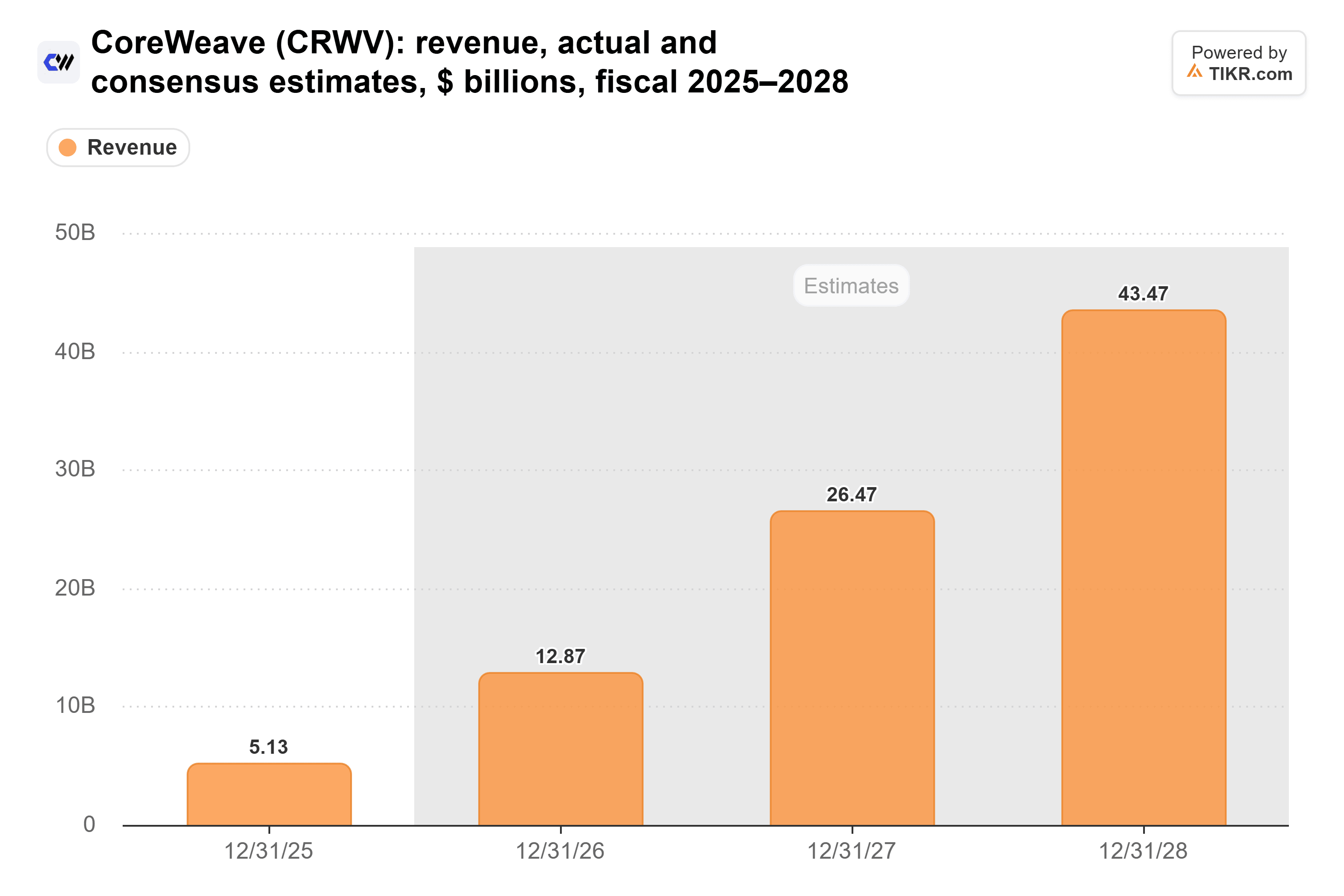
Only 41% of CoreWeave’s $103.7 billion in remaining performance obligations comes due within 24 months. Most of the backlog is years away, and there are a lot of delivery dates to hit before then.
Little room to absorb a penalty
CoreWeave also has very little profit to pay for a slip. Its operating margin fell from 16.9% in 2024 to about break-even in 2025…

…and it was -1.9% in the second quarter of 2026.
The build-out runs on borrowed money. Total debt rose from $2 billion in 2023 to $29.8 billion in 2025:
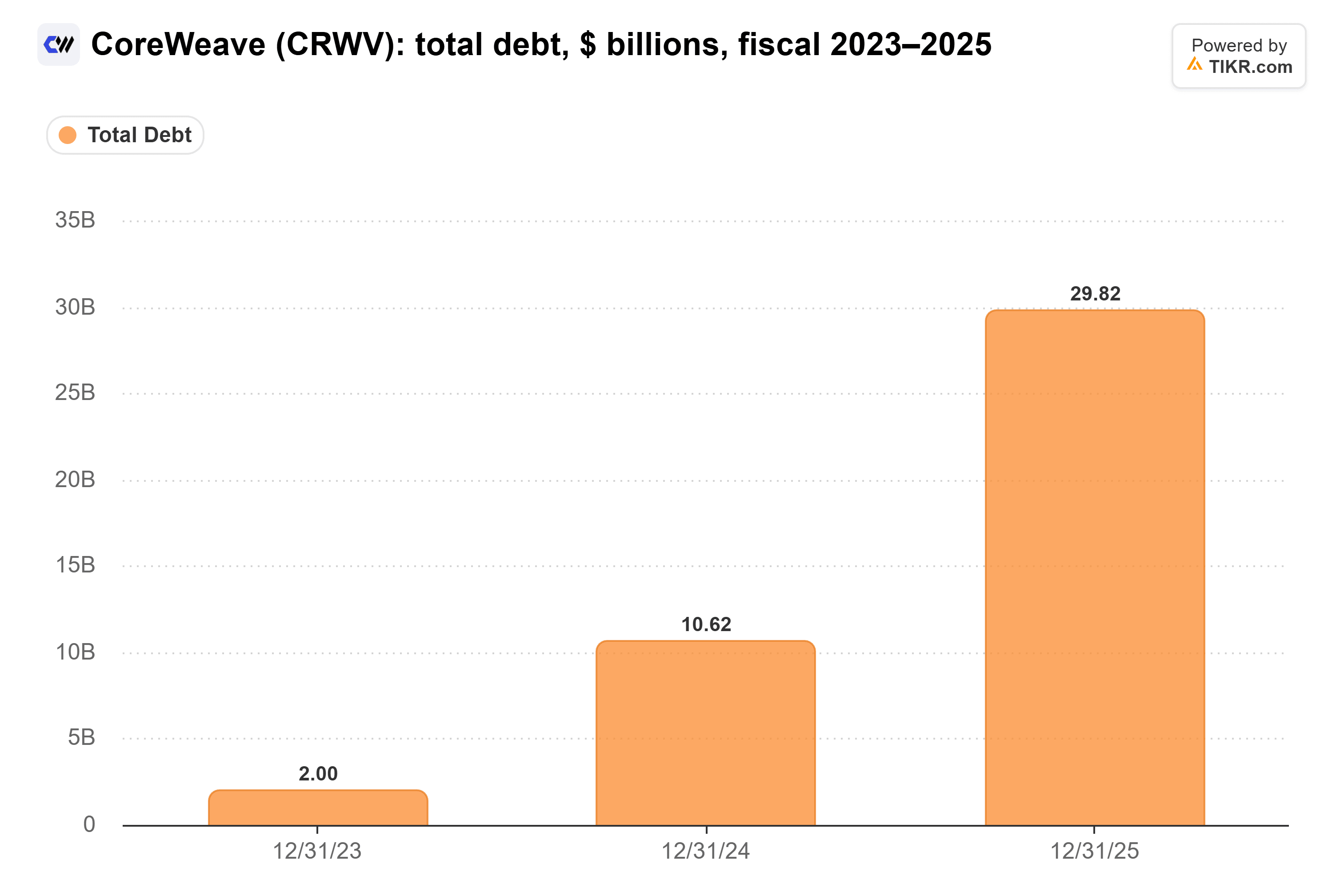
By June 30, TIKR’s total debt, which includes CoreWeave’s data center leases, had reached $51.6 billion. That borrowing produced a $640 million interest bill in the second quarter alone. For the third quarter, management expects interest expense of $860 million to $940 million and adjusted operating income of just $200 million to $260 million.
At the rate tenants now ask, a one-month delay at a single site would cost about $150 million. That’s more than half of the most CoreWeave expects to earn in adjusted operating income this quarter.
Scale cuts both ways
CoreWeave has more experience bringing GPU clusters online than almost any neocloud. Tougher terms could push smaller, less experienced operators out and send their customers to CoreWeave. Nebius and IREN face the same tenants and the same terms.
Elon Musk summed up the catch in one line: neoclouds benefit from all that demand “only if they can get their compute online and reliable, which is extremely difficult to do at scale.”
And few rivals are building at CoreWeave’s scale. About 500 megawatts went live in the second quarter alone, 300 of them in June. Management expects more than 1.85 gigawatts of active power by year-end, up from 1.5 gigawatts at June 30. Every one of those megawatts comes with a date a customer is counting on.
Show me the megawatts
My take: these penalties make CoreWeave’s backlog a much thinner cushion for its debt than the $104 billion figure suggests. I’d want proof that its new capacity is arriving on time before I bought this dip.
The first test comes with third-quarter results on Nov. 12. If the megawatts CoreWeave added in June are earning, adjusted operating income should come in at or above $200 million to $260 million.
Of course, CoreWeave’s experience could make it one of the few operators that wins this fight.
So what is CoreWeave stock actually worth?
TIKR lets you forecast the future price of any stock in less than a minute. Just enter a few assumptions into TIKR’s valuation model and see what CoreWeave could be worth. Start from Wall Street consensus estimates, or adjust the inputs to reflect your own view of the business. It’s free to use.
Disclaimer:
Please note that the articles on TIKR are not intended to serve as investment or financial advice from TIKR or our content team, nor are they recommendations to buy or sell any stocks. We create our content based on TIKR Terminal’s investment data and analysts’ estimates. Our analysis might not include recent company news or important updates. TIKR has no position in any of the stocks mentioned. Thank you for reading, and happy investing!