Key Takeaways
- Verizon beat third-quarter profit estimates with adjusted EPS of $1.31, added 406,000 postpaid phones and raised its full-year guidance for the third straight quarter.
- SpaceX’s planned phone network hasn’t hurt Verizon’s earnings, but it is weighing on the valuation: Verizon’s forward P/E has dropped to 8.8x from 10.5x in March.
- Revenue of $34.31 billion missed estimates, and revenue per postpaid account fell 1.9%, which is the cost of Verizon’s decision to stop raising prices.
- Through their trade group, Verizon, AT&T and T-Mobile asked the FCC to keep satellites off two key 5G bands ahead of an Oct. 29 vote on satellite-to-phone rules.
Verizon (VZ) beat third-quarter profit estimates this morning and raised its full-year guidance for the third straight quarter.
Just days earlier, Verizon, AT&T (T) and T-Mobile had joined their trade group in lobbying the FCC on satellite-to-phone rules. That matters because SpaceX (SPCX) is planning a phone network of its own for 2028.
So far, the only place SpaceX hurts Verizon is the stock price. (Shares fell [2%] today, even after the beat.)
TIKR tracks 25 analysts on Verizon. How many say “Buy”?
See the full breakdown of Buy, Hold, and Sell ratings on Verizon, along with Wall Street’s revenue and earnings estimates, all in one place. More than 500,000 investors use TIKR to research stocks like this one. See Verizon’s Analyst Ratings
What exactly happened
Verizon’s third-quarter results were strong almost everywhere that counts…
- Adjusted EPS of $1.31, above the $1.28 analysts expected
- 406,000 postpaid phone net adds, its best third quarter in five years, plus 137,000 net new postpaid accounts, its best in over a decade
- Consumer postpaid phone churn of 0.87%, down from 0.91% a year earlier
- Adjusted EBITDA of $13.8 billion, up 8% and a company record
- Free cash flow of $7.8 billion, up 12.1%
Management now expects 2026 adjusted EPS of $5.04 to $5.06, or 7% to 7.5% growth, up from 6% to 7% before. It also expects 1.1 million to 1.2 million postpaid phone net adds this year. The old target was the upper half of 750,000 to 1 million.
Revenue was the one miss. It came in at $34.31 billion, up 1.5% but below the $34.77 billion consensus. Revenue per postpaid account fell 1.9% to $168.08.
Verizon chose that trade. It stopped pushing through yearly price increases so fewer customers would leave. Back in January, management said the change would cost about 1.8 percentage points of service revenue growth this year.
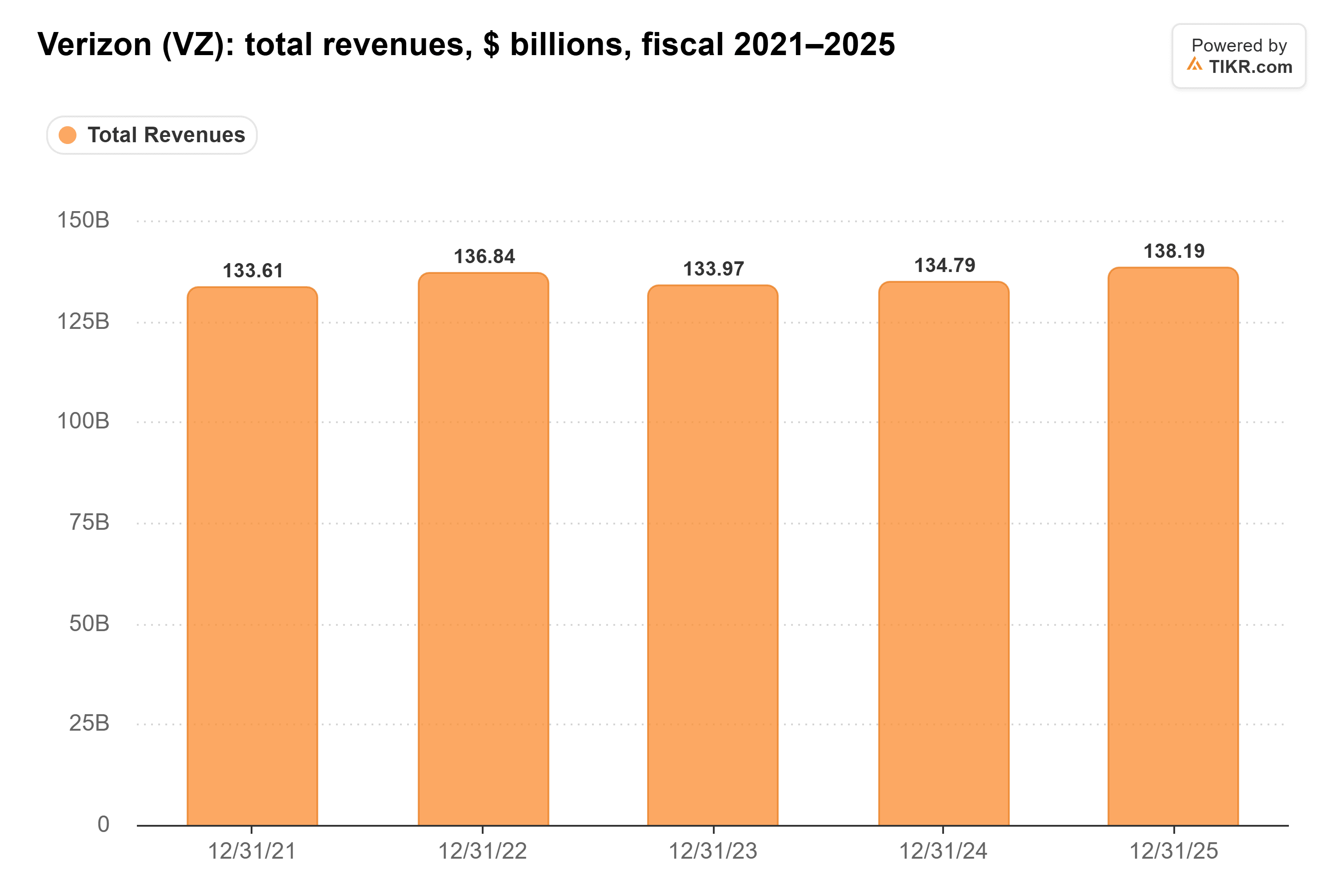
And Verizon doesn’t have much room to give up. Revenue went from $134 billion in fiscal 2021 to $138 billion in fiscal 2025, barely any growth in five years.
SpaceX hasn’t touched the earnings yet
SpaceX has been busy this month. It agreed to a roughly $8 billion deal for nationwide 800 MHz spectrum. On SpaceX’s third-quarter call, President Gwynne Shotwell said Starlink Mobile is aiming to start service on its own airwaves in early 2028. Elon Musk told analysts he sees “a clear path to several hundred billion dollars a year” in connectivity revenue. That business brought in about $5.2 billion last quarter.
Then Bloomberg [reported](LINK NEEDED) that SpaceX is in talks to use at least 80,000 US cell sites. AT&T and T-Mobile both fell 8% on Oct. 23.
The carriers’ response is to lobby. Their trade group, CTIA, met with FCC officials on Oct. 20 and followed up with a [letter](LINK NEEDED). It warned that the agency’s “buildout decisions have real consequences for consumers who rely on ever-increasing wireless capacity.”
CTIA asked the FCC to keep satellites off two bands that carry much of the carriers’ 5G traffic. The FCC votes on its new satellite-to-phone proposal on Oct. 29. CTIA also wants carriers to keep the right to approve and end any lease of their airwaves to a satellite company. The letter never names SpaceX, but SpaceX is the company the carriers are worried about.
Meanwhile, analysts expect Verizon’s earnings to rise every year through 2028, from $4.71 a share in fiscal 2025 to $5.75.
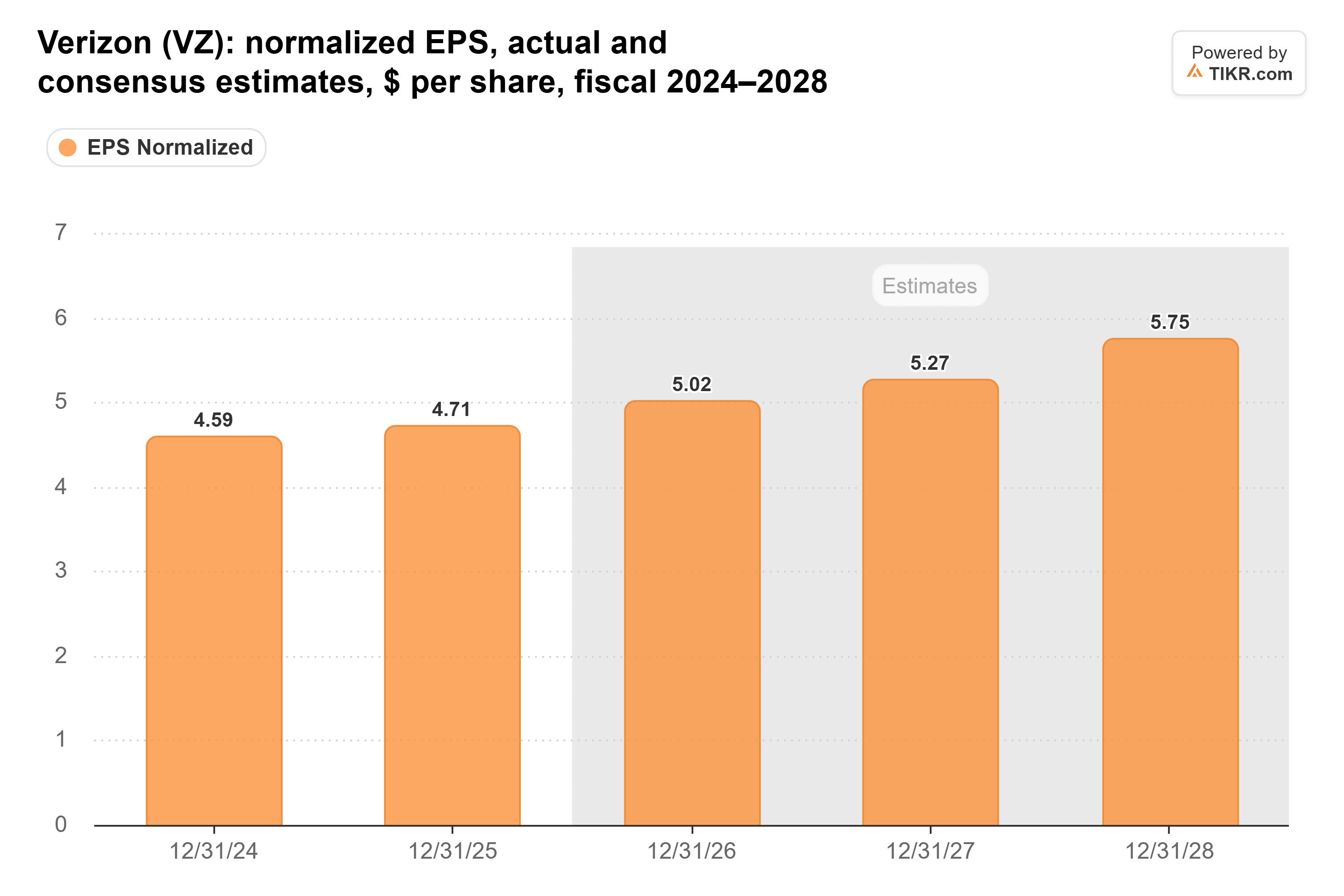
Today’s guidance should push those estimates higher: its $5.05 midpoint is already above the $5.02 analysts expected for 2026.
The SpaceX risk is in the price
Altimeter Capital CEO Brad Gerstner talked about telecom stocks getting hit by Starlink fears on CNBC’s Squawk Pod last week: “the market doesn’t really care about what your earnings are today. They’re saying there’s this massive disruption coming to your business, right? And so your discount rate has to go up. Your multiple has to come down.”
That’s what has happened to Verizon. Its forward P/E was 8.8x on Friday, down from 10.5x in March.
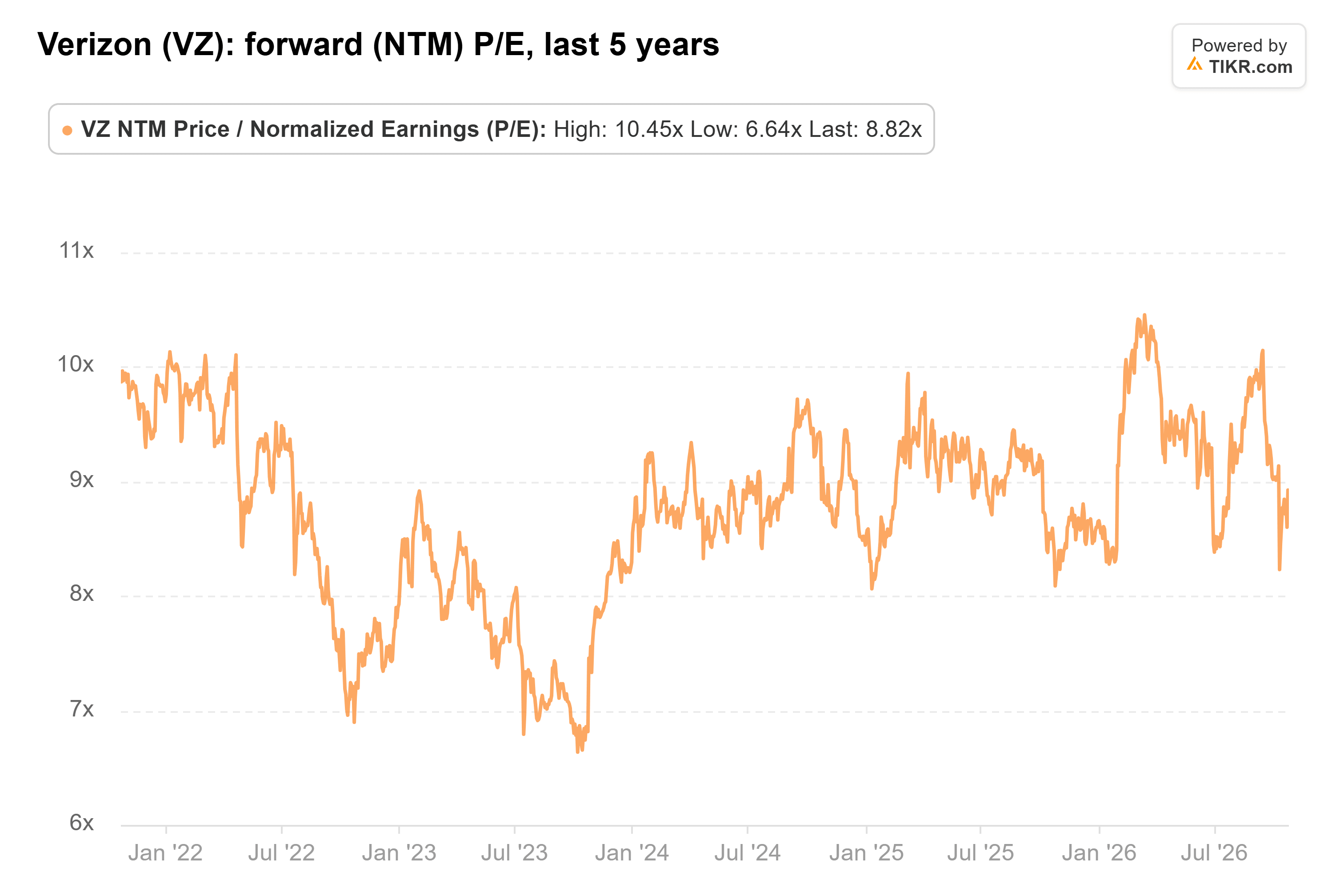
(That’s right at its five-year average, so the stock isn’t priced for disaster either.)
Of course, Starlink Mobile’s service on its own spectrum isn’t due until early 2028. One strong quarter says little about whether Verizon keeps its customers then. And falling revenue per account is a bad trend to have while SpaceX is getting ready.
My take: Verizon is adding customers and growing earnings while the threat is still more than a year off. At under 9x those earnings, I think the stock is pricing in more SpaceX damage than the numbers show. The FCC’s Oct. 29 vote, and any tower deals SpaceX signs, could change that quickly.
So what is Verizon stock actually worth?
TIKR lets you forecast the future price of any stock in less than a minute. Just enter a few assumptions into TIKR’s valuation model and see what Verizon could be worth. Start from Wall Street consensus estimates, or adjust the inputs to reflect your own view of the business. It’s free to use.
Disclaimer:
Please note that the articles on TIKR are not intended to serve as investment or financial advice from TIKR or our content team, nor are they recommendations to buy or sell any stocks. We create our content based on TIKR Terminal’s investment data and analysts’ estimates. Our analysis might not include recent company news or important updates. TIKR has no position in any of the stocks mentioned. Thank you for reading, and happy investing!