
Key Takeaways
- Naveen Rao said on 20VC that inference will reach $10 trillion within 10 years, and that he doesn’t expect chips to become a commodity.
- If he’s right, cheaper AI grows the market while the profit stays with hardware makers like NVIDIA, and pure software investors lose out.
- NVIDIA’s gross margin has stayed above 70% for three straight fiscal years, and analysts expect revenue to grow from $216 billion last fiscal year to $903 billion in the year ending January 2029.
- The stock trades at 17x forward earnings, against a three-year average of 30x, and the Nov. 17 report’s margin guidance is the next test.
If you own NVIDIA (NVDA), or any software stock, this week’s episode of 20VC is worth a listen.
Naveen Rao sold his last startup to Databricks for $1.3 billion and now runs Unconventional AI. He told host Harry Stebbings: “The inference market is going to be a $10 trillion market within 10 years.”
Then he said who he thinks gets paid: “I actually think the hardware is the place to be over the next 10 years.” He was blunter about pure software investors: he thinks they’re in trouble.
So much for software eating the world.
Cheaper tokens, bigger market
Rao’s case starts with price: “if we knock off a zero, one order of magnitude of efficiency on delivery of a token, that effectively 10x’s the market in some ways.” Cheaper tokens make AI worth using for far more jobs, and he expects the number of uses to grow more than tenfold. (He calls it Jevons paradox.)
The same force is behind Jensen Huang’s point that token costs are falling 30 to 40 times a year. At NVIDIA, revenue rose from $131 billion in the year ended January 2025 to $216 billion a year later. Analysts expect $412 billion this fiscal year, $692 billion next year and $903 billion the year after.
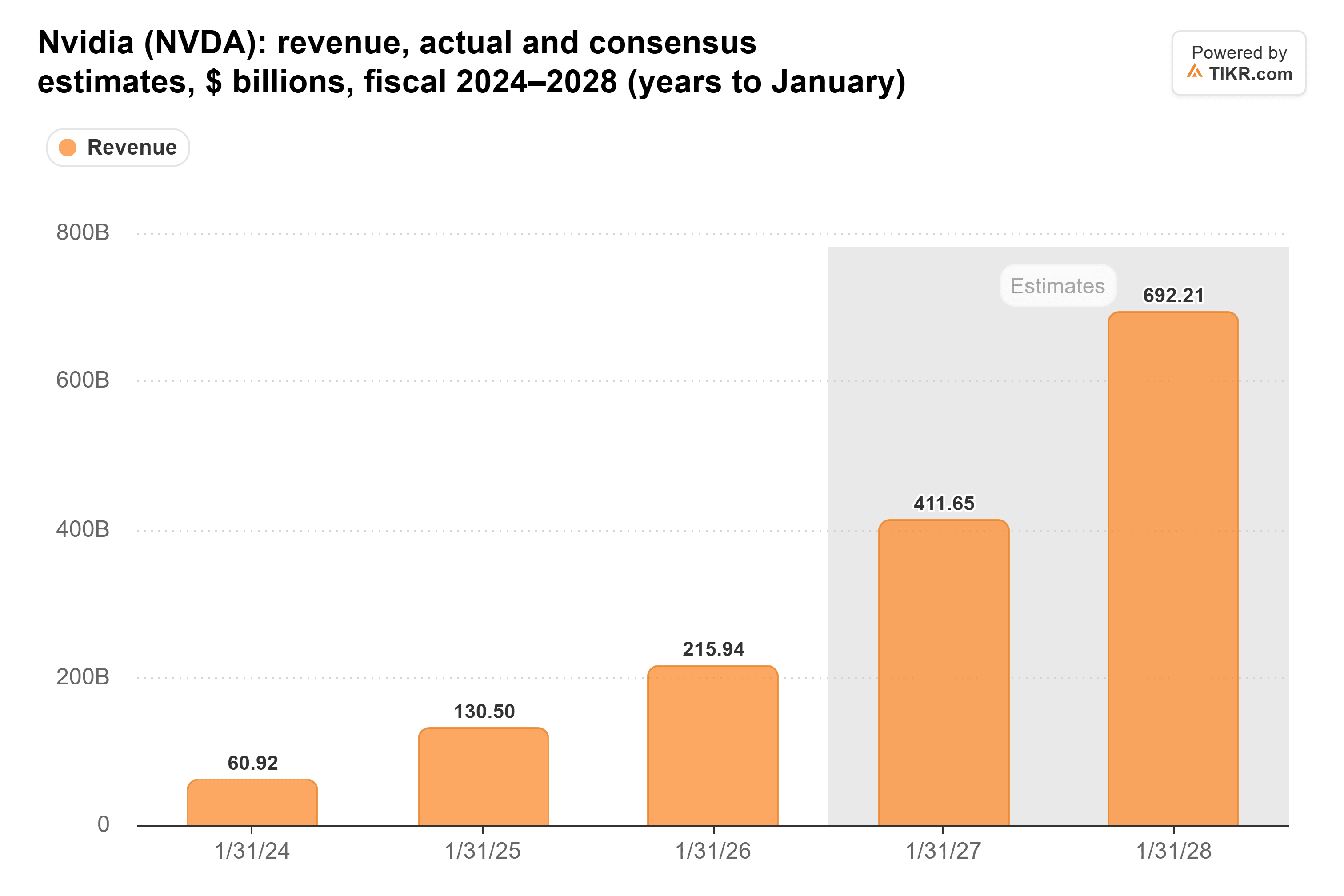
Management says supply is what’s holding even that back. It guides for revenue growth of about 70% in fiscal 2028 and says customers’ own forecasts point to closer to doubling.
TIKR tracks 62 analysts on Nvidia. How many say “Buy”?
See the full breakdown of Buy, Hold, and Sell ratings on Nvidia, along with Wall Street’s revenue and earnings estimates, all in one place. More than 500,000 investors use TIKR to research stocks like this one. See Nvidia’s Analyst Ratings
The chips aren’t turning into a commodity
Stebbings asked whether chips will become a commodity now that the big cloud companies, and even AI labs, design their own. Rao’s answer: “So I actually don’t see chips being commoditized.”
His reasoning is that demand for intelligence has no ceiling. As the price of a token falls, he expects margins to shrink for the companies that run models on other people’s hardware, and he sees the models themselves as commoditized already. He thinks the hardware maker that turns energy into intelligence most efficiently keeps its edge.
So far, NVIDIA’s numbers back him up. Its gross margin has held above 70% in each of the last three fiscal years.
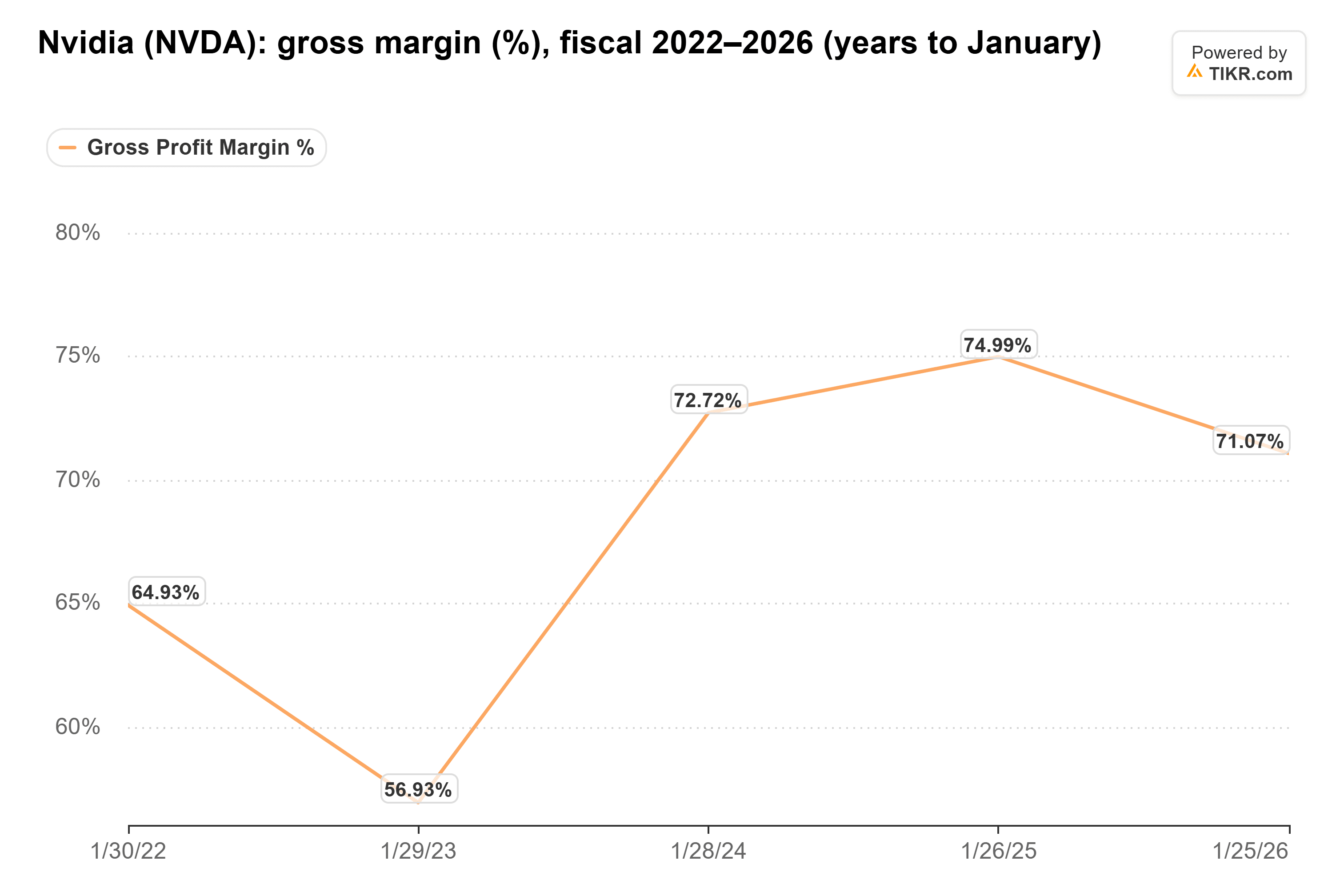
It reached 75.0% in the quarter ended July 2026. Management expects it to bottom at 71% to 72% in the January 2027 quarter as memory costs climb, then recover to 72% to 73% in fiscal 2028 as price increases take effect.
More of every data center goes to NVIDIA
As the market grows, NVIDIA keeps selling more of each data center. Management puts its revenue opportunity per gigawatt of capacity at about $18 billion with Hopper, $25 billion with Grace Blackwell, and $40 billion with Vera Rubin, which adds CPUs, more networking and the Groq inference accelerator. That’s more than double in two generations.
The custom-chip threat hasn’t slowed the buyers who don’t make their own chips. In the July 2026 quarter, revenue from AI clouds, industrial and enterprise customers rose 138% to $40.3 billion, which is 45.3% of data center revenue. Hyperscaler revenue grew 102%.
That leaves software on the losing side of Rao’s ledger. He doesn’t think software-as-a-service is where companies will earn their margins anymore. As he put it: “I just don’t see software being a huge market in 20 years.”
The stock is priced like the cycle is peaking
Investors aren’t paying for Rao’s decade. As of Oct. 23, NVIDIA traded at 17x forward earnings. Its three-year average is 30x, and it hit a high of 47x in June 2024.
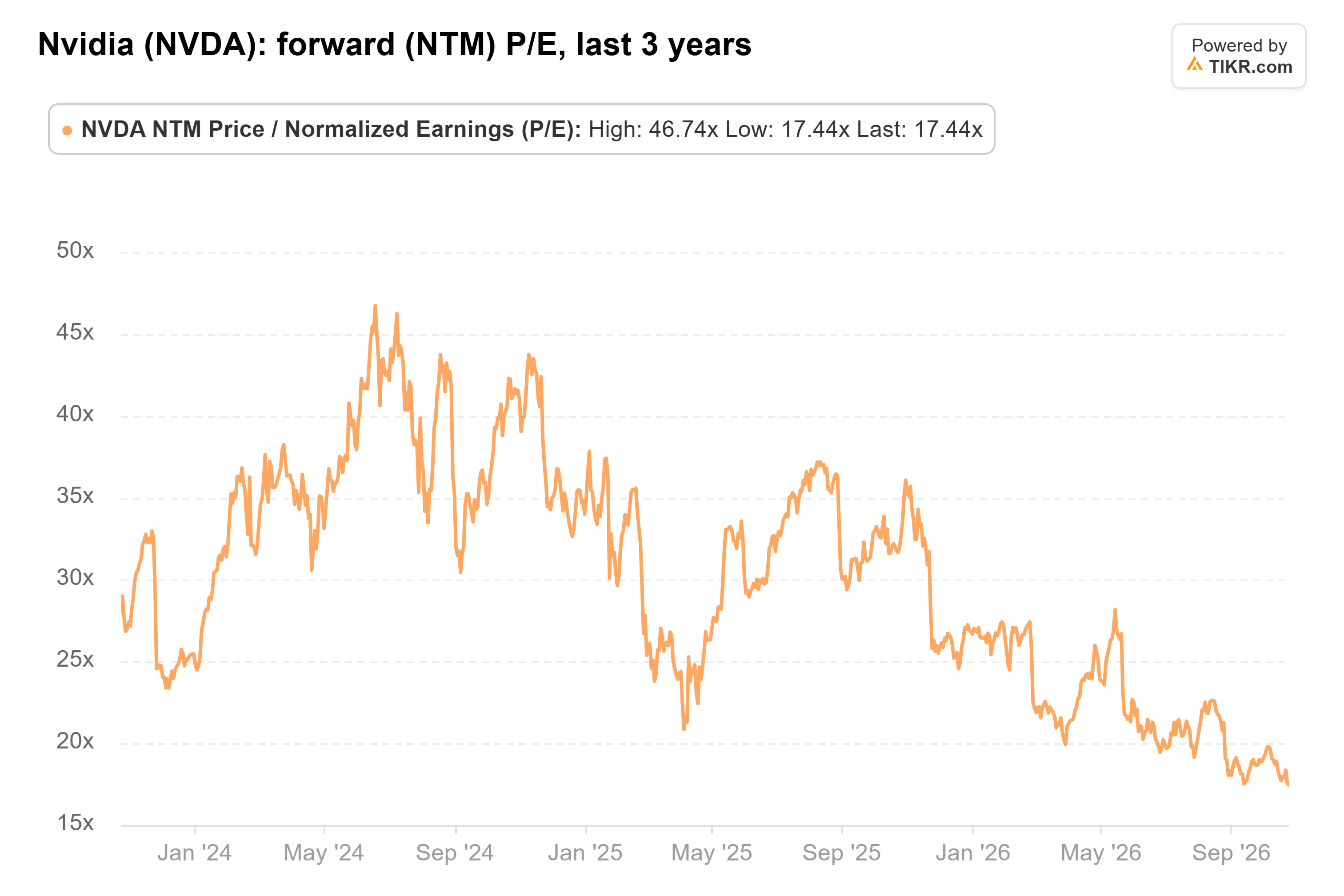
That’s lower than at any quarter-end since 2015, even though analysts expect earnings per share to rise 71% in fiscal 2028.
There’s real risk here. A 10-year market size is easy to claim and hard to disprove, and Rao has a hardware company of his own. NVIDIA’s last downturn also shows what happens when demand cools: in the year ended January 2023, revenue was flat at $27.0 billion and gross margin fell to 56.9%.
My take: you don’t have to believe the $10 trillion figure to like this setup. If inference keeps growing and NVIDIA’s gross margin holds in the low 70s, 17x is a low price for the company that owns the hardware.
Of course, the Nov. 17 report is the next test. If the 71% to 72% margin guidance for the January quarter holds, Rao’s case that chips won’t commoditize looks that much stronger.
So what is NVIDIA stock actually worth?
TIKR lets you forecast the future price of any stock in less than a minute. Just enter a few assumptions into TIKR’s valuation model and see what NVIDIA could be worth. Start from Wall Street consensus estimates, or adjust the inputs to reflect your own view of the business. It’s free to use.
Disclaimer:
Please note that the articles on TIKR are not intended to serve as investment or financial advice from TIKR or our content team, nor are they recommendations to buy or sell any stocks. We create our content based on TIKR Terminal’s investment data and analysts’ estimates. Our analysis might not include recent company news or important updates. TIKR has no position in any of the stocks mentioned. Thank you for reading, and happy investing!