Key Takeaways
- Amazon CEO Andy Jassy says AI inference is still “an order of magnitude too expensive” for widespread use, and that Amazon’s own chips are a big part of bringing that cost down.
- Cheaper inference could open up the biggest part of the AI market, and Amazon’s Trainium chips let it add that capacity without buying every chip from NVIDIA.
- The stakes are high: Amazon expects about $220 billion of capex in 2026, and its free cash flow was a $7.6 billion outflow over the 12 months to June 30, 2026.
- Amazon reports third-quarter results on Oct. 29, and AWS’s operating margin against the second quarter’s 39.4% is the number to watch.
Amazon (AMZN) plans to spend about $220 billion on capex this year, and CEO Andy Jassy still thinks AI costs too much.
On The a16z Show, in an episode published Friday, Jassy said AI inference is “still an order of magnitude too expensive in my opinion for it to be used as pervasively as possible.”
That’s a factor of 10.
His fix? “Our chips business is a big piece of that.”
That’s a bold plan for a company that still buys plenty of chips from NVIDIA (NVDA).
TIKR tracks 60 analysts on Amazon. How many say “Buy”?
See the full breakdown of Buy, Hold, and Sell ratings on Amazon, along with Wall Street’s revenue and earnings estimates, all in one place. More than 500,000 investors use TIKR to research stocks like this one. See Amazon’s Analyst Ratings
The prize is the middle of the barbell
Jassy described AI demand as a “barbell.” On one end, AI labs are consuming “gobs and gobs of compute unlike anything I’ve seen.” On the other, businesses use AI for specific jobs like customer service and fraud detection.
The middle is everyday business software that hasn’t widely adopted AI yet. Jassy thinks it could become the biggest source of demand once inference is cheap enough to justify rebuilding that software around it.
Amazon isn’t short of customers today: Jassy said its capacity is effectively sold out for 2026, largely booked for 2027, and “a good chunk of 28 is sold out.” Cheaper inference is about the next wave of buyers.
Naveen Rao, co-founder and CEO of the AI hardware startup Unconventional AI, put the stakes plainly on the latest episode of the 20VC podcast:
“if we knock off a zero, one order of magnitude of efficiency on delivery of a token, that effectively 10x’s the market in some ways.”
Rao is building chips himself, so he has a horse in this race. But Jassy’s barbell points the same way.
Amazon has seen this movie before
Jassy said Amazon had the same problem years ago with Intel, which dominated the processors in cloud servers. Amazon wanted more computing for its money but struggled to get Intel to prioritize that, so it built its own processor, Graviton.
“We saw that same movie in the AI space,” Jassy said.
Graviton worked out. On Amazon’s second-quarter call, management said 98% of AWS’s top 1,000 compute customers use it.
Trainium is the sequel. Jassy said it delivers about 30% to 40% better price-performance than comparable processors. Amazon has disclosed more than $225 billion of Trainium revenue commitments, including from Anthropic and OpenAI, and its chips business ran at a rate above $25 billion a year in the second quarter of 2026.
(Jassy didn’t name NVIDIA, and he called the dominant supplier an important partner.)
Every capex dollar has to stretch further
Amazon’s capex has climbed from $52.7 billion in fiscal 2023 to $132 billion in fiscal 2025.
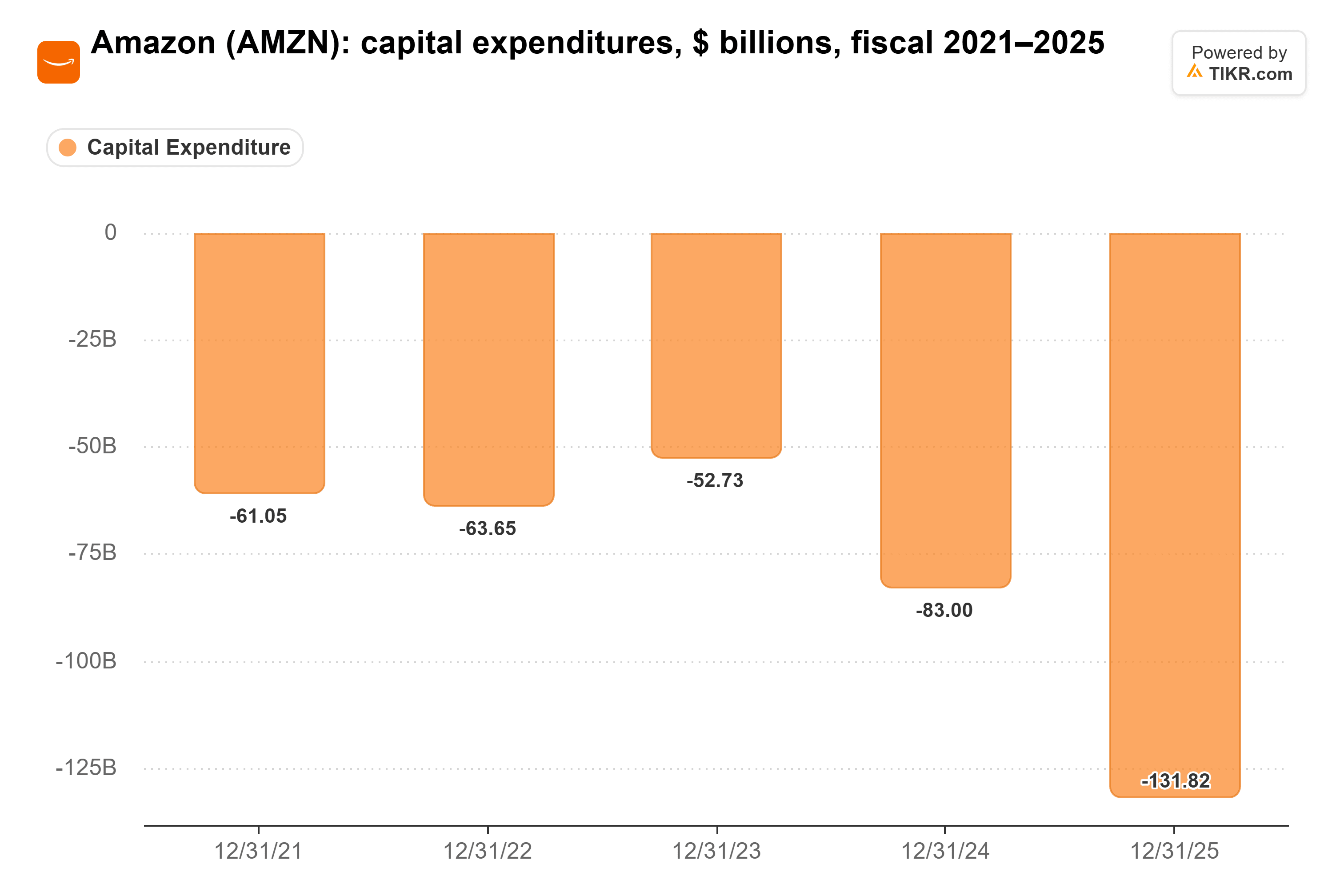
And it’s headed much higher. On top of this year’s roughly $220 billion, Jed Ellabrook of Argent Capital told Bloomberg Tech he thinks next year’s number is “probably going to be $350B when you combine both AWS and retail.”
That spending has eaten into free cash flow, which fell to $7.7 billion in fiscal 2025 from $32.9 billion the year before.
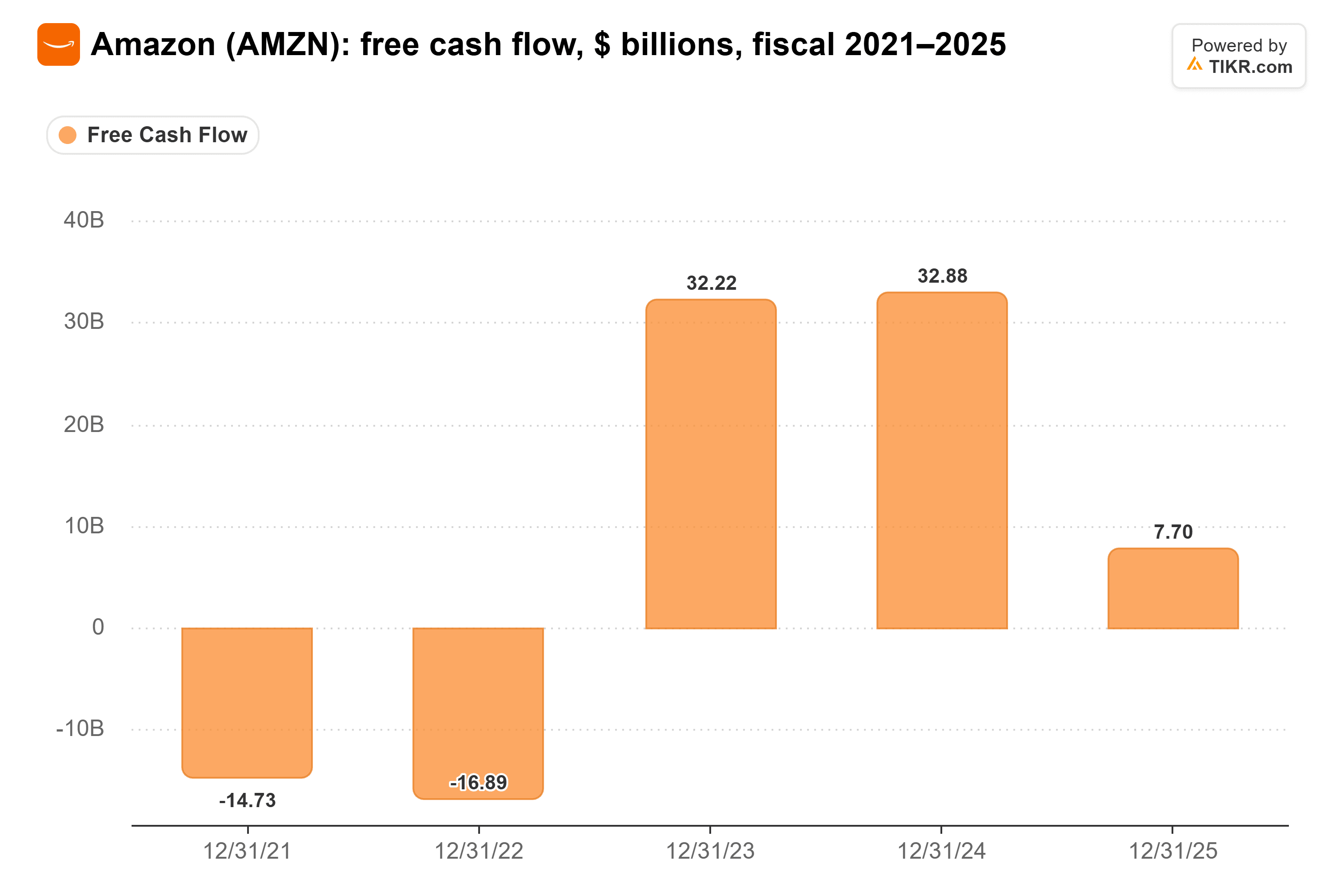
And over the 12 months to June 30, 2026, free cash flow was a $7.6 billion outflow.
So far, profits have held up. Amazon’s operating margin widened from 2.6% in fiscal 2022 to 11.2% in fiscal 2025.
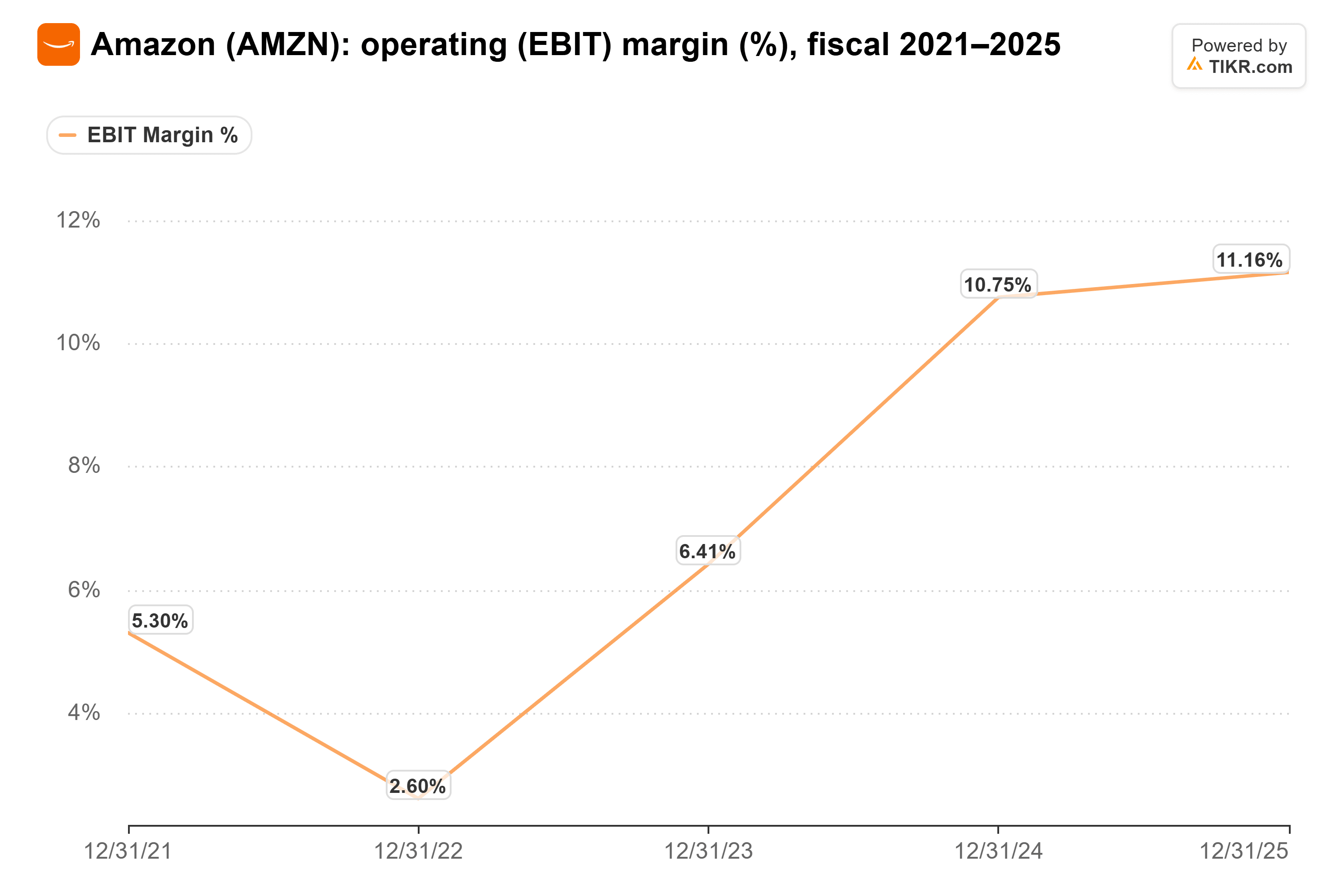
AWS drives most of that profit, with a 39.4% operating margin in the second quarter of 2026, up from 32.9% a year earlier. But depreciation is climbing with the build: it equaled 19.1% of AWS’s sales in the quarter, up from 15.7% a year earlier.
A chip with 30% to 40% better price-performance buys Amazon more computing per server dollar, with no supplier’s markup on top. That’s how AWS keeps its margin while capex climbs.
The savings will take a while
Amazon still relies on NVIDIA, whose CFO said in August that AWS will add 2 million more NVIDIA GPUs in 2027 and 2028. Custom chips don’t fix memory prices either: management said on the second-quarter call that memory costs pushed 2026 capex guidance up $20 billion. And some of Amazon’s new AI servers are reportedly waiting on power.
So Trainium’s savings will take years to show up across Amazon’s whole fleet.
Jassy has the right answer
My take: Amazon’s own chips are the best answer it has to its capex bill. If Trainium makes inference meaningfully cheaper, Amazon wins twice: more businesses put AI to work, and AWS keeps more of what they spend.
Of course, the savings have to show up in the numbers. Amazon reports third-quarter results on Oct. 29. AWS’s margin against the second quarter’s 39.4% (which included about $551 million of energy-contract gains) is the first read.
So what is Amazon stock actually worth?
TIKR lets you forecast the future price of any stock in less than a minute. Just enter a few assumptions into TIKR’s valuation model and see what Amazon could be worth. Start from Wall Street consensus estimates, or adjust the inputs to reflect your own view of the business. It’s free to use.
Disclaimer:
Please note that the articles on TIKR are not intended to serve as investment or financial advice from TIKR or our content team, nor are they recommendations to buy or sell any stocks. We create our content based on TIKR Terminal’s investment data and analysts’ estimates. Our analysis might not include recent company news or important updates. TIKR has no position in any of the stocks mentioned. Thank you for reading, and happy investing!