Key Takeaways
- SpaceX is borrowing $40 billion to buy AI chips at a reported 7.75% to 8.3%, more than a point above where its existing bonds trade.
- SpaceX’s lower borrowing cost gives it a real funding edge over neoclouds like CoreWeave and Nebius in a build that runs on debt.
- CoreWeave’s 2032 notes hit a 15% yield in October, which would mean nearly twice SpaceX’s yearly interest on the same $40 billion.
- SpaceX’s own borrowing costs are rising and its capex far outruns any single raise, so the final deal terms and its fourth-quarter cash balance are what to watch.
SpaceX (SPCX) is borrowing $40 billion to buy AI chips, and it’s paying up to do it.
Semafor reported on Oct. 22 that the lowest-rated slice of the deal, led by Apollo and Goldman Sachs, is expected to carry about 8.3%. A safer slice backed by SpaceX’s chips would price near 7.75%, more than a point above where SpaceX’s existing bonds trade.
Investor Chamath Palihapitiya isn’t worried. “This SpaceX paper is money good and better than most sovereign debt,” he posted on X. “Also means that everyone else except IG-grade hypers will price at 10-12% in 2027.”
That second sentence matters most for CoreWeave (CRWV) and Nebius (NBIS).
TIKR tracks 38 analysts on SpaceX. How many say “Buy”?
See the full breakdown of Buy, Hold, and Sell ratings on SpaceX, along with Wall Street’s revenue and earnings estimates, all in one place. More than 500,000 investors use TIKR to research stocks like this one. See SpaceX’s Analyst Ratings
The build runs on borrowed money
In the AI compute build, capex dwarfs cash flow, so the cost of borrowing decides who can build profitably.
Bloomberg Intelligence’s tech lead, Mandeep Singh, said on the Oct. 22 Bloomberg Intelligence podcast that SpaceX’s plan to add up to 10 gigawatts of capacity “equates to almost $400 billion in CapEx for a company that doesn’t even generate $2 billion in free cash flow.”
If anything, he was being generous. SpaceX’s free cash flow was negative in both of the last two years, and the burn got much bigger in 2025.
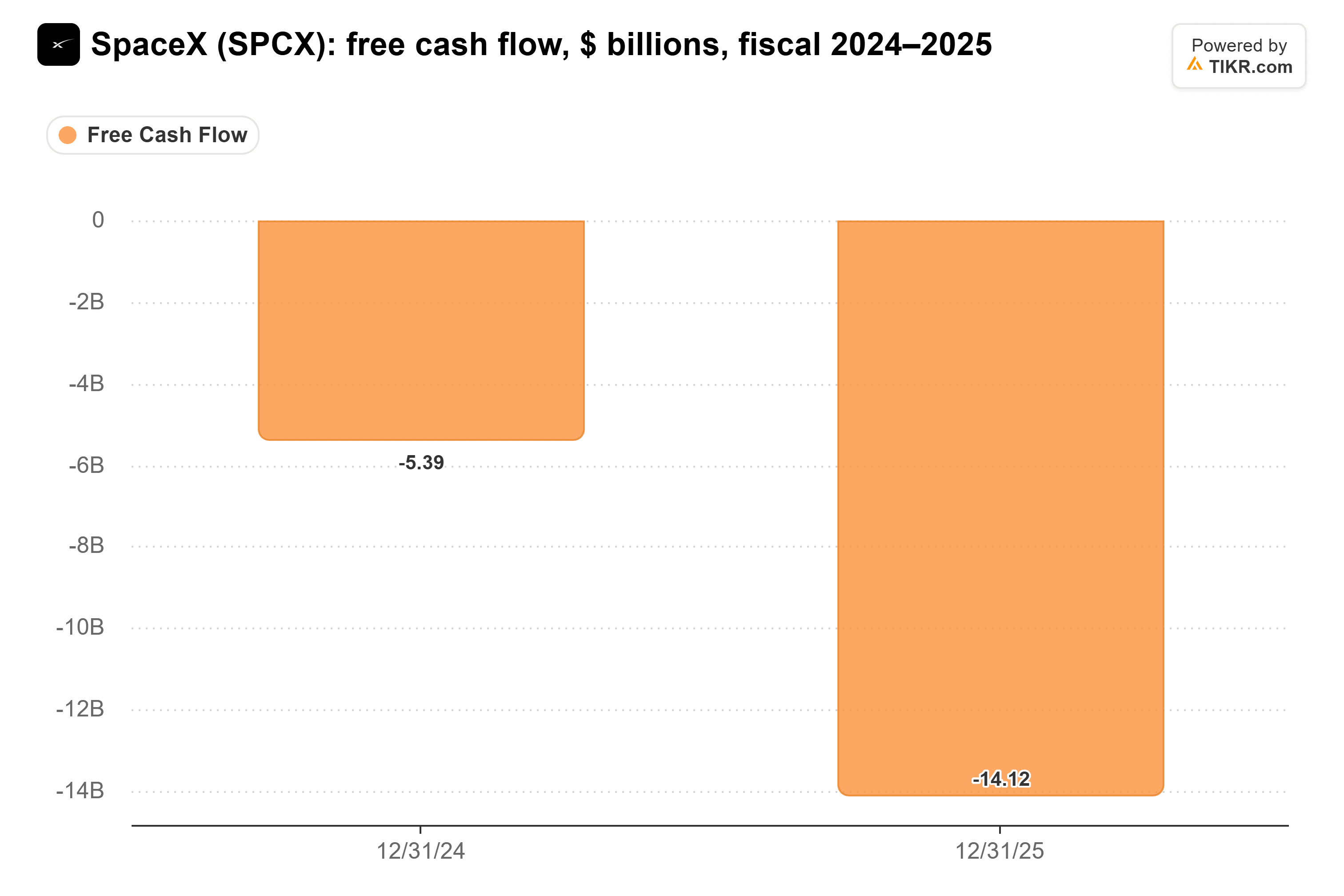
Over the 12 months through September, the burn reached $39.3 billion.
SpaceX isn’t selling stock to close the gap, either. JPMorgan’s Doug Anmuth wrote after earnings that the company “is not considering raising equity,” even as Meta opened a new nonvoting share class to fund its own build.
That leaves debt, at whatever price lenders set.
The gap between 8% and 15% adds up fast
CoreWeave’s 2032 notes hit a 15% yield by Oct. 20, up from 13% at the start of the month.
As Jim Cramer put it on Mad Money on Oct. 19, “If 15% is your cost of capital, then it’s going to cost you an arm and a leg to build a data center.”
Here’s what that means in dollars. On $40 billion, 8% comes to $3.2 billion of interest a year. At 15%, it’s $6 billion. At the 10% to 12% Palihapitiya expects most borrowers to pay in 2027, it’s $4 billion to $4.8 billion.
So at CoreWeave’s rate, a neocloud would pay nearly twice what SpaceX pays to finance the same chips. CoreWeave already carries a heavy interest bill…
Elon Musk took it a step further on Oct. 25, saying debt markets have nearly cut off funding for companies without substantial revenue outside AI data centers. He said SpaceX had closed its $40 billion and gave the reason: “we’re investment grade and have Starlink & launch revenue.”
SpaceX’s own borrowing costs are rising too
None of this makes SpaceX’s money cheap. The new debt reportedly prices well above the 5.855% weighted rate on the $25 billion of notes it sold in June.
And SpaceX already had a growing pile of debt before this deal. Total debt went from $15.4 billion at the end of 2024 to $24.5 billion at the end of 2025.
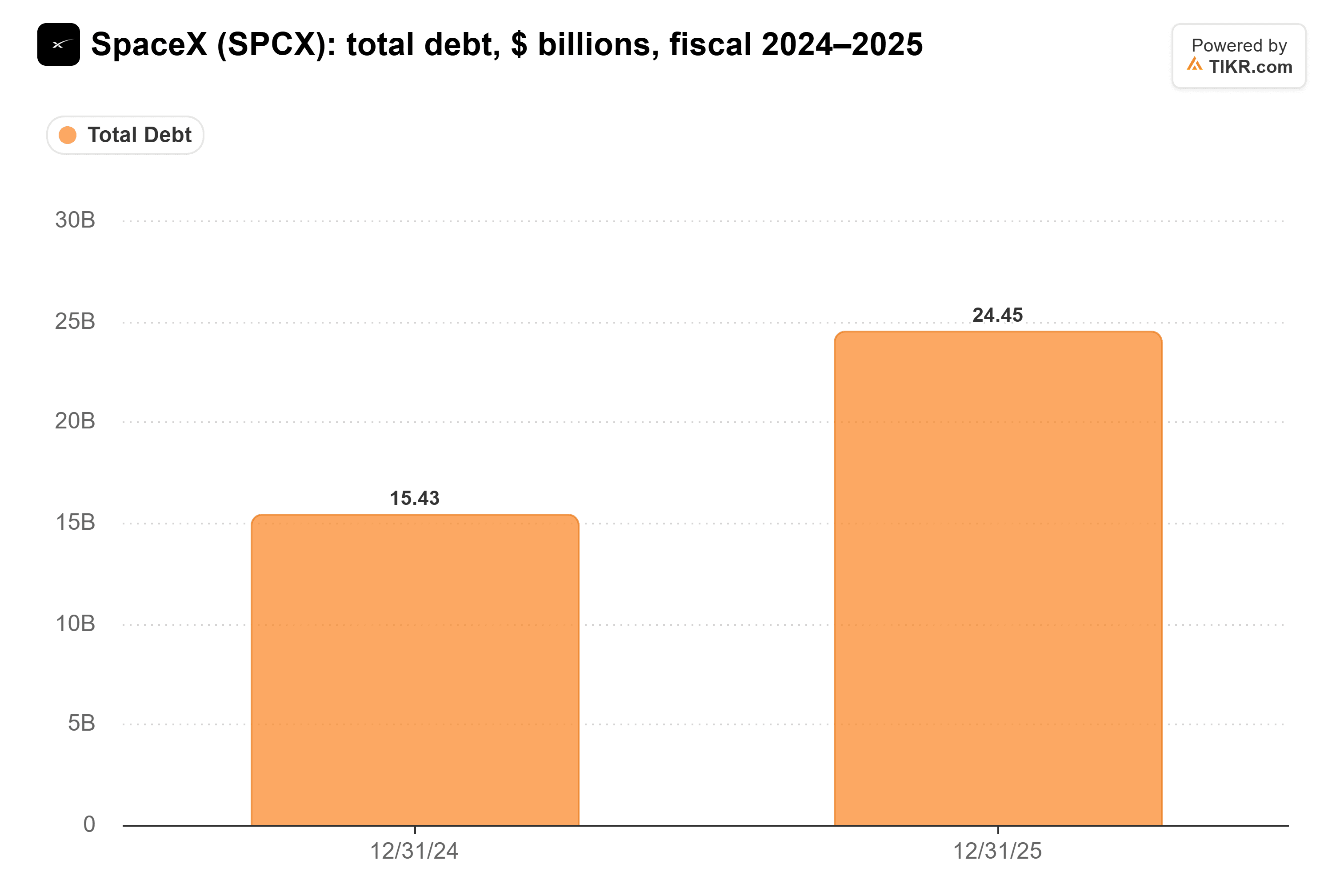
By Sept. 30, debt and finance leases had reached $38.8 billion.
Plus, $40 billion is only a tenth of Singh’s $400 billion. Analysts expect SpaceX to burn $140.7 billion of free cash flow in 2027 alone, so this won’t be its last raise.
Palihapitiya argued in a follow-up post that SpaceX belongs among the handful of investment-grade names that trade inside Treasuries. At about 8%, the bond market isn’t there yet.
SpaceX still borrows far cheaper than the neoclouds
SpaceX’s cost of money is rising, but the gap is what matters. If Palihapitiya is right about 2027, CoreWeave and Nebius will pay 10% to 12% or more to build the same capacity SpaceX is financing at about 8%. That’s billions of dollars a year that never reach their shareholders.
My take: SpaceX’s funding edge is real, and Starlink’s cash flow is why lenders will keep backing it even while AI spending runs far ahead of cash flow.
Of course, the payback on all those chips depends on today’s compute rental prices. If prices fall as new capacity comes online, even an 8% bill gets heavy. SpaceX’s fourth-quarter results in early 2027 will show how much cash a $35 billion to $40 billion capex quarter actually used up.
So what is SpaceX stock actually worth?
TIKR lets you forecast the future price of any stock in less than a minute. Just enter a few assumptions into TIKR’s valuation model and see what SpaceX could be worth. Start from Wall Street consensus estimates, or adjust the inputs to reflect your own view of the business. It’s free to use.
Disclaimer:
Please note that the articles on TIKR are not intended to serve as investment or financial advice from TIKR or our content team, nor are they recommendations to buy or sell any stocks. We create our content based on TIKR Terminal’s investment data and analysts’ estimates. Our analysis might not include recent company news or important updates. TIKR has no position in any of the stocks mentioned. Thank you for reading, and happy investing!