


Key Takeaways
- Nvidia CEO Jensen Huang said the cost of an AI token is falling 30 to 40 times a year, and he wants it to keep falling.
- Cheaper tokens help Nvidia because usage is growing faster than prices fall, while the neoclouds and AI labs that sell tokens carry the price risk.
- OpenAI CFO Sarah Friar said an 80% price cut on the company’s cheapest models raised usage 10x.
- Analysts expect Nvidia’s revenue to nearly double to $412 billion this fiscal year, and the main risk is heavily indebted customers like CoreWeave, which fell 15% on Oct. 14.
Nvidia (NVDA) CEO Jensen Huang has a message for anyone worried that AI is getting too cheap: Good.
“The cost of AI, the cost of a token is reducing by 30, 40 times per year,” Huang told Bloomberg’s Emily Chang in an interview played on the Oct. 15 episode of Bloomberg Tech.
He also said on the BG2 podcast that he wants it that way: “we want intelligence costs to decrease by a factor of two or 20 every single year because the consumption of it is going to more than make up for it.”
So the company whose chips make the tokens is rooting for those tokens to get cheaper, fast.
Investors are fighting over this right now. Falling token prices are half the bear case behind last week’s neocloud selloff. CoreWeave (CRWV) sank 15% on Wednesday, Oct. 14, as the yields on its bonds neared 15%.
I think Huang’s math works for Nvidia, and it’s much harder on the companies that sell the tokens.
Price down 80%, usage up 10x
OpenAI CFO Sarah Friar gave a live example on Bloomberg Talks on Oct. 14. About six weeks earlier, OpenAI had cut prices on Luna, its cheapest model series, by 80%.
“We saw use go up 10x,” Friar said. “So that tells you there’s a lot of price elasticity of demand right now.”
Do the math: each token sells for a fifth of what it used to, and OpenAI is selling 10 times as many. That’s about twice the revenue from the same models. (This assumes Friar’s “use” means tokens, which she didn’t say.)
Volume is Nvidia’s friend
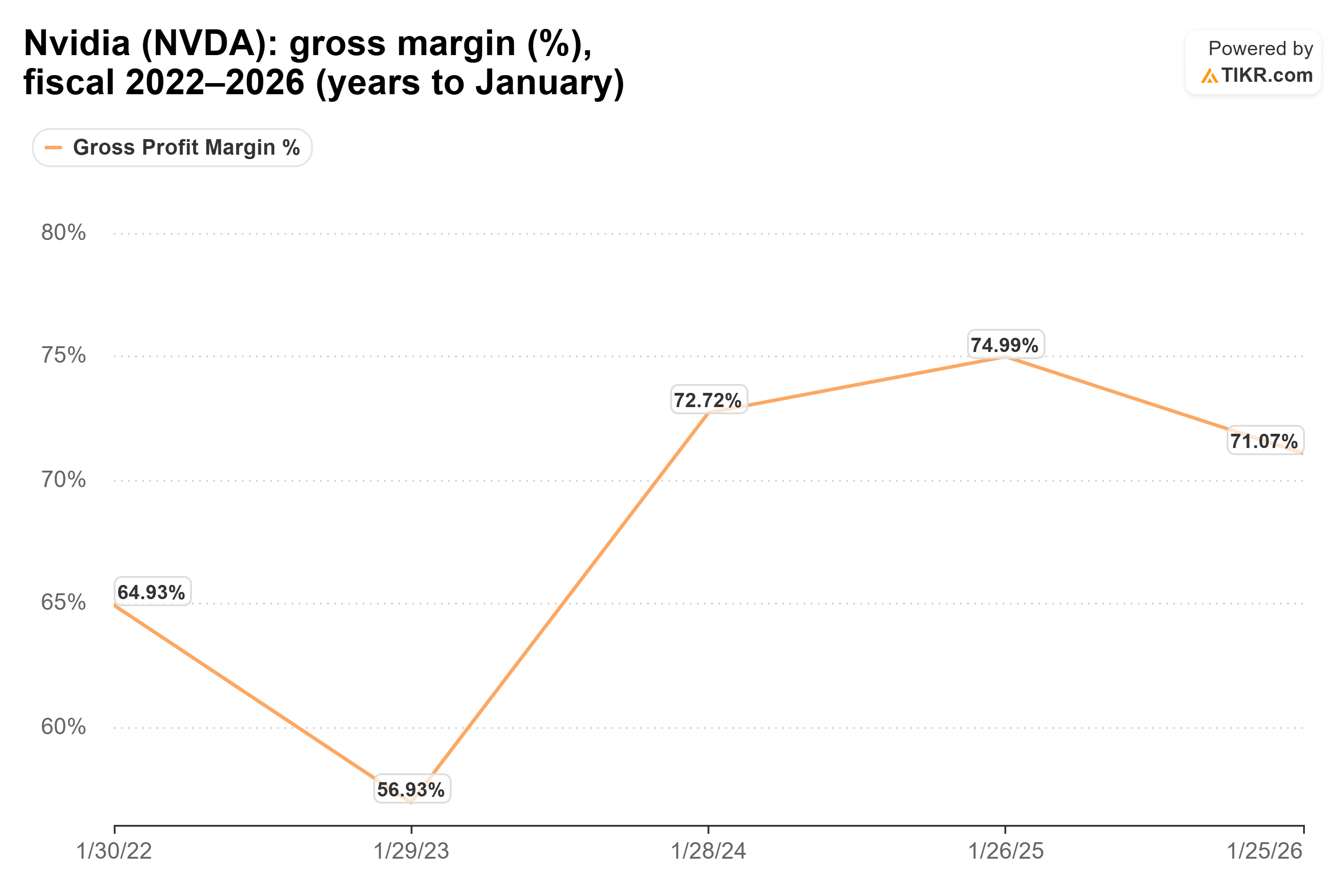
More tokens need more compute, and compute is what Nvidia sells. Cheaper tokens haven’t made Nvidia’s chips cheaper, either. Its gross margin has stayed above 70% in each of the last three fiscal years, from 72.7% in the year ended January 2024 to 71.1% in the year ended January 2026, while token costs dropped steeply.
Wall Street expects that volume to keep coming. Consensus has Nvidia’s revenue nearly doubling from $216 billion in the year ended January 2026 to $412 billion in the year ending January 2027, then reaching $692 billion the year after.
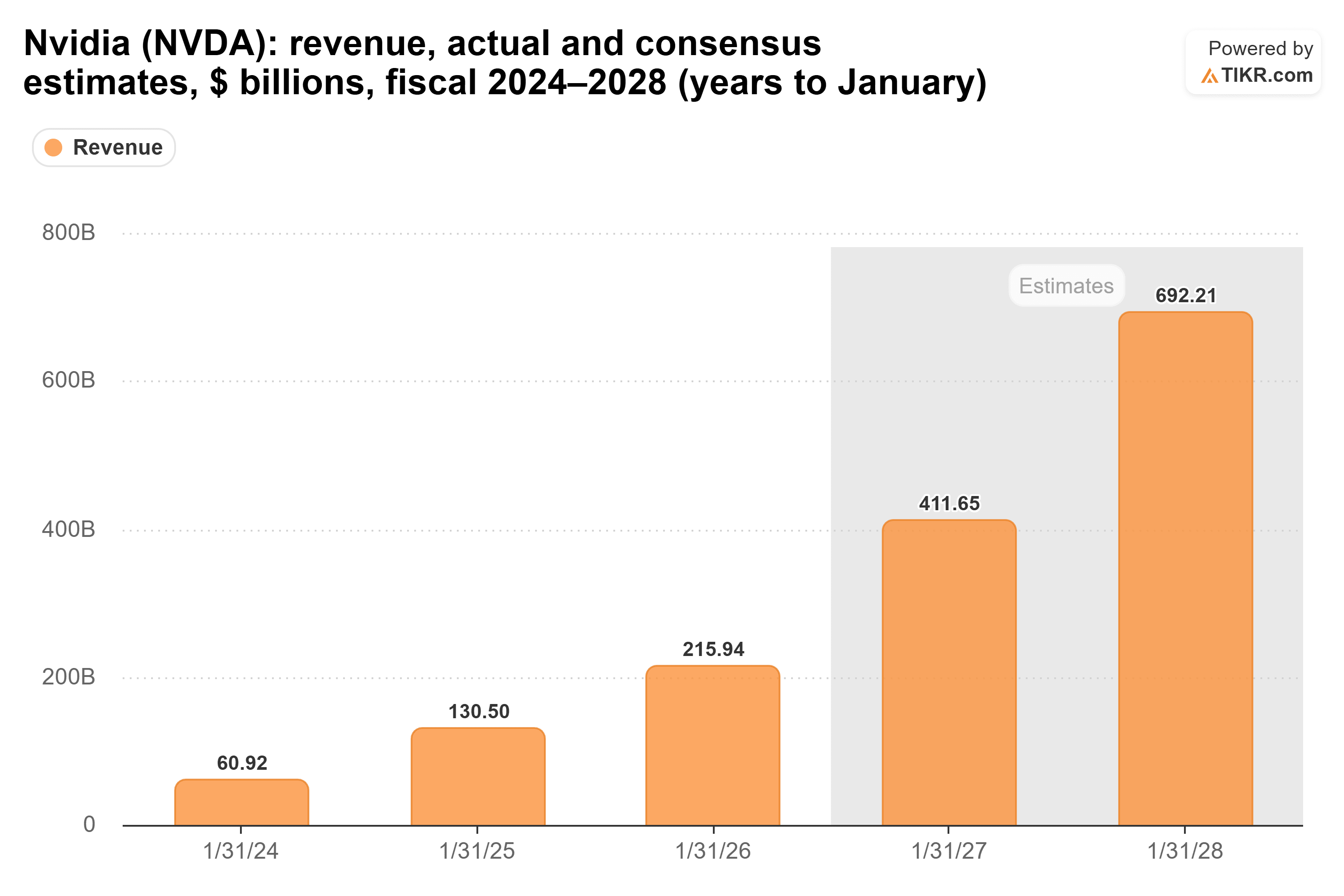
That’s Huang’s plan in one chart: make tokens cheaper and let volume do the rest.
For token sellers, it’s a treadmill
The companies on the other side of that trade can’t cheer as loudly, because they earn their money on the price of each token.
On the Oct. 15 episode of Prof G Markets, investor Paul Kedrosky pointed to a report from research group Epoch AI: “we’ve had for the last four years roughly a 13-fold annual decrease in the cost of tokens.”
Kedrosky said that if you pay down debt out of “price times volume,” you have to grow volume 13x a year just to stand still. Or as he put it: “you have to double your token sales every 90 days.”
CoreWeave’s revenue went from $230 million in 2023 to $5.13 billion in 2025, more than 20x in two years.
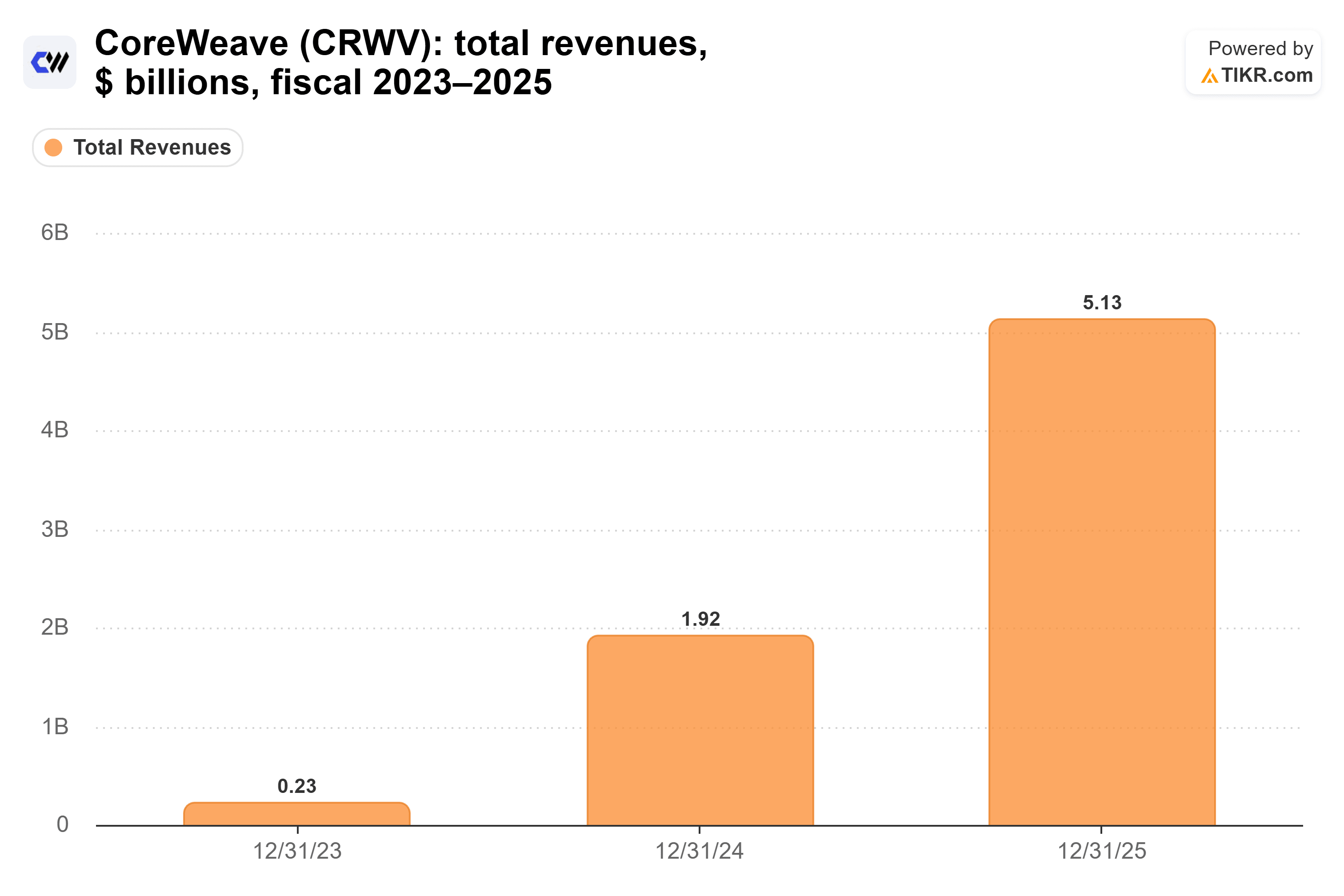
That’s huge growth. Still, it slowed from about 8x in 2024 to 2.7x in 2025, as you’d expect at that size, and Kedrosky’s treadmill keeps the same pace.
Nvidia’s risk sits on its customers’ balance sheets
The strongest case against Huang’s plan goes like this: if prices fall faster than volume grows, the labs and neoclouds take in less revenue, and they have less cash to spend on Nvidia’s chips. Kedrosky called the squeeze “very specific to the most indebted neoclouds,” and CoreWeave’s bonds show lenders are worried about the same thing.
So far, though, the evidence points Huang’s way. Friar’s price cut roughly doubled revenue on those models, and analysts expect Nvidia’s revenue to reach $903 billion in the year ending January 2029.
Moore’s Law worked the same way. Computing got cheaper every year for decades, and the world kept buying more of it. Same story here.
So yes, falling token costs are Nvidia’s plan, and it’s a good one as long as usage keeps growing faster than prices fall. Nvidia gets paid for the chips that make tokens cheaper, and the companies selling those tokens carry the price risk. The plan depends on those customers being able to keep buying, and Nvidia’s next quarterly report will be the first real test after the selloff.
So what is Nvidia stock actually worth?
TIKR lets you forecast the future price of any stock in less than a minute. Just enter a few assumptions into TIKR’s valuation model and see what Nvidia could be worth. Start from Wall Street consensus estimates, or adjust the inputs to reflect your own view of the business. It’s free to use.
Disclaimer:
Please note that the articles on TIKR are not intended to serve as investment or financial advice from TIKR or our content team, nor are they recommendations to buy or sell any stocks. We create our content based on TIKR Terminal’s investment data and analysts’ estimates. Our analysis might not include recent company news or important updates. TIKR has no position in any of the stocks mentioned. Thank you for reading, and happy investing!


