


Key Takeaways
- Microsoft unveiled its Maia 300 AI chip on Monday and plans to scale its Maia chips to multi-gigawatt deployments starting next calendar year.
- Bloomberg Intelligence analyst Mandeep Singh said Microsoft’s chips are “nowhere close” to Google’s TPUs or NVIDIA, which puts Alphabet ahead in the custom-chip race.
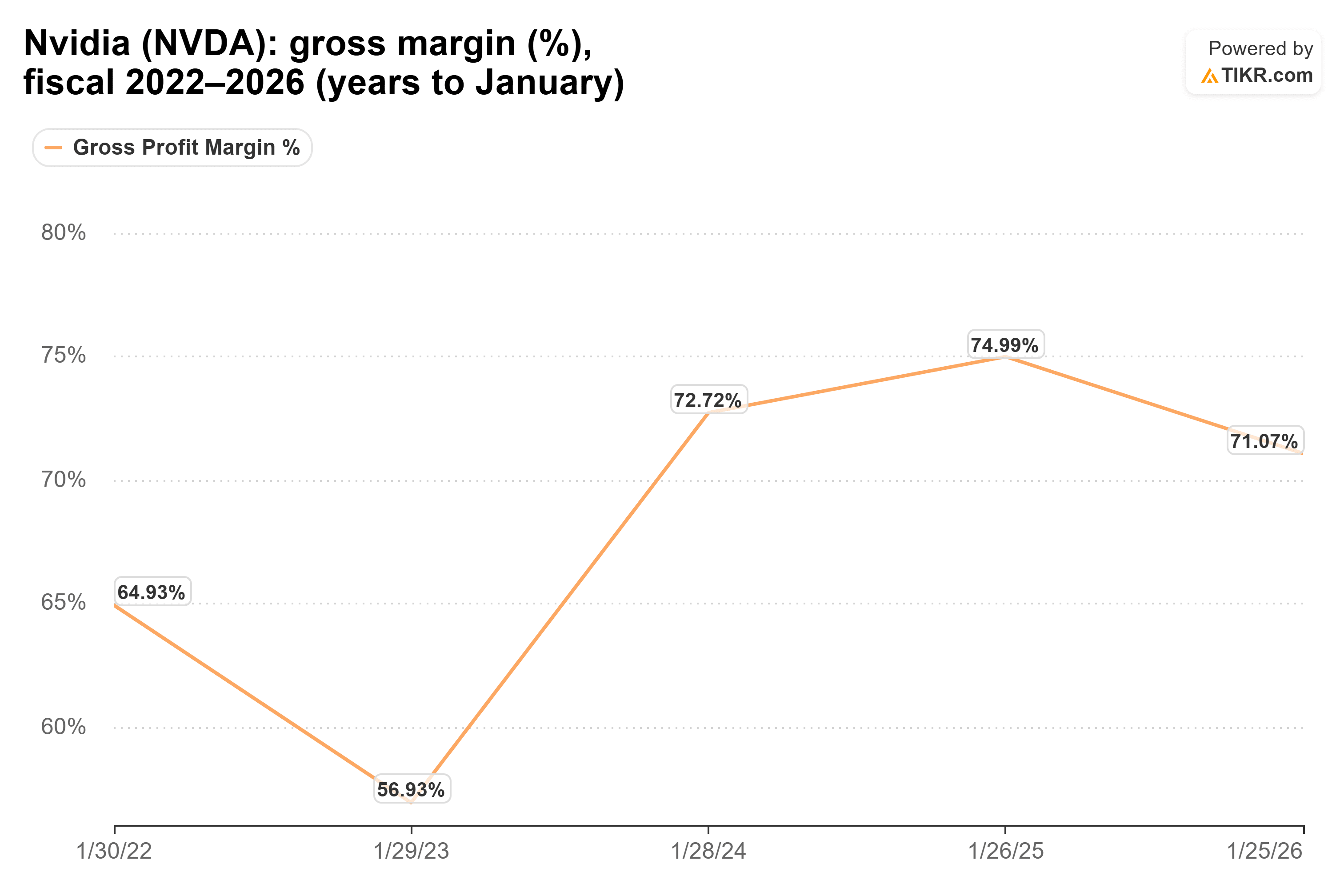
- Microsoft’s capital expenditures reached $116 billion in the year ended June 2026, nearly 5x the level four years earlier, while NVIDIA has kept a gross margin above 70% for three straight fiscal years.
- Microsoft measures Maia against GPU-based systems, so the real test is how its spending and its NVIDIA orders look once the larger rollout starts next year.
Microsoft (MSFT) just made what CEO Satya Nadella calls “our biggest bet yet on our own silicon.”
On Monday, Nadella posted on X that Microsoft will scale its Maia chips “to multi-gigawatt deployments” starting next calendar year, “making it the primary inference system for our own product and services.” He said the new Maia 300 “delivers 40% more tokens per watt compared to leading GPU-based systems.”
That’s aimed straight at NVIDIA (NVDA).
Bloomberg Intelligence analyst Mandeep Singh was less impressed. Asked on Monday’s episode of a Bloomberg Intelligence podcast whether Maia threatens NVIDIA, he said Microsoft and its peers “are still way behind when it comes to incorporating their own chips in the tech stack.”
Then he added: “they’re nowhere close to where Google is at with its TPUs or where NVIDIA is at.”
That leaves Microsoft as the third wheel in its own chip story.
Google wrote the playbook
Singh’s point is that Alphabet (GOOG) has already done what Microsoft is only now scaling up. He called Google’s vertical integration “the playbook to emulate.” He noted that Google is on its eighth or ninth generation of TPUs, and now makes separate chips for training and for inference.
Google also rents its TPUs to outside customers, so the chips earn money on top of serving Google’s own products.
Meanwhile, Alphabet’s operating margin rose from 26.5% in 2022 to 32.0% in 2025, during its heavy spending on AI.

How much of that comes from TPUs can’t be separated out from the outside, and the ad business does a lot of the work. Still, it’s the margin trend you’d expect from a company that owns more of its own AI stack.
NVIDIA’s markup is the prize
The reason to build your own chips is to stop paying NVIDIA’s prices. NVIDIA’s gross margin has topped 70% in each of its last three fiscal years, which is rich for a hardware maker.
Microsoft is pouring money into data centers at a pace that makes that markup hard to ignore. Its capital expenditures climbed from $23.9 billion in the year ended June 2022 to $116 billion in the year ended June 2026.

Moving even a small share of that budget from NVIDIA’s GPUs to Maia would save real money. That’s why Singh says Microsoft has to keep at it. If it doesn’t, he said, “they’ll be reliant on NVIDIA for the foreseeable future.”
Maia 200 is already shipping
To be fair to Microsoft, Maia is real. Nadella says Maia 200 is already deployed across the US, Europe, and Australia, “delivering up to 1.7x more tokens per watt across experiences in Teams and Copilot.” Microsoft says the chip also runs OpenAI’s models and its own MAI models.
Look at what those gains are measured against, though. Both the 1.7x and the 40% compare Maia with “leading GPU-based systems,” so the benchmark is NVIDIA’s hardware. None of Microsoft’s figures compares Maia with a TPU, and Google’s TPUs are the bar Singh sets. The 1.7x is also an “up to” figure, measured in Microsoft’s own apps.
Nadella’s post also says Microsoft will keep “bring[ing] the latest innovations from across the ecosystem into our fleet.” I read that as a promise to keep buying other companies’ chips, NVIDIA’s included.
Third wheel, for now
On the evidence, Singh’s call holds up. Maia should trim Microsoft’s NVIDIA bill over time. But Google is several chip generations ahead and already rents its TPUs to others, so Alphabet leads the custom-chip race today. Microsoft is still catching up.
Of course, Maia’s multi-gigawatt rollout only starts next calendar year. Microsoft’s capital spending in the quarters after that will show whether the gap is closing faster than Singh expects.
So what is Microsoft stock actually worth?
TIKR lets you forecast the future price of any stock in less than a minute. Just enter a few assumptions into TIKR’s valuation model and see what Microsoft could be worth. Start from Wall Street consensus estimates, or adjust the inputs to reflect your own view of the business. It’s free to use.
Disclaimer:
Please note that the articles on TIKR are not intended to serve as investment or financial advice from TIKR or our content team, nor are they recommendations to buy or sell any stocks. We create our content based on TIKR Terminal’s investment data and analysts’ estimates. Our analysis might not include recent company news or important updates. TIKR has no position in any of the stocks mentioned. Thank you for reading, and happy investing!


