


Key Takeaways
- Meta launched Muse Wonder and Muse Wonder Full, which it calls its most capable AI models yet, on Oct. 12, and Dragonfly’s Haseeb Qureshi said the release puts Meta in second place.
- Meta hasn’t set an API price for the models, and because ads pay its bills, it can push down what top-tier AI costs in a way OpenAI and Anthropic can’t.
- Meta’s operating margin was 41% in 2025, and its $116 billion of operating cash covered $69.7 billion of capex.
- The risks are that Meta prices the model like its rivals do, and that its 2026 capex, guided in January at $115 billion to $135 billion, uses up most of its operating cash.
Meta Platforms (META) just caught up to the AI frontier, and it doesn’t need to make a dime there.
On Oct. 12, Meta launched Muse Wonder and Muse Wonder Full, which it calls its most capable AI models yet.
Haseeb Qureshi, managing partner at Dragonfly, reacted on X: “Wow. Suddenly Meta is in second place.”
Then he added the line that matters most: “Curious once pricing lands–no API pricing yet, only available within Muse Code.”
That’s the part OpenAI should worry about.
The frontier, with no price list
Qureshi wasn’t the only one impressed. Shopify (SHOP) CEO Tobi Lütke posted: “This model is very very good. I was struggling to find anything to throw at it that it couldn’t do, even when other top models failed. Meta is back.”
For now, Muse Wonder reaches people only through Meta’s own products. Meta said Muse Wonder will soon power its Muse personal AI agent, starting with subscribers, and Muse Wonder Full is available to subscribers of its coding tool, Muse Code. Developers have no per-token price to compare yet.
Meta can afford to wait. Nilay Patel, editor-in-chief of The Verge, put it plainly on an Oct. 8 episode of the Decoder podcast, talking about the Muse agent a few days before Wonder launched:
“What’s different here is OpenAI needs money a lot more than Meta needs money.”
Ads pay for all of it
The numbers back him up. Meta’s operating margin has stayed above 40% for two straight years, at 42.2% in 2024 and 41.4% in 2025.
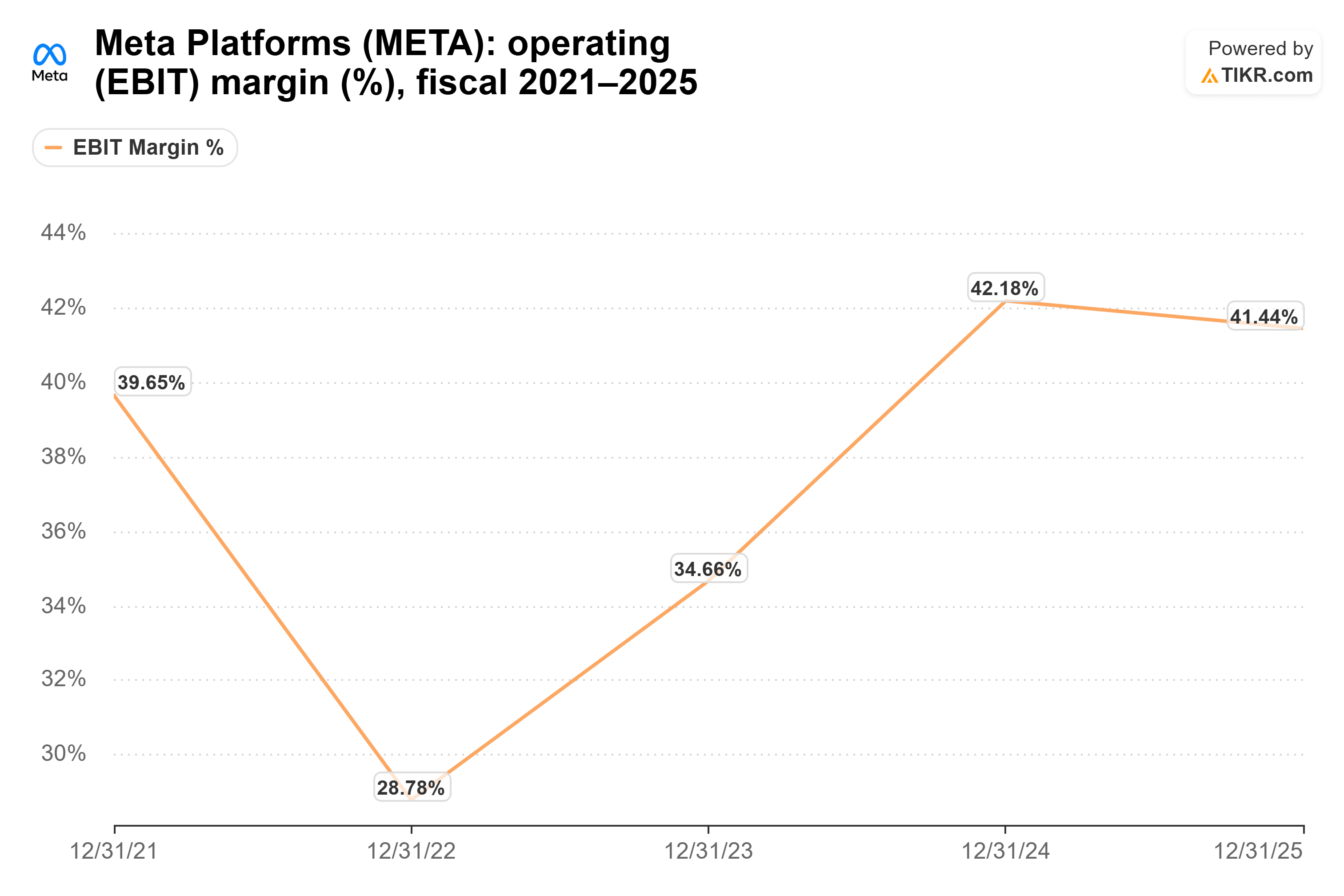
That margin pays for the AI buildout. In 2025, Meta brought in $116 billion of cash from operations and spent $69.7 billion on capex, with plenty left over.

That cushion gets thinner this year. In January, Meta guided to 2026 capex of $115 billion to $135 billion, about what it brought in from operations in all of 2025. (Of course, operating cash should rise with revenue, too.)
OpenAI’s math looks very different. The [Financial Times](LINK NEEDED) reported in September, citing a company presentation, that OpenAI expects to burn $278 billion of cash from 2026 through 2030.
Cheaper tokens at the very top
Box CEO Aaron Levie, of Box (BOX), saw where this goes: “Now that there are multiple players pushing the state of the art, this is going to lead to a further acceleration of advances, as well as the lowering cost of tokens for even the highest levels of capability.”
OpenAI and Anthropic sell their best models by the token, and that money helps pay for the next model. Now a rival at the same level has an ad business behind it and no price list at all. Every developer pricing out a top-tier model has a new option, and its owner can set the price wherever it hurts rivals most.
Alphabet (GOOG) did this with Android. It gave the software to phone makers for free and made its money on the searches people ran on those phones. Same playbook here.
The pressure reaches Microsoft (MSFT) and Amazon (AMZN) too, as major backers of OpenAI and Anthropic.
Meanwhile, analysts expect Meta’s revenue to climb from $201 billion in 2025 to $254 billion this year and $307 billion in 2027.

That’s an ad business expected to grow by about half in two years before Muse Wonder earns anything, and a launch with no price attached gives analysts no reason to cut those numbers.
Second place can slip
Meta hasn’t priced the model yet, and it may well charge a premium. Qureshi himself is waiting to see the pricing. And “second place” is a ranking built on benchmarks, which change with every release. I put more weight on hands-on tests like Lütke’s.
Still, Meta is now a frontier player that doesn’t need its model to pay its way. OpenAI does. That gives Meta the room to set a low price and keep it there, and I think shareholders are underrating how much that edge is worth.
Of course, the API price will show how hard Meta wants to press, whenever it arrives. Meta’s next earnings report, due Oct. 21, is the next place to see what the buildout costs.
So what is Meta stock actually worth?
TIKR lets you forecast the future price of any stock in less than a minute. Just enter a few assumptions into TIKR’s valuation model and see what Meta could be worth. Start from Wall Street consensus estimates, or adjust the inputs to reflect your own view of the business. It’s free to use.
Disclaimer:
Please note that the articles on TIKR are not intended to serve as investment or financial advice from TIKR or our content team, nor are they recommendations to buy or sell any stocks. We create our content based on TIKR Terminal’s investment data and analysts’ estimates. Our analysis might not include recent company news or important updates. TIKR has no position in any of the stocks mentioned. Thank you for reading, and happy investing!


