Key Takeaways
- Elon Musk confirmed SpaceX closed $40 billion of mostly callable debt to buy NVIDIA GPUs that arrive in the first half of 2027.
- Jim Chanos wants to know how much of the 10 gigawatts SpaceX is building in 2027 sits in ground data centers, and he calls that a $500 billion question.
- SpaceX’s near-term AI revenue comes from renting out compute on the ground, while its biggest future markets depend on data centers in space and on Starship.
- Analysts expect revenue to jump from $48.8 billion in 2026 to $180 billion in 2027, so the estimates need rental prices to hold as the new capacity comes online.
SpaceX (SPCX) just borrowed $40 billion for AI chips, and Jim Chanos wants to know where they’re going.
Over the weekend, Elon Musk confirmed that the raise is “primarily callable debt for GPU purchases that will arrive in Q1 and Q2,” in a reply on X. The chips are NVIDIA (NVDA) GPUs.
The X account RHouseResearch then asked: “Why is SpaceX borrowing $40B to build ‘terrestrial’ data centers?”
Noted short seller Jim Chanos followed up: “And what percentage of the 10 GW of capacity being built out by $SPCX in 2027 is terrestrial….?! That’s a pretty material $500B question.”
It is. The answer tells you what SpaceX shareholders actually own for the next couple of years.
TIKR tracks 38 analysts on SpaceX. How many say “Buy”?
See the full breakdown of Buy, Hold, and Sell ratings on SpaceX, along with Wall Street’s revenue and earnings estimates, all in one place. More than 500,000 investors use TIKR to research stocks like this one. See SpaceX’s Analyst Ratings
The $40 billion is going on the ground
SpaceX was borrowing heavily well before this deal. Its total debt rose to $24.5 billion at the end of 2025, up from $15.4 billion a year earlier.
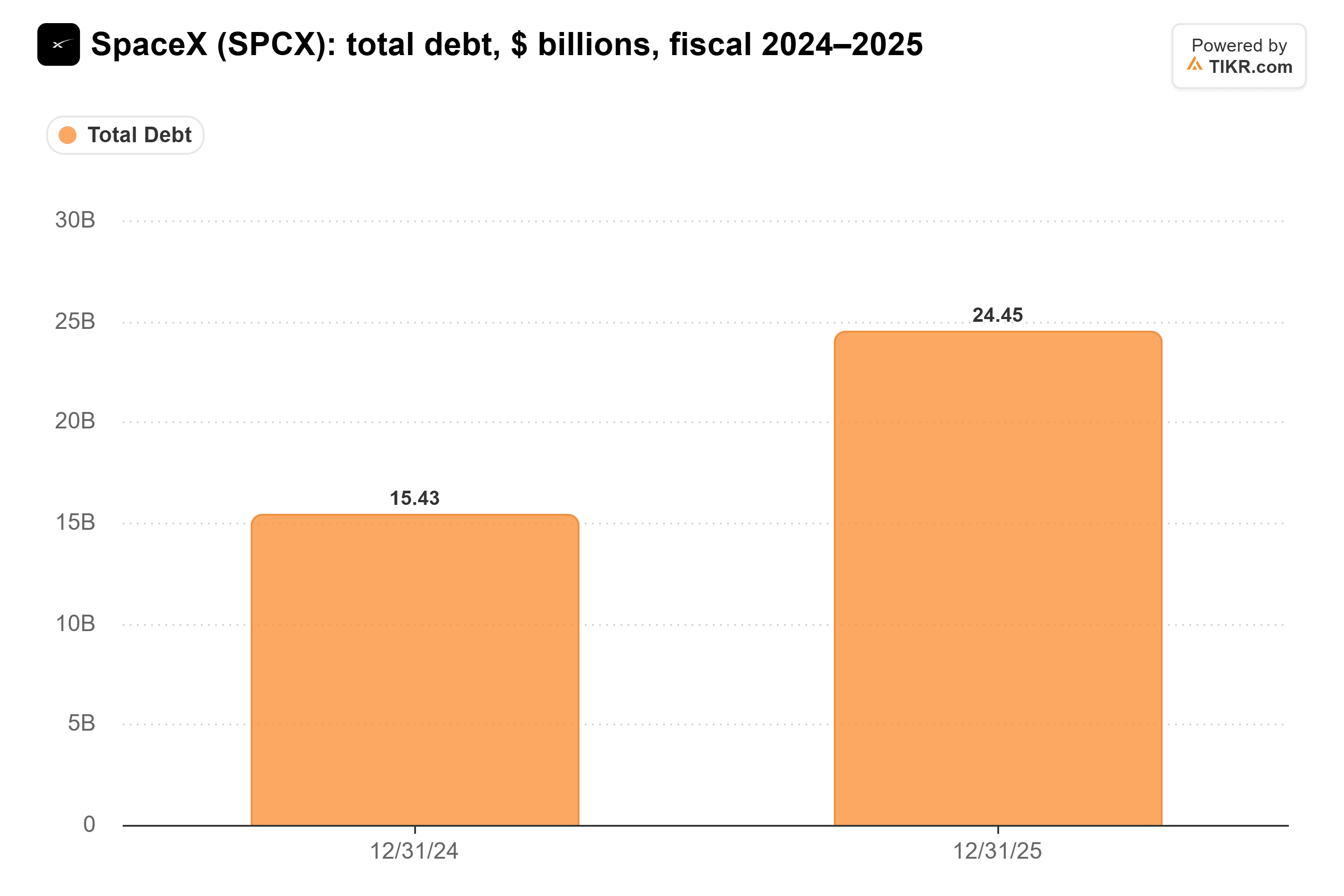
By Sept. 30, debt and finance leases had reached $38.8 billion. The new $40 billion is more than that whole load.
Spending climbed just as fast.
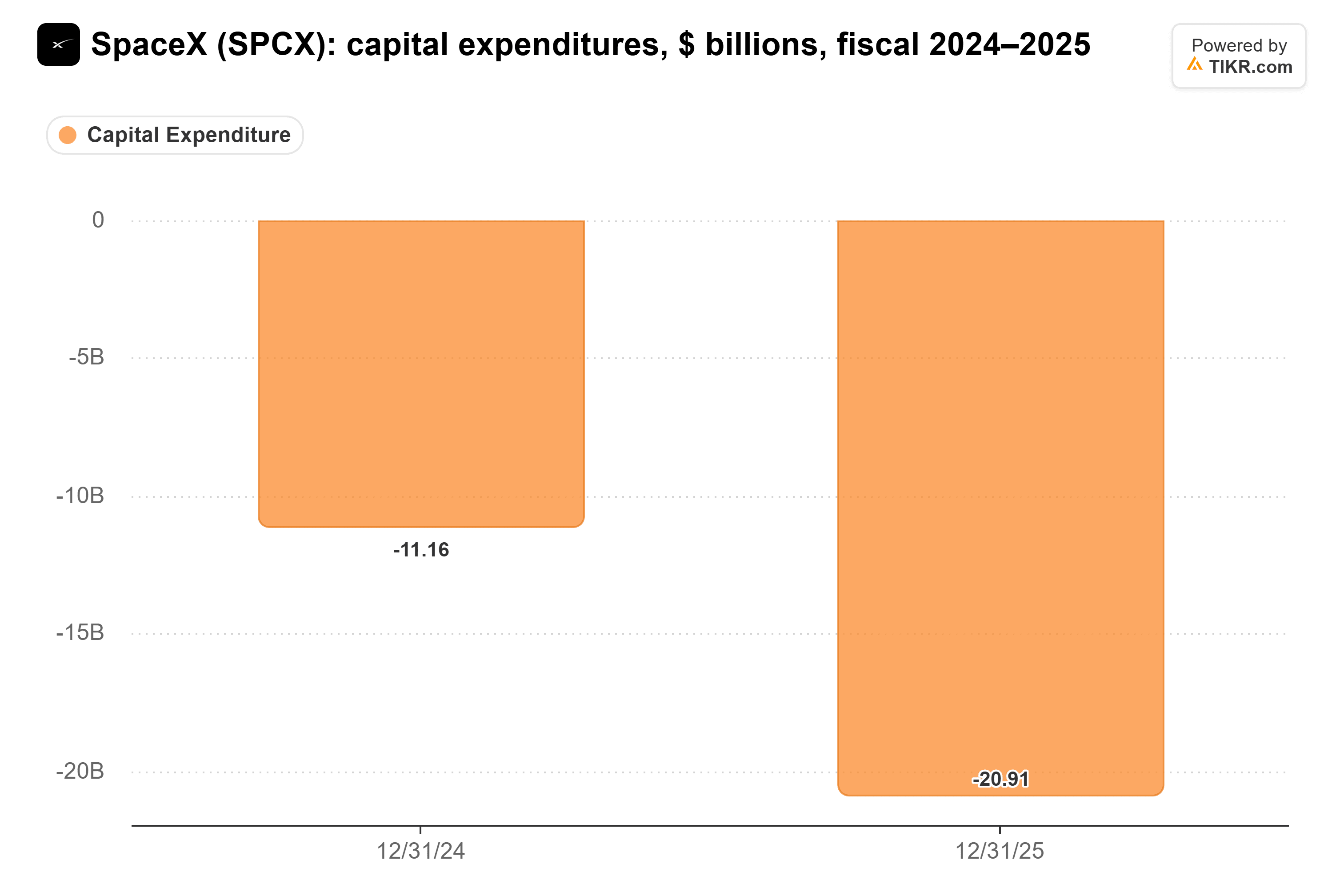
And 2026 is on another level: $48.1 billion of capex in the first nine months, with $35 billion to $40 billion more guided for the fourth quarter on SpaceX’s third-quarter call.
So where does it all go? My read is mostly into buildings on the ground. SpaceX hasn’t put a data center in space yet, and it’s targeting weekly Starship flights only in the first half of 2027, the same months these GPUs show up. (SpaceX hasn’t said how the 10 gigawatts split.)
That gap matters. As Bloomberg Tech host Ed Ludlow said on a Bloomberg Intelligence earnings special after SpaceX’s report, “Orbital data centers do not happen without Starship.” He also pointed out that the IPO prospectus tied all $26.5 trillion of SpaceX’s future addressable markets to data centers in space.
The near-term money comes from a neocloud
Until then, SpaceX’s AI segment makes its money renting out compute from the ground. That’s the business behind Chanos calling SpaceX “the largest global neocloud” last week. The segment brought in $7.6 billion of SpaceX’s $14.6 billion of third-quarter revenue, more than half the total.
Analysts expect a lot more where that came from.
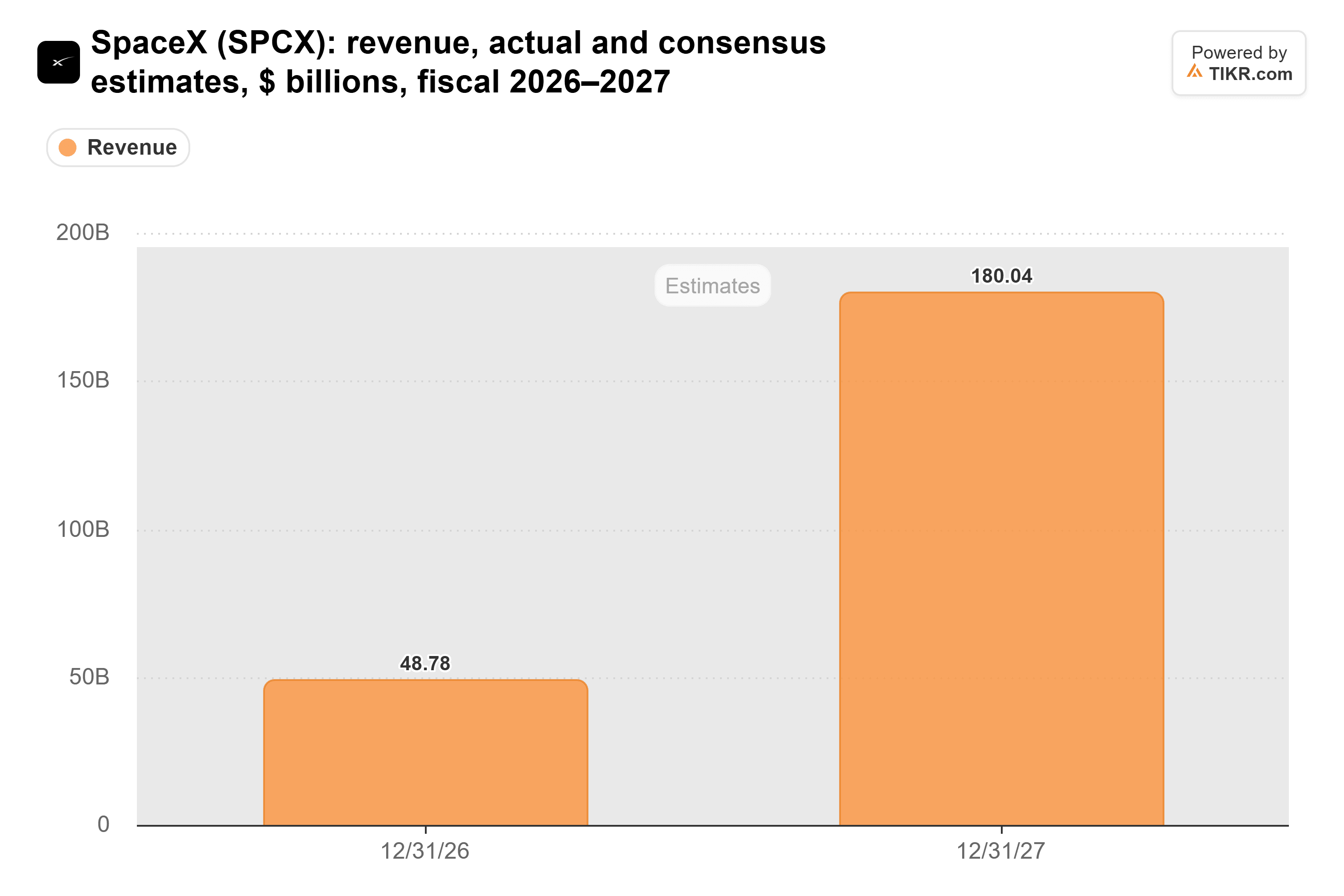
The 2027 estimate is counting on the GPUs this debt pays for. Even four quarters at the top of SpaceX’s first-quarter guidance would only reach $148 billion, so the estimate needs the ramp to keep climbing all year.
Ground compute can pay for orbit if prices hold
SpaceX’s CFO says new compute pays for itself in less than a year at current rental prices. If that holds, every gigawatt on the ground helps fund the ones meant for orbit, and building here first is the sensible order.
But that payback depends on prices and on a short list of buyers. One AI customer supplied 34.5% of SpaceX’s third-quarter revenue, and the Anthropic contract lets either side walk away on 90 days’ notice.
Musk himself just wrote that “debt markets have almost entirely shut off access to money for any company that doesn’t have substantial revenue independent of AI data centers” (post). SpaceX got its $40 billion because it’s “investment-grade” and has Starlink and launch revenue, as he put it. Starlink’s Connectivity segment earned $5.2 billion from operations in the first nine months of 2026, and that’s the credit standing behind the neocloud.
For now, the answer is mostly ground
SpaceX hasn’t answered Chanos, but the timing does. NVIDIA GPUs landing in the first half of 2027 will be earning their keep in ground data centers.
My take: for the next couple of years, I’d value SpaceX’s AI business like the neocloud it is, with Starlink’s cash behind it. The $26.5 trillion orbital story is an option Starship still has to earn.
Of course, a fast Starship ramp would change that. Flight 15, which Musk expects in November, will try to catch both the booster and the ship. And fourth-quarter results in early 2027 will show how much cash a $35 billion to $40 billion quarter burned.
So what is SpaceX stock actually worth?
TIKR lets you forecast the future price of any stock in less than a minute. Just enter a few assumptions into TIKR’s valuation model and see what SpaceX could be worth. Start from Wall Street consensus estimates, or adjust the inputs to reflect your own view of the business. It’s free to use.
Disclaimer:
Please note that the articles on TIKR are not intended to serve as investment or financial advice from TIKR or our content team, nor are they recommendations to buy or sell any stocks. We create our content based on TIKR Terminal’s investment data and analysts’ estimates. Our analysis might not include recent company news or important updates. TIKR has no position in any of the stocks mentioned. Thank you for reading, and happy investing!