
Key Takeaways
- On the All-In podcast, former White House AI czar David Sacks said CoreWeave can’t go bankrupt. At the same time, its credit default swaps implied about a 55% chance of default over five years.
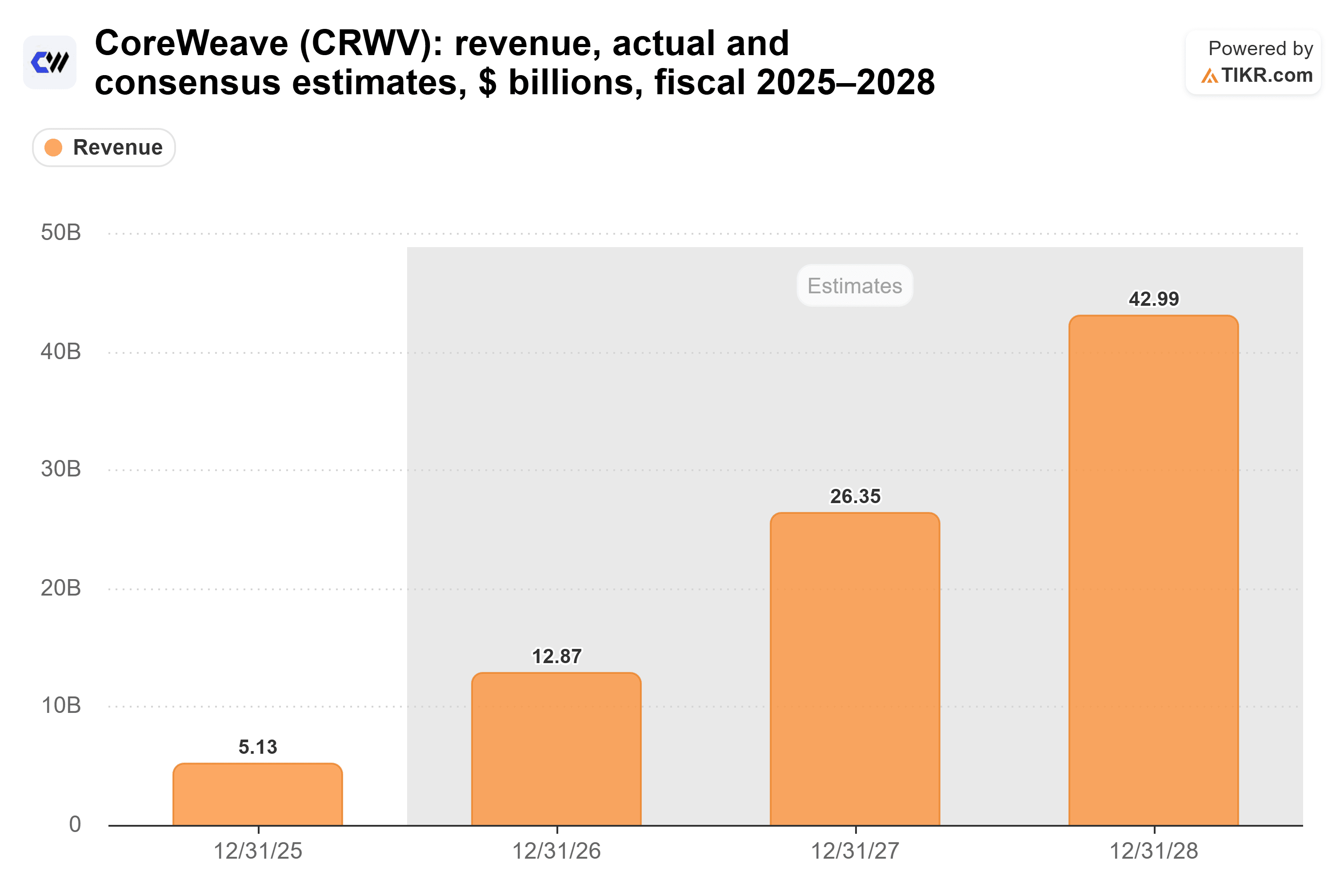
- CoreWeave’s demand holds up: analysts expect revenue to climb from $5.13 billion in 2025 to $43.0 billion in 2028.
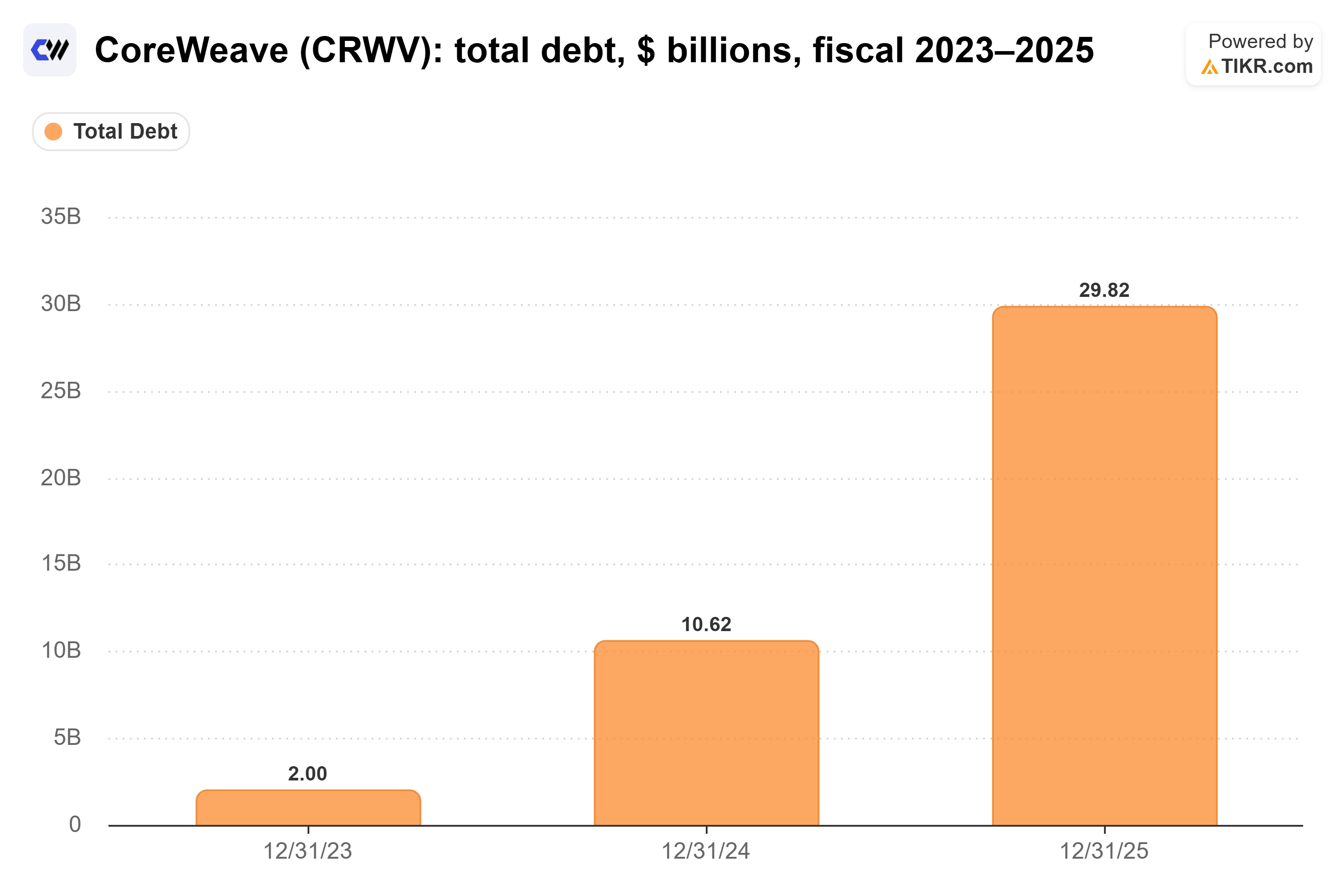
- The risk is in the financing. Total debt reached $29.8 billion at the end of 2025, and Jim Chanos puts the company’s pre-tax return on capital at 9%, while its unsecured bonds yield around 15%.
- JPMorgan estimates CoreWeave may need outside money until 2030, so shareholders are likely to pay for the growth through dilution and expensive debt. Third-quarter results in November are the next read.
When CoreWeave (CRWV) stock fell more than 25% last week on bond distress, the hosts of the All-In podcast put a Polymarket bet on screen: a 23% chance CoreWeave announces bankruptcy by the end of 2028.
Co-host David Sacks, Trump’s first AI czar (he left the role in March), called the bet dumb:
“CoreWeave can’t go bankrupt.”
His reason is the way CoreWeave pays for its build-out. Each data center sits in its own asset-level vehicle. So if one goes bad, Sacks says, that vehicle goes into receivership and its GPUs get sold, and the company carries on.
And he doesn’t see demand drying up. Powered compute is hard to build, and local communities aren’t rushing to approve new data centers. So in his words, “there’s enforced scarcity.”
That’s a bold call when the credit market was pricing in the opposite.
On the same episode, co-host Chamath Palihapitiya pointed to CoreWeave’s credit default swaps, which spiked to about 953 basis points last week. His conclusion: “what that math implies is about a 55% chance of a default. So it’s a coin flip, whether they default or not.”
Since then, Goldman Sachs upgraded the stock to Buy from Neutral on Monday and raised its price target to $139 from $106. JPMorgan called the business sound.
TIKR tracks 41 analysts on CoreWeave. How many say “Buy”?
See the full breakdown of Buy, Hold, and Sell ratings on CoreWeave, along with Wall Street’s revenue and earnings estimates, all in one place. More than 500,000 investors use TIKR to research stocks like this one. See CoreWeave’s Analyst Ratings
The demand side checks out
Also on the episode, Andreessen Horowitz co-founder Ben Horowitz put a date on the scarcity. He said Amazon CEO Andy Jassy told him capacity is sold out “beyond 2028.”
CoreWeave’s own order book backs that up. It ended the second quarter with a revenue backlog of about $104 billion in signed customer commitments.
And analysts expect revenue to grow more than eightfold in three years, from $5.13 billion in 2025 to $43.0 billion in 2028.
If the bull case only needed demand, it would be an easy one.
Paying for it is the hard part
To meet that demand, CoreWeave has borrowed heavily. Its total debt went from $2.00 billion at the end of 2023 to $29.8 billion at the end of 2025, nearly 15x in two years.
That borrowing has gotten pricier, too. CoreWeave’s unsecured notes were issued with a 9.625% coupon and have traded at yields around 15% this month. The notes it has already sold keep their coupon, but 15% is roughly what the market would charge it for new unsecured debt.
A 9% return on 15% money
Short seller Jim Chanos thinks full demand may not cover that cost. He builds on a model from the X account Uncovered Alpha, which estimates that each $1 of capex brings in about $0.30 of annual revenue. From there, Chanos puts CoreWeave’s pre-tax return on capital at 9%, assuming the GPUs earn for 10 years.
That’s a generous life for a GPU (the model’s own base case uses six years). And a 9% return falls well short of 15% money.
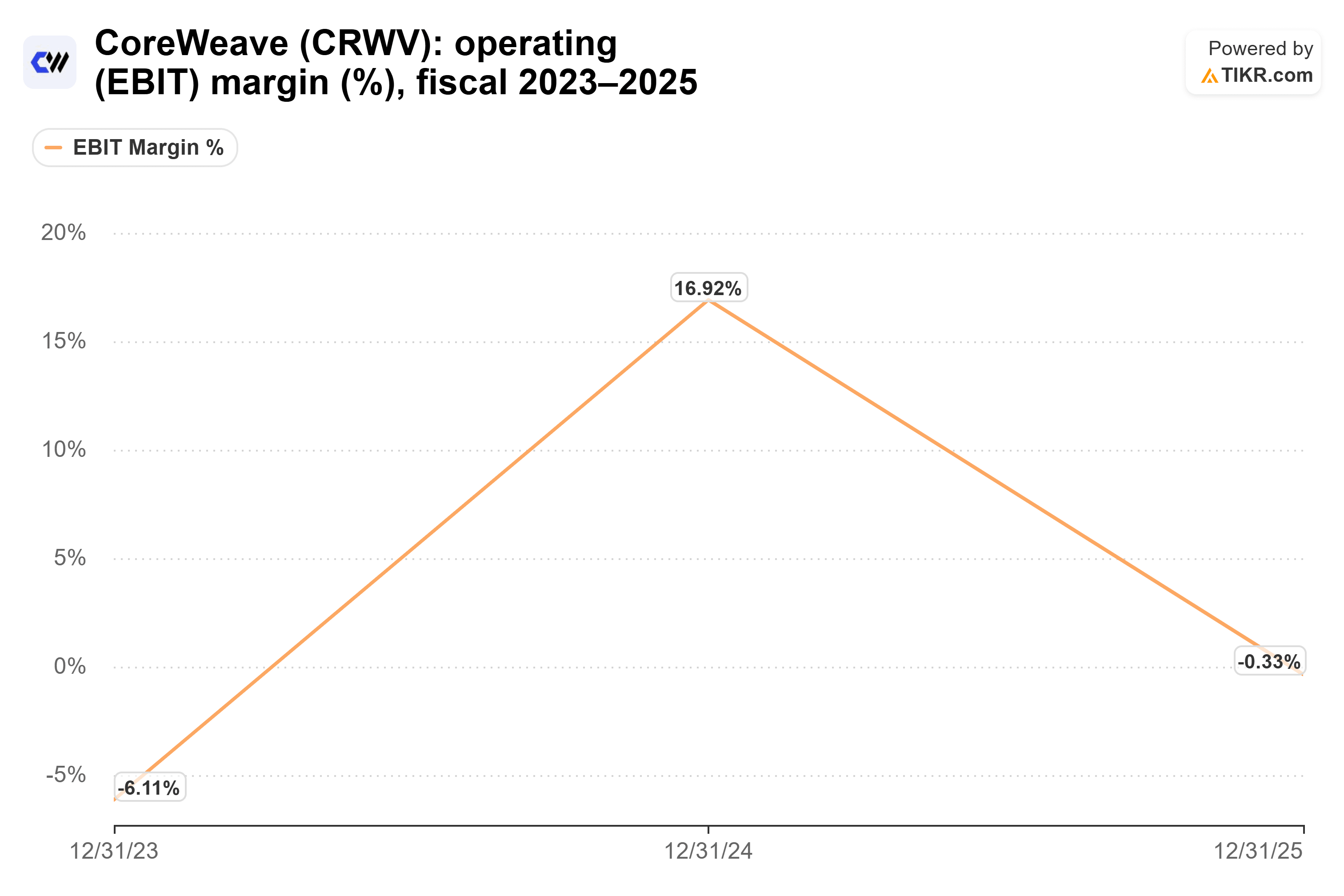
CoreWeave’s reported results look even thinner. Its operating margin went from 16.9% in 2024 to just below breakeven in 2025.
JPMorgan’s analysts work the math differently. They estimate a typical five-year contract earns an unlevered return in the mid-teens. That’s above the 9% to 11% blended cost of capital they estimate for CoreWeave. The 15% yield only applies to the unsecured notes, and in the bank’s conservative case about 80% of a project’s capex is paid for with asset-level debt.
Survival is a low bar
So, can CoreWeave go bankrupt? Put together the project-by-project financing Sacks described, a $104 billion backlog and JPMorgan’s contract math, and a company-wide collapse looks like a stretch to me.
But JPMorgan also estimates that CoreWeave may not generate enough cash from its existing operations to fund its expansion until 2030. Until then, the gap has to be filled with more debt or more stock.
My take: Sacks is right about demand, and CoreWeave will most likely make it through. But shareholders will pay for the build-out through dilution and expensive funding, at least until the GPUs show what they can earn after their first contracts end.
Of course, third-quarter results in November will show more clearly whether revenue is keeping up with that growing pile of debt.
So what is CoreWeave stock actually worth?
TIKR lets you forecast the future price of any stock in less than a minute. Just enter a few assumptions into TIKR’s valuation model and see what CoreWeave could be worth. Start from Wall Street consensus estimates, or adjust the inputs to reflect your own view of the business. It’s free to use.
Disclaimer:
Please note that the articles on TIKR are not intended to serve as investment or financial advice from TIKR or our content team, nor are they recommendations to buy or sell any stocks. We create our content based on TIKR Terminal’s investment data and analysts’ estimates. Our analysis might not include recent company news or important updates. TIKR has no position in any of the stocks mentioned. Thank you for reading, and happy investing!