


Key Takeaways
- Salesforce’s Q2 FY27 results and a wave of executive appearances built a case that fears of an AI-driven SaaSpocalypse are over, anchored on Agentforce ARR reaching $1.5 billion and a new Anthropic-built product, Claudeforce.
- Trailing revenue growth, the plainest test of reacceleration, slowed to 10.8% year over year last quarter after hitting 13.2% the quarter before, even as bookings-based cRPO grew faster at 14%.
- GAAP operating margin contracted year over year in the same quarter management is showcasing as proof of reacceleration, and the CFO has said internal AI spending is part of the reason margin guidance wasn’t raised.
- Wall Street’s own price targets haven’t kept pace with the rally: the average target now sits only about 10% above the current share price, the smallest premium of the past year, versus premiums above 150% during the depths of the selloff.
From SaaSpocalypse to Claudeforce
On the same day Salesforce (CRM) reported fiscal second-quarter results, Marc Benioff went on CNBC with Anthropic’s Dario Amodei to unveil Claudeforce, a product layering Claude’s reasoning on top of Salesforce’s data and workflow engine. Both moments made the same point: the narrative that autonomous AI agents would let enterprises bypass software like Salesforce, the SaaSpocalypse, has not played out. Benioff cited net new annual order value growth at its strongest pace in four years, near-record-low customer attrition, Agentforce annual recurring revenue reaching $1.5 billion, Data and AI combined near $3.9 billion, and a sixfold jump in agentic work unit usage.
Those are real, disclosed figures, and the customer testimonials on the earnings call, from Xero, Legora and Replit, describe genuine deployments rather than pilots. The question for an investor is not whether Salesforce is finding AI use cases. It’s whether the reacceleration being sold to the market is already visible in the numbers that matter most: revenue actually recognized, the margin funding it, and whether the analysts closest to the company believe the story enough to move their targets.
What Salesforce’s Revenue and Margin Trend Actually Shows
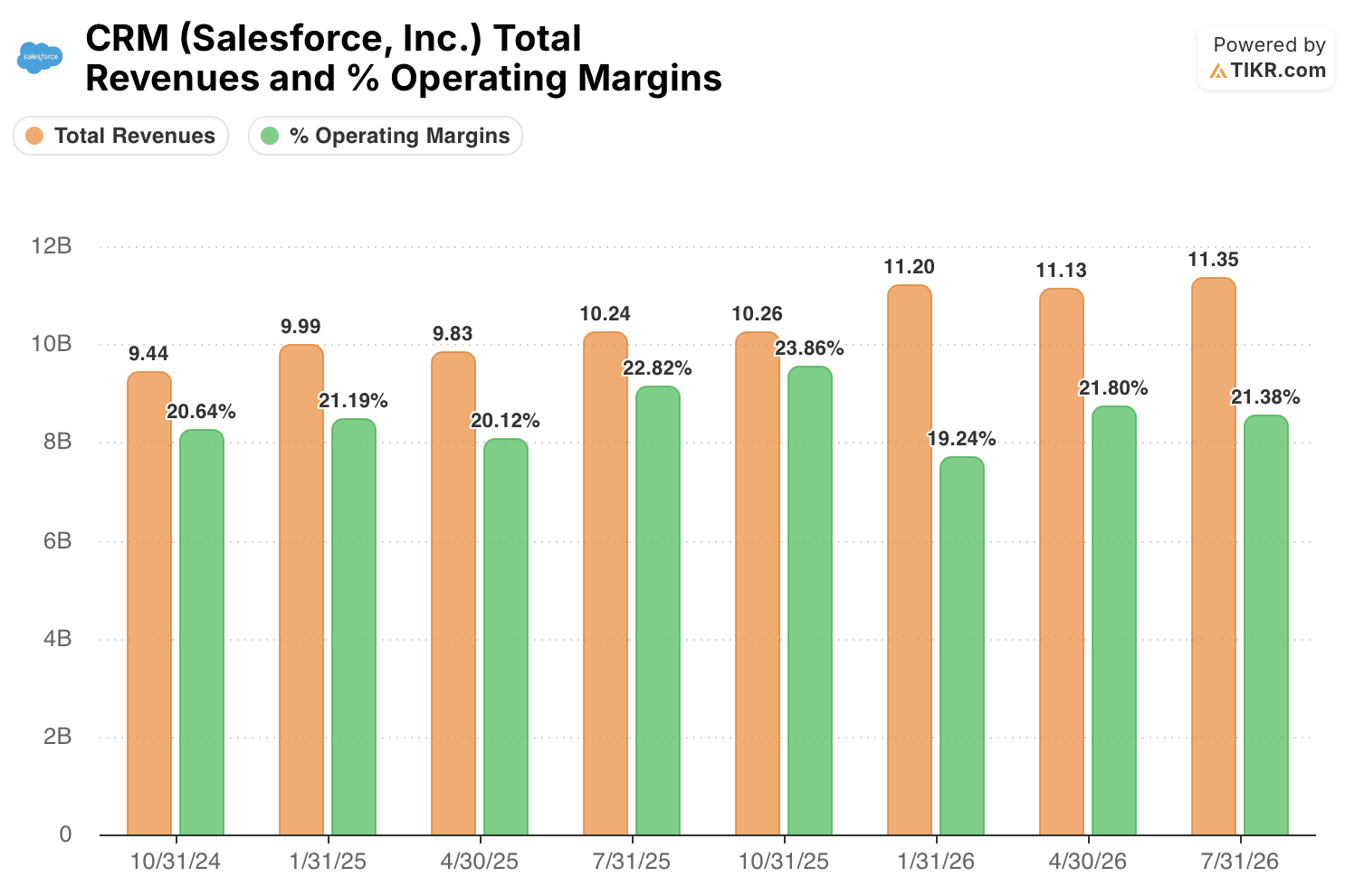
Salesforce’s total revenue over the last eight fiscal quarters climbed steadily from $9.44 billion in the quarter ended October 2024 to $11.35 billion in the quarter ended July 2026. Measured year over year, though, growth hasn’t accelerated in a straight line. It moved from 8.7% to 12.1% to 13.2%, then slowed to 10.8% last quarter, the very period management holds up as evidence the corner has been turned.
That’s not necessarily contradictory. Current remaining performance obligation, or cRPO, the value of contracted, unrecognized revenue expected in the next twelve months, grew 14% in constant currency last quarter, ahead of the 11% revenue growth print. Since cRPO converts into revenue over time, bookings running hotter than recognized revenue is a legitimate leading indicator, consistent with management’s argument that reacceleration is still in the pipeline rather than fully reported. But it means the “strongest bookings growth in four years” claim is, for now, a one-quarter data point layered onto a revenue growth rate that just decelerated sequentially. Investors are being asked to trust the leading indicator over the trailing one.
Margin adds a second wrinkle. GAAP operating margin ran 21.38% last quarter, down from 22.82% a year earlier, even though the prior quarter’s margin of 21.80% had been up year over year. Deputy CFO Mike Spencer told analysts at the Deutsche Bank conference that margin guidance wasn’t raised this year partly because Salesforce is absorbing token costs from rolling Claude out across its own R&D organization.
Non-GAAP operating margin, which strips out stock compensation and acquisition-related charges, held at 34.1% for the quarter, and full-year guidance for that metric is essentially unchanged at 34.3%. So the erosion shows up more in the GAAP figure than the number management steers by, but the admission that AI investment is a live drag on margin is telling on its own: growth and profitability are currently in tension, not moving up together.
The Street Hasn’t Fully Bought It Either
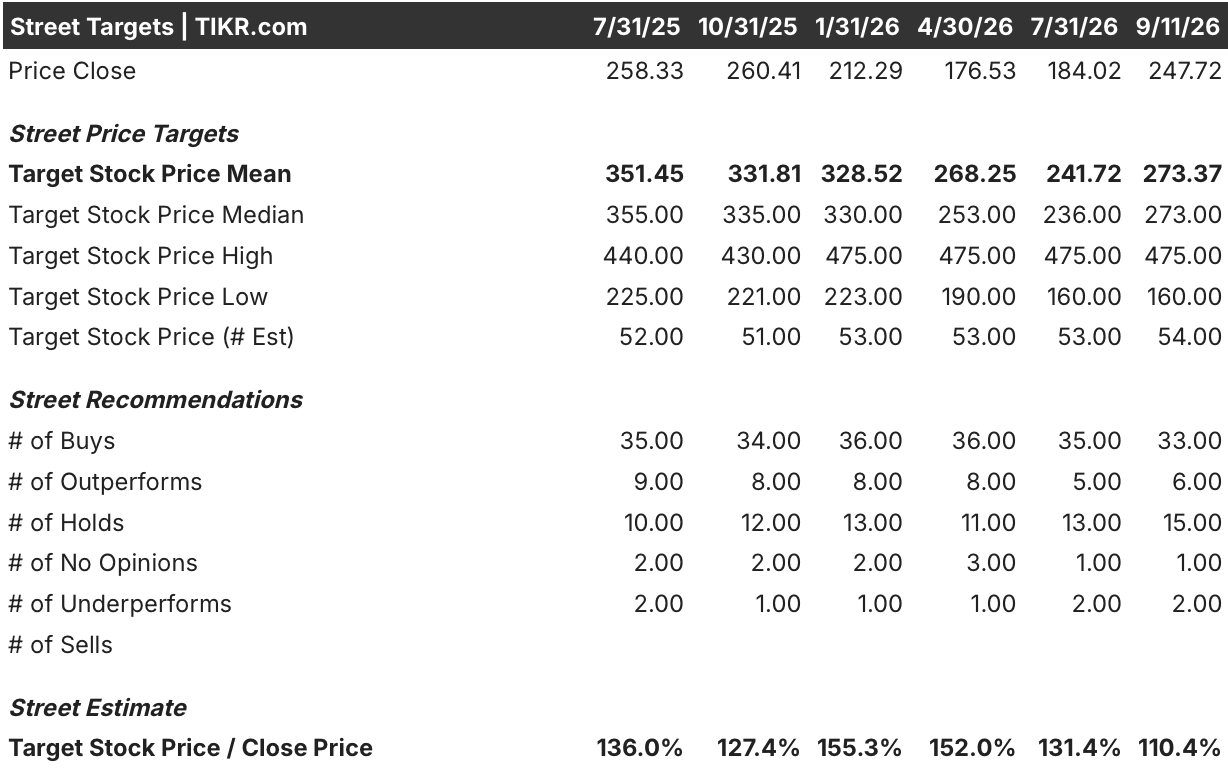
If the reacceleration case were airtight, sell-side price targets should be catching up to the stock’s rally. They haven’t, at least not proportionally. Salesforce shares fell from $258.33 in July 2025 to $176.53 by April 2026, the trough of the selloff Benioff keeps referencing, before rallying to $247.72 by September 11, 2026, a roughly 40% recovery from the low. Over that same window, the average analyst target moved the other way for most of the period: from $351.45 down to $241.72 by July 2026, only ticking up to $273.37 as of September 11.
The result is that the ratio of target price to current price, a rough gauge of how much upside the sell side still sees, has compressed from 155% in January 2026, when the stock was cheap and fear was highest, to just 110% now, the narrowest gap in the entire series. Buy ratings have also drifted down, from 36 in April 2026 to 33 today, while hold ratings climbed from 11 to 15 over the same stretch. None of this means the analysts are right and Benioff is wrong. It means the people whose job is to underwrite this exact reacceleration story have raised their targets by about 13% while the stock rallied nearly 35%, and a growing share of them are choosing to sit on the sidelines rather than affirm it.
Is Salesforce’s Reacceleration Priced In Before It’s Proven
None of this invalidates Salesforce’s AI thesis. Agentforce and Data Cloud combined are compounding at over 200% year over year, cRPO is outgrowing revenue, and a company with only 5% premium-edition penetration across its installed base has a large, largely untapped monetization runway if even a fraction of its base upgrades. But an investor buying into the idea that the SaaSpocalypse is over today is paying for that story before it shows up cleanly in reported revenue growth, while GAAP margin compresses on the back of the same AI investment management points to as the solution, and while the analysts closest to the company have raised their targets at roughly a third of the pace the stock has moved.
The next disclosure that would actually settle this is straightforward. Q3 FY27 revenue growth needs to show the acceleration cRPO implied rather than another sequential slowdown, and cRPO growth itself needs to hold near 14% rather than fade back toward the growth rate of reported revenue. If both come in, the bookings-led story converts into an earnings-led one, and today’s valuation looks more like the start of a re-rating than the end of one. If either stalls, the gap between the narrative investors are hearing at Dreamforce this month and the numbers already on the tape gets harder to explain away.
Should You Invest in Salesforce, Inc.?
The only way to really know is to look at the numbers yourself. TIKR gives you free access to the same institutional-quality financial data that professional analysts use to answer exactly that question.
Pull up CRM stock and you’ll see years of historical financials, what Wall Street analysts expect for revenue and earnings in the quarters ahead, how valuation multiples have moved over time, and whether price targets are trending up or down.
You can build a free watchlist to track CRM alongside every other stock on your radar. No credit card required. Just the data you need to decide for yourself.
Access Professional Tools to Analyze CRM stock on TIKR for Free →
Looking for New Opportunities?
- See what stocks billionaire investors are buying so you can follow the smart money.
- Analyze stocks in as little as 5 minutes with TIKR’s all-in-one, easy-to-use platform.
- The more rocks you overturn… the more opportunities you’ll uncover. Search 100K+ global stocks, global top investor holdings, and more with TIKR.
Disclaimer:
Please note that the articles on TIKR are not intended to serve as investment or financial advice from TIKR or our content team, nor are they recommendations to buy or sell any stocks. We create our content based on TIKR Terminal’s investment data and analysts’ estimates. Our analysis might not include recent company news or important updates. TIKR has no position in any stocks mentioned. Thank you for reading, and happy investing!


