Key Stats for Rivian Stock
- Price Change for Rivian stock: -7%
- $RIVN Share Price as of Jan. 14: $17.50
- 52-Week High: $22.69
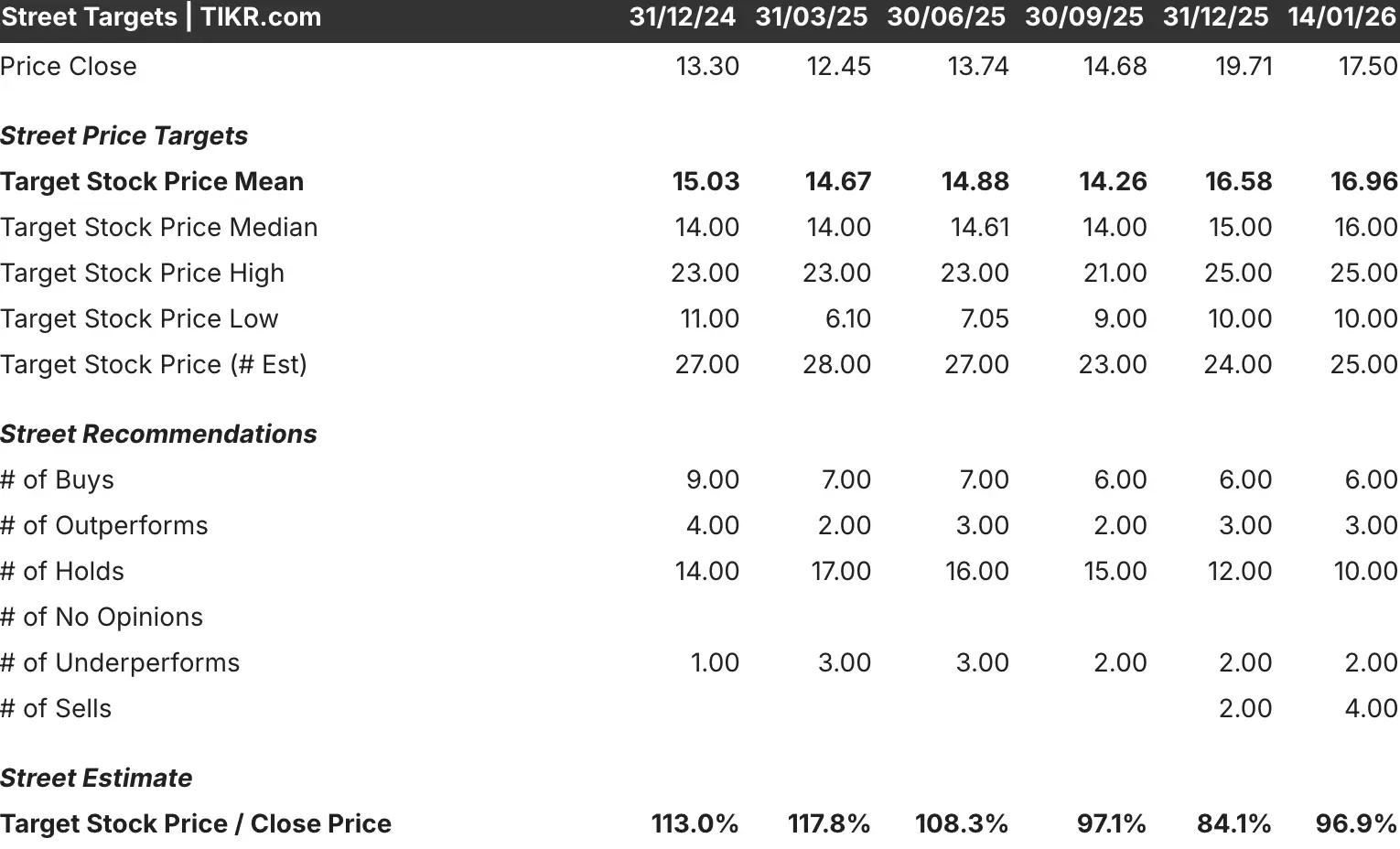
- $RIVN Share Price Target: $16.96
Now Live: Discover how much upside your favorite stocks could have using TIKR’s new Valuation Model (It’s free)>>>
What Happened?
Rivian (RIVN) stock crashed 7% after UBS downgraded the electric vehicle maker to “Sell” from “Neutral,” warning that investors are getting too excited about the company’s AI and self-driving potential while ignoring a looming $4 billion cash burn.
- UBS analyst Joseph Spak threw cold water on the recent rally, arguing that the market has already priced in the hype around Rivian’s upcoming Autonomy and AI Day on December 11.
- He warned that expectations for the company’s self-driving technology have outpaced reality and that the risk-to-reward setup now looks unfavorable.
- UBS expects Rivian’s free cash flow burn to increase to $4 billion or more as the company ramps spending on the R2 launch and Georgia factory buildout.
- That’s a massive drain on resources, even with the $2 billion still coming from Volkswagen and the $6.6 billion Department of Energy loan earmarked for Georgia.
UBS also slashed its R2 sales forecasts for 2026 and 2027, projecting volumes “significantly below consensus estimates.” The firm is skeptical that Rivian can meet the market’s lofty expectations for its mass-market crossover, which is supposed to launch in the first half of 2026.
The downgrade hits Rivian stock at a vulnerable moment. The company just reported 2025 deliveries of 42,247 vehicles, down 18% from the prior year and slightly below Wall Street’s forecast.
That’s a red flag that demand for premium-priced EVs is weakening, especially as federal tax credits get rolled back and the broader North American EV market contracts.
Sales in the U.S. EV market fell 4% in 2025 after some incentives were pulled. Rivian’s average selling price sits well above $70,000 for its R1T truck and R1S SUV, making it particularly exposed to any pullback in consumer willingness to pay up for electric vehicles.
CFO Claire McDonough tried to paint an optimistic picture at the Barclays Global Autos Conference, highlighting progress on gross profit per unit and the upcoming R2 ramp.
Rivian reported cost of goods sold of roughly $96,000 per vehicle in the third quarter, its best-ever result. The R1 platform is now variable margin positive, meaning each vehicle sold generates a positive contribution margin before fixed costs.
But the path to overall profitability remains murky. McDonough confirmed that Rivian is no longer including regulatory credits in its forecast, removing a key revenue source for many EV makers that helps offset losses.
The company also faces tariff headwinds of a couple of thousand dollars per vehicle, though recent policy changes reduced that exposure to a couple of hundred dollars.
See analysts’ growth forecasts and price targets for Rivian stock (It’s free!) >>>
What the Market Is Telling Us About Rivian Stock
The UBS downgrade cuts against the recent bullish sentiment that had been building around Rivian. Just 26 days ago, Wedbush analyst Dan Ives raised his price target by 56% to $25, maintaining an “Outperform” rating.
Baird also upgraded the stock to “Outperform,” betting that the R2 launch would broaden Rivian’s customer base and drive higher delivery volumes.
So who’s right? The bulls or the bears?
The bull case hinges entirely on R2 execution. McDonough laid out the roadmap at the Barclays conference, confirming that R2 has roughly half the bill of materials cost of an R1 and significantly lower non-material costs.
The company is starting production intent builds by year-end and plans to launch in the first half of 2026 with a base price around $45,000.
That’s below the $50,000 average new vehicle price in the U.S., which should open up a much larger addressable market. Rivian’s installed capacity for R2 is 155,000 units across three shifts, starting with one shift in 2026 and adding a second shift in the back half of the year.
If Rivian can ramp R2 to those volumes while maintaining positive contribution margins, the fixed cost leverage should drive rapid improvement in overall profitability.
McDonough said Rivian expects to exit 2026 at total gross margin positive, though she acknowledged that early quarters of the ramp will see inefficiencies and overhead drag.
The software and services revenue stream is also ramping faster than expected. Rivian is earning background IP revenue from the Volkswagen joint venture, development services revenue, and subscription revenue from FleetOS and Connect+.
This business is now “very profitable” according to McDonough and growing considerably, providing a cushion that wasn’t factored into the 2023 Investor Day projections.
But the bear case is straightforward: Rivian is burning massive amounts of cash at a time when EV demand is softening, and the regulatory environment is getting worse.
The company ended Q3 with $7.1 billion in cash and expects to receive an additional $2.5 billion from VW between 2026 and early 2028. Add in the DOE loan, and Rivian has access to significant capital.
A $4 billion annual cash burn means Rivian could run through its current resources in less than two years without additional funding. The company would need R2 to ramp smoothly, hit volume targets, and reach profitability on a much faster timeline than most EV startups have managed.
UBS is betting that won’t happen. The firm expects R2 sales to come in well below consensus, which would keep Rivian in cash-burning mode longer than the market expects. And with no regulatory credits to offset losses, the pressure on automotive gross margins is intensifying.
The AI and autonomy story adds another layer of complexity. Rivian is hosting its Autonomy and AI Day on December 11 to showcase progress on self-driving technology.
The company has transitioned to a fully in-house camera and sensor suite feeding its large driving model, and McDonough said the rate of improvement has accelerated dramatically with monthly over-the-air updates.
But UBS thinks the market has already gotten too excited about this. Self-driving is a long game, and even if Rivian makes impressive progress, it’s years away from generating meaningful revenue from autonomous capabilities. In the meantime, Rivian stock has rallied on AI hype, with underlying business fundamentals unchanged.
The competitive landscape is also getting tougher. Chinese EV makers are flooding Europe with lower-priced, tech-forward vehicles.
Rivian plans to export R2 to Europe, benefiting from reduced tariffs on U.S. exports, but it will face intense competition from BYD, NIO, and other Chinese brands that have mastered cost efficiency.
Estimate a company’s fair value instantly (Free with TIKR) >>>
How Much Upside Does Rivian Stock Have From Here?
With TIKR’s new Valuation Model tool, you can estimate a stock’s potential share price in under a minute.
All it takes is three simple inputs:
- Revenue Growth
- Operating Margins
- Exit P/E Multiple
If you’re not sure what to enter, TIKR automatically fills in each input using analysts’ consensus estimates, giving you a quick, reliable starting point.
From there, TIKR calculates the potential share price and total returns under Bull, Base, and Bear scenarios so you can quickly see whether a stock looks undervalued or overvalued.
See a stock’s true value in under 60 seconds (Free with TIKR) >>>
Looking for New Opportunities?
- See what stocks billionaire investors are buying so you can follow the smart money.
- Analyze stocks in as little as 5 minutes with TIKR’s all-in-one, easy-to-use platform.
- The more rocks you overturn… the more opportunities you’ll uncover. Search 100K+ global stocks, global top investor holdings, and more with TIKR.
Disclaimer:
Please note that the articles on TIKR are not intended to serve as investment or financial advice from TIKR or our content team, nor are they recommendations to buy or sell any stocks. We create our content based on TIKR Terminal’s investment data and analysts’ estimates. Our analysis might not include recent company news or important updates. TIKR has no position in any stocks mentioned. Thank you for reading, and happy investing!