Key Stats for Marvell Stock
- Current Price: $194.23
- Target Price (Mid): ~$660
- Street Target: ~$257
- Potential Total Return: ~242%
- Annualized IRR: ~31% / year
- Max Drawdown: 40.49% (July 16, 2026)
Now Live: Discover how much upside your favorite stocks could have using TIKR’s new Valuation Model (It’s free) >>>
What Happened?
Marvell Technology (MRVL) fell 7.21% on July 24 to $194.23, on a session when the S&P 500 and the Dow both closed higher. The Philadelphia Semiconductor Index dropped 4.3%, and Intel fell nearly 8% despite beating its quarterly estimates, with Marvell falling roughly 1.7 times as far as the chip index. No company-specific news accompanied the move, and the sources covering the session do not agree on a single cause, citing Middle East developments, day-to-day flows, and unease over AI spending.
The timing is the part worth noting. Two days earlier, Alphabet raised its 2026 capital expenditure guidance to $195 billion to $205 billion from $180 billion to $190 billion, and its shares fell about 5% anyway. Investors are not pricing less data center spending. They are questioning what the spending earns, which is a different risk from the one Marvell’s revenue actually runs on.
The Multiple Halved While the Budgets Went Up
The repricing has been fast. Marvell traded at roughly 52 times NTM EV/EBITDA on June 30. By July 24, that had compressed to around 34 times, with the forward P/E falling from roughly 66 to about 43 over the same four weeks. Shares closed about 39% below their early-June closing peak near $316.
Analysts moved the other way. TIKR’s Street data shows the mean target across 40 estimates rising to around $257 from around $249 at the end of June, spanning a $126 low and a $400 high, with 30 Buys and 7 Outperforms among the ratings tracked. KeyBanc’s John Vinh lifted his target to $400 from $385 on July 14 on custom silicon momentum and Amazon’s Trainium 3 ramp. Erste Group downgraded the stock to Hold the same day, a single-outlet report that Marvell has not commented on.
Marvell is not cheap on any reading, but it is no longer the most expensive way to own AI connectivity. Astera Labs trades around 71 times NTM EV/EBITDA and AMD around 49 times, both well above Marvell. Broadcom sits near 20 times, so the premium depends entirely on which comparison you accept.

See historical and forward estimates for Marvell stock (It’s free!) >>>
Murphy Assumed Capex Would Moderate, and Said What Happens If It Doesn’t
Speaking at the Bank of America Global Technology Conference on June 3, Chairman and CEO Matthew Murphy described the assumption underneath his fiscal 2028 target. “In our model to get to our $16.5 billion target, we do assume CapEx will moderate,” he said. “We don’t think it’s going to collapse, but we have kind of a 30% plug in there for next year.” He added that if capital spending runs above that, “we would probably do better.”
He did not spell out the base that 30% applies to, so read it as an assumption of moderation rather than a precise growth rate. What matters is the direction. Alphabet’s July 22 guidance moved the opposite way, which puts Marvell’s target on the conservative side of at least one major customer’s actual budget.
That fits how Murphy has handled expectations since custom silicon estimates ran ahead of him. He reset deliberately: “I’m just going to be very prescriptive now. I don’t want anybody getting confused.” He guided custom silicon growth above 20% for fiscal 2027 and more than a doubling for fiscal 2028, and spent the conference talking investors down rather than up. Some revenue sits outside the guide entirely, including scale-up optics, which goes from zero this year to a called-out $300 million next year, doubled from $150 million when Marvell bought Celestial AI six months earlier.
The fiscal 2028 target is about $16.5 billion in revenue, roughly 45% growth, raised by around $1.5 billion at the May earnings call. Fiscal 2027 sits near $11.5 billion, and the quarter ended May 2 delivered record revenue of $2.418 billion with record operating cash flow, per the company’s investor relations materials.

See how Marvell performs against its peers in TIKR (It’s free!) >>>
TIKR Advanced Model Analysis
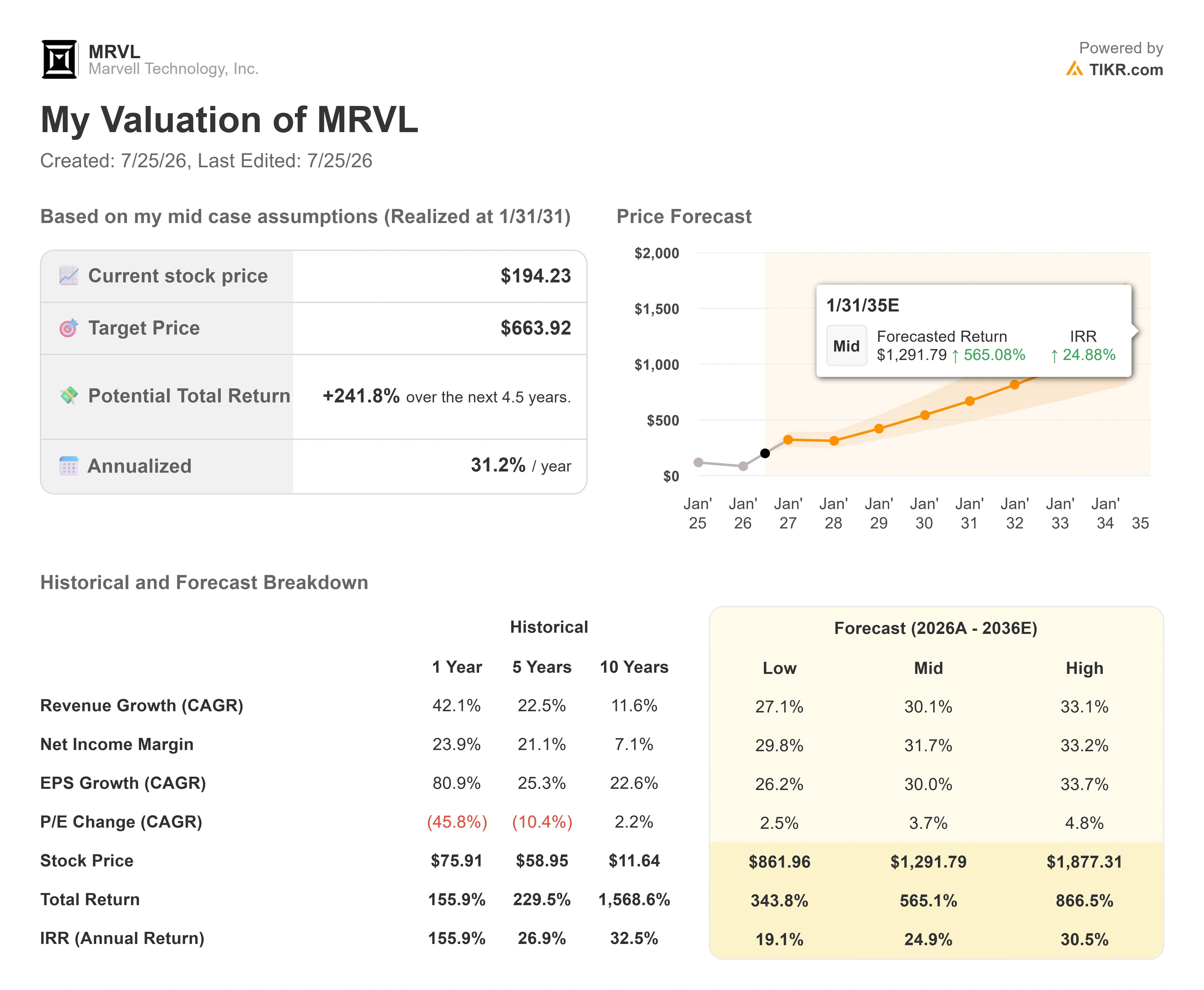
- Current Price: $194.23
- Target Price (Mid): ~$660
- Potential Total Return: ~242%
- Annualized IRR: ~31% / year
See analysts’ growth forecasts and price targets for Marvell stock (It’s free!) >>>
The mid case is the one worth running, because the question is whether ordinary execution justifies the price. It points to a scenario target near $660 by January 31, 2031, implying a total return of roughly 242% and an IRR of about 31% per year from $194.23. That is a modeled outcome built on stated assumptions, not a forecast.
- Revenue driver one: Interconnect, guided to grow above 70% in fiscal 2027
- Revenue driver two: Custom silicon, guided above 20% growth in fiscal 2027 and more than a doubling in fiscal 2028
- Margin driver: Net income margin holding near 32% as data center mix crowds out legacy revenue
- Primary risk: Gross margin erosion
The aggressive input is the multiple, not the growth. The mid case has the P/E expanding about 4% a year over a ten-year horizon from an already elevated starting point, against a ten-year history near 2%. Checked against earnings, a $660 target on the $17.40 of fiscal 2031 earnings, the Street models work out near 38 times, which still asks the market to pay a growth multiple five years out.
Margin deserves more attention than it gets. Consensus has gross margin falling every year from 59.5% in fiscal 2026 to roughly 57% by fiscal 2029, and Marvell’s reported non-GAAP gross margin in the quarter ended May 2 came in at 58.9% against 59.8% a year earlier. Custom silicon is the growth engine and the dilution at once. Upside comes if scale-up revenue converts while guidance keeps climbing; the downside is that Marvell grows into a lower-margin business and the market pays a lower multiple for it.
Conclusion
Microsoft and Meta report on July 29, Amazon and Apple on July 30. Their capital spending guidance is the input Murphy’s fiscal 2028 target runs on, and Alphabet has already set the tone by raising rather than trimming. Budgets held or lifted again leave the $16.5 billion figure looking conservative, and July 24’s price is a discount on numbers that never moved.
The harder outcome is budgets that hold while the market keeps punishing the spenders anyway. In that case, Marvell’s revenue stays intact and its multiple keeps compressing regardless, and the August 20 report will not settle it either.
See what stocks billionaire investors are buying so you can follow the smart money with TIKR.
Should You Invest in Marvell?
The only way to really know is to look at the numbers yourself. TIKR gives you free access to the same institutional-quality financial data that professional analysts use to answer exactly that question.
Pull up Marvell, and you’ll see years of historical financials, what Wall Street analysts expect for revenue and earnings in the quarters ahead, how valuation multiples have moved over time, and whether price targets are trending up or down.
You can build a free watchlist to track Marvell alongside every other stock on your radar. No credit card required. Just the data you need to decide for yourself.
Analyze Marvell on TIKR Free →
Looking for New Opportunities?
- See what stocks billionaire investors are buying so you can follow the smart money.
- Analyze stocks in as little as 5 minutes with TIKR’s all-in-one, easy-to-use platform.
- The more rocks you overturn… the more opportunities you’ll uncover. Search 100K+ global stocks, global top investor holdings, and more with TIKR.
Disclaimer:
Please note that the articles on TIKR are not intended to serve as investment or financial advice from TIKR or our content team, nor are they recommendations to buy or sell any stocks. We create our content based on TIKR Terminal’s investment data and analysts’ estimates. Our analysis might not include recent company news or important updates. TIKR has no position in any stocks mentioned. Thank you for reading, and happy investing!