Key Stats for Carnival Stock
- Current Price: $26.33
- Target Price (Mid): ~$49
- Street Target: ~$36
- Potential Total Return: ~86%
- Annualized IRR: ~15% / year
- Max Drawdown: 29.71% (May 19, 2026)
Now Live: Discover how much upside your favorite stocks could have using TIKR’s new Valuation Model (It’s free) >>>
What Happened?
Carnival Corporation Ltd. (CCL) closed at $26.33 on July 24, up 4.19% from the prior session. Truist raised its price target to $31 from $29 that morning while keeping its Hold rating, citing lower fuel and depreciation assumptions rather than better demand. Coverage of the session also pointed to sector positioning ahead of Royal Caribbean’s earnings, and no single catalyst has been confirmed.
The credit market has been keeping a separate scoreboard. Carnival’s December 2025 results release said the company had reached investment grade with Fitch and sat one notch away at S&P. That notch closed in June.
S&P Closed the Notch Fitch Had Already Crossed
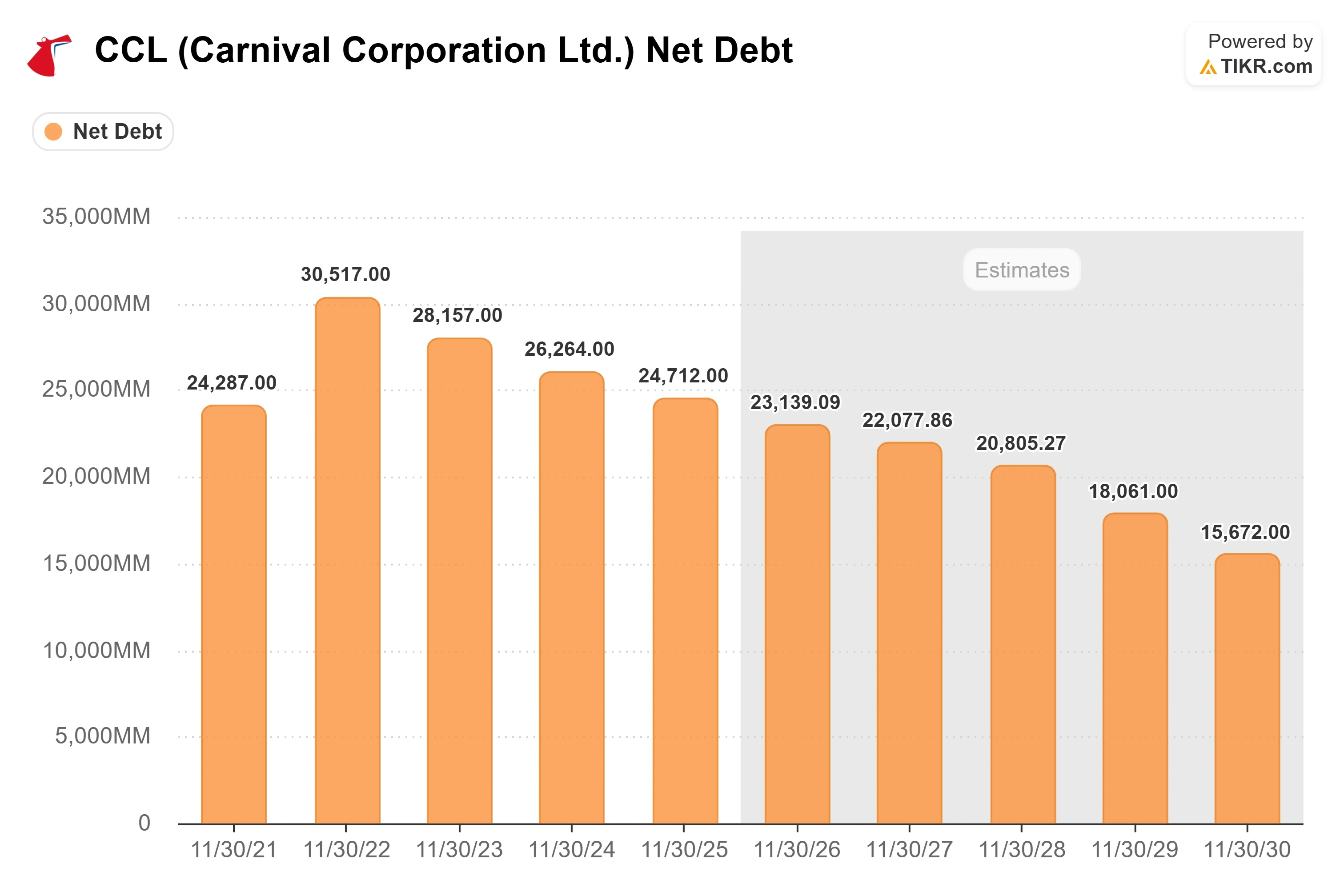
CFO David Bernstein walked investors through a net debt to adjusted EBITDA ratio that fell from 3.4x at the end of fiscal 2025 to 3.3x after the first quarter and 3.1x after the second. TIKR puts trailing net debt to EBITDA at 3.09x, on net debt of $23.9 billion as of May 31.
Two days after that call, S&P Global Ratings raised Carnival’s long-term issuer credit rating to BBB- from BB+ with a stable outlook. The agency cited 93% of fiscal 2026 capacity already booked and 2027 running ahead of last year on volume and price, and projected funds from operations to debt near 25% this year against the 3.75x leverage threshold it had set for an upgrade.
Fitch had crossed that line in October 2025. Moody’s has not followed, and the company’s own year-end release named Fitch and S&P only. Two agencies at investment grade are the test most bond indices and institutional mandates apply, which is why the June action carried more weight than the October one.
Consensus estimates carry net debt from $24.7 billion at fiscal 2025 year-end to roughly $15.7 billion by fiscal 2030, taking leverage under 2x.

See historical and forward estimates for Carnival stock (It’s free!) >>>
The Cost Beat Is Measured in Forklifts
Truist raised its target on costs, and the second quarter explains why. Unit cruise costs excluding fuel ran essentially flat year over year, roughly 250 basis points better than March guidance, while fuel efficiency improved more than 5% on top of last year’s gain of more than 6%.
Bernstein described savings he expects to keep: “When you go from 14 to 13 forklifts and you can make a change on multiple ships over multiple itineraries, it saves hundreds of thousands of dollars in a year.” He counted hundreds of such items and called them permanent.
Revenue was the weaker line. Adjusted EPS of $0.41 beat the $0.34 consensus, but revenue of $6.66 billion fell short of the $6.69 billion estimate. Management cut full-year net yield growth guidance to 1.75% in constant currency, or around 2.25% normalized for last year’s Arabian Gulf redeployment and fourth-quarter loyalty accounting. Shares fell about 6% on June 23.
CEO Josh Weinstein filed the revision under timing: “The key takeaway here is that this moderation is already proving to be transitory and is not something that alters the underlying trajectory of the company.”
See how Carnival performs against its peers in TIKR (It’s free!) >>>
Caribbean Discounting Is Already Showing Up
Weinstein volunteered the supply number himself: outside Carnival, Caribbean capacity is up 27% over two years, which he said is already built into the company’s planning. Truist’s same note found early evidence of what that supply does, flagging heavier discounting on fall 2026 and winter Caribbean sailings and calling Norwegian’s semi-annual sale “the most aggressive post-Covid outside of Black Friday promos.”
Carnival trades at 8.2x forward EV/EBITDA and 11.3x forward earnings. Royal Caribbean Cruises (RCL) commands 12.9x and 16.7x, and Norwegian sits between the two at 9.7x and 12.5x. Europe, about a third of fiscal 2025 segment revenue, is where the disruption landed, which accounts for part of that gap.
Management is not treating the buyback as a floor either. More than $450 million was repurchased in the first half under a $2.5 billion authorization approved in March, but Weinstein was direct about the pace: “At an annualized rate, $450 million a quarter would probably be too much to expect, at least on our current thinking.”
TIKR Advanced Model Analysis
- Current Price: $26.33
- Target Price (Mid): ~$49
- Potential Total Return: ~86%
- Annualized IRR: ~15% / year

See analysts’ growth forecasts and price targets for Carnival stock (It’s free!) >>>
Those four figures use the mid-case realized in November 2030. The underlying assumption set, measured across the model’s full 2025 to 2035 window, runs revenue compounding near 4% and net income margin reaching around 13% against 11.6% in fiscal 2025.
Two drivers carry the revenue line: measured capacity, at a stated cadence of one to two ships per year, and pricing from the exclusive destinations, where the extended pier at Celebration Key handles four ships, and the new pier at RelaxAway, Half Moon Cay supports more than 12,000 guests a day. The margin driver is the permanent cost reduction plus interest expense falling alongside the debt. Upside comes from yields normalizing while the multiple closes toward Norwegian’s. The risk is Caribbean supply, because Truist’s yield caution now reaches into the first quarter of 2027, and a second year of sub-2% yield growth pushes this target out rather than up. The Street mean of around $36 sits between Truist’s $31 and the model.
Conclusion
Carnival is expected to report fiscal third quarter results on September 29, a date the company has not formally confirmed, with management’s bar at around $1.35 in adjusted EPS against a Street estimate near $1.42. Watch the yield line rather than the EPS line. Net yields at or above the record promised for the second half, with the 2027 book holding the mid-teens European gains Weinstein described, would confirm the disruption was timing. Another point of revision, and the discounting Truist found, becomes the story instead.
See what stocks billionaire investors are buying so you can follow the smart money with TIKR.
Should You Invest in Carnival?
The only way to really know is to look at the numbers yourself. TIKR gives you free access to the same institutional-quality financial data that professional analysts use to answer exactly that question.
Pull up Carnival, and you’ll see years of historical financials, what Wall Street analysts expect for revenue and earnings in the quarters ahead, how valuation multiples have moved over time, and whether price targets are trending up or down.
You can build a free watchlist to track Carnival alongside every other stock on your radar. No credit card required. Just the data you need to decide for yourself.
Analyze Carnival on TIKR Free →
Looking for New Opportunities?
- See what stocks billionaire investors are buying so you can follow the smart money.
- Analyze stocks in as little as 5 minutes with TIKR’s all-in-one, easy-to-use platform.
- The more rocks you overturn… the more opportunities you’ll uncover. Search 100K+ global stocks, global top investor holdings, and more with TIKR.
Disclaimer:
Please note that the articles on TIKR are not intended to serve as investment or financial advice from TIKR or our content team, nor are they recommendations to buy or sell any stocks. We create our content based on TIKR Terminal’s investment data and analysts’ estimates. Our analysis might not include recent company news or important updates. TIKR has no position in any stocks mentioned. Thank you for reading, and happy investing!