


Key Takeaways for HCA Healthcare Stock as of July 2026
- $20.23 billion in second-quarter revenue beat the $19.74 billion estimate by 2.46% and climbed 8.73% year over year, while adjusted EPS of $7.59 topped estimates by 1.23% and grew 11%.
- Cutting its full-year adjusted EBITDA guide to $15.4 billion-$16.1 billion, HCA Healthcare now models a $1.0 billion to $1.2 billion exchange headwind for 2026, nearly double the impact built into its original outlook.
- Free cash flow cratered to $1.10 billion, a 62% miss against estimates.
- With exchange enrollees losing coverage converting almost one-for-one to uninsured, CFO Mike Marks pinned the guidance cut on that conversion rate rather than weaker demand, telling investors the original 80% to 85% assumption is now “closer to one-for-one.”
HCA Stock Beats on EPS, But a Bigger Exchange Exodus Cuts the Guide

HCA Healthcare (HCA) posted second-quarter revenue of $20.23 billion on the July 24 call, beating the $19.74 billion estimate by 2.46% and climbing 8.73% from a year earlier. Adjusted EPS of $7.59 topped estimates by 1.23% and grew 11% year over year, extending double-digit earnings growth even as the payer mix underneath it shifted against the company.
That tension traces back to the Affordable Care Act exchanges. Enhanced premium tax credits expired at the end of 2025, and HCA had modeled that 80% to 85% of patients losing that coverage would shift into other insurance. Instead, exchange-linked admissions fell 15% in the quarter, and nearly all of that volume converted straight to uninsured.
CFO Mike Marks addressed the shift directly on the Q2 earnings call: “What’s different as we have gone through second quarter is that we originally assumed that about 80% to 85% of the patients who lose exchange coverage would become uninsured. And our data is telling us now that it’s closer to one-for-one.” That single change in assumption, not a collapse in demand, pushed HCA to raise its estimated full-year exchange hit to adjusted EBITDA to $1.0 billion to $1.2 billion, a figure that also folds in a $75 million revision to the first-quarter estimate.
Partially offsetting that hit, HCA booked a $400 million net benefit from Medicaid Supplemental Payment Programs in the quarter, including $540 million tied to a newly approved Florida program spanning October 2024 through June 2026. Full-year guidance for these programs now sits at $300 million to $500 million, implying a $100 million to $300 million headwind in the back half as 2025 approvals roll off.
Core demand held up beneath the exchange noise. Same-facility insured admissions excluding exchanges rose 3.2%, and emergency room visits climbed 3.6%. The damage concentrated in three of HCA’s 15 divisions, Gulf Coast, North Florida and South Atlantic, which carried roughly 50% of the total exchange impact and saw HICS-linked admissions drop 25% to 28% through the first half. Elective surgery volume softened too, down 6% against a 2% decline a year earlier, a trend CEO Sam Hazen tied to exchange attrition and broader affordability pressure.
HCA now guides to full-year revenue of $77 billion to $79.5 billion, adjusted EBITDA of $15.4 billion to $16.1 billion and diluted EPS of $28.70 to $30.50, a reset Marks framed as a return to the company’s long-term growth target of 4% to 6%. Cash flow carried its own bruise: operating cash flow fell 44.54% to $2.34 billion on Florida payment timing, and free cash flow dropped 63.61% to $1.10 billion, even as HCA repurchased $2.06 billion in stock and held its $5 billion to $5.5 billion capital plan intact.
TIKR Prices HCA Stock at $655, a 72% Return Through 2030
TIKR’s mid-case model values HCA Healthcare stock at $655 by December 2030, implying a 72% total return from the current price of $382, or 13% annualized over 4.4 years.
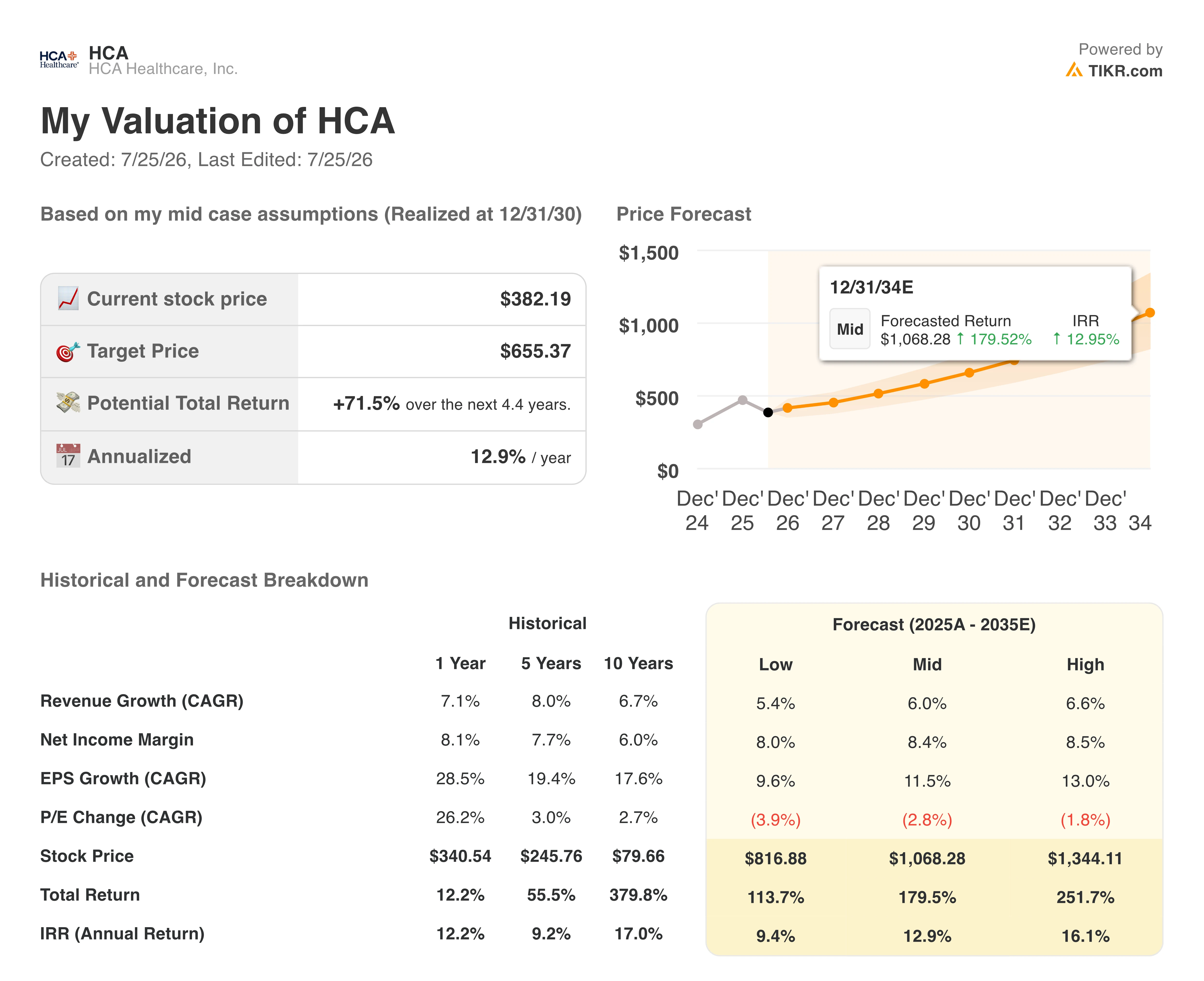
That 13% annualized path outruns what most large-cap hospital operators offer, positioning HCA stock as priced below the growth and margin trajectory management has already laid out in its guide.
That target rests on HCA’s ability to keep expanding admissions and net revenue per admission even as the exchange headwind fades into 2027, alongside a resiliency program that already held same-facility cost per equivalent admission flat this quarter. With $7 billion in approved capital spending adding beds and outpatient sites through 2029, the network capacity behind that growth is already funded.
Should You Invest in HCA Healthcare, Inc.?
The only way to really know is to look at the numbers yourself. TIKR gives you free access to the same institutional-quality financial data that professional analysts use to answer exactly that question.
Pull up HCA Healthcare, Inc. stock and you’ll see years of historical financials, what Wall Street analysts expect for revenue and earnings in the quarters ahead, how valuation multiples have moved over time, and whether price targets are trending up or down.
You can build a free watchlist to track HCA Healthcare, Inc. alongside every other stock on your radar. No credit card required. Just the data you need to decide for yourself.
Access Professional Tools to Analyze HCA stock on TIKR for Free →
Looking for New Opportunities?
- See what stocks billionaire investors are buying so you can follow the smart money.
- Analyze stocks in as little as 5 minutes with TIKR’s all-in-one, easy-to-use platform.
- The more rocks you overturn… the more opportunities you’ll uncover. Search 100K+ global stocks, global top investor holdings, and more with TIKR.
Disclaimer:
Please note that the articles on TIKR are not intended to serve as investment or financial advice from TIKR or our content team, nor are they recommendations to buy or sell any stocks. We create our content based on TIKR Terminal’s investment data and analysts’ estimates. Our analysis might not include recent company news or important updates. TIKR has no position in any stocks mentioned. Thank you for reading, and happy investing!


