Key Stats for NVIDIA Stock
- Current Price: $208.76
- Target Price (Mid): ~$570
- Street Target: ~$305
- Potential Total Return: ~172%
- Annualized IRR: ~25% / year
- Max Drawdown: 20.22% (March 30, 2026)
Now Live: Discover how much upside your favorite stocks could have using TIKR’s new Valuation Model (It’s free) >>>
What Happened?
NVIDIA (NVDA) closed at $208.76 on July 23, up about 12% from its $186.27 close at the end of 2025, while AMD and Intel gained roughly 128% and 149% as of July 21. The two server CPU incumbents have led the chip group all year, which makes the timing of NVIDIA’s July 21 disclosure worth reading closely.
That day, one before AMD’s Advancing AI conference, NVIDIA published the full architecture and benchmarks for Vera, its first CPU built on custom Olympus cores. Shares rose 2.30% in a session where the broader chip tape also gained. The specs matter less than the revenue number management attached to them in May, and where that number does not appear.
The $20 Billion Sits Outside the $1 Trillion
On the May 20 earnings call, Colette Kress, Executive Vice President and CFO, said Vera “opens a brand new $200 billion TAM for NVIDIA, a market we have never addressed before,” adding: “We have visibility to nearly $20 billion in total CPU revenue this year, setting us up to become the world-leading CPU supplier.”
Two analysts pressed on what that figure contained, because it determines whether the CPU is new money or repackaged money. Vivek Arya of Bank of America asked whether the $20 billion was standalone or already embedded in Vera Rubin systems. CEO Jensen Huang: “The $20 billion is for standalone CPU.” Vera has four uses, he explained: inside Rubin racks at one CPU per two GPUs, as a standalone chip, and paired with CX9 for storage and for confidential computing.
Jim Schneider of Goldman Sachs asked the question that matters for the model. NVIDIA has guided to $1 trillion in combined Blackwell and Rubin revenue from 2025 through calendar 2027. Does the CPU sit inside it? Huang: “we didn’t include any Vera CPU, standalone CPU in that number. And so I expect that to be the second largest” source of upside above the $1 trillion, behind only share gains in frontier AI models.
His demand case is more specific than agentic growth generally. Huang described an agent as a harness, Claude Code around Opus or Codex around GPT-5.5, where “the harness runs on CPU and the tool use runs on CPUs.” Thinking happens on GPUs; orchestration, memory management, and tool calls do not. From there the scaling follows: “The world has 1 billion users, human users. My sense is that the world is going to have billions of agents,” each spinning off sub-agents that need tools. He also named why legacy silicon is the wrong shape: “The CPUs of the past were designed to have many cores, so that it could be easily rentable. People rented cores. Well, agents don’t rent cores.”
July’s specifications are that the thesis is in silicon. Vera carries 88 Olympus cores and 176 threads with 1.2 TB/s of memory bandwidth, and NVIDIA reports up to 1.8x the performance of x86 processors on agentic workloads, from SPEC CPU 2026 results, which the company states were measured internally. Kress framed it in system terms in May: up to 1.5x faster per core, 2x performance per watt, and 4x density per rack against x86 alternatives.

See historical and forward estimates for NVIDIA stock (It’s free!) >>>
What the Multiple Currently Pays For
NVIDIA trades at 20.95x NTM earnings, down from 35.40x last July, even as estimates rose, against AMD at 60.94x and Broadcom at 24.90x. AMD’s earnings are depressed mid-ramp, which inflates its multiple, so the cleanest read is that the group’s fastest grower de-rated hardest while LTM gross margin held at 74.1% and return on invested capital at 77.2%.
The competitive reality tempers it. AMD holds roughly a third of the server CPU market and Intel nearly two-thirds, and Gartner analyst Kevin Knox told CNBC that AMD leads innovation in enterprise AI server processors with established hyperscaler relationships. NVIDIA’s $200 billion figure is a company projection of a future market; Bernstein put the mature server CPU market at roughly $37 billion in 2025. And $20 billion is management’s visibility for the year, not a booked result.

See how NVIDIA performs against its peers in TIKR (It’s free!) >>>
TIKR Advanced Model Analysis
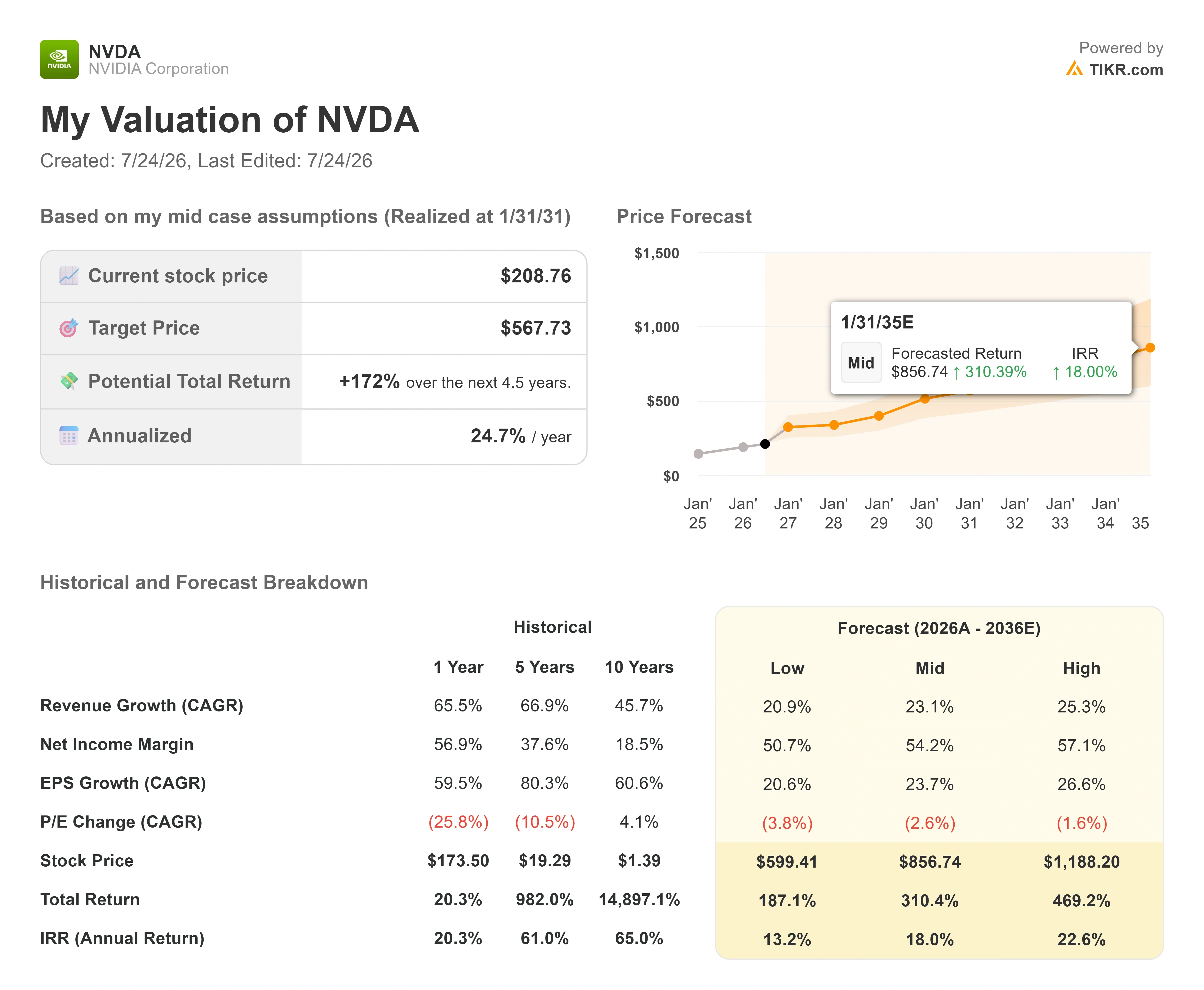
- Current Price: $208.76
- Target Price (Mid): ~$570
- Potential Total Return: ~172%
- Annualized IRR: ~25% / year
See analysts’ growth forecasts and price targets for NVIDIA stock (It’s free!) >>>
The mid case, realized January 31, 2031, values NVDA at around $570, a total return of roughly 172%, and an annualized IRR of around 25%.
Two drivers carry the mid-case revenue growth rate of around 23% annually. The first is the standalone CPU line Huang placed outside the $1 trillion forecast, a category with no prior revenue history at NVIDIA. The second is rising content per rack as Vera Rubin’s seven-chip architecture, which Kress said starts shipping in Q3 and ramps into Q4, replaces narrower Blackwell configurations.
The margin driver is operating leverage, holding a net income margin near 54%. The primary risk is that the standalone attach disappoints while the rack-attached CPU merely relabels revenue NVIDIA was already capturing, leaving the $200 billion framing as a slide rather than a segment. Upside comes if the standalone line lands near management’s visibility and forces the Street to model a business it currently treats as zero.
Conclusion
August 26 is the test, and it is a narrow one. NVIDIA reports fiscal Q2 2027 after the close against guidance of $91 billion, and the line to watch is not that number. It is whether any CPU revenue appears separately, or whether standalone Vera stays a figure management describes rather than reports. Two quarters of visibility without disclosure would tell that the $20 billion is harder to isolate than the May call implied.
See what stocks billionaire investors are buying so you can follow the smart money with TIKR.
Should You Invest in NVIDIA?
The only way to really know is to look at the numbers yourself. TIKR gives you free access to the same institutional-quality financial data that professional analysts use to answer exactly that question.
Pull up NVIDIA, and you’ll see years of historical financials, what Wall Street analysts expect for revenue and earnings in the quarters ahead, how valuation multiples have moved over time, and whether price targets are trending up or down.
You can build a free watchlist to track NVIDIA alongside every other stock on your radar. No credit card required. Just the data you need to decide for yourself.
Looking for New Opportunities?
- See what stocks billionaire investors are buying so you can follow the smart money.
- Analyze stocks in as little as 5 minutes with TIKR’s all-in-one, easy-to-use platform.
- The more rocks you overturn… the more opportunities you’ll uncover. Search 100K+ global stocks, global top investor holdings, and more with TIKR.
Disclaimer:
Please note that the articles on TIKR are not intended to serve as investment or financial advice from TIKR or our content team, nor are they recommendations to buy or sell any stocks. We create our content based on TIKR Terminal’s investment data and analysts’ estimates. Our analysis might not include recent company news or important updates. TIKR has no position in any stocks mentioned. Thank you for reading, and happy investing!