Key Takeaways for Norfolk Southern Stock as of July 2026
- Norfolk Southern posted Q2 2026 revenue of $3.46 billion, a 2.6% beat against the $3.37 billion estimate and up 11% year over year, with adjusted EPS of $3.52 topping estimates by 6%.
- Management raised its 2026 operating expense outlook to $8.8 billion to $8.9 billion from the prior $8.2 billion to $8.4 billion range, entirely to absorb $400 million to $500 million of incremental fuel cost versus its original plan.
- EBITDA margin still slipped 287 basis points year over year to 45% even as the dollar figure beat estimates by 5%, showing that fuel and inflation pressure ate into profitability even during a demand upswing.
- CEO Mark George called it a quarter that “exceeded our own expectations starting with strong volume and revenue growth, culminating in 7% net income and EPS growth,” tying the beat directly to an energy-driven demand inflection.
An Energy-Driven Demand Surge Masks Margin Pressure at Norfolk Southern
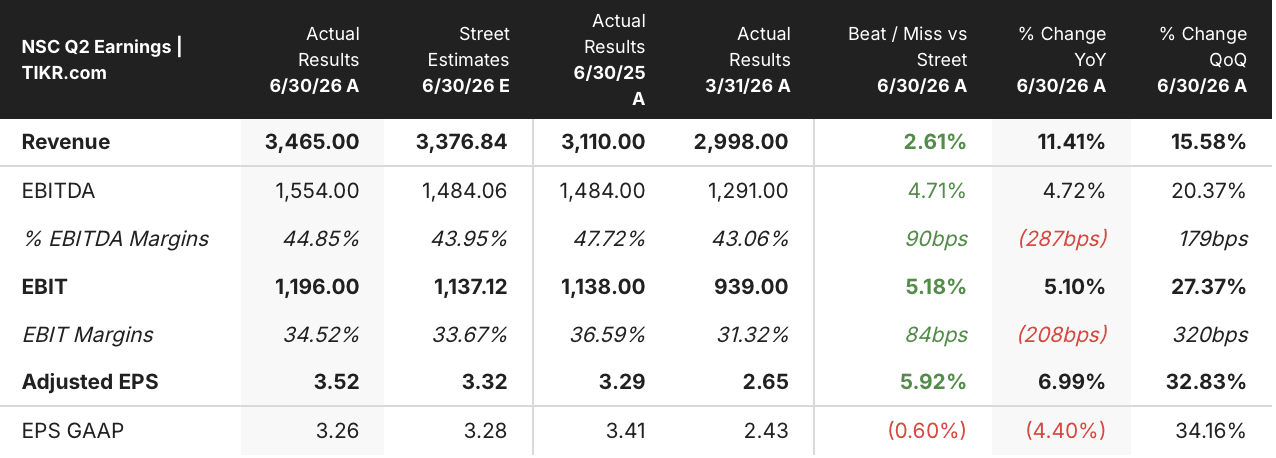
Norfolk Southern (NSC) delivered a second quarter that beat the board across revenue, EBITDA, EBIT and adjusted EPS, with the $3,465 million top line running 11.41% ahead of last year and 15.58% ahead of the prior quarter. The move came from a sharp volume inflection that CEO Mark George linked to a specific catalyst: the Iran conflict, which lifted energy markets and then spread into domestic intermodal and industrial demand. Total volume rose 4% year over year, with intermodal volume up 5% and merchandise revenue less fuel hitting a record on continued gains in chemicals and energy-linked demand.
That volume came with strain. Absorbing the surge on top of earlier winter disruptions pressured crew resources and network fluidity, pushing new Chief Operating Officer Brian Barr to whiteboard fixes terminal by terminal, including a rework at Chattanooga that pulled 150 cars a day out of double-handling. The payoff showed up in the cost line: adjusted operating ratio came in at 65.5%, a 320 basis point sequential improvement that beat the normal 200 basis point seasonal step-down CFO Jason Zampi had flagged the prior quarter.
Fuel and inflation still took a bite. Operating ratio rose 210 basis points year over year, with fuel adding 110 basis points and inflation another 190. Costs overall climbed 15% for the quarter, with fuel responsible for more than two-thirds of that increase. EBITDA margin fell 287 basis points year over year to 44.85%, and EBIT margin gave up 208 basis points to 34.52%, even as both dollar figures beat estimates comfortably.
Management framed the quarter’s strength as durable rather than one-time. As George put it on the Q2 earnings call: “we delivered a strong second quarter with results that exceeded our own expectations starting with strong volume and revenue growth, culminating in 7% net income and EPS growth.” That confidence carried into guidance.
The company raised its 2026 opex outlook by roughly $600 million at the midpoint, attributing the entire increase to a fuel cost swing of $400 million to $500 million versus its original plan, while holding capital spending at approximately $1.9 billion and reaffirming its $150 million 2026 cost-takeout target. Zampi went further on the third quarter, guiding to a sequential margin improvement of up to 100 basis points better than normal seasonality, helped by fuel turning into a tailwind even as a roughly 4% wage increase took effect in July.
TIKR Values Norfolk Southern Stock at $380, Pointing to a Muted Multiyear Return
TIKR’s mid case model values Norfolk Southern at $380 by December 2030, implying a 9% total return from the current price of $349, or 2% annualized over 4.4 years.

That 2% annualized path sits well below what a rail operator riding a genuine volume inflection would typically need to deliver for investors chasing double-digit annual returns, leaving the stock priced for modest appreciation rather than a re-rating.
The model’s restraint tracks directly with the quarter’s tension: revenue and EPS beat, but EBITDA and EBIT margins both contracted year over year on fuel and inflation, and the newly raised opex guide confirms those cost pressures are running through the rest of 2026.
Norfolk Southern’s own sequential operating ratio improvement shows the cost discipline exists, but the model is pricing a business still working through fuel volatility and pending merger uncertainty rather than one already compounding margin gains.
Should You Invest in Norfolk Southern Corporation?
The only way to really know is to look at the numbers yourself. TIKR gives you free access to the same institutional-quality financial data that professional analysts use to answer exactly that question.
Pull up Norfolk Southern Corporation stock and you’ll see years of historical financials, what Wall Street analysts expect for revenue and earnings in the quarters ahead, how valuation multiples have moved over time, and whether price targets are trending up or down.
You can build a free watchlist to track Norfolk Southern Corporation stock alongside every other stock on your radar. No credit card required. Just the data you need to decide for yourself.
Access Professional Tools to Analyze NSC stock on TIKR for Free →
Looking for New Opportunities?
- See what stocks billionaire investors are buying so you can follow the smart money.
- Analyze stocks in as little as 5 minutes with TIKR’s all-in-one, easy-to-use platform.
- The more rocks you overturn… the more opportunities you’ll uncover. Search 100K+ global stocks, global top investor holdings, and more with TIKR.
Disclaimer:
Please note that the articles on TIKR are not intended to serve as investment or financial advice from TIKR or our content team, nor are they recommendations to buy or sell any stocks. We create our content based on TIKR Terminal’s investment data and analysts’ estimates. Our analysis might not include recent company news or important updates. TIKR has no position in any stocks mentioned. Thank you for reading, and happy investing!