


Key Stats for Pinterest Stock
- Current Price: $22.54
- Target Price (Mid): ~$47
- Street Target (Mean): ~$28
- Potential Total Return: ~108%
- Annualized IRR: ~18% / year
- Max Drawdown: 60.63% (on 2/13/26)
Now Live: Discover how much upside your favorite stocks could have using TIKR’s new Valuation Model (It’s free) >>>
What Happened?
Pinterest, Inc. (PINS) picked up two supportive analyst notes in as many days this month, and the stock closed at $22.54 on July 22, down 1.27% on the session and roughly where it traded before either arrived.
On July 7, Wells Fargo analyst Alec Brondolo raised his price target to $30 from $28 and kept an Overweight rating, telling clients his second-quarter advertising checks came back modestly positive while adding that he does not view the quarter as an inflection point. A day later, DA Davidson analyst Wyatt Swanson initiated coverage with a Buy rating and a $26 target, citing ten straight quarters of low-double-digit engagement growth against a valuation that keeps compressing anyway.
Neither note engaged with the argument that CEO Bill Ready spent most of the last earnings call making, and it is the one that decides whether the margin structure holds.
Cheap Models, Expensive Compute, and Why Both Are Deliberate
Ready’s case was specific. Pinterest builds compact fit-for-purpose models for its core visual tasks, and for general language work, it post-trains open-source models inside its own cloud environment. His stated advantages: better security, lower latency, better performance on Pinterest-specific problems because the models see proprietary data, and cost at a fraction of third-party alternatives. He argued the industry is converging on a conclusion Pinterest reached early: that paying a premium for overengineered generalized capability rarely makes sense for company-specific use cases.
That strategy still requires somewhere to run the models. CFO Julia Donnelly guided the second-quarter cost of revenue to grow sequentially by mid-single-digit percent, driven partly by the full-quarter impact of the tvScientific acquisition and partly by GPU capacity investment. Pinterest reportedly committed $4 billion to Amazon Web Services through 2031 on June 4, though that figure has not been confirmed in a company filing.
TIKR’s data shows the trade so far. Gross margin was 80.07% for full-year 2025, and consensus models expect it to ease to 78.07% by 2030, about two points surrendered to infrastructure. Over the same span, consensus expects EBITDA margin to expand from 29.1% this year to 31.8%. Operating leverage is projected to absorb the compute bill and then some.

See historical and forward estimates for Pinterest stock (It’s free!) >>>
The Chatbot Question Management Answered With Its Own Numbers
Asked by Oppenheimer’s Jason Helfstein about competition from AI chatbots, Ready gave a quantitative answer rather than a reassuring one.
His framing: of Pinterest’s more than 80 billion monthly searches, roughly half are commercial in nature, while ChatGPT’s own data, as Ready characterized it, indicates about 2% of its prompts are commercial. The comparison is his, and the two metrics are not measured on the same basis, but his conclusion is testable. Chatbot adoption and Pinterest’s ten consecutive quarters of double-digit user growth happened at the same time.
Ready added that general-purpose chatbots start with a blank command line, requiring users to know what to type, while Pinterest serves people who cannot yet describe what they want. When a chatbot generates an image, he noted, there is usually no path from that image to a purchasable product.
He extended it to agentic commerce, observing that several platforms that pursued it most aggressively have since pivoted, which he reads as evidence that the obstacles were behavioral rather than technical. That reading is unproven, but it carries a date and will be checkable.
What Advertisers Will Actually Pay
The gap between Ready’s strategic case and the stock sits in one line of the first-quarter results. Ad impressions grew 24% year over year while ad pricing fell 5%.
Pinterest is selling more inventory at lower prices. Donnelly attributed the sequential pricing improvement to a higher relative mix of higher-priced U.S. and Canada impressions, alongside stronger demand in that region, rather than to broad pricing power.
That matters for the AI thesis. Cheaper inference protects margin, but revenue growth still depends on advertisers paying more per impression eventually. On valuation, shares trade at 8.73x next-twelve-months EV/EBITDA and 11.93x forward earnings, against Reddit at 19.58x and 23.01x and Meta Platforms at 10.55x and 19.25x. Forward two-year revenue CAGR of 13.9% trails the 20.1% five-year historical rate, so a discount is warranted. Whether this much is warranted is the open question.
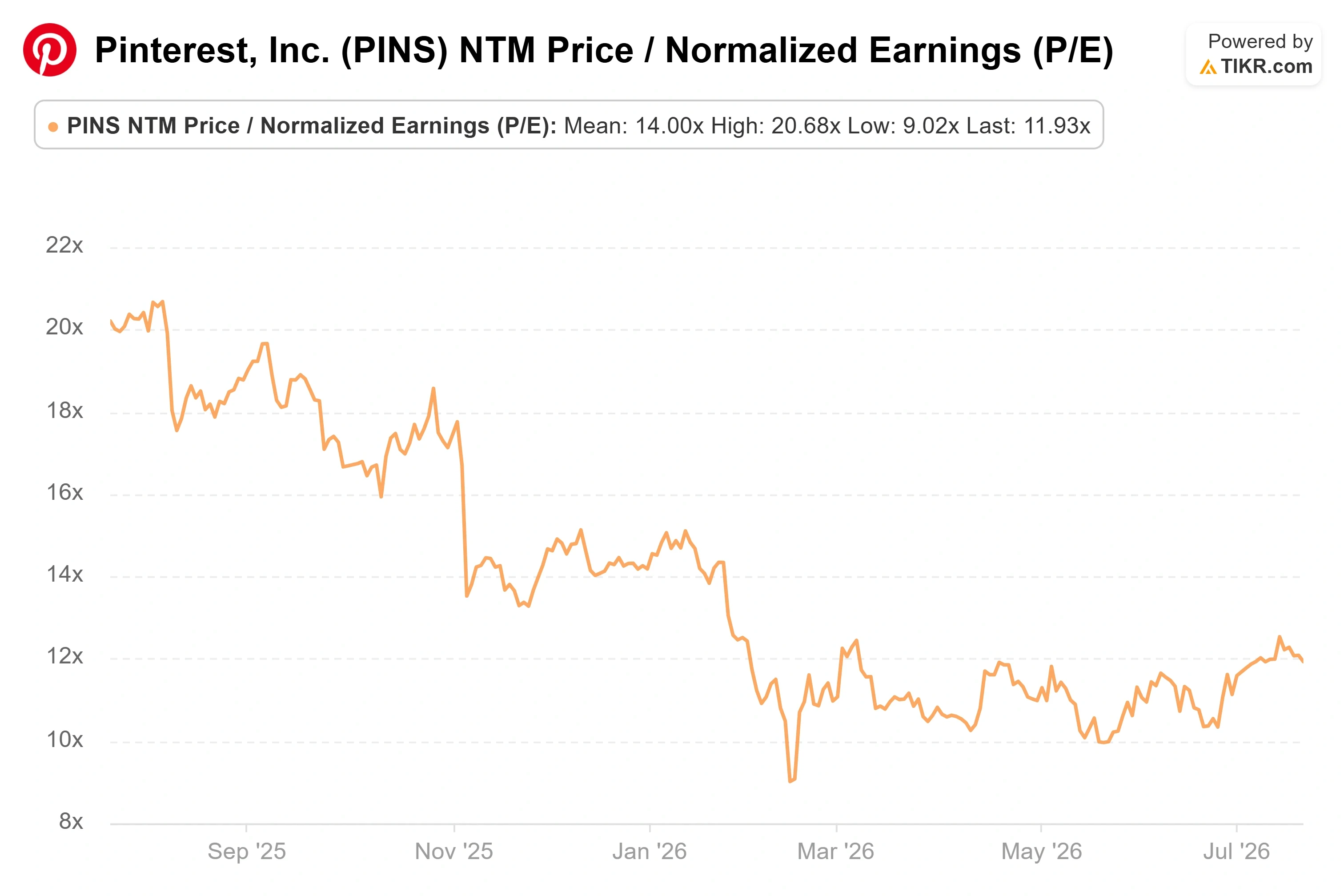
See how Pinterest performs against its peers in TIKR (It’s free!) >>>
TIKR Advanced Model Analysis
- Current Price: $22.54
- Target Price (Mid): ~$47
- Potential Total Return: ~108%
- Annualized IRR: ~18% / year

See analysts’ growth forecasts and price targets for Pinterest stock (It’s free!) >>>
This uses the mid case because its assumptions sit below management’s own targets. Donnelly reaffirmed a long-term adjusted EBITDA margin goal of 30% to 34% against roughly 29% guided for this year.
Revenue drivers: international monetization, where Rest of World produced $72 million of first-quarter revenue from 367 million users against $750 million from 106 million users in the U.S. and Canada; and continued adoption of the company’s automated ad suite, which management put at roughly 30% of lower-funnel revenue.
Margin driver: the in-house AI cost structure, which adds capability without frontier-model licensing fees.
Primary risk: negative ad pricing. If the 5% year-over-year decline persists while impression growth decelerates, revenue depends on volume, the platform cannot expand indefinitely.
Upside: cheap inference lets Pinterest compound AI capability at structurally lower cost than competitors paying licensing fees.
Downside: if fit-for-purpose models fall behind frontier capability, the infrastructure spend becomes a cost against a widening product gap.
Conclusion
Pinterest reports second-quarter results after the close on August 4, guiding to $1.133 billion to $1.153 billion in revenue and $256 million to $276 million in adjusted EBITDA.
Ad pricing is the number that matters. It fell 5% year over year in the first quarter, and Donnelly credited the sequential improvement to regional mix and stronger U.S. and Canada demand rather than to pricing power. A second consecutive quarter of negative pricing alongside slowing impression growth would mean the AI spending is not yet reaching what advertisers pay. Flat or positive pricing would be the first hard evidence that it is.
Brondolo said outright he does not expect an inflection point. The Street mean sits at $27.64 across 17 Buys, 2 Outperforms, 20 Holds, and one Underperform. Almost nobody expects much from August 4, which is what makes the pricing line worth reading closely.
See what stocks billionaire investors are buying so you can follow the smart money with TIKR.
Should You Invest in Pinterest?
The only way to really know is to look at the numbers yourself. TIKR gives you free access to the same institutional-quality financial data that professional analysts use to answer exactly that question.
Pull up Pinterest, and you’ll see years of historical financials, what Wall Street analysts expect for revenue and earnings in the quarters ahead, how valuation multiples have moved over time, and whether price targets are trending up or down.
You can build a free watchlist to track Pinterest alongside every other stock on your radar. No credit card required. Just the data you need to decide for yourself.
Analyze Pinterest on TIKR Free →
Looking for New Opportunities?
- See what stocks billionaire investors are buying so you can follow the smart money.
- Analyze stocks in as little as 5 minutes with TIKR’s all-in-one, easy-to-use platform.
- The more rocks you overturn… the more opportunities you’ll uncover. Search 100K+ global stocks, global top investor holdings, and more with TIKR.
Disclaimer:
Please note that the articles on TIKR are not intended to serve as investment or financial advice from TIKR or our content team, nor are they recommendations to buy or sell any stocks. We create our content based on TIKR Terminal’s investment data and analysts’ estimates. Our analysis might not include recent company news or important updates. TIKR has no position in any stocks mentioned. Thank you for reading, and happy investing!