Key Stats for Delta Air Lines Stock
- Current Price: $85.06
- Target Price (Mid): ~$84
- Street Target: ~$106
- Potential Total Return: ~(2)%
- Annualized IRR: ~(0.4)% / year
- Max Drawdown: 23.11% (March 12, 2026)
Now Live: Discover how much upside your favorite stocks could have using TIKR’s new Valuation Model (It’s free) >>>
What Happened?
Delta Air Lines (DAL) closed at $85.06 on July 24, down about 9% from the record close it set on June 30. Between those two dates, Wall Street’s consensus forecast for Delta’s next twelve months of earnings climbed roughly 44%.
The price fell while expected earnings rose. That combination dropped Delta’s forward multiple from about 16 times earnings to about 10, and every one of those new estimates rests on a fuel assumption Delta set on July 10.
The 44% Revision That Reset Delta’s Multiple
On June 30, consensus put Delta’s next-twelve-month normalized EPS at around $5.85. By July 24, it had reached around $8.41, with forward EBITDA estimates up about 30% alongside it. Delta’s forward P/E fell from about 16x to about 10x over the same stretch.
The revisions came from guidance rather than from the headline beat. Adjusted EPS of $1.56 cleared consensus by only a few cents. What moved the models was the September quarter outlook of $2.00 to $2.50 per share against an actual $1.71 a year earlier, alongside an affirmed full-year range of $6.50 to $7.50.
The base was depressed to begin with. Analysts had cut Delta’s forward numbers hard during the spring fuel spike, so part of that 44% is recovery rather than fresh optimism.
Those analysts had also been trailing the stock. On June 30, their mean target of about $88 sat below the $93.66 share price, meaning the run had happened without them. Morgan Stanley’s Ravi Shanker has since moved to $125 from $115, now the top of TIKR’s Street range.

See historical and forward estimates for Delta Air Lines stock (It’s free!) >>>
Why the June Quarter Exited Far Stronger Than It Entered
The reason forward numbers moved sits in how Delta repriced fares as the quarter progressed. Chief Commercial Officer Joe Esposito said the fuel recapture effort started in March, and that April was already 70% booked by then. Each later month, therefore, carried a higher share of newly priced tickets.
Esposito told analysts on the July 10 call that “our exit rate on TRASM was significantly higher than our entry rate.” TRASM means total revenue per available seat mile, and the exit rate matters more than the quarterly average because it is what carries into September. Total unit revenue rose 12.4% for the quarter on roughly 1% capacity growth.
The mix shifted in an unexpected direction. Esposito said Main Cabin unit revenue actually exceeded Premium in the June quarter, in a cabin he called one of Delta’s biggest improvement objectives last year, helped by Main Cabin capacity running down 2% to 3% while premium seats grew. He put ultra low-cost carrier capacity down about 30%, and CEO Ed Bastian said the low end of the market still needs roughly 5% more fare, by Delta’s own estimate, just to break even at today’s fuel prices.
Bastian also pointed to a statistic he said he had seen recently. Getting domestic Main Cabin margins anywhere close to 2019 levels would be worth 2 to 3 points on Delta’s overall margin, against an operating margin of 8.8% in the June quarter.

See how Delta Air Lines performs against its peers in TIKR (It’s free!) >>>
The September Guide Assumes $3.15 a Gallon
CFO Erik Snell built the September quarter outlook on all-in fuel of about $3.15 per gallon, roughly 20% below the $3.93 Delta paid in the June quarter. That single number underwrites the 11% to 13% margin guide.
Crude has moved hard against it since. Brent crossed $100 a barrel on July 23, its first time above that level since May 26, then eased nearly 4% to settle at $96.78 the following day. It still finished the week up roughly 10%, and roughly 30% above where it traded a month earlier.
US forces have struck Iran on 13 consecutive nights, and Houthi attacks on two Saudi tankers have hit the Red Sea corridor that Saudi Arabia uses to bypass the Strait of Hormuz. The Congressional Research Service estimates roughly 27% of the world’s maritime crude and petroleum products trade moves through that strait. Benjamin Jones, global head of research at Invesco, expects crude to hold near or above $100 while the disruption persists.
Delta’s own trading now tracks the barrel more than the business. Shares fell 3.1% on July 23 as Brent broke $100, then gained 3.77% the next session as it retreated, inside a sector move that lifted United, American, and Alaska by more than Delta.
One qualifier belongs on the fare story. The recapture Bastian describes is management’s read of industry pricing behavior, not a contracted floor, and it has been running only since March.
TIKR Advanced Model Analysis
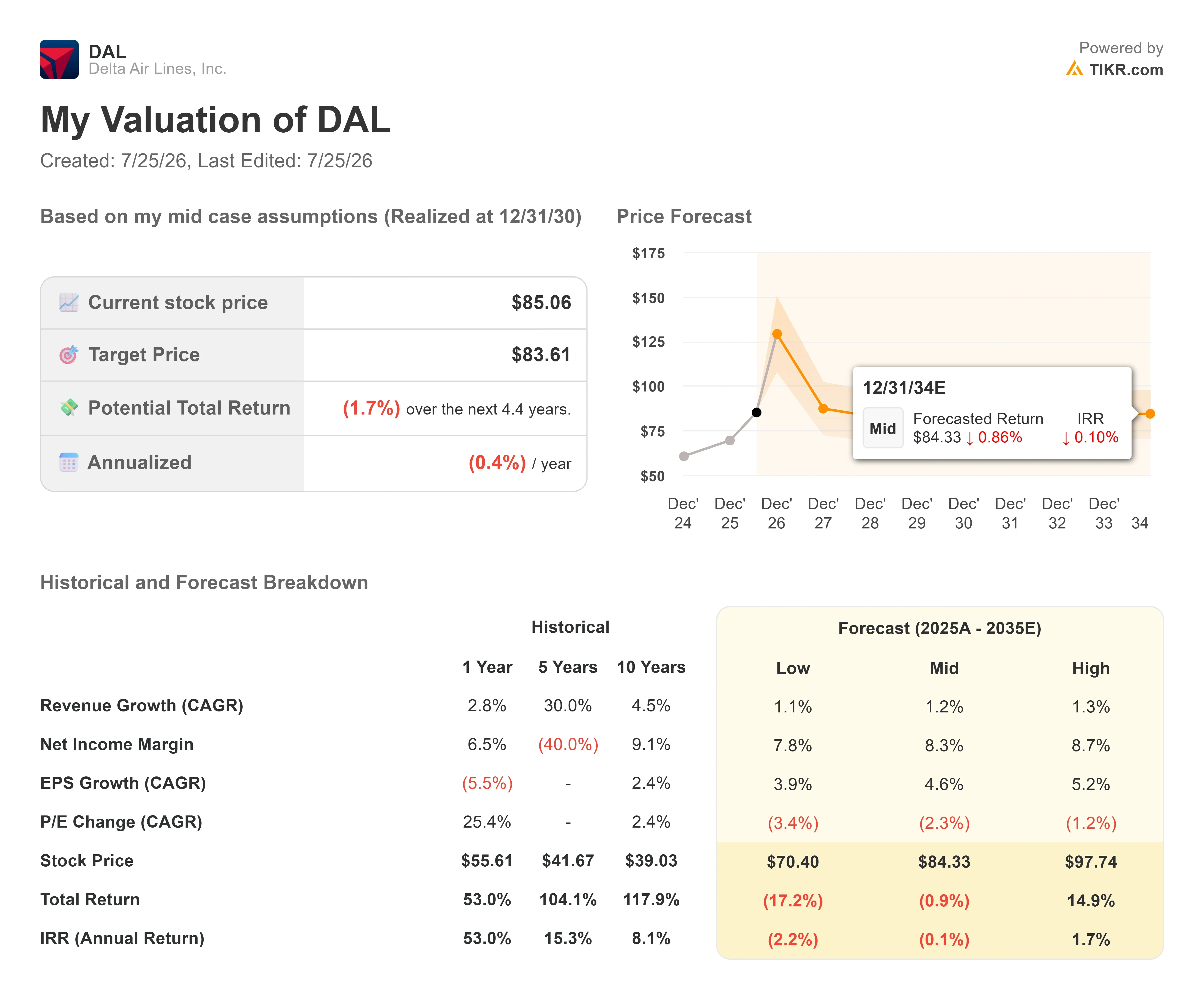
- Current Price: $85.06
- Target Price (Mid): ~$84
- Potential Total Return: ~(2)%
- Annualized IRR: ~(0.4)% / year
See analysts’ growth forecasts and price targets for Delta Air Lines stock (It’s free!) >>>
The mid case lands near $84 by the end of 2030, just under the current price. That is not a margin-pessimism call. The model carries an 8.3% net income margin, above the 6.0% Delta posted in 2025 and between what consensus expects for 2027 and 2028.
What holds the target down is revenue. The model assumes long-run growth in the low single digits, against roughly 15% that consensus expects for 2026 alone, with modest multiple compression on top. Note that this is a multi-year projection, while the Street’s ~$106 is a twelve-month target.
Two revenue drivers carry the case: the fare recapture holding as it flows into later quarters, and the premium cabin mix. The margin driver is industry capacity discipline, and fuel is the primary risk. Upside comes if the recapture holds and Delta reaches the mid-teens margins Bastian has targeted, while the model turns sharply negative should crude stay elevated and low-cost capacity rebuild once fuel normalizes.
Conclusion
Delta reports September quarter results in early October, though the company has not confirmed the date. Snell guided to about $3.15 per gallon on July 10, and Brent has traded above $96 since July 23, which puts the 11% to 13% margin range and the affirmed $6.50 to $7.50 full-year outlook under live pressure rather than hypothetical risk.
Watch the exit rate as closely as the headline number. If unit revenue leaves the September quarter stronger than it entered for a second straight period, the recapture starts to look structural rather than opportunistic.
See what stocks billionaire investors are buying so you can follow the smart money with TIKR.
Should You Invest in Delta Air Lines?
The only way to really know is to look at the numbers yourself. TIKR gives you free access to the same institutional-quality financial data that professional analysts use to answer exactly that question.
Pull up Delta Air Lines, and you’ll see years of historical financials, what Wall Street analysts expect for revenue and earnings in the quarters ahead, how valuation multiples have moved over time, and whether price targets are trending up or down.
You can build a free watchlist to track Delta Air Lines alongside every other stock on your radar. No credit card required. Just the data you need to decide for yourself.
Analyze Delta Air Lines on TIKR Free →
Looking for New Opportunities?
- See what stocks billionaire investors are buying so you can follow the smart money.
- Analyze stocks in as little as 5 minutes with TIKR’s all-in-one, easy-to-use platform.
- The more rocks you overturn… the more opportunities you’ll uncover. Search 100K+ global stocks, global top investor holdings, and more with TIKR.
Disclaimer:
Please note that the articles on TIKR are not intended to serve as investment or financial advice from TIKR or our content team, nor are they recommendations to buy or sell any stocks. We create our content based on TIKR Terminal’s investment data and analysts’ estimates. Our analysis might not include recent company news or important updates. TIKR has no position in any stocks mentioned. Thank you for reading, and happy investing!