Key Takeaways
- Jim Cramer says Microsoft’s new cloud revenue is “hostage to OpenAI,” and NewEdge Wealth’s Cameron Dawson says OpenAI makes up 40% of Microsoft’s backlog.
- Microsoft can handle that exposure far better than Oracle can, but at 27x forward earnings the stock isn’t priced for much risk from one customer.
- Microsoft’s capital spending rose from $23.9 billion in fiscal 2022 to $116 billion in fiscal 2026, so free cash flow ended up at $67 billion, barely above where it started.
- Microsoft reports on Oct. 28, and the question to watch is how much of its Azure demand comes from customers other than OpenAI.
Microsoft (MSFT) reports its September-quarter results on Oct. 28, and Jim Cramer already knows which number worries him.
On the Oct. 19 episode of Mad Money, the CNBC host called hyperscaler earnings the next big test for the AI data center complex. Then he narrowed it down:
“Microsoft’s new cloud revenue is hostage to OpenAI.”
(He put Amazon (AMZN) and Alphabet (GOOG) in the same spot with Anthropic.)
That’s a strong word for a company with a AAA credit rating. But it comes with AI stocks already on edge. Oracle (ORCL) sank on Oct. 8, along with other AI names, after a report on OpenAI’s revenue.
TIKR tracks 56 analysts on Microsoft. How many say “Buy”?
See the full breakdown of Buy, Hold, and Sell ratings on Microsoft, along with Wall Street’s revenue and earnings estimates, all in one place. More than 500,000 investors use TIKR to research stocks like this one. See Microsoft’s Analyst Ratings
A quarter-trillion dollars on one customer
Cameron Dawson, chief investment officer at NewEdge Wealth, put a number on the problem on Bloomberg Surveillance on Oct. 14:
“…you look at a name like Microsoft, 40% of their backlog is OpenAI.”
Microsoft’s commercial backlog stood at $678 billion at the end of June, up 84% from a year earlier. If Dawson’s 40% holds, that’s roughly $270 billion riding on one customer.
Which, yikes.
And that customer’s revenue just shrank, at least on paper. Steve Eisman, the investor made famous by The Big Short, said this on The Compound and Friends:
“…last week OpenAI came out and said that their annualized revenue at the end of September was 50 billion. A month ago they said 70.”
Most of that gap is bookkeeping. The $50 billion figure, first reported by the [Financial Times](LINK NEEDED), reportedly leaves out the gross revenue from OpenAI’s partners that the higher number counted.
Even so, the backlog looks heavy next to it. Roughly $270 billion is more than five years of OpenAI’s revenue at its current run rate. Dawson’s question is how much of OpenAI’s spending depends on raising more money. So part of Microsoft’s growth now rides on OpenAI’s next funding round.
Wall Street is counting on all of it
Analysts expect Microsoft’s revenue to climb from $332 billion in fiscal 2026 (the year ended June 2026) to $391 billion in fiscal 2027 and $468 billion in fiscal 2028, with growth speeding up to nearly 20%.
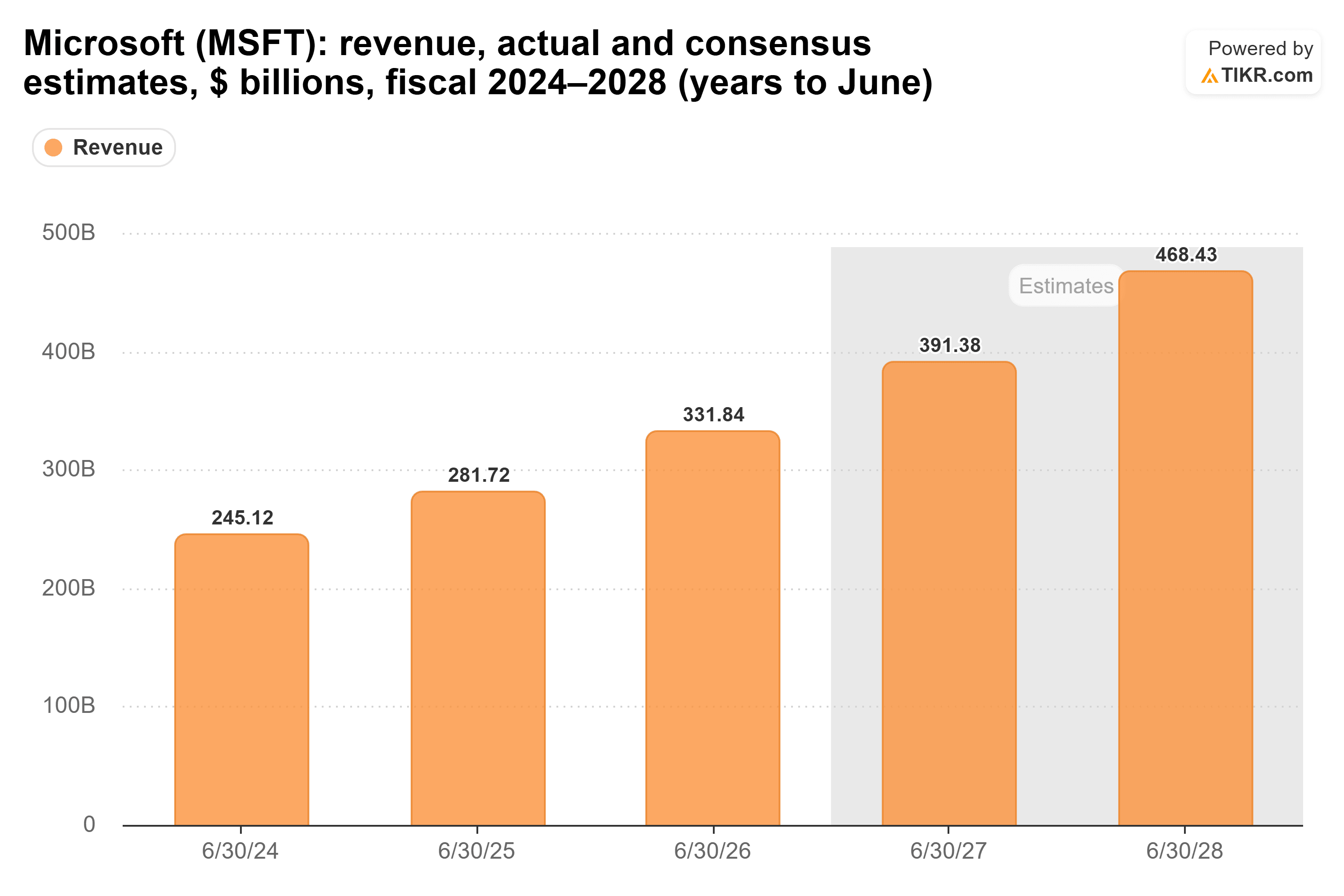
Those estimates assume the backlog turns into revenue roughly on schedule. OpenAI’s lower run rate is mostly an accounting change, so I don’t expect it to move these numbers before Oct. 28. The bigger risk to them is whether OpenAI can keep paying.
Meanwhile, Microsoft is spending the money up front. Capital expenditures rose from $23.9 billion in fiscal 2022 to $116 billion in fiscal 2026, nearly 5x, while cash from operations roughly doubled to $183 billion.
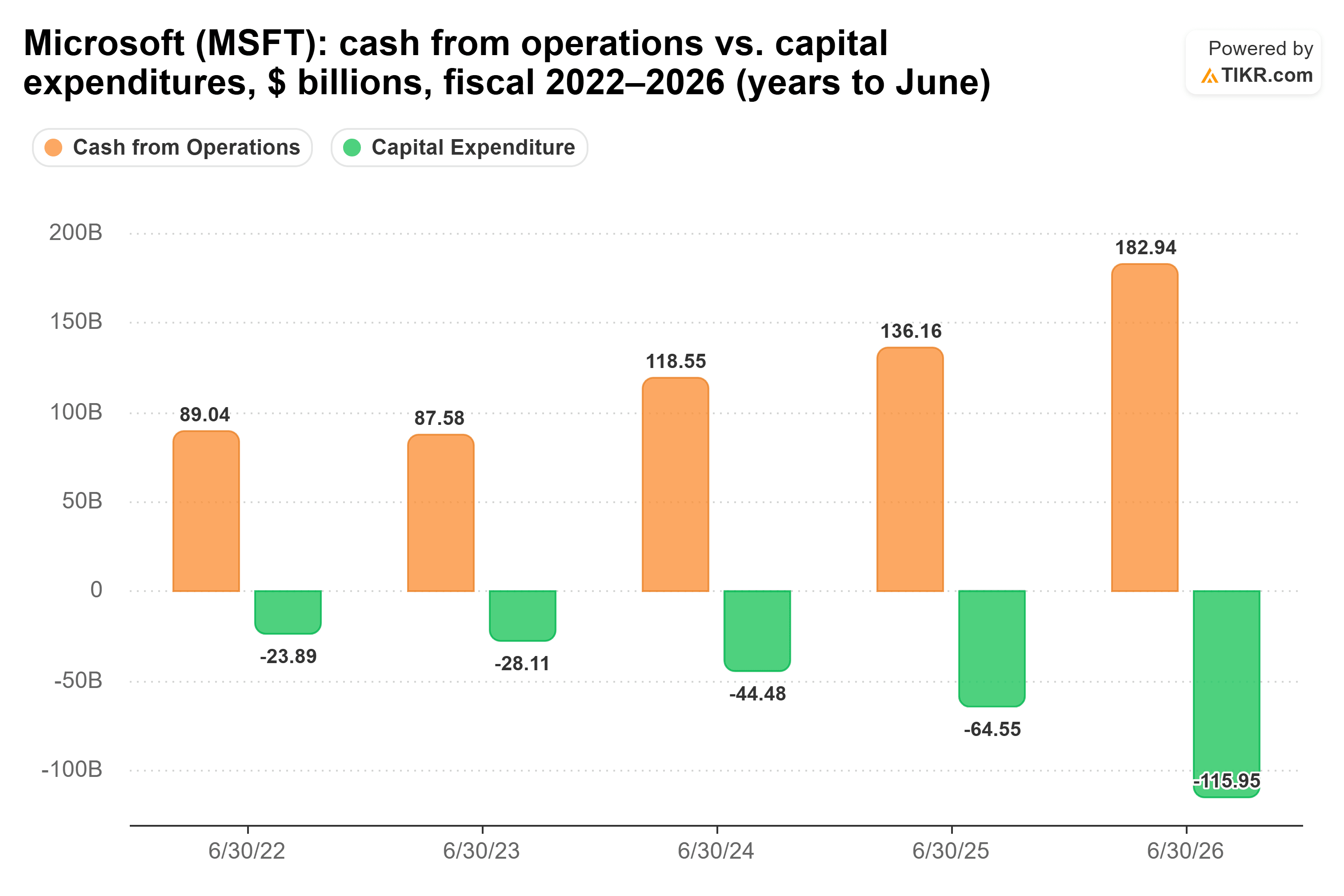
That left free cash flow of $67 billion in fiscal 2026, barely above the $65 billion of fiscal 2022.
Microsoft can afford it
None of this puts Microsoft in Oracle’s shoes. Eisman says “half of Oracle’s backlog is just OpenAI.” Microsoft has $183 billion a year of operating cash and a AAA rating to absorb a stumble.
Microsoft’s core business is still humming, too. Microsoft Cloud revenue hit $59.3 billion in the June quarter, up 27%. Baird’s Ted Mortonson expects more of the same: “If you look at Microsoft, I think they’re going to have a blowout number.”
A normal price for an unusual risk
Microsoft trades at 27.0x forward earnings. That’s a bit under its five-year average of 29.4x and well above the 19.1x low it hit in June.
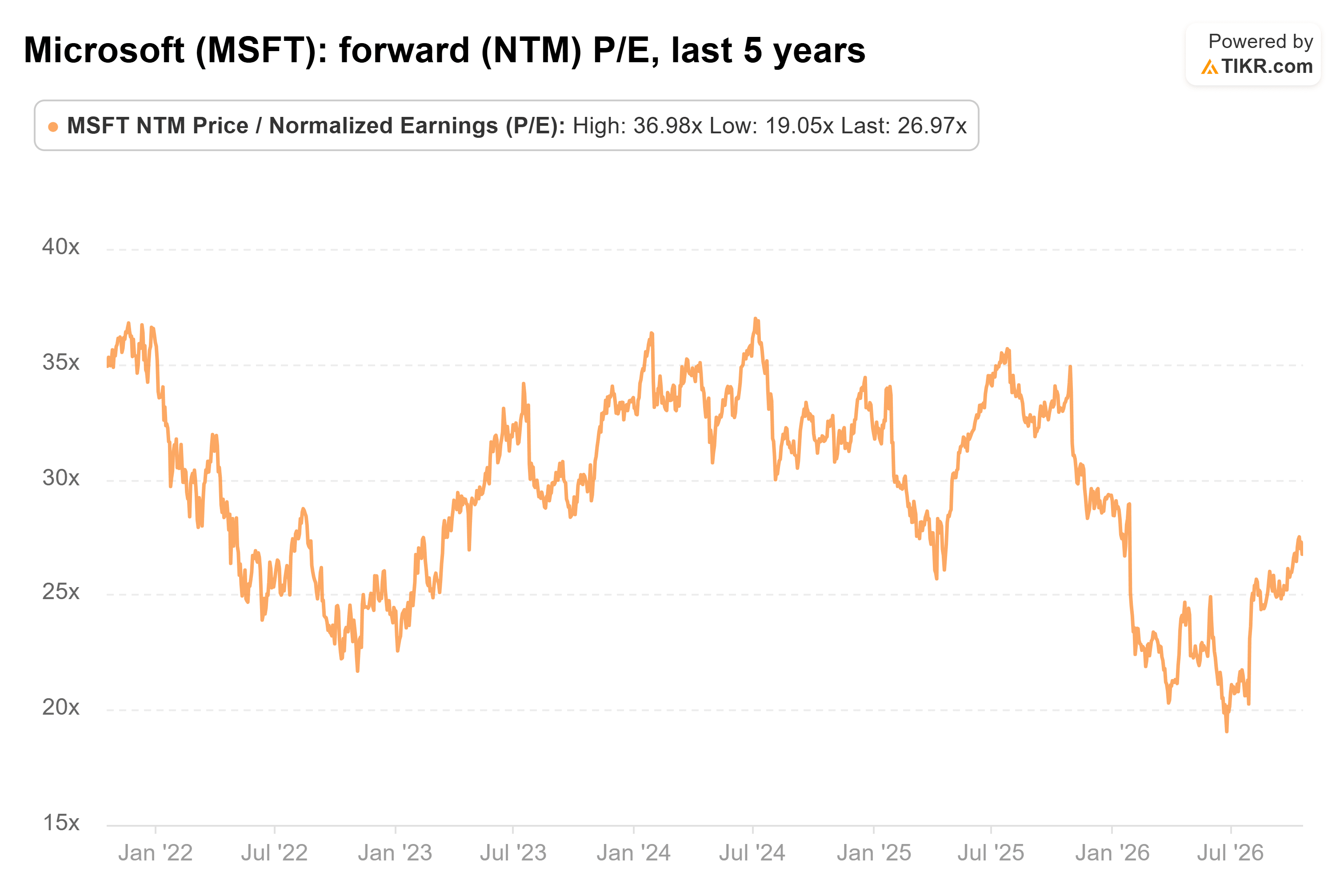
That’s close to what investors have paid for Microsoft through most of the past five years, even though one customer now stands behind a big share of its backlog.
My take: Cramer’s right. Microsoft can handle its OpenAI exposure far better than Oracle can, but at 27x the stock isn’t charging much for it. I’d want the Oct. 28 report to show Azure demand that doesn’t depend on OpenAI before paying up.
Of course, OpenAI expects to reach $70 billion or more of annualized revenue by year-end, according to Bloomberg. If it gets there and keeps raising money, that $270 billion looks a lot safer. Alphabet and Amazon report the same week, so we’ll know soon how much of the cloud boom rides on two AI labs.
So what is Microsoft stock actually worth?
TIKR lets you forecast the future price of any stock in less than a minute. Just enter a few assumptions into TIKR’s valuation model and see what Microsoft could be worth. Start from Wall Street consensus estimates, or adjust the inputs to reflect your own view of the business. It’s free to use.
Disclaimer:
Please note that the articles on TIKR are not intended to serve as investment or financial advice from TIKR or our content team, nor are they recommendations to buy or sell any stocks. We create our content based on TIKR Terminal’s investment data and analysts’ estimates. Our analysis might not include recent company news or important updates. TIKR has no position in any of the stocks mentioned. Thank you for reading, and happy investing!