


Key Takeaways
- Liquidity Cushion: IonQ closed its most recent quarter with $2.12 billion in cash and short-term investments, up from $365.7 million two years earlier, enough to cover more than four years of the company’s $120.3 million quarterly adjusted EBITDA loss.
- Dilution Run Rate: Diluted weighted average shares outstanding climbed 72% between September 2024 and June 2026, from 214.3 million to 367.7 million, with the steepest jump landing the quarter Oxford Ionics closed.
- Quiet Quarter: Share count barely moved across the last three quarters, 368.98 million, then 358.87 million, then 367.66 million, even as quarterly revenue rose 29%, from $61.9 million to $80.1 million.
- Unreflected Deal: SkyWater Technology closed July 31, 2026, a month after that last share count was measured, and the deal was priced partly in IonQ stock, so the next 10-Q will show a dilution step these numbers don’t yet capture.
A Guidance Number Built Mostly From an Acquisition
IonQ (IONQ) raised its 2026 revenue outlook to $450 million to $460 million at its September Investor Day, five weeks after CEO Niccolo de Masi had already lifted standalone guidance to $280 million to $290 million on the August earnings call. CFO Inder Singh built the bigger number by adding Street consensus for SkyWater Technology, the chipmaker IonQ had owned for barely a month, then subtracting an estimated $70 million of intercompany revenue that disappears once IonQ stops billing itself as SkyWater’s own customer.
Singh called the SkyWater side of that math unaudited and said combined EBITDA guidance would come later, once the accountants finished.
That caveat matters because the organic business is genuinely accelerating on its own terms. Quarterly revenue grew from $61.9 million in the fourth quarter of 2025 to $80.1 million in the second quarter of 2026, a 29% gain in two quarters with no acquisition attached to it. The guidance headline investors reacted to on September 8, when the stock jumped as much as 9.6% intraday on the CHIPS Act news and the revenue raise together, is mostly a company IonQ has owned for weeks bolted onto a business that was already growing without it.
The Balance Sheet Rules Out a Cash Crisis
It would be easy to look at a company still posting an adjusted EBITDA loss of $120.3 million a quarter and a GAAP net loss of $1.9 billion, most of it a noncash markdown on warrant valuations, and assume IonQ is running short on capital. The cash figures say otherwise.

Total cash and short-term investments grew from $365.7 million in September 2024 to $2.12 billion in June 2026, a six-fold increase in under two years.
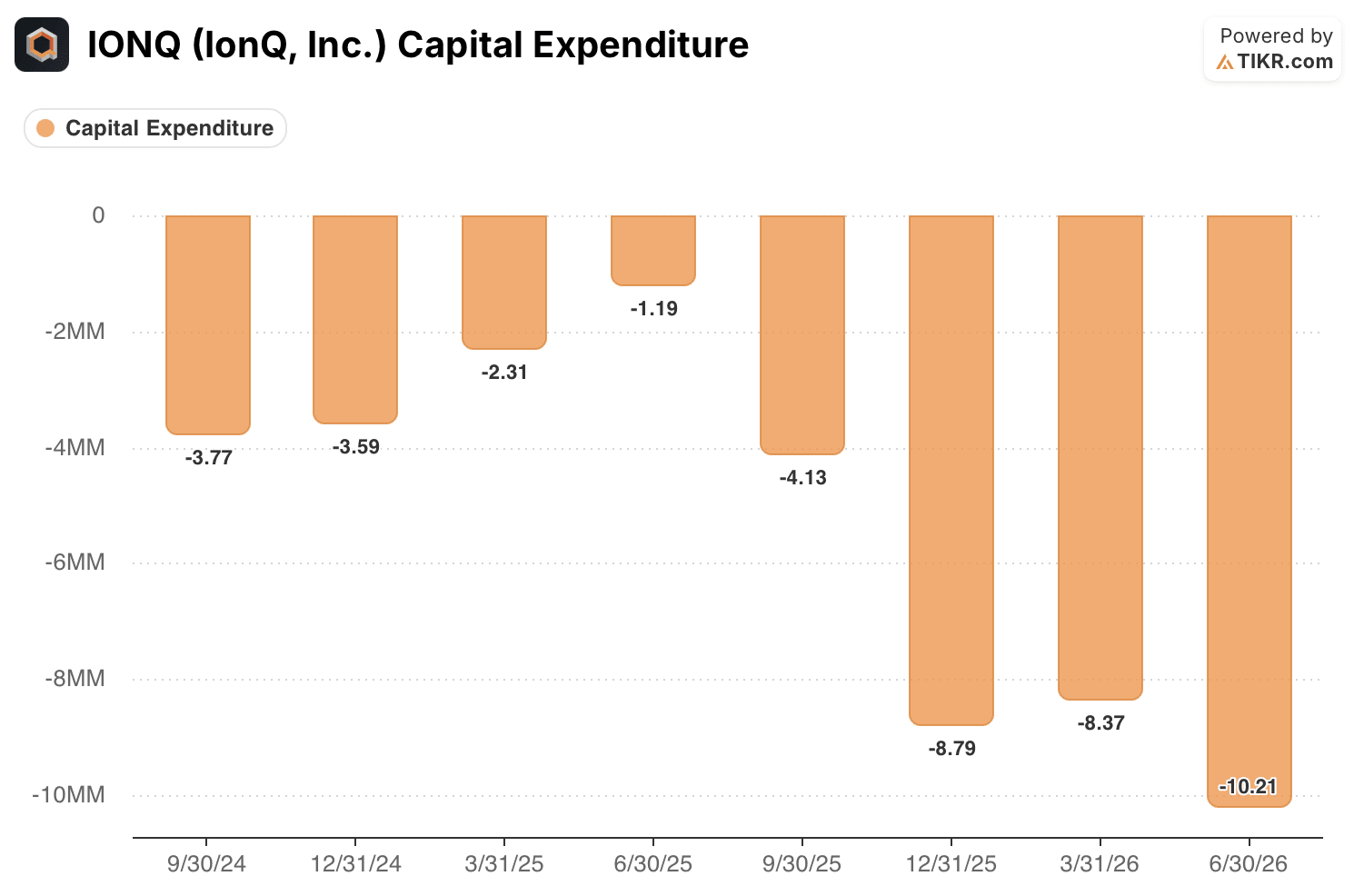
Meanwhile, capital expenditures stayed tiny across the same stretch, climbing from under $4 million a quarter to just $10.2 million in the latest print, because IonQ has historically leaned on outside foundries rather than owning its own fabs. Divide that $2.12 billion cushion by the current quarterly burn rate and IonQ has more than four years of cover before SkyWater’s own cash flows are even added to the picture. Whatever risk sits inside this stock, running out of money in the next few years isn’t it.
How IonQ Actually Pays for Its Platform

That cash didn’t materialize from operations. It shows up alongside diluted weighted average shares outstanding climbing from 214.3 million in September 2024 to 367.7 million in June 2026, a 72% increase in 21 months. The steepest single jump, from 294.5 million to 369.0 million shares, landed in the quarter Oxford Ionics closed last September, a deal IonQ has valued at roughly $1 billion.
SkyWater was structured the same way: $15 in cash and $20 in stock for every SkyWater share, on a deal IonQ priced near $1.8 billion in total equity value, which implies somewhere around $1 billion of freshly issued IonQ stock changing hands. Warrant exercises tied to IonQ’s capital structure add another channel for new shares reaching the market, part of why GAAP net income swings so violently on warrant revaluations each quarter.
None of this is unusual for a company chasing an expensive, capital-intensive roadmap. But it does mean the revenue growth investors are paying up for and the ownership stake they hold against that revenue are not moving together. One grows through operations. The other grows mostly through the next deal.
The Dilution Clock Just Reset
Here is what the last three quarters actually got right. Diluted share count moved from 368.98 million in December 2025 to 358.87 million in March 2026 and back to 367.66 million in June 2026, essentially flat, while quarterly revenue climbed 29% over the same stretch. That is the pattern a shareholder wants: growth funded by the business itself, not by the next stock swap, at least in the gap between acquisitions.
But SkyWater didn’t close until July 31, 2026, a month after that June 30 share count was measured. The next 10-Q will report IonQ’s true post-SkyWater diluted share count for the first time, and given the stock consideration in the deal, it will almost certainly land well above 367.7 million. Whether that new count still leaves shareholders better off per share than they were in June depends on how much of SkyWater’s business actually shows up as IonQ’s own revenue once the $70 million of intercompany sales gets stripped out.
Whether SkyWater Pays for Its Own Dilution
None of this settles into a clean verdict, and it shouldn’t. The cash position rules out a solvency scare, and the last three quarters show IonQ is capable of growing revenue without printing new shares to fund it. The unresolved question is narrower than either the bull case, a platform compounding for free, or the bear case, a company quietly out of runway. It comes down to whether each big acquisition still leaves shareholders with more revenue per share than they had before the ink dried.
By my calculation, using the 367.66 million diluted shares reported for June 2026 and the September 11 closing price of $36.75, IonQ carries a market value near $13.5 billion, or roughly 30 times the midpoint of its own $450 million to $460 million combined revenue guide for 2026. That multiple was set before the market has seen a single quarter of actual post-SkyWater results.
The specific number that will settle this is straightforward. When IonQ reports its first full quarter including SkyWater, compare revenue per diluted share against the 367.7 million share, $80.1 million quarter already on the books. If that ratio holds or improves, the acquisition strategy is paying for its own dilution. If the share count outruns the combined revenue, IonQ shareholders will have funded a more diversified company with a smaller claim on what it earns.
Should You Invest in IonQ, Inc.?
The only way to really know is to look at the numbers yourself. TIKR gives you free access to the same institutional-quality financial data that professional analysts use to answer exactly that question.
Pull up IonQ, Inc. stock and you’ll see years of historical financials, what Wall Street analysts expect for revenue and earnings in the quarters ahead, how valuation multiples have moved over time, and whether price targets are trending up or down.
You can build a free watchlist to track IonQ, Inc. alongside every other stock on your radar. No credit card required. Just the data you need to decide for yourself.
Access Professional Tools to Analyze IONQ stock on TIKR for Free →
Looking for New Opportunities?
- See what stocks billionaire investors are buying so you can follow the smart money.
- Analyze stocks in as little as 5 minutes with TIKR’s all-in-one, easy-to-use platform.
- The more rocks you overturn… the more opportunities you’ll uncover. Search 100K+ global stocks, global top investor holdings, and more with TIKR.
Disclaimer:
Please note that the articles on TIKR are not intended to serve as investment or financial advice from TIKR or our content team, nor are they recommendations to buy or sell any stocks. We create our content based on TIKR Terminal’s investment data and analysts’ estimates. Our analysis might not include recent company news or important updates. TIKR has no position in any stocks mentioned. Thank you for reading, and happy investing!


