


Key Stats for Intuit:
- 52-week high: ~$840
- Current price: $291.09
- Street mean target: ~$430
- Annualized IRR (TIKR mid case): ~15% / year
- Full-year FY2026 revenue guidance: $21.341B – $21.374B (~13% growth)
- FY2025 free cash flow: $6.123B
Now Live: Discover how much upside your favorite stocks could have using TIKR’s new Valuation Model (It’s free) >>>
From $840 to $291: The Steepest Drawdown in Intuit’s Public History
Intuit (INTU) is the company behind TurboTax, the dominant consumer tax-filing software used by tens of millions of Americans each year, and QuickBooks, the small-business accounting platform that manages payroll, invoicing, and cash flow for roughly 7 million businesses.
It also owns Credit Karma, a personal finance platform with hundreds of millions of members, and Mailchimp, one of the most widely used email marketing tools for small businesses.
Together, these products make Intuit one of the most deeply embedded financial software franchises ever built, touching consumers and small businesses at nearly every stage of their financial lives.
The stock has not been treated that way. A max drawdown of 60.92% hit on June 25, 2026, and the stock still sits 55% below its peak today.
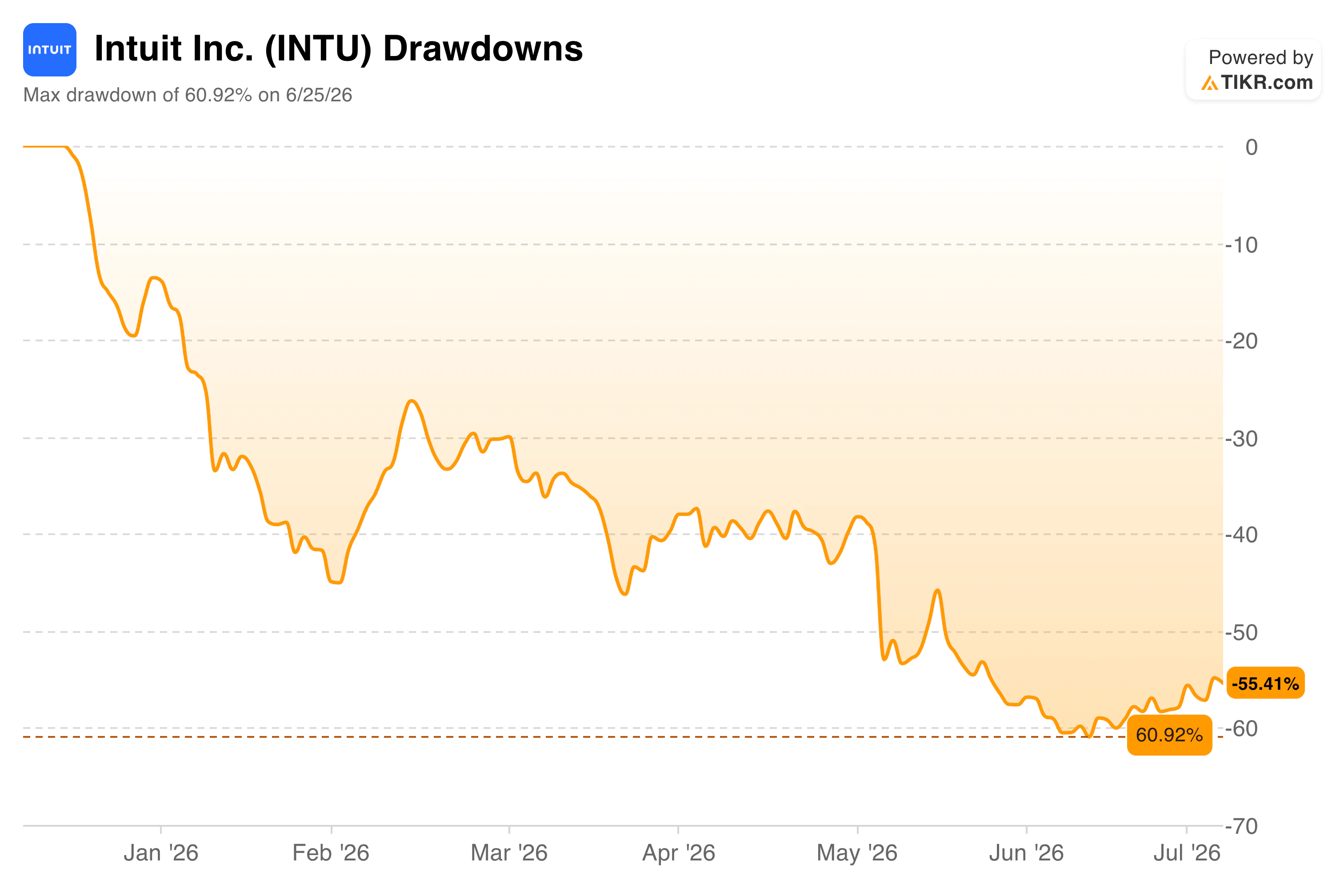
The shape of this drawdown is different from everything else in this batch. There were no sharp relief rallies, no V-shaped recoveries, no moments where the market changed its mind. The line moved in one direction, steadily and relentlessly, for roughly eight months.
The catalyst was a combination of factors hitting at once: Intuit lowered its fiscal 2026 TurboTax revenue forecast and announced plans to cut 17% of its workforce as part of a broader restructuring, sending shares down more than 13% in a single session in May. But the deeper driver was the question beneath it all.
The market is not saying AI kills Intuit tomorrow. It is saying AI may compress the long-term pricing power and growth expectations of the most guidance-heavy parts of Intuit’s business.
TurboTax, which walks users through their tax return question by question, looks more exposed than QuickBooks, which sits within a business’s daily workflow and connects to bank feeds, payroll, vendors, and historical records, a far stickier system.
See what analysts think about INTU stock right now (Free with TIKR) >>>
A Business Generating $6 Billion in Free Cash Flow That Trades Like It Might Not Exist in Ten Years
The bear case on Intuit is coherent. The bull case is also coherent, and it starts with the cash flow chart.
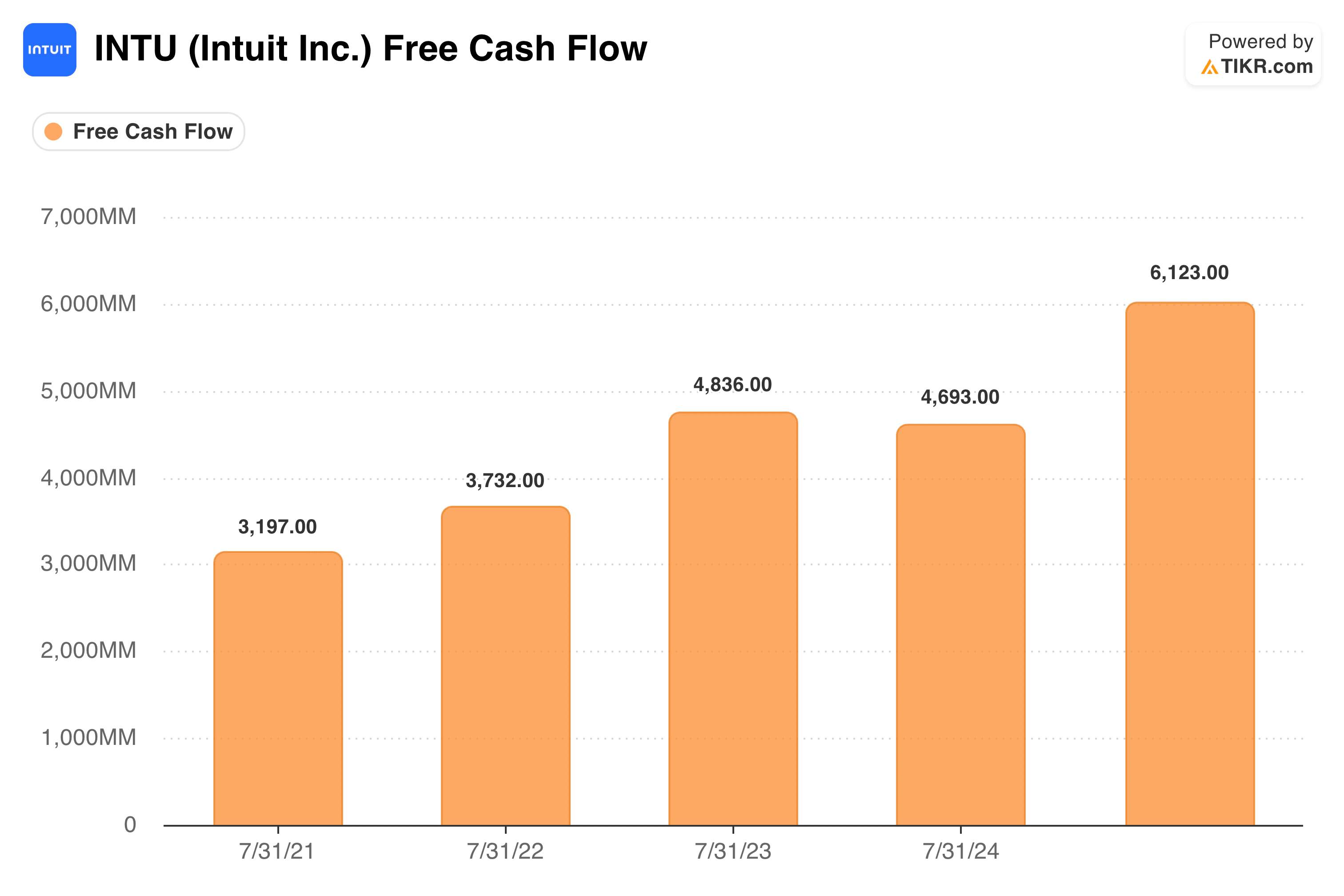
Annual free cash flow grew from $3.2 billion in FY2021 to $3.7 billion in FY2022, $4.8 billion in FY2023, $4.7 billion in FY2024, and $6.1 billion in FY2025. At the current market cap of roughly $80 billion, the stock trades at around 13x trailing free cash flow, a multiple that implies essentially no growth and significant ongoing risk. The business reality looks different.
Full-year FY2026 guidance calls for revenue of around $21.35 billion, representing roughly 13% growth, with non-GAAP EPS of around $23.80 to $23.85. TurboTax Live revenue is projected to climb by about 36% to about $2.8 billion this fiscal year, suggesting the AI-plus-human-assisted model is gaining traction rather than losing it.
Credit Karma’s revenue is growing over 30%. The restructuring, painful as it is, removes cost from a structure built for a prior growth rate and creates room for margin expansion on the other side. Intuit Assist, the generative AI layer launched in 2024, is now expanding across QuickBooks, TurboTax, Mailchimp, and Credit Karma.
The bull case is not that AI leaves Intuit untouched. It is that Intuit has the data, distribution, and customer relationships to use AI as an upsell engine rather than be replaced by it.
See how Intuit performs against its peers in TIKR (It’s free!) >>>
What the Model Says About a Stock Priced for Disruption
TIKR’s valuation model points to a mid-case target of around $506, implying roughly 74% total return over the next four years, or about 15% annualized.

The most important detail in this model is the P/E compression assumption: around 12% annually in the mid case.
Even with that significant multiple headwind built in, the model still projects 15% annualized returns, driven entirely by earnings growth. The scenario range runs from around 10% annualized on the low end to around 17% on the high end.
Historically, Intuit traded at 35x to 39x forward earnings. At the current price of $291, the stock is valued at roughly 14x FY2026 non-GAAP EPS guidance, one of the lowest multiples in the company’s modern history.
The model’s mid-case assumes further multiple compressions, which means even a partial re-rating toward historical norms would produce returns well above what the model projects.
The street mean target sits around $430, implying around 48% upside from current levels, with a broad range of analysts split between those who believe the AI disruption risk is overpriced and those who see structural impairment in TurboTax that the market has not yet fully processed.
Should You Invest in Intuit?
Intuit is the most genuinely difficult call in this batch. The free cash flow is real, the guidance is intact, and the valuation has compressed to levels that price in a lot of bad news.
The bear case rests on a plausible structural shift, and the sustained nature of the drawdown suggests the market is not treating this as a temporary sentiment problem.
Whether the AI disruption fears are appropriately priced or overdone depends on how quickly consumer tax behavior changes and on whether QuickBooks can defend its small-business relationships against cheaper AI-native competitors. The model suggests meaningful upside if execution holds.
See analysts’ growth forecasts and price targets for Intuit stock (It’s free!) >>>
Looking for New Opportunities?
- See what stocks billionaire investors are buying so you can follow the smart money.
- Analyze stocks in as little as 5 minutes with TIKR’s all-in-one, easy-to-use platform.
- The more rocks you overturn… the more opportunities you’ll uncover. Search 100K+ global stocks, global top investor holdings, and more with TIKR.
Disclaimer:
Please note that the articles on TIKR are not intended to serve as investment or financial advice from TIKR or our content team, nor are they recommendations to buy or sell any stocks. We create our content based on TIKR Terminal’s investment data and analysts’ estimates. Our analysis might not include recent company news or important updates. TIKR has no position in any stocks mentioned. Thank you for reading, and happy investing!


