
Key Stats for Cadence Stock
- Friday Performance: -9%
- 52-Week Range: $263 to $417
- Valuation Model Target Price: Around $397
- Implied Upside: Around 20%
Analyze your favorite stocks like Cadence Design Systems with TIKR (It’s free) >>>
What Happened?
Cadence Design Systems stock fell 9% on Friday, dropping from $365 to $330 and trading as low as $320 as investors questioned whether agentic AI could weaken demand for its chip-design software. Volume reached 5.2 million shares, more than double its recent average of 2.4 million, showing that disruption concerns overwhelmed positive company and analyst news.
The stock fell because Moonshot AI’s Kimi K3 reportedly designed a functional chip during a 48-hour run using open-source tools, raising concerns that general-purpose AI agents could weaken demand and pricing for electronic design automation software, the specialized programs engineers use to design and verify chips.
Cadence’s closest competitors are Synopsys and Siemens EDA; Synopsys also fell about 8% Friday, although its latest quarterly revenue increased 42% to $2.276 billion, partly reflecting the Ansys acquisition. Mizuho argued that Kimi K3 still depended on existing EDA tools rather than replacing the underlying software, suggesting AI agents could ultimately increase the number of chips designed and expand demand for paid design tools. Cadence’s new AuraStack AI system and Rapidus partnership supported that view by applying agentic AI to circuit-board, advanced-packaging, and system-on-chip development.
At Cadence’s June 9 investor conference, Vice President of Investor Relations Richard Gu said the company expects 2026 revenue to grow around 17% and adjusted operating margin to reach around 44%. Together, those figures would put Cadence above the Rule of 60, a software-industry benchmark combining revenue growth and profit margin, for a company record. Gu added that its intellectual-property business, which supplies reusable connectivity and memory components for chip designs, is expected to grow about 23% this year, while its ChipStack AI assistant delivered more than a 40-fold productivity improvement for one customer’s engineering team. Gu said Cadence plans to monetize its AI agents through “a combination of subscription plus consumption,” allowing the company to collect base fees and additional revenue as customers use the software for more design work.
Analyst actions remained positive this week, with Rosenblatt raising its price target from $375 to $410, Benchmark initiating coverage with a Buy rating and a $450 target, and Mizuho maintaining its Outperform rating following Friday’s decline. First-quarter institutional filings were mixed: Fifth Third Bancorp increased its position by 117.1% to 120,809 shares, LGT Fund Management raised its stake by 34.5% to 13,004 shares, and Bessemer Group reduced its holdings by 31.9% to 429,154 shares. These filings reflect positions as of March 31 and did not cause Friday’s decline, but they show that large investors were divided before the AI disruption debate intensified. Cadence’s July 27 earnings report now becomes the next test of its around 17% revenue-growth outlook, around 44% margin target, and AI monetization strategy.

Value Cadence Design Systems instantly (Free with TIKR) >>>
Is Cadence Stock Fairly Valued?
Under the valuation assumptions, the stock is modeled using:
- Revenue Growth (CAGR): Around 15%
- Operating Margins: Around 44%
- Exit P/E Multiple: Around 34x
The model’s 15% revenue-growth assumption sits below management’s 2026 outlook of around 17% and accounts for an expected slowdown in later years, making it more defensible than simply extending the current growth rate.
Cadence ended the first quarter with an $8.0 billion backlog and expects $4.0 billion of remaining performance obligations to be recognized as revenue within 12 months, while the Hexagon Design and Engineering acquisition expands its addressable market into mechanical simulation for automotive, aerospace, and robotics customers.
See analysts’ growth forecasts and price targets for Cadence Design Systems (It’s free) >>>
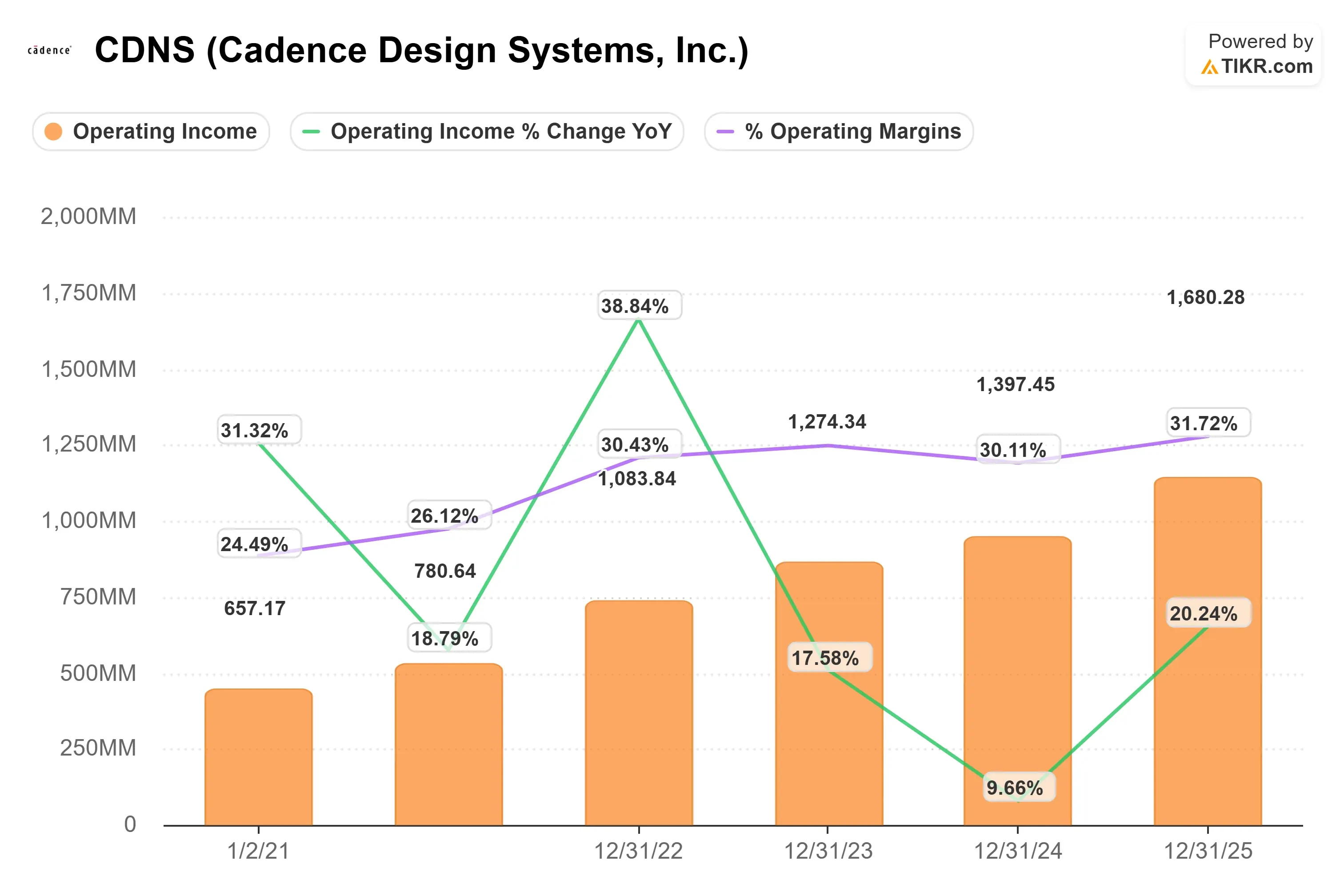
Across the period shown, Cadence’s GAAP operating income increased from about $657 million to $1.68 billion as operating margin expanded from 24.5% to 31.7%, while the model’s 44% assumption matches management’s adjusted outlook, which excludes items such as stock-based compensation and acquisition-related expenses.
The 34x exit P/E sits below Cadence’s current forward multiple of about 41x and its five-year average of about 44x; based on these inputs, the model estimates a target price of around $397, implying around 20% total upside over about two and a half years, or an annualized return of around 8%, which makes Cadence look fairly valued rather than clearly undervalued.
Performance through the rest of 2026 depends on converting backlog into revenue, completing the AuraStack rollout, generating consumption fees from its AI agents, cross-selling Hexagon’s simulation products, and proving that AI increases paid design activity faster than open-source alternatives threaten pricing.
How Much Upside Does CDNS Stock Have From Here?
Investors can estimate Cadence Design Systems’ potential share price, or what any stock could be worth, in under a minute using TIKR’s New Valuation Model tool.
All it takes is three simple inputs:
- Revenue Growth
- Operating Margins
- Exit P/E Multiple
From there, TIKR calculates the potential share price and total returns under Bull, Base, and Bear scenarios so you can quickly see whether a stock looks undervalued or overvalued.
If you’re not sure what to enter, TIKR automatically fills in each input using analysts’ consensus estimates, giving you a quick, reliable starting point.
Value Cadence Design Systems in under 60 seconds with TIKR (It’s free) >>>