Key Takeaways
- CFO David Kieske called buybacks pointless for VICI right now, favoring loans yielding near 9.5% and the new Club Med deal instead.
- VICI’s quarterly dividend rose from $0.43 to $0.45, unchanged since.
- VICI stock’s payout ratio jumped to 91.33% in the most recent quarter even as its NTM dividend yield reached 7.64%, the top of its range.
- TIKR’s mid-case model puts VICI stock at a $38 target by the end of 2031, a potential total return of 57% and an annualized rate of 11% a year.
VICI’s payout ratio just spiked to 91.33% while its yield hit 7.64%. See how those numbers square with each other. Analyze VICI stock on TIKR for free →
VICI Properties Skips Buybacks Because Its Capital Earns More Elsewhere
VICI Properties (VICI) used its second-quarter 2026 call to make a specific case for how it spends money, and buybacks lost. Analyst Greg McGinniss asked directly whether the REIT would consider repurchasing shares once its heavy investment pipeline clears.
CFO David Kieske didn’t hedge.
He said putting capital out at “SOFR plus 8.25%” on the One Beverly Hills loan, with the broader loan book yielding close to 9.5%, beats a buyback “by a lot,” and called the Club Med transaction “a very attractive return” too.
Then he added the structural point: for a net lease REIT whose growth depends on deploying capital, buybacks are “just not something that makes a lot of sense.”
That statement matters because VICI stock’s dividend has always been funded by growth, not by shrinking the share count.
On the same call, David Kieske reported adjusted funds from operations, AFFO, of $0.62 per share for the quarter, up from $0.60 a year earlier, a gain he described as 5%.
He also raised full-year 2026 AFFO guidance to a range of $2.45 to $2.47 per diluted share, lifting the low end by a cent from the prior outlook. At the midpoint of that raised guidance, VICI Properties expects AFFO per share to grow 3% year over year in 2026.
Kieske paired that with a balance sheet update: net debt sat at roughly 4.9 times annualized second-quarter adjusted EBITDA, below the REIT’s own target range of 5 to 5.5 times, with $2.5 billion in total liquidity, including $2.2 billion of revolver availability.
Set against that leverage cushion, the decision to route free cash flow into 9.5%-yielding loans and new tenant relationships like Club Med reads less like a choice against shareholders and more like one that keeps the AFFO base, and the dividend it funds, growing.
VICI’s CFO said its loan book yields near 9.5%, a return buybacks can’t match. Explore VICI stock on TIKR for free →
VICI Stock’s Payout Ratio Hits 91% While AFFO Guidance Still Points Higher
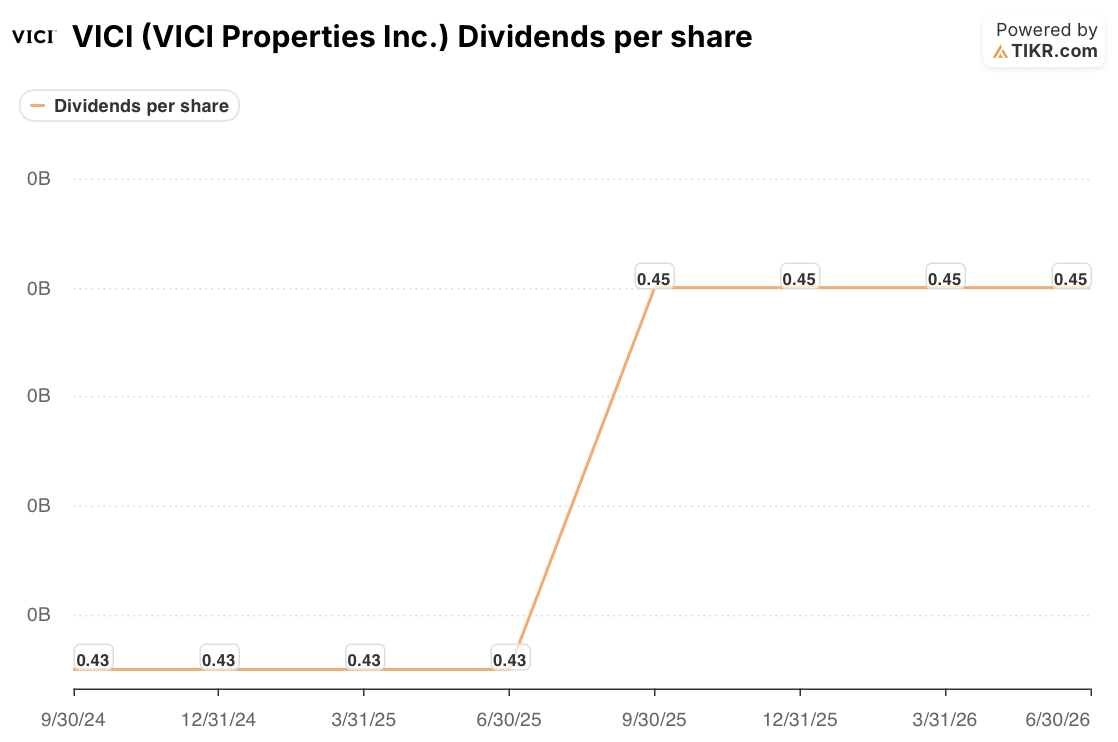
VICI stock’s dividend history shows a company that moves in one direction only, even if it rarely rushes. The quarterly dividend held flat at $0.43 for four consecutive quarters, from September 2024 through June 2025, then stepped up to $0.45 starting in September 2025 and has held there for four quarters running.
That single move, not a string of small increases, is the entire raise on record here. For a landlord whose tenants are casino operators paying long-dated leases, a dividend that only ever holds or rises is the point.
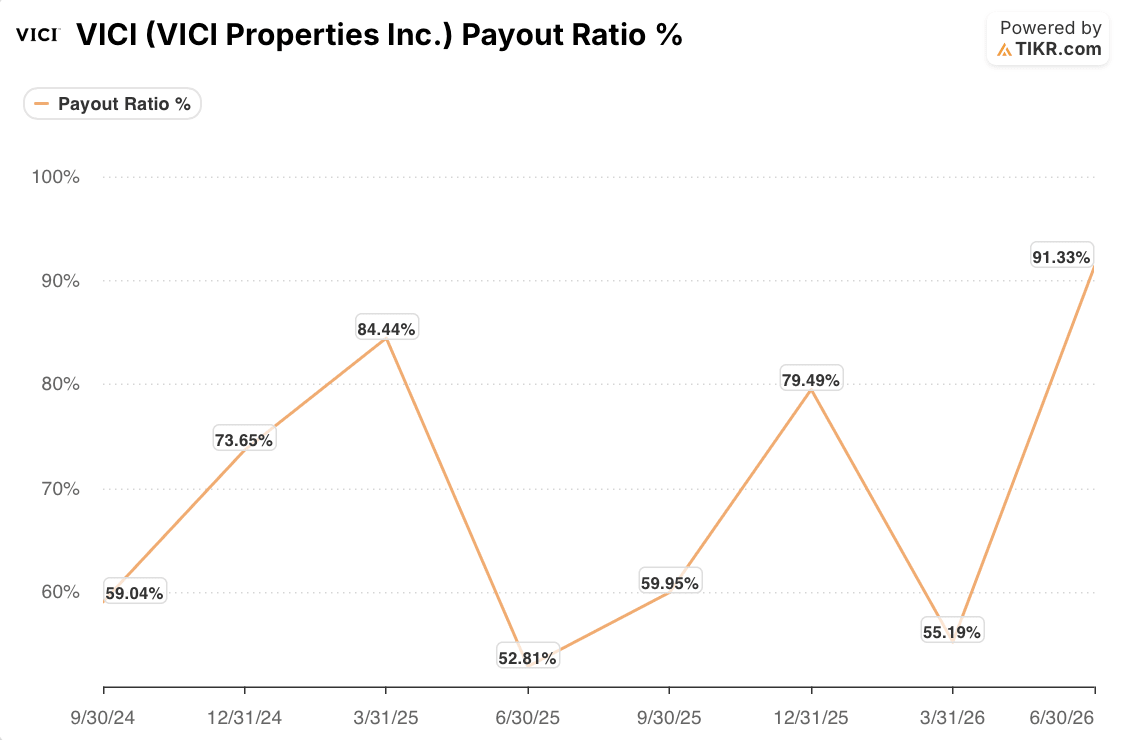
The payout ratio tells a noisier story. It swung from 59.04% in September 2024 to 84.44% by March 2025, back to 52.81% in June 2025, then to 91.33% by June 2026, its highest reading in the stretch. That kind of quarter-to-quarter swing is normal for a REIT, since payout ratios get calculated off net income lines that can move with one-time items.
That is exactly why the AFFO figures management gave on the call carry more weight than the ratio alone. Kieske’s guidance for $2.45 to $2.47 in AFFO per share this year, growing 3% at the midpoint, describes a payout management believes it can keep funding from operating cash flow. That holds even as the ratio spikes. Still, a 91.33% reading is not one to wave off. It leaves less room than the 52.81% level from a year earlier, and if that ratio keeps climbing toward 100%, the cushion behind future raises gets thinner even as the AFFO base grows.

The yield adds the final piece. VICI stock’s NTM dividend yield last printed at 7.64%, matching the high point of its own range and sitting well above the 5.89% mean and the 5.06% low over the period shown. A stock yielding near the top of its own multi-year band usually means one of two things.
Either the market has bid the shares down relative to the payout, or investors are pricing in real risk to it. Given that the dividend itself has never been cut in this data and just took its only step up to $0.45, the more likely read is the first one.
For an income buyer, the payout ratio near its ceiling and the yield near its own high tell two different stories, but the dividend itself has only ever gone up. The number that decides where it goes next isn’t the payout ratio’s next print. It’s whether management’s capital discipline on this call holds.
TIKR’s Model Puts VICI Stock’s Target at $38 by 2031
TIKR’s mid-case model puts VICI stock at a $38 target by the end of 2031, up from a current price of $24, for a potential total return of 57% and an annualized rate of 11% a year.

An 11% annualized return that blends both price appreciation and income puts VICI stock among REITs whose total-return case doesn’t depend on the market re-rating the shares alone.
That target looks reachable against the growth picture management laid out on the call: AFFO per share guided to $2.45 to $2.47 for 2026, a loan book yielding close to 9.5%, and $2.5 billion in liquidity to keep funding new relationships like Club Med. VICI Properties enters the second half of 2026 with leverage below its own target range, giving it room to keep compounding AFFO without leaning on financial engineering to hit TIKR’s target.
TIKR’s model sees VICI stock returning 57% by 2031, an 11% annualized rate. Check the assumptions yourself. Research VICI stock on TIKR for free →
Should You Invest in VICI Properties Inc.?
The only way to really know is to look at the numbers yourself. TIKR gives you free access to the same institutional-quality financial data that professional analysts use to answer exactly that question.
Pull up VICI Properties Inc. stock and you’ll see years of historical financials, what Wall Street analysts expect for revenue and earnings in the quarters ahead, how valuation multiples have moved over time, and whether price targets are trending up or down.
You can build a free watchlist to track VICI Properties Inc. alongside every other stock on your radar. No credit card required. Just the data you need to decide for yourself.
Access Professional Tools to Analyze VICI stock on TIKR for Free →
Looking for New Opportunities?
- See what stocks billionaire investors are buying so you can follow the smart money.
- Analyze stocks in as little as 5 minutes with TIKR’s all-in-one, easy-to-use platform.
- The more rocks you overturn… the more opportunities you’ll uncover. Search 100K+ global stocks, global top investor holdings, and more with TIKR.
Disclaimer:
Please note that the articles on TIKR are not intended to serve as investment or financial advice from TIKR or our content team, nor are they recommendations to buy or sell any stocks. We create our content based on TIKR Terminal’s investment data and analysts’ estimates. Our analysis might not include recent company news or important updates. TIKR has no position in any stocks mentioned. Thank you for reading, and happy investing!