
Key Takeaways
- Energy Transfer (ET) posted Q2 2026 adjusted EBITDA of roughly $5.1 billion, up from $3.9 billion a year earlier, and raised full year guidance to $18.8 billion to $19.1 billion, its second upward revision this year.
- Management told analysts on the Q2 call that return thresholds on new growth projects are rising, not falling, even as organic capital spending climbs to $5.6 billion to $5.9 billion in 2026 and is expected to stay above $5 billion a year through 2029.
- TIKR data back that claim, for now. Return on Capital rose from 7.55% at year end 2025 to 11.29% by June 2026, Net Debt to EBITDA fell from 4.41x to 3.33x over the same stretch, and free cash flow swung from barely covering dividends in Q4 2025 to more than double covering them by Q2 2026.
- Management is explicit that part of the beat came from commodity volatility it is not forecasting to repeat in the back half of 2026, and the heaviest, not yet earning phases of Desert Southwest and other projects are still years away.
Energy Transfer’s Pipeline Network Sits Right Under the Data Center Boom

Energy Transfer (ET) built most of its footprint decades before anyone was sizing power lines for AI training clusters. Co-CEO Marshall McCrea made the point plainly on the Q2 earnings call: when data center site selection started a few years ago, “we looked at the map and then we looked at where a lot of the proposed data centers were going and they were on top of our pipeline.” That is a convenient accident, but the company has spent the past two years converting it into contracted demand.
The clearest example is the Hugh Brinson Pipeline, which entered commercial service during the quarter and is running ahead of its own construction schedule, with full Phase 1 capacity of 1.5 billion cubic feet a day expected by September 1, 2026. Shippers on that line include Florida utilities and Texas data center and power customers, several of whom have already added incremental volume to their contracts. Management also flagged a structural edge: most of its power plant and data center deals are behind the meter, meaning those customers generate their own electricity on site rather than waiting in line for a grid interconnection. That matters because interconnection queues, not gas supply, are the bottleneck slowing several competing power projects nationally.
Desert Southwest, the larger and later pipeline aimed at Arizona and New Mexico power demand, is moving through FERC scoping meetings and is still targeted for the back half of 2029. Mustang Draw II, a Permian processing expansion, and Frac IX, a new fractionator at Mont Belvieu, are both due late in 2026 but will contribute only marginally to this year’s results. In other words, most of the growth story is still ahead of the company, not behind it.
The Numbers Start Backing Up the Pitch
That framing would be easy to wave off as guidance-speak if the return data did not move with it.
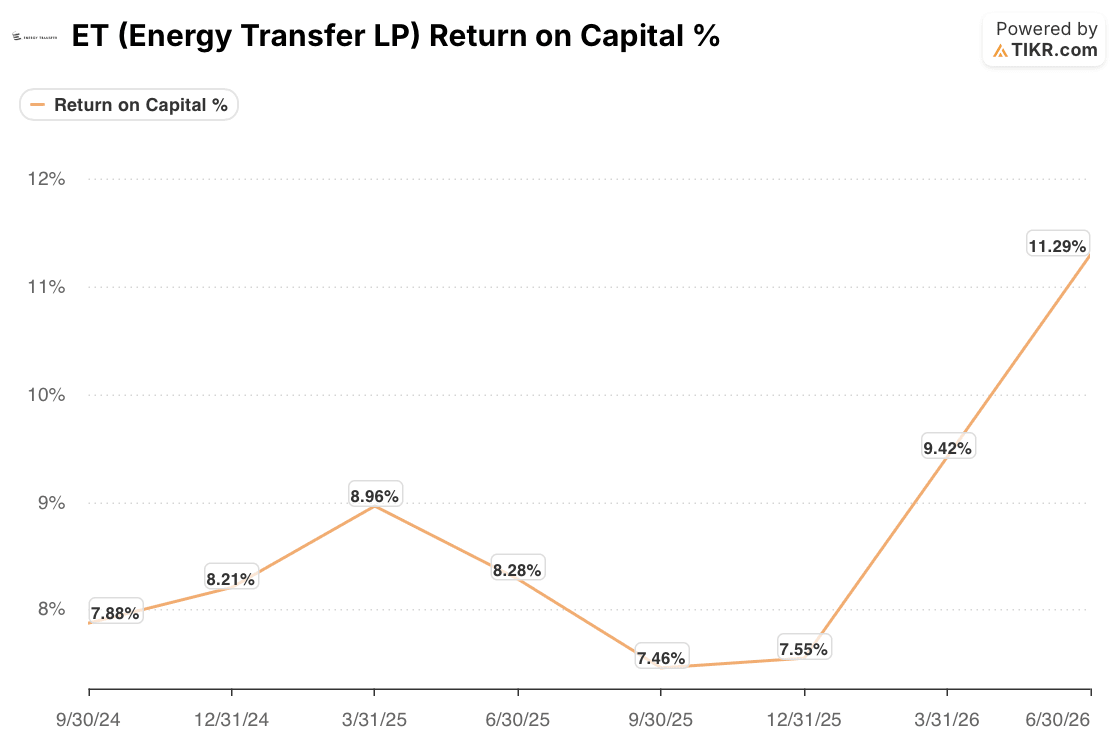
Energy Transfer’s Return on Capital sat in a narrow 7.5% to 9% band for six straight quarters through late 2025, then jumped to 9.42% in the first quarter of 2026 and 11.29% in the second, its highest reading in the two year period. Leverage moved the same direction. Net Debt to EBITDA had drifted up to 4.41x at the end of 2025, near the top of management’s stated 4x to 4.5x target, then fell to 3.80x and 3.33x over the next two quarters, even as the company priced $3.0 billion of senior notes in January to keep funding its capital program.
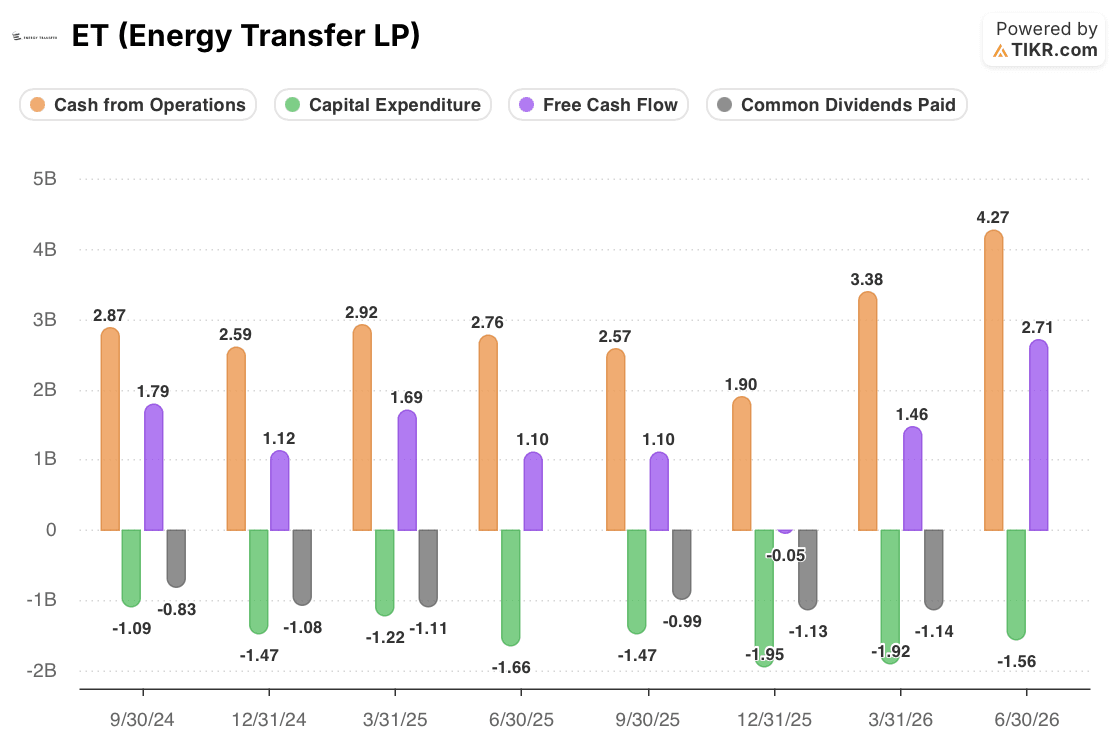
Free cash flow tells the sharpest version of the story. It nearly cratered in the fourth quarter of 2025, when capital expenditure spiked to roughly $1.95 billion against operating cash flow of $1.90 billion, essentially wiping out the cushion above that quarter’s dividend payment. By the second quarter of 2026, free cash flow reached about $2.71 billion against a dividend of a similar size to prior quarters, comfortably more than double coverage.
What Energy Transfer’s Improvement Isn’t Proof Of Yet
CFO Dylan Bramhall was careful on the call to separate the base business from the tailwind. He told analysts the company does not have “much of” the wider commodity spreads and price swings from the first half of 2026 built into its second half plan, and that additional volatility would be what pushes results toward the high end of guidance rather than the assumed case. Record NGL export premiums, blending margins, and crude market arbitrage all contributed materially to the quarter, and none of those are contracted, repeatable revenue.
The 2025 trough is also a reminder that the current run of strong quarters followed a period when leverage crept toward its ceiling and free cash flow briefly stopped covering the distribution. Two strong quarters do not erase that pattern; they interrupt it. Meanwhile, the company’s most capital intensive, longest dated projects, Desert Southwest and the still unresolved MLO2 pipeline tied up in Canadian regulatory negotiations, have not yet started contributing to EBITDA and will keep absorbing capital for years before they do. Co-CEO Marshall McCrea’s planned retirement by the end of 2026 also hands sole leadership to Thomas Long during the stretch when Desert Southwest execution matters most.
The Thesis Depends on the Next Two Quarters, Not the Last Two
The evidence so far supports a specific, narrower claim than “data centers will drive Energy Transfer higher”: the company’s most recent capital has generated better returns than its 2025 vintage did, and it financed that growth without breaching its own leverage ceiling. That is a meaningfully different claim from saying the trend is now durable. The honest read is that Energy Transfer converted a real structural advantage, gas infrastructure already positioned under demand growth, into two quarters of standout returns that were flattered by volatility management itself says will not repeat.
The metric worth watching is whether Return on Capital and free cash flow coverage hold near their second quarter levels once Mustang Draw II and Frac IX ramp without the extra market volatility, and once the July 2026 junior subordinated notes start adding interest expense without a matching offsetting boost from trading conditions. If leverage stays under 4x and coverage stays above the roughly 2x seen in the second quarter through the back half of 2026, the return improvement will look structural. If it slides back toward the 2025 range once the noisier commodity backdrop fades, the current spike will look more like a favorable quarter than a new baseline.
Should You Invest in Energy Transfer LP?
The only way to really know is to look at the numbers yourself. TIKR gives you free access to the same institutional-quality financial data that professional analysts use to answer exactly that question.
Pull up ET stock and you’ll see years of historical financials, what Wall Street analysts expect for revenue and earnings in the quarters ahead, how valuation multiples have moved over time, and whether price targets are trending up or down.
You can build a free watchlist to track Energy Transfer LP alongside every other stock on your radar. No credit card required. Just the data you need to decide for yourself.
Access Professional Tools to Analyze ET stock on TIKR for Free →
Looking for New Opportunities?
- See what stocks billionaire investors are buying so you can follow the smart money.
- Analyze stocks in as little as 5 minutes with TIKR’s all-in-one, easy-to-use platform.
- The more rocks you overturn… the more opportunities you’ll uncover. Search 100K+ global stocks, global top investor holdings, and more with TIKR.
Disclaimer:
Please note that the articles on TIKR are not intended to serve as investment or financial advice from TIKR or our content team, nor are they recommendations to buy or sell any stocks. We create our content based on TIKR Terminal’s investment data and analysts’ estimates. Our analysis might not include recent company news or important updates. TIKR has no position in any stocks mentioned. Thank you for reading, and happy investing!