
Key Stats for CMCSA Stock
- Past week’s performance: -1.6%
- 52-week range: $21 to $34
- Valuation model target price: $31
- Implied upside: 16.7% over 2.3 years
Value your favorite stocks like CMCSA with 5 years of analysts’ forecasts using TIKR’s new Valuation Model (It’s free) >>>
Peacock Turns a Profit, but Wall Street Wants More
Comcast (CMCSA) shares slipped modestly this week, trading near $26 as investors digested a mixed set of signals from the media and telecom giant. The stock has been volatile since Comcast reported second quarter results in late July, and this week’s move reflects ongoing questions about the pace of NBCUniversal’s planned spinoff.

The headline number from earnings was a beat. Comcast posted adjusted earnings per share of $1.04, above the $0.97 analysts expected, but adjusted EBITDA fell about 13% year over year because cable connectivity, Comcast’s core broadband business, keeps losing ground to fiber and fixed wireless competitors. So the market is weighing real strength in streaming against real weakness in the legacy cable pipe.
Peacock, Comcast’s streaming service, posted its first-ever profitable quarter, with $189 million in adjusted EBITDA. Subscription revenue jumped more than 50%, and advertising revenue climbed nearly 70%, while paid subscribers grew by a net 2 million to 48 million. Shortly after earnings, Peacock raised prices by 18%, its fourth increase in four years, pushing the ad-supported tier to $12.99 a month.
CEO Brian Roberts has repeatedly framed streaming profitability and sports rights as central to Comcast’s next act, and the quarter gave that thesis some real evidence. If Comcast stock can find a floor, Peacock’s turn to profit and the newly announced YouTube partnership look like the two catalysts most likely to do it.
See how analysts model Comcast’s next five years with TIKR’s Guided Valuation Model (It’s free) >>>
Is CMCSA Stock Undervalued?
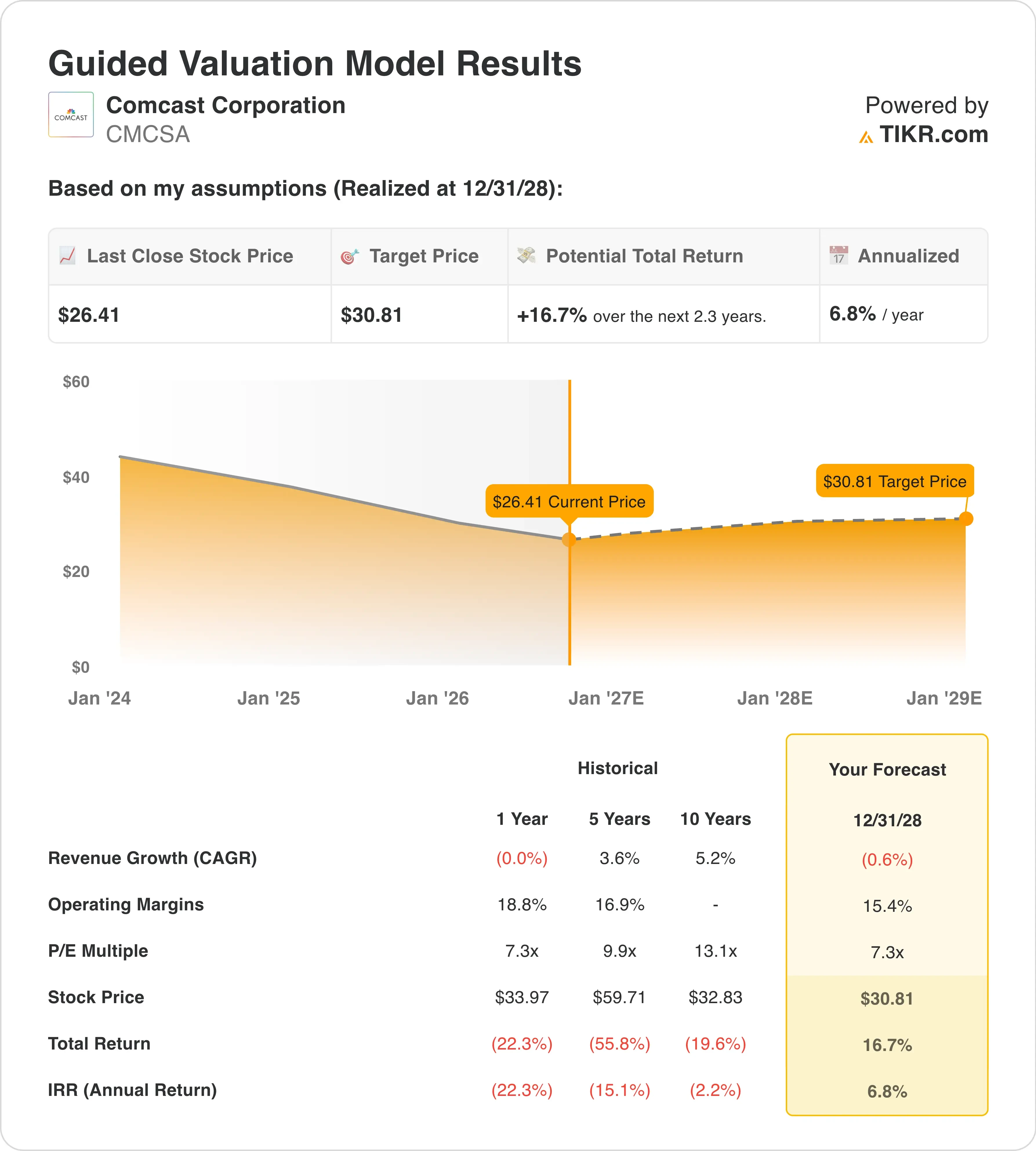
Under valuation model assumptions realized through 12/31/28, the stock is modeled using:
- Revenue growth (CAGR): -0.6%
- Operating margins: 15.4%
- Exit P/E multiple: 7.3x
Based on these inputs, the model estimates a target price of $31, implying 16.7% total upside from the current share price and a 6.8% annualized return over the next 2.3 years.
Comcast trades at roughly 8.5x trailing earnings, a discount that reflects genuine concern about broadband subscriber losses rather than optimism about streaming. Because the model assumes essentially flat revenue growth, the return case leans almost entirely on Comcast holding its current margin structure while the market gives it credit for Peacock’s newfound profitability.

That is a lower bar than most growth stories require, but it still depends on execution. Cable connectivity revenue has been shrinking as households switch to fiber and fixed wireless alternatives, so any upside in the model has to come from wireless bundling, Peacock, and cost discipline rather than the traditional cable business.
The pending NBCUniversal spinoff adds another layer of uncertainty to the multiple. Investors do not yet know how the market will price a standalone media company versus a leaner connectivity business, and that separation could unlock value or simply split one discounted stock into two.
Model Comcast’s separation scenario yourself (Free with TIKR) >>>
Cable Giants and Streaming Rivals: How Comcast Stacks Up
Comcast’s closest broadband peer is Charter Communications (CHTR), which is also fighting subscriber attrition as fiber providers expand. Charter posted second quarter revenue of $13.5 billion, down 1.7% year over year, with an operating margin of 23.3%, and the stock trades at a forward price-to-earnings ratio of roughly 5.4x, even cheaper than Comcast’s multiple. Charter is also mid-acquisition of Cox Communications, a deal expected to close imminently, which adds scale but also integration risk that Comcast does not currently carry.

On the streaming side, Comcast’s Peacock is still a distant fourth behind Netflix, Disney+, and Amazon Prime Video in subscriber count, though its new YouTube bundling agreement gives it distribution reach those rivals cannot match. The Walt Disney Company (DIS) remains the more direct media comparison, since both companies are managing legacy cable networks alongside growing streaming units, though Disney’s streaming arm reached profitability earlier and at greater scale.
Comcast’s moat is really its bundle: broadband, wireless, and now a profitable streaming service under one roof, plus the leverage of NBCUniversal’s sports rights. Whether that bundle is worth more together or split apart is exactly what the spinoff will test.
What’s Driving CMCSA Stock Going Forward?
The YouTube partnership announced in July is the biggest forward catalyst on the table. Starting in early 2027, Peacock Premium will be bundled with YouTube Premium in the United States, giving Comcast access to more than 125 million global Premium and Music subscribers. Because this is Peacock’s largest wholesale distribution deal to date, it could meaningfully accelerate subscriber growth without Comcast having to spend heavily on its own marketing.
The NBCUniversal spinoff remains the other major event to watch. Comcast has paused share buybacks during the separation process to preserve financial flexibility, and management recently named a new chief financial officer, both signs that the company is preparing its balance sheet for a split. If the spinoff proceeds smoothly, investors could get a cleaner read on what the connectivity business and the media business are each worth on their own.
Regulatory catalysts also loom. The FCC recently voted to end a 39% cap on local TV station ownership, which could open the door to further consolidation in Comcast’s broadcast footprint. Meanwhile, Universal Studios Japan’s planned $1.9 billion expansion signals continued investment in theme parks, a segment that has been a steady cash generator even as cable struggles.
Estimate a company’s fair value instantly (Free with TIKR) >>>
Should You Invest in Comcast?
The only way to really know is to look at the numbers yourself. TIKR gives you free access to the same institutional-quality financial data that professional analysts use to answer exactly that question.
Pull up CMCSA, and you’ll see years of historical financials, what Wall Street analysts expect for revenue and earnings in the quarters ahead, how valuation multiples have moved over time, and whether price targets are trending up or down.
You can build a free watchlist to track CMCSA alongside every other stock on your radar. No credit card required. Just the data you need to decide for yourself.
Analyze CMCSA stock on TIKR Free→
Disclaimer:
Please note that the articles on TIKR are not intended to serve as investment or financial advice from TIKR or our content team, nor are they recommendations to buy or sell any stocks. We create our content based on TIKR Terminal’s investment data and analysts’ estimates. Our analysis might not include recent company news or important updates. TIKR has no position in any stocks mentioned. Thank you for reading, and happy investing!