
Key Takeaways
- Coca-Cola reports third-quarter results before the open on Tuesday, Oct. 27. That comes less than three weeks after PepsiCo cut its 2026 outlook for core EPS growth to 2.5% to 3.5%.
- PepsiCo’s dividend yields about twice as much, but Coca-Cola has faster earnings growth and more cash behind its payout.
- Leaving out two one-time payments, Coca-Cola’s dividend took 77% of free cash flow in 2025, and its 2026 guidance would cover it at about 73%.
- The report has to show a higher operating margin, full-year EPS guidance that keeps up with analysts’ $3.31, and free cash flow guidance still at about $12.4 billion.
Coca-Cola (KO) reports its third-quarter results before the open on Tuesday, Oct. 27. Income investors choosing between the two big cola dividends will get their first hard numbers since PepsiCo stumbled.
On Oct. 8, PepsiCo (PEP) cut its 2026 outlook for core EPS growth to 2.5% to 3.5%. It had been guiding to the low end of 5% to 7%. Coca-Cola has gone the other way this year, raising its 2026 guidance for comparable EPS growth twice, most recently in July to 9% to 10%.
A week later, KFC signed Coca-Cola as its U.S. drinks supplier and ended its long partnership with PepsiCo. KFC’s 3,718 U.S. restaurants switch by spring 2027.
PepsiCo still pays more. Its $5.92 annual dividend yields roughly twice what Coca-Cola’s $2.12 does.
So Coca-Cola has to keep earning that smaller check, and Tuesday’s report has three things to prove…
Margins have to keep climbing
Coca-Cola’s operating margin has risen every year since 2022, from 28.7% to 31.4% in 2025…

Part of that rise came from selling off low-margin bottlers. Management expects the sale of its African bottler to lift margins again in the fourth quarter. In the second quarter, the comparable operating margin rose to 35.6% from 34.7% a year earlier. Tuesday’s quarter needs another gain over last year.
TIKR tracks 25 analysts on Coca-Cola. How many say “Buy”?
See the full breakdown of Buy, Hold, and Sell ratings on Coca-Cola, along with Wall Street’s revenue and earnings estimates, all in one place. More than 500,000 investors use TIKR to research stocks like this one. See Coca-Cola’s Analyst Ratings
Analysts are already at the top of the guide
Analysts expect normalized EPS of $3.31 this year, up from $3.00 in 2025, and $3.78 by 2028…
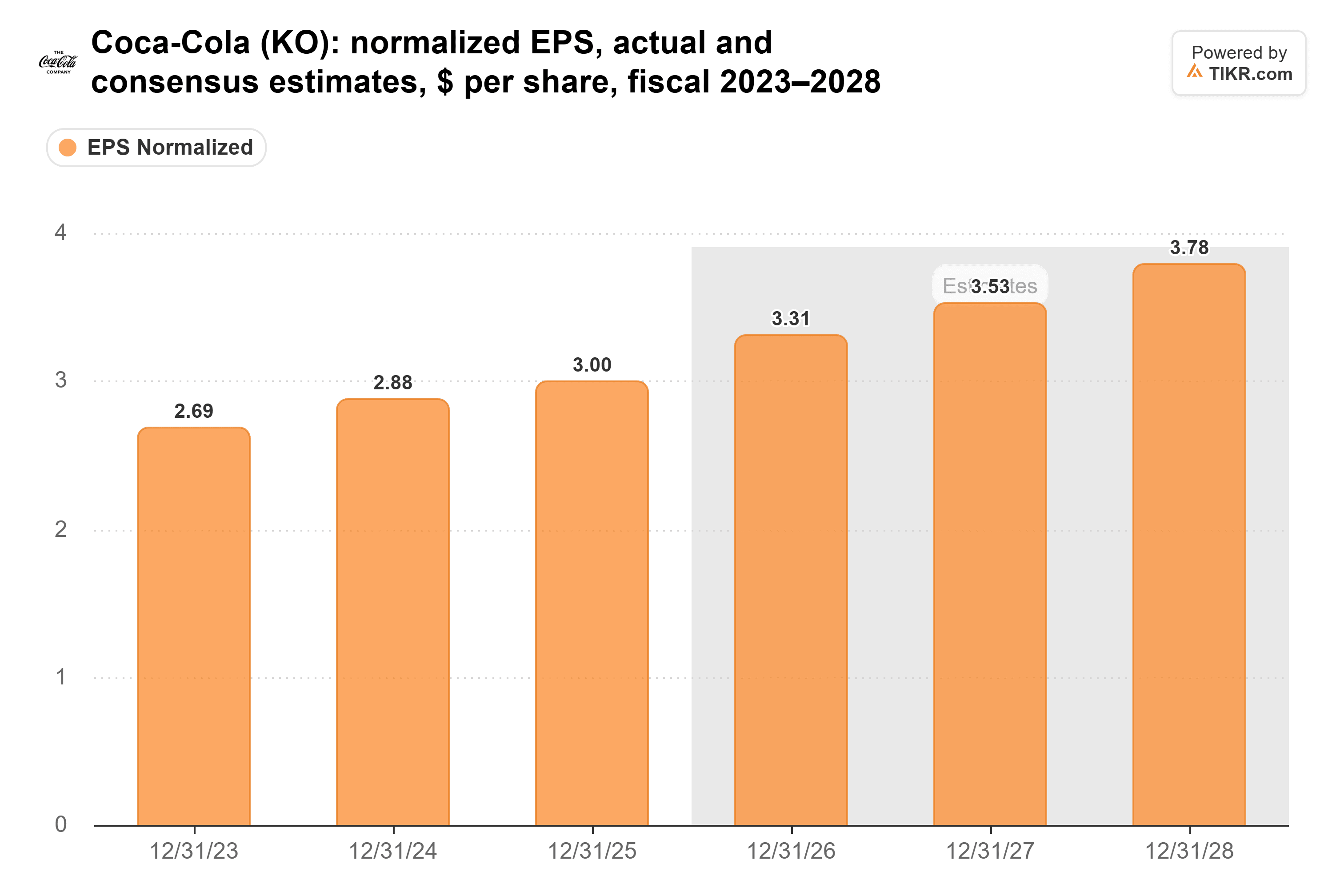
Growth of 9% to 10% from $3.00 gets you to $3.27 to $3.30, so the consensus is already a penny above the top of management’s range. If Coca-Cola only holds its guidance, analysts stay a little ahead of the company. A third raise would put it back in front. (By management’s estimate, about 3 points of this year’s growth comes from currency.)
That bar matters because investors are paying up. At the end of September, Coca-Cola traded at 25x forward earnings, against a 12-year average of 23x.
The cash cushion is bigger than it looks
Coca-Cola’s free cash flow covered its dividend comfortably through 2023, then fell short in 2024 and 2025…
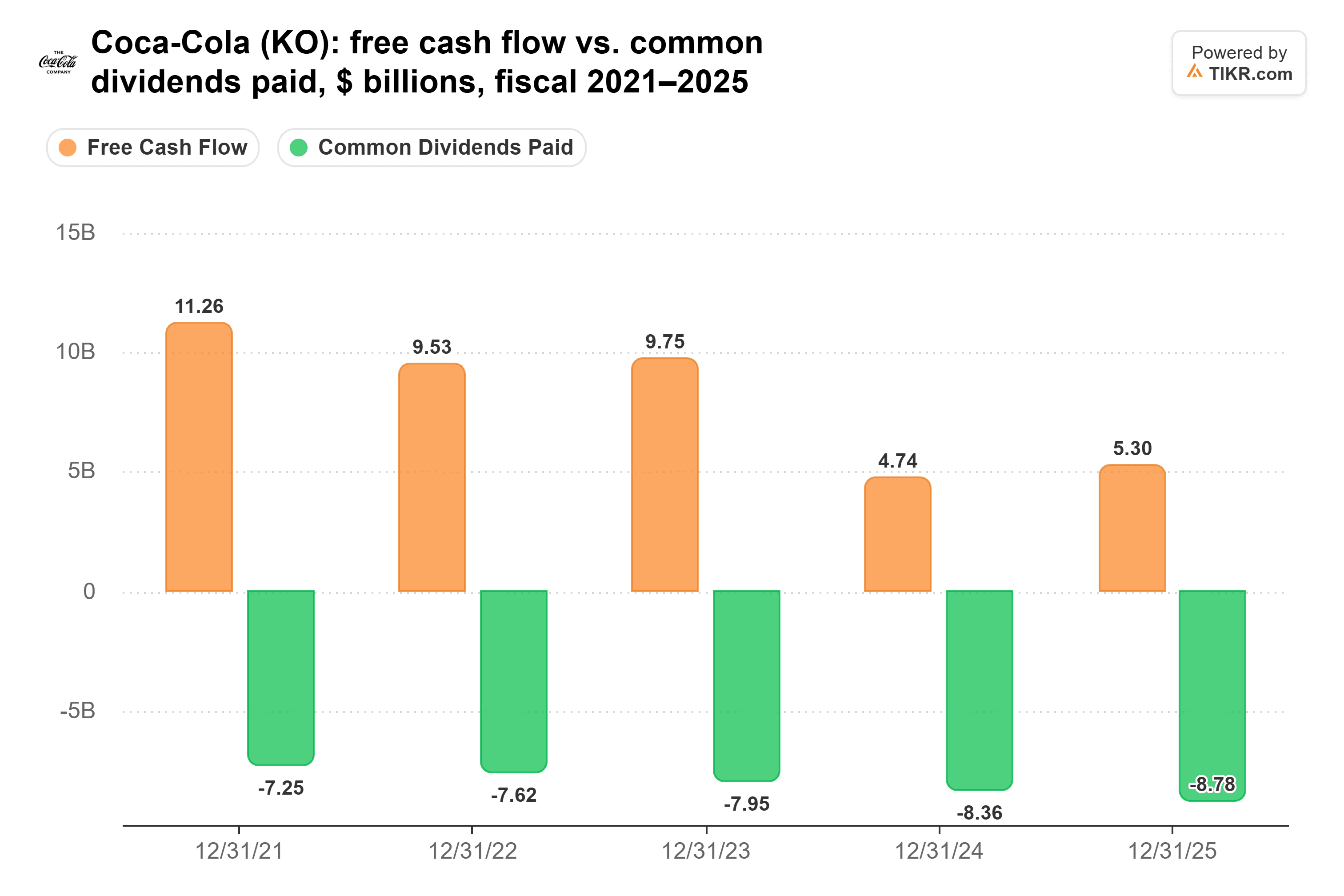
Each of those two years carried a one-time payment of about $6 billion: a $6.0 billion deposit with the IRS in 2024 and the final $6.1 billion payment for fairlife in 2025. Without them, the dividend took 78% of free cash flow in 2024 and 77% in 2025.
This year should be easier. Management guides to free cash flow of about $12.4 billion, against a dividend bill of about $9.1 billion. That’s a well-covered 73%. Free cash flow was already $6.9 billion in the first half. A single quarter can swing on one-off items, so the full-year guidance is the number to listen for on Tuesday.
PepsiCo has less room. It plans to pay $7.9 billion in dividends this year, close to all of its free cash flow over the last twelve months.
The biggest risk to Coca-Cola’s cash isn’t in the quarter at all. An appeals court is weighing its tax case with the IRS. If Coca-Cola loses, it gives up the $6.0 billion deposit and faces about $14 billion more for 2010 through 2025, by management’s estimate.
Volume moves the stock
Margins and cash make the case for the dividend, but the stock usually trades on organic revenue growth and how it splits between volume and price.
Unit case volume grew 3% in the first quarter and 5% in the second, after a flat 2025. The World Cup and easy comparisons helped. On a two-year basis, second-quarter volume grew 2%.
Tuesday’s report covers the first quarter without the World Cup, against 1% volume growth a year earlier. Management’s long-term model calls for 2% to 3% growth a year from volume and 2% to 3% from price. For this year, it guides to organic revenue growth of about 5%.
The safer dividend comes at a full price
Coca-Cola keeps the “stronger” label on Tuesday if it shows three things:
- an operating margin above last year’s third quarter
- full-year EPS guidance at or above the top of 9% to 10%
- free cash flow guidance still at about $12.4 billion
Volume growth near 3% without the World Cup would help the stock’s case too.
My take: for a retiree, Coca-Cola’s smaller check has the bigger cushion behind it, and that’s worth the lower yield. The stock is a harder call at 25x forward earnings, when simply holding guidance leaves the company behind its analysts.
Of course, one quarter won’t settle it. Coca-Cola’s 2027 guidance early next year and the IRS ruling will matter more.
So what is Coca-Cola stock actually worth?
TIKR lets you forecast the future price of any stock in less than a minute. Just enter a few assumptions into TIKR’s valuation model and see what Coca-Cola could be worth. Start from Wall Street consensus estimates, or adjust the inputs to reflect your own view of the business. It’s free to use.
Disclaimer:
Please note that the articles on TIKR are not intended to serve as investment or financial advice from TIKR or our content team, nor are they recommendations to buy or sell any stocks. We create our content based on TIKR Terminal’s investment data and analysts’ estimates. Our analysis might not include recent company news or important updates. TIKR has no position in any of the stocks mentioned. Thank you for reading, and happy investing!