


Key Takeaways
- Payments bet: Circle has agreed to acquire cross-border payments platform Tazapay for $400 million in Class A stock, adding local payout infrastructure across more than 100 markets and a claimed $25 billion-plus annualized payment volume.
- Revenue dependence: Circle reported $701 million in Q2 total revenue and reserve income, but $668 million came from reserve income. Other revenue was $34 million, showing that payment and subscription revenue remain small today.
- Cash flow: TIKR shows $517.43 million of Q2 cash from operations against $1.03 million of capital expenditure. That is encouraging, but one quarter does not establish a recurring free-cash-flow run rate for a reserve-backed stablecoin issuer.
- Price of execution: CRCL traded at 68.45x next-twelve-month normalized earnings on September 11, below its 86.71x one-year average but still a valuation that demands evidence that new payment rails can become profitable revenue.
Track Circle’s revenue mix, USDC metrics, and quarterly results on TIKR for free →
Tazapay Offers a Payments Network, Not Immediate Earnings
Circle Internet Group (CRCL) has built its public-market story around a simple promise: USDC can become foundational infrastructure for global finance. Its proposed purchase of Singapore-based Tazapay is a concrete attempt to make that promise more commercial.
The all-stock deal, valued at $400 million and expected to close in 2027 subject to customary conditions and approval, would bring Circle a business that accepts, holds, converts, and pays out funds through local rails in more than 100 markets. Tazapay describes its own platform as a way for businesses to access those markets without building separate local integrations.
The appeal to Circle is clear. Tazapay reported more than $25 billion in annualized payment volume, more than 60 banking and fintech partners, and roughly 60% of its transaction volume using stablecoins. For Circle, that is potentially a distribution channel where USDC is not merely held or traded, but used to settle cross-border payments.
It also fits with management’s Q2 disclosure that its Circle Payments Network, or CPN, had reached $14.7 billion in annualized transaction volume over the trailing 30 days, with 175 financial institutions enrolled. Circle’s Q2 release provides the figures, but neither CPN volume nor Tazapay volume should be read as Circle revenue.
The important distinction is take rate. A payments platform can move large sums while retaining only a small fee, and Circle has not disclosed the revenue, margins, or integration costs that the acquired operations will contribute after closing. The 2027 closing date also means investors cannot assume that the headline volume will affect near-term results. The strategic logic is tangible, but the financial payoff remains an execution question.
Circle Internet Group’s Reserve Income Still Does Most of the Financial Work
Circle’s latest results show why the Tazapay deal matters. In Q2, the company generated $668 million of reserve income and just $34 million of other revenue, which management said was driven by subscription and services growth. Total revenue and reserve income rose 7% year over year to $701 million, while USDC in circulation rose 19% to $73.3 billion at quarter end.
The gap reflects a 66-basis-point decline in the reserve return rate, which partially offset growth in average USDC circulation.

CRCL stock’s quarterly revenue chart also illustrates that sensitivity. It rose from $634.27 million in Q2 2025 to $667.73 million in Q2 2026, but remains below the $733.40 million recorded in Q4 2025.
The $667.73 million figure is consistent with the company’s separately reported $668 million reserve-income figure, rather than the broader $701 million total that includes other revenue. That definition matters when comparing the chart with the earnings release.
This is not evidence that the business is weakening. USDC circulation, on-chain transaction volume, CPN participation, and institutional integrations were all expanding in the Q2 release. But it does show that Circle’s reported income is still tied closely to the size of USDC reserves and prevailing yields.
A broader payments network could diversify that model over time, but the company has not yet shown that transaction and infrastructure revenue can offset a weaker interest-rate backdrop.
Compare Circle’s reserve-income trend with its operating metrics on TIKR for free →
Strong Q2 Cash Generation Deserves a Careful Reading
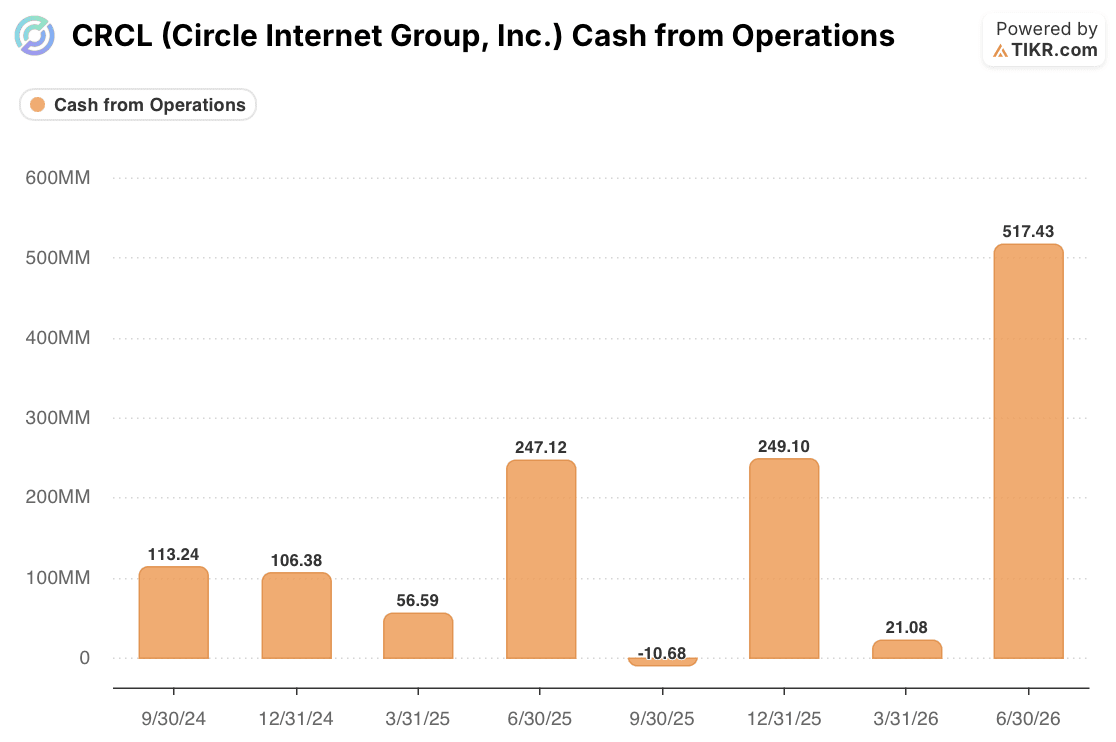
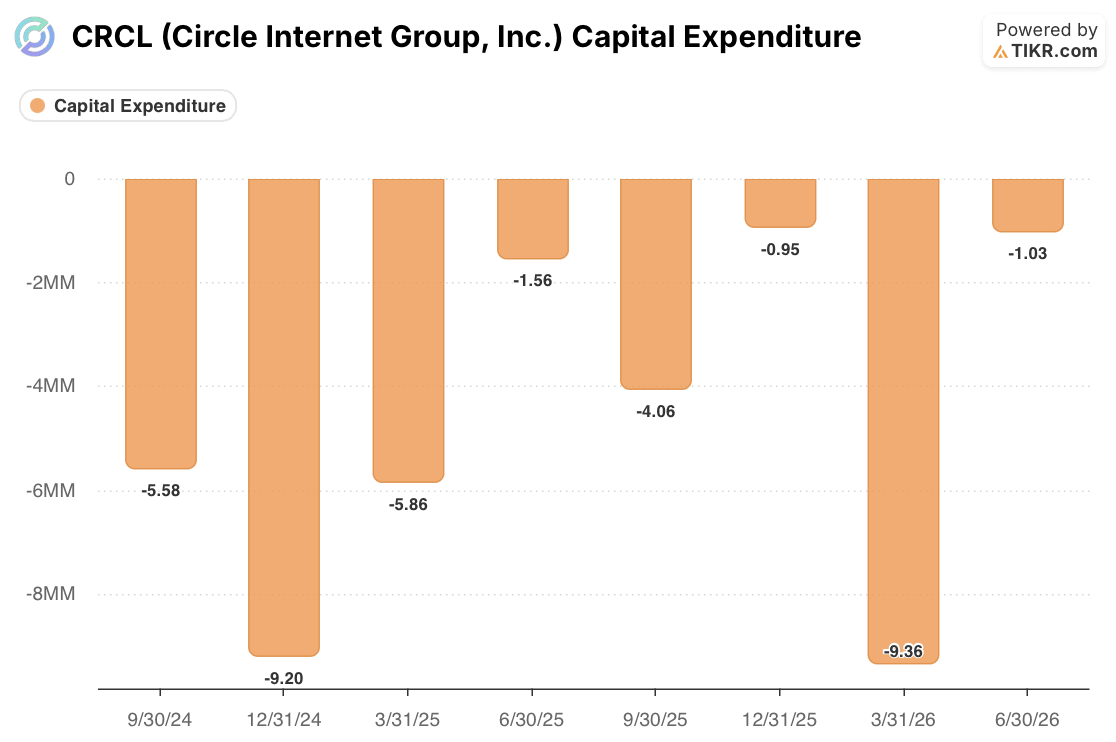
The cash-flow data gives the expansion story some support. TIKR shows cash from operations of $517.43 million in Q2, sharply above $21.08 million in Q1, while capital expenditure was only $1.03 million. A simple cash-from-operations-less-capex calculation is about $516.4 million for the quarter.
That supports Circle’s ability to fund product, compliance, and integration work without the capital intensity of a physical payments network.
Still, investors should resist annualizing that number. Circle’s operating cash flow can be affected by the timing of reserve-related assets, distribution payments, and other working-capital movements. The contrast between Q1 and Q2 is precisely why it needs several quarters of confirmation.
The more durable signal would be recurring cash generation alongside a growing share of revenue from services that do not depend on reserve yields.
That caveat also helps explain the all-stock structure. Circle is preserving cash while using its equity to acquire a ready-built international payments network. It can be a sensible choice for a deal focused on strategic reach, but it makes the value created for existing shareholders dependent on integration, transaction economics, and eventual revenue conversion rather than the initial payment volume alone.
A 68x Forward Multiple Prices In More Than a Payments Pilot
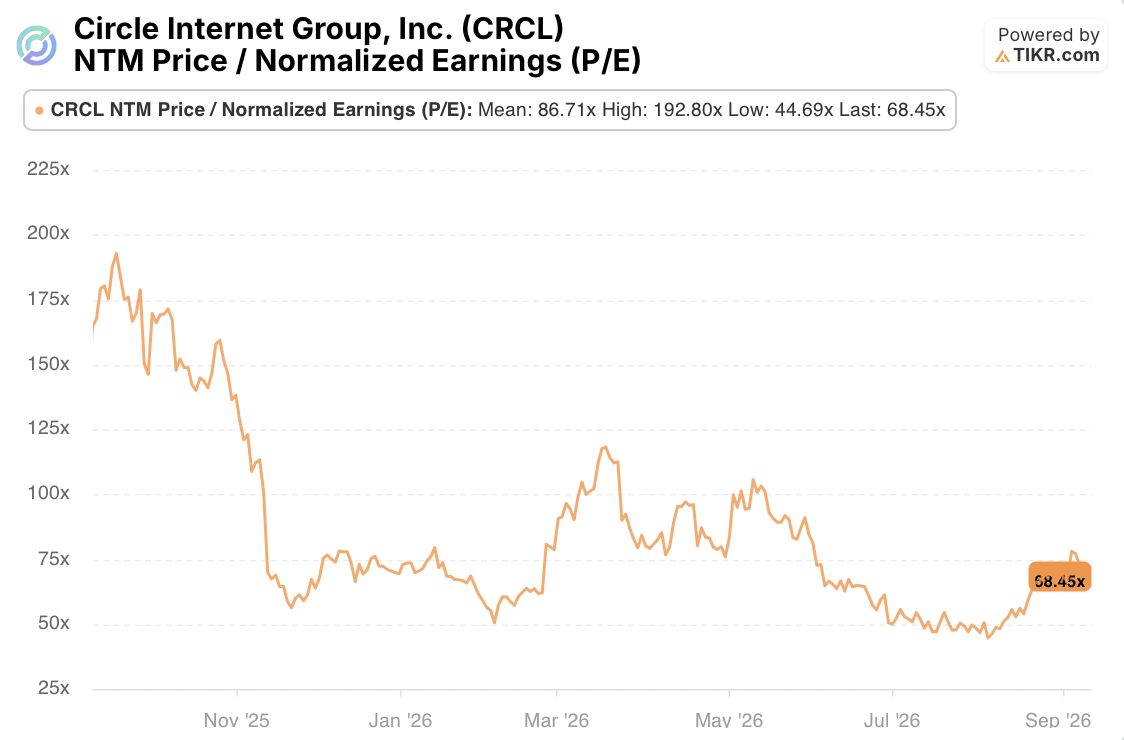
At 68.45x NTM normalized earnings, CRCL is well below the 192.80x high and 86.71x average shown in one-year valuation history. But it is also well above the chart’s 44.69x low.
The lower multiple should not automatically be called cheap because normalized earnings expectations and the share price may both have changed over the period.
What it does show is that investors still assign substantial value to a future platform business, not only to the reserve-income business reported today. The Tazapay deal supports that longer-term narrative because it adds cross-border rails, banking relationships, and a customer base already familiar with stablecoins.
Yet the deal is not proof that Circle will capture a meaningful share of that payment volume or earn a premium take rate.
Revenue Conversion Is the Shareholder Test
The Tazapay acquisition makes Circle’s strategy easier to understand. Rather than waiting for external partners to build every route into local payment systems, Circle is seeking to own more of the infrastructure that can make USDC useful in day-to-day cross-border commerce. That could reduce dependence on reserve income and make the company less exposed to changes in short-term rates.
For now, however, Circle stock is priced for a transition that has only begun. The next meaningful disclosures are not simply more payment-volume milestones. Investors should watch for the acquisition to close, management to identify Tazapay’s revenue and margin contribution, and other revenue to become a larger, more visible portion of Circle’s results.
If those indicators advance while operating cash generation remains resilient, the payments thesis gains substance. If they do not, the valuation will remain anchored to a reserve-income engine whose economics are partly set by interest rates outside Circle’s control.
Follow CRCL’s forward valuation and earnings estimates on TIKR for free →
Should You Invest in Circle Internet Group, Inc.?
The only way to really know is to look at the numbers yourself. TIKR gives you free access to the same institutional-quality financial data that professional analysts use to answer exactly that question.
Pull up Circle Internet Group, Inc. stock and you’ll see years of historical financials, what Wall Street analysts expect for revenue and earnings in the quarters ahead, how valuation multiples have moved over time, and whether price targets are trending up or down.
You can build a free watchlist to track Circle Internet Group, Inc. alongside every other stock on your radar. No credit card required. Just the data you need to decide for yourself.
Access Professional Tools to Analyze CRCL stock on TIKR for Free →
Looking for New Opportunities?
- See what stocks billionaire investors are buying so you can follow the smart money.
- Analyze stocks in as little as 5 minutes with TIKR’s all-in-one, easy-to-use platform.
- The more rocks you overturn… the more opportunities you’ll uncover. Search 100K+ global stocks, global top investor holdings, and more with TIKR.
Disclaimer:
Please note that the articles on TIKR are not intended to serve as investment or financial advice from TIKR or our content team, nor are they recommendations to buy or sell any stocks. We create our content based on TIKR Terminal’s investment data and analysts’ estimates. Our analysis might not include recent company news or important updates. TIKR has no position in any stocks mentioned. Thank you for reading, and happy investing!


