


Key Takeaways
- Atlassian fell from $203.09 in June 2025 to $68.25 by the end of March 2026 as vibe coding fears gripped software stocks, even though not a single sell-side analyst carried a Sell or Underperform rating through the entire slide.
- Fiscal fourth-quarter results, cloud revenue up 31% year over year and remaining performance obligations up 44%, plus a sector-wide AI-monetization rally sparked by Snowflake and Salesforce, helped the stock climb to $179.70 by September 11, nearly triple its 2026 low.
- The Street’s mean price target has gone from trading 247.5% above the stock in March to just 109.2% above it now, but Atlassian’s forward EV/revenue multiple of 6.08x still sits below its own two-year average of 8.43x.
- Management’s fiscal 2027 guide calls for subscription ARR growth to slow to 18% from 23%, a gap analysts on three separate calls have pressed on without getting a fully settled answer.
Atlassian’s Drawdown Wall Street Never Downgraded
Atlassian (TEAM) traded at $203.09 on June 30, 2025. By March 31, 2026, it closed at $68.25, a two-thirds collapse. The proximate cause was the broader vibe coding scare that gripped enterprise software through late 2025 and into 2026, the fear that AI coding agents and autonomous tools would let companies build their own replacements for platforms like Jira and Confluence, cutting incumbents out entirely.
Reuters Breaking views described investors treating the sector as if they faced an existential threat for much of the year. The fear deepened in mid-July when IBM warned that customer spending was shifting away from software toward chips, servers and storage faster than expected, a shock that dragged ServiceNow, Atlassian, and Adobe lower alongside IBM’s own 25% one-day drop.

What makes the slide notable is that sell-side coverage never reflected the panic. TIKR’s Street Targets data show Atlassian carried 19 to 21 Buy ratings and five to eight Holds across every quarter from mid-2025 through the trough, with zero Underperforms or Sells recorded at any point. Analysts kept their mean target near $140 to $169 even as the stock sat near $68 to $78, implying 180% to 247% upside that the market simply was not buying. The price action was a sentiment call the raters did not make.
The Quarter That Flipped Atlassian’s Narrative
The turn started with Atlassian’s own numbers. Fiscal fourth-quarter revenue, reported August 6, grew 28% year over year to $1.77 billion, with cloud revenue up 31%, the fifth straight quarter of cloud acceleration according to analysts on the company’s KeyBanc appearance, a trend CFO James Chuong later confirmed at Citi’s TMT conference, citing cloud growth climbing from 26% to 31% over the trailing four quarters.
Remaining performance obligations, a measure of contracted future revenue, jumped 44% to $4.82 billion. GAAP net income swung to $139.08 million from a $98.4 million loss the prior quarter. Enterprise traction stood out too: the cohort of customers spending more than $3 million annually grew 50% year over year to 164 accounts, and the $5 million-plus cohort grew 70% to 69 accounts.
AI adoption metrics backed up management’s framing that artificial intelligence is a tailwind rather than a threat. Rovo, the company’s AI assistant, reached over 80% of the Fortune 500, and Model Context Protocol calls into Atlassian’s Teamwork Graph rose 400% quarter over quarter.
The results landed days before Snowflake’s own AI-driven beat sent that stock up 25% and lifted software peers broadly, and weeks after Salesforce’s Claudeforce announcement drove its best single-day gain in six years. Atlassian rode the same wave, nearly tripling off its March low to close at $179.70 on September 11.
TEAM Stock’s Sentiment Gap Is Mostly Closed, Its Multiple Isn’t
The rally has done most of the work of closing the gap between price and Wall Street’s targets. Data show the Street’s mean target traded 247.5% above Atlassian’s price on March 31 and 180.4% above it on June 30. By September 11, with the mean target at $196.23 against a $179.70 close, that premium had shrunk to 109.2%, near the smallest gap in the five quarters. Sentiment and price have effectively converged.
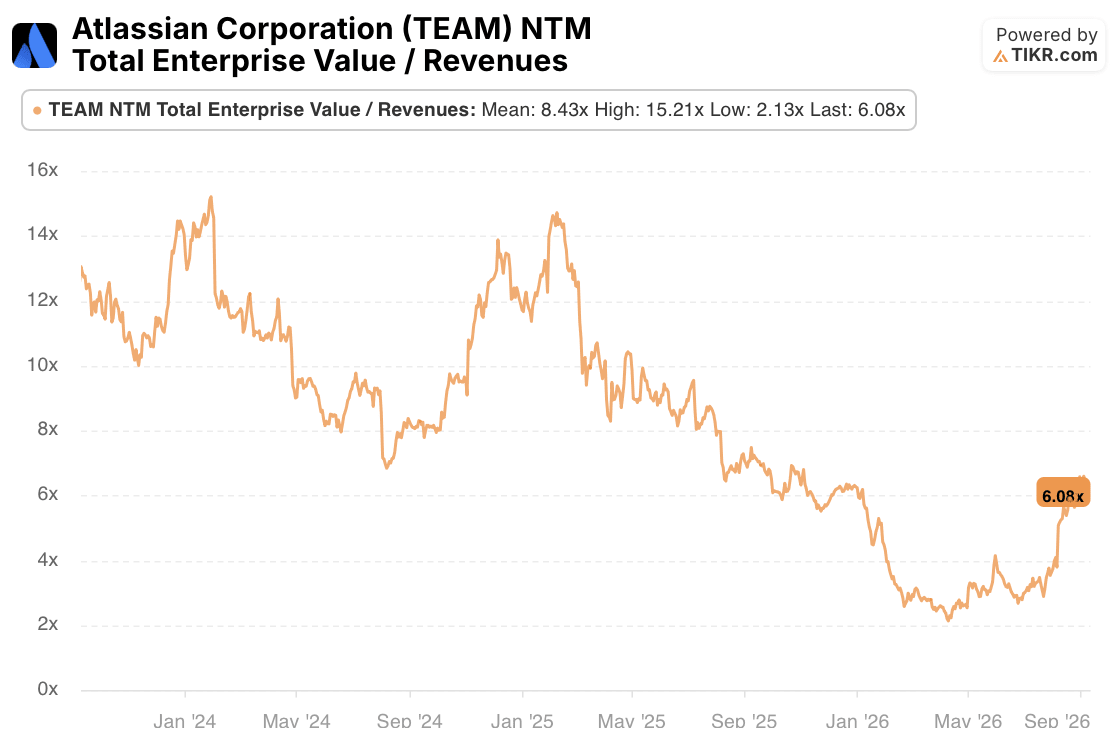
Valuation tells a more mixed story. Atlassian’s forward enterprise value to revenue multiple sits at 6.08x. That is below the stock’s own two-year mean of 8.43x, and well under the 11x to 15x range it commanded through 2024 and early 2025, though it is also far above the roughly 2x trough it touched during the worst of the 2026 selloff.
In other words, the stock has repriced most of the way back from crisis-level pessimism, but not all the way back to where the market valued Atlassian’s growth before the vibe coding scare took hold. Whether that remaining gap closes further, or whether 6.08x turns out to be the new normal, depends less on sentiment than on whether Atlassian’s own growth numbers keep supporting a premium multiple, which is where the company’s own guidance becomes the central question.
Why Atlassian’s Subscription ARR Guide Is the Number That Matters Most
That guidance is where the bull and bear cases actually diverge. Atlassian’s own fiscal 2027 framework calls for subscription ARR, the metric management introduced this year to normalize its cloud transition, to grow 18% year over year, down from 23% in fiscal 2026. That sits awkwardly next to RPO growth of 44% and cloud net revenue retention above 120%.
Analysts on Atlassian’s earnings call, at KeyBanc, and again at Citi all raised the same question, and management’s answer has been consistent: roughly a point of fiscal 2026’s growth came from the DX acquisition that will lap, quarter-to-quarter purchasing behavior gets distorted as the company scales an enterprise sales force that still has only 400 quota-carrying reps, and leadership is choosing prudence given macro and fiscal policy uncertainty.
That explanation is plausible and consistent with a company that has beaten and raised through prior transitions, including the pull-forward dynamic it flagged between its third and fourth fiscal quarters this year. But it remains unproven, and it is the specific number the current multiple has to keep validating. If subscription ARR growth tracks closer to 23% than 18% over the next two quarters, the case for further multiple expansion toward Atlassian’s own two-year average strengthens.
If it settles nearer 18%, the stock’s forward multiple may already reflect a fair price for that trajectory. The next checkpoints worth watching are Atlassian’s fiscal first-quarter print, guided to $1.705 billion to $1.715 billion in revenue, and December, when the company begins enforcing consumption limits on Rovo credits for the first time, an early read on whether its AI monetization can hold up once the free-credit runway narrows.
Should You Invest in Atlassian Corporation?
The only way to really know is to look at the numbers yourself. TIKR gives you free access to the same institutional-quality financial data that professional analysts use to answer exactly that question.
Pull up TEAM stock and you’ll see years of historical financials, what Wall Street analysts expect for revenue and earnings in the quarters ahead, how valuation multiples have moved over time, and whether price targets are trending up or down.
You can build a free watchlist to track TEAM alongside every other stock on your radar. No credit card required. Just the data you need to decide for yourself.
Access Professional Tools to Analyze TEAM stock on TIKR for Free →
Looking for New Opportunities?
- See what stocks billionaire investors are buying so you can follow the smart money.
- Analyze stocks in as little as 5 minutes with TIKR’s all-in-one, easy-to-use platform.
- The more rocks you overturn… the more opportunities you’ll uncover. Search 100K+ global stocks, global top investor holdings, and more with TIKR.
Disclaimer:
Please note that the articles on TIKR are not intended to serve as investment or financial advice from TIKR or our content team, nor are they recommendations to buy or sell any stocks. We create our content based on TIKR Terminal’s investment data and analysts’ estimates. Our analysis might not include recent company news or important updates. TIKR has no position in any stocks mentioned. Thank you for reading, and happy investing!


