Key Takeaways
- Steve Eisman says AI is “a $500 billion issuance this year” that is crowding out Treasuries, and he sees a market correction unless the 10-year yield falls back below 5%.
- AllianceBernstein’s Inigo Fraser Jenkins argues that AI’s need for capital now ties stocks, credit, the dollar and foreign flows together, which makes AI risk hard to diversify away from.
- There are exceptions! Berkshire Hathaway, Johnson & Johnson and Waste Management have below-average beta and businesses that don’t depend on the AI trade.
Steve Eisman, the investor Michael Lewis made famous in The Big Short, has a new worry about the AI boom: the bond market.
On Friday’s episode of the Prof G Markets podcast, he put it bluntly:
“AI is a $500 billion issuance this year and it’s having a crowding out effect of the treasury markets.”
His reasoning: when Microsoft (MSFT) or Alphabet (GOOG) builds a data center, it borrows for the long haul (“10-year debt, something like that”). The Treasury wants that same long-term money. So there’s “a bit of a competition,” as Eisman put it, and AI debt is crowding out Treasuries.
Coming from the guy who bet against the housing bubble, that’s worth hearing out.
Eisman’s line in the sand
Eisman has also said when he thinks this becomes a problem for stocks. He’s written that 5% on the 10-year Treasury yield is the market’s “Rubicon.” Host Ed Elson read his conclusion back to him on the show: “unless something happens that pushes rates back below 5%, a market correction seems imminent.”
The 10-year sits at 5.3%, so…yeah, we’re there.
Why does 5% matter so much? Higher long-term rates push up mortgage rates. Eisman’s example is a 6% mortgage becoming “7, 7.5%,” which hits the whole housing sector. They also make debt more expensive for every company that borrows, including the ones paying for the AI build-out.
To be fair, Eisman also blames higher oil prices and nervous investors for where the 10-year is. And he’s honest about timing: “Nobody ever knows until after the fact.”
Here’s the thing: AI is everyone’s trade now
The trouble is that AI is getting harder to avoid.
AllianceBernstein strategist Inigo Fraser Jenkins argues in a new note that “AI’s appetite for capital has now gotten so large that it is tying together equities, credit, the dollar, and foreign flows.”
AllianceBernstein isn’t telling anyone to sell. Its point is that “portfolios urgently need to hold up in case this whole AI freight train stalls.”
So I figured I’d spend a little time taking Jenkins’ advice – looking for stocks with a below-average beta that are less dependent on the AI trade.
Here are three:
1. Berkshire Hathaway is sitting on a mountain of cash
Eisman is worried about big borrowers competing for money. Berkshire Hathaway (BRK.B), with a beta of 0.6, is on the other side of that trade. It ended fiscal 2025 with $373 billion of cash and short-term investments, against $135 billion of total debt…
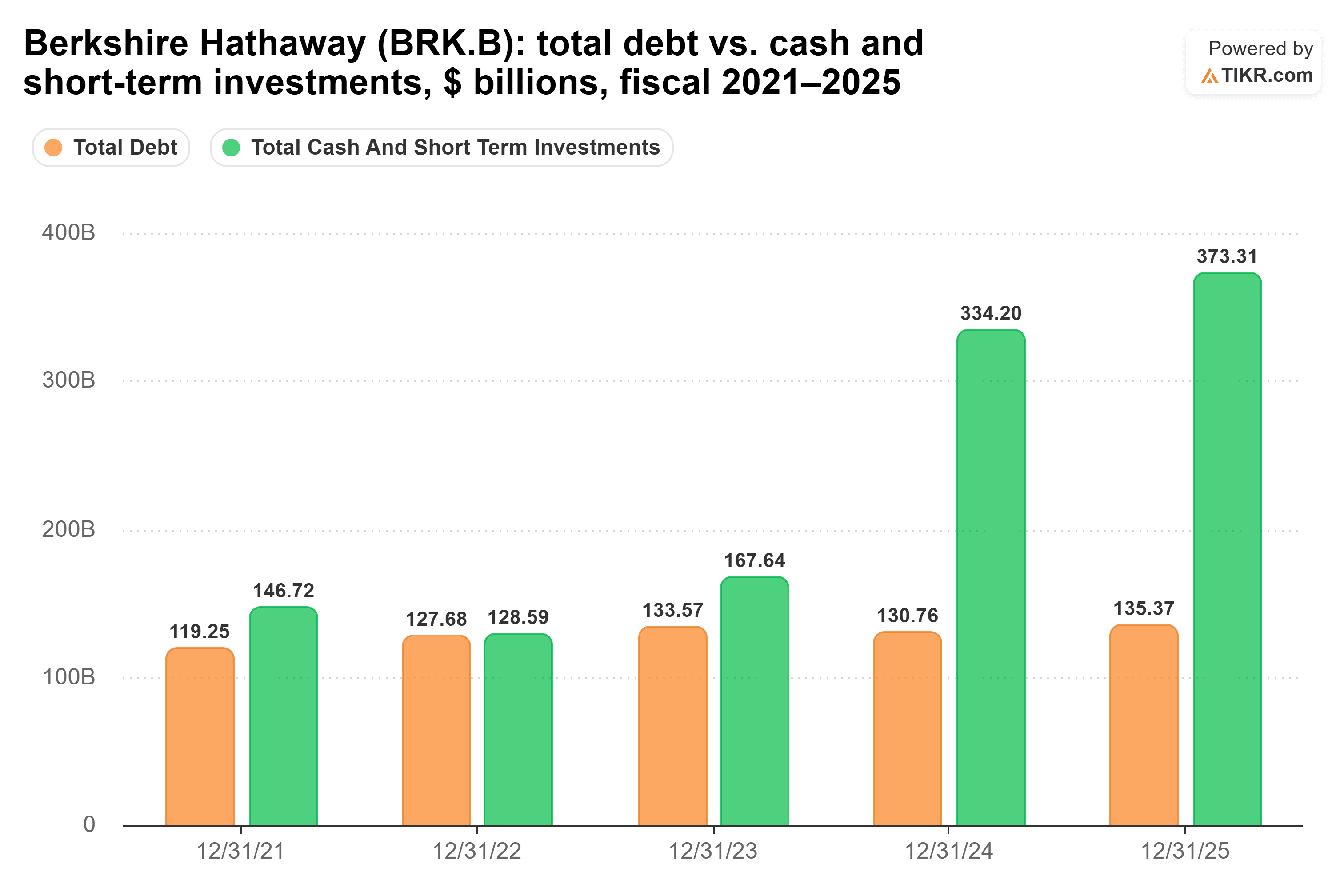
That cash pile has more than doubled since 2023(!), while debt barely moved.
Berkshire still feels a weaker economy through its insurance, railroad and energy businesses, and its stock portfolio would fall with the market. But if a correction does hit, Berkshire has the money to do what Warren Buffett has always said to do: be “greedy when others are fearful.” (And there are so many historical examples of it doing precisely that that I won’t waste your time recounting them all.)
2. Johnson & Johnson’s dividend pays for itself
Berkshire’s safety is a cash pile. Johnson & Johnson (JNJ) offers a check that keeps arriving: it yields about 2%, with a beta of just 0.23.
People need their prescriptions and surgical devices whatever the 10-year is doing. That shows up in the cash flow. J&J’s free cash flow has stayed between $17.5 billion and $19.8 billion in each of the last five years, and it’s covered the dividend with room to spare every time…

In fiscal 2025, J&J paid $12.4 billion of dividends out of $19.7 billion of free cash flow. That’s a cash dividend payout ratio of about 63%, comfortable enough to keep its streak of 64 straight years of raises going without borrowing a dime.
J&J’s main risk is its own business: like every drugmaker, it has to replace sales as older drugs lose patent protection, and it has to keep stocking its pipeline with fresh drugs to grow that topline.
3. Waste Management’s trucks keep rolling
J&J’s demand doesn’t care about AI, and neither does trash. Waste Management (WM) has a beta of just 0.43.
Nobody stops rolling the bins to the curb because an AI stock had a bad quarter. Restaurants still need their dumpsters emptied in a recession, and so do hospitals and factories. That’s why revenue has grown every year for the last five, from $17.9 billion in fiscal 2021 to $25.2 billion in fiscal 2025…
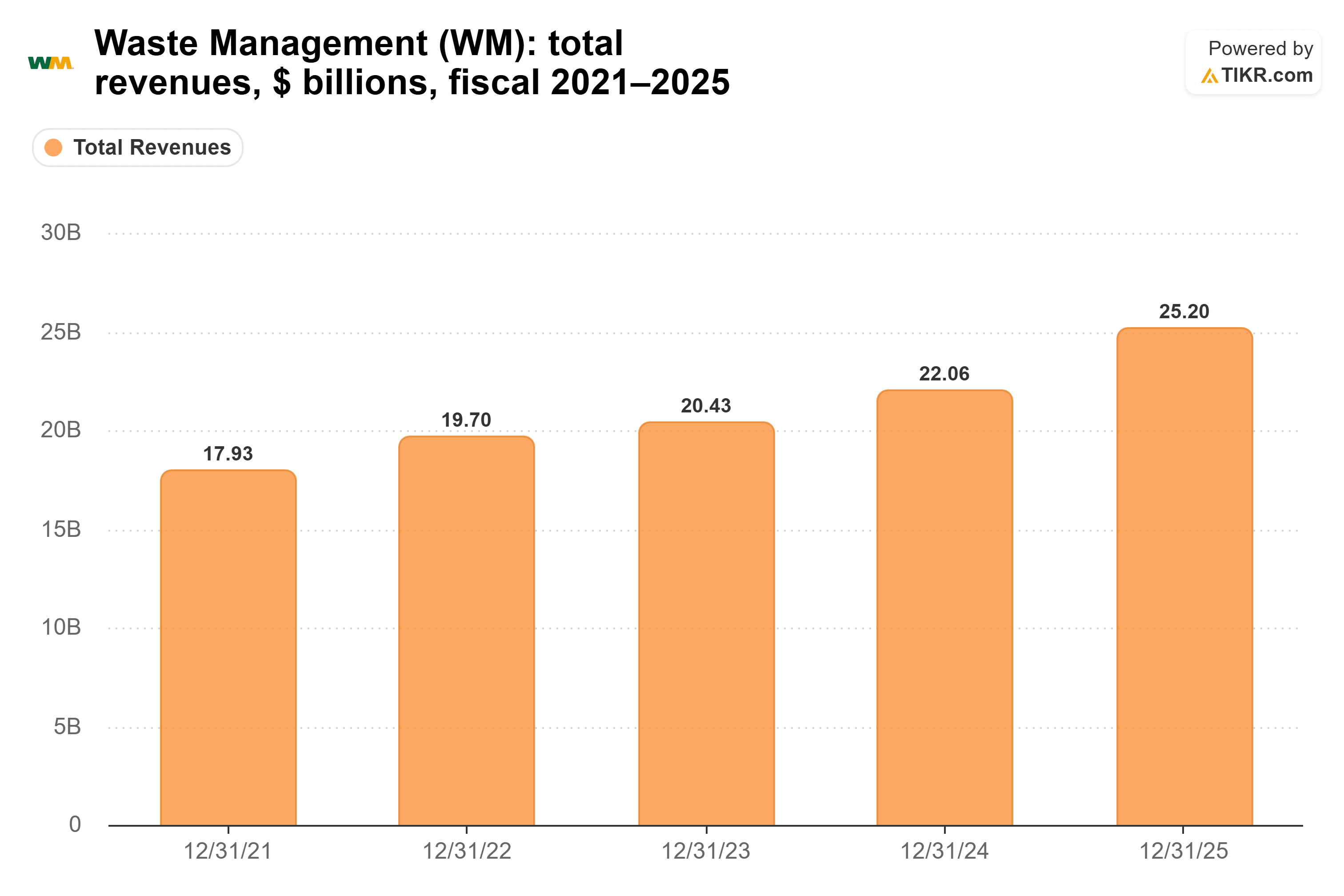
(Part of last year’s 14% jump came from the Stericycle acquisition, so don’t expect that pace every year.)
I guess we’re at the point of the cycle where countercyclicals start looking attractive.
The upshot
My view: Eisman may well be right about the 10-year, and he may be early. Like he said, nobody knows until after the fact. That’s exactly why I like these three. I don’t have to call the top to own them.
If the correction comes, Berkshire has the cash to go shopping, J&J’s dividend is paid out of its free cash flow, and Waste Management’s trucks keep rolling.
Of course, if rates fall back below 5% and the AI trade keeps running, all three will probably lag the market for a while. That’s what a low beta costs you in a rally.
So what is Berkshire Hathaway stock actually worth?
TIKR lets you forecast the future price of any stock in less than a minute. Just enter a few assumptions into TIKR’s valuation model and see what Berkshire Hathaway could be worth. Start from Wall Street consensus estimates, or adjust the inputs to reflect your own view of the business. It’s free to use.
Value Berkshire Hathaway for free
Disclaimer:
Please note that the articles on TIKR are not intended to serve as investment or financial advice from TIKR or our content team, nor are they recommendations to buy or sell any stocks. We create our content based on TIKR Terminal’s investment data and analysts’ estimates. Our analysis might not include recent company news or important updates. TIKR has no position in any of the stocks mentioned. Thank you for reading, and happy investing!