Key Stats for ASML Stock
- Current Price: $1,575.15
- Target Price (Mid): ~$3,193
- Street Target: ~$2,163
- Potential Total Return: ~88%
- Annualized IRR: ~16% / year
Now Live: Discover how much upside your favorite stocks could have using TIKR’s new Valuation Model (It’s free) >>>
What Happened?
ASML Holding N.V. (ASML) lost 7.25% on Monday, September 14, closing at $1,575.15. The cause was not an earnings miss or a lost customer. It was an essay. On Saturday, September 12, Anthropic CEO Dario Amodei published a roughly 3,800-word piece titled “We Must Pace the Frontier,” arguing that AI labs should deliberately slow how fast they improve their models. OpenAI’s Sam Altman and Elon Musk said they agreed. By Monday, the fear that a slower AI build-out means fewer chips, and therefore fewer of ASML’s machines, had pushed semiconductor equipment names sharply lower.
ASML sits further from the AI end demand than any chipmaker, because it sells into what fabs plan to spend, not what they sell today. So a sentiment shock about future AI capex hits it hard. Yet the company’s own numbers went the other way two months ago: a Q2 beat, raised guidance, and an order book management describes as booked years out.
An Essay Repriced the Stock
The Philadelphia Semiconductor Index had its worst day since July, and ASML fell alongside Applied Materials, down about 7%. Morgan Stanley added pressure separately, trimming its target from €1,930 to €1,700 on valuation. None of this touched ASML’s results or guidance.
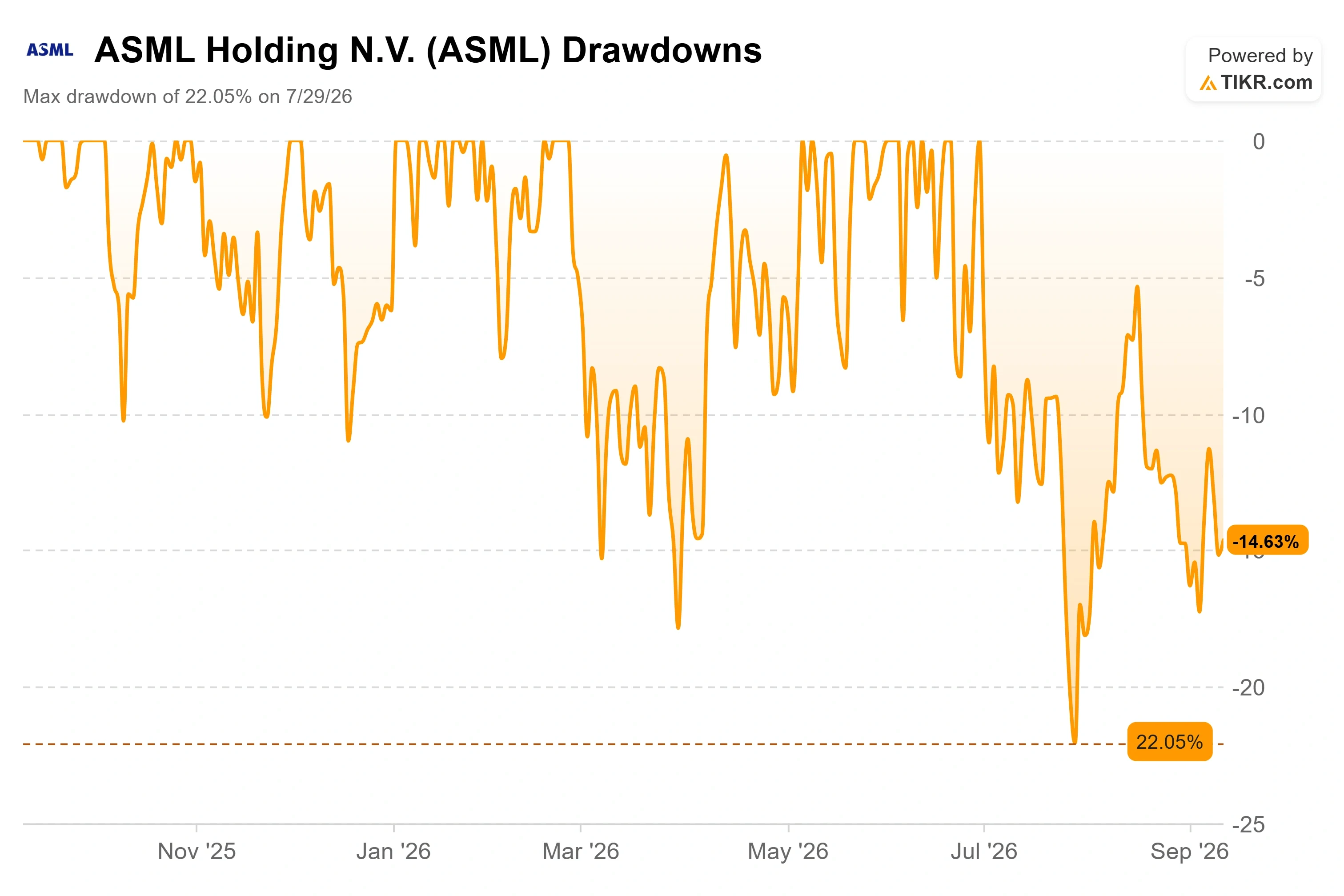
When the market fears AI progress will be paced deliberately, it questions whether foundries keep spending aggressively on leading-edge capacity, and ASML’s revenue is a lagging function of those decisions. A stock trading above 50 times trailing earnings, as ASML was before Monday, has room to derate when that growth assumption gets questioned. The drop was the multiple compressing, not the business shrinking. It also landed on a stock that had already cooled: at $1,575.15, ASML sits roughly 21% below its 52-week high of $1,999.96, after a 22.05% peak-to-trough drawdown on July 29.
See historical and forward estimates for ASML stock (It’s free!) >>>
The Order Book Runs Through 2028
On the Q2 2026 earnings call on July 15, management did not describe the company as bracing for a slowdown. It described one raising output to chase demand that it cannot fully meet.
ASML reported Q2 net sales of €9.3 billion, above the high end of guidance, with a 54% gross margin and EPS of €7.59, and raised full-year revenue guidance to €43 billion to €45 billion. CFO Roger Dassen told analysts ASML is “now close to being fully covered with orders for Low-NA EUV” for 2027 and is planning to raise Low-NA capacity by around 30% that year. More striking, he confirmed the company has “already received a significant number of Low-NA EUV orders” for 2028, a two-years-out position he said ASML “haven’t enjoyed in many, many years.” CEO Christophe Fouquet tied that demand to the AI theme the market now fears, guiding memory-related system sales to grow over 75% this year as DRAM makers migrate to EUV. The exact AI-driven capex the essay warns could slow is the capex ASML says is already in its backlog. An announced intent to pace future model development is not a foundry canceling a signed order.
ASML also gave a concrete technology milestone that day, confirming Intel Foundry is using its High-NA EUV technology on the Intel 18A node to produce a subset of Intel Core Ultra Series 3 processors, the strongest sign yet that its highest-priced platform is reaching production readiness.
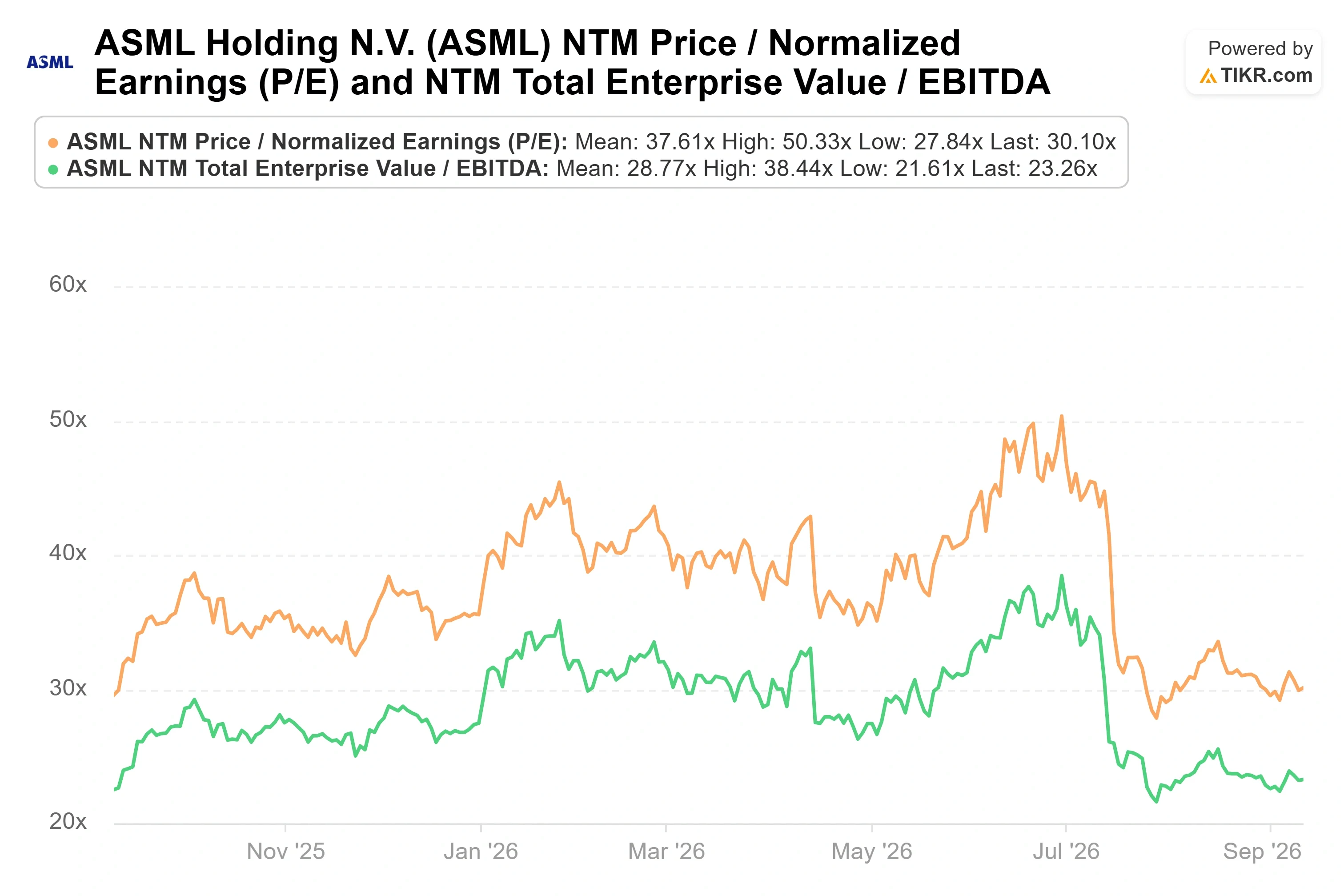
Even after the drop, ASML does not screen as cheap, and its peers show why the market tolerates that. On next-twelve-months EV/EBITDA, it trades at 21.8x, a premium to Applied Materials at 20.6x and near Lam Research at 24.1x. That premium rests on one fact no peer can claim: ASML is the sole supplier of EUV lithography, the tool every leading-edge chip requires. The question the drop forces is whether that monopoly still justifies the premium if AI capex growth moderates.
See how ASML performs against its peers in TIKR (It’s free!) >>>
TIKR Advanced Model Analysis
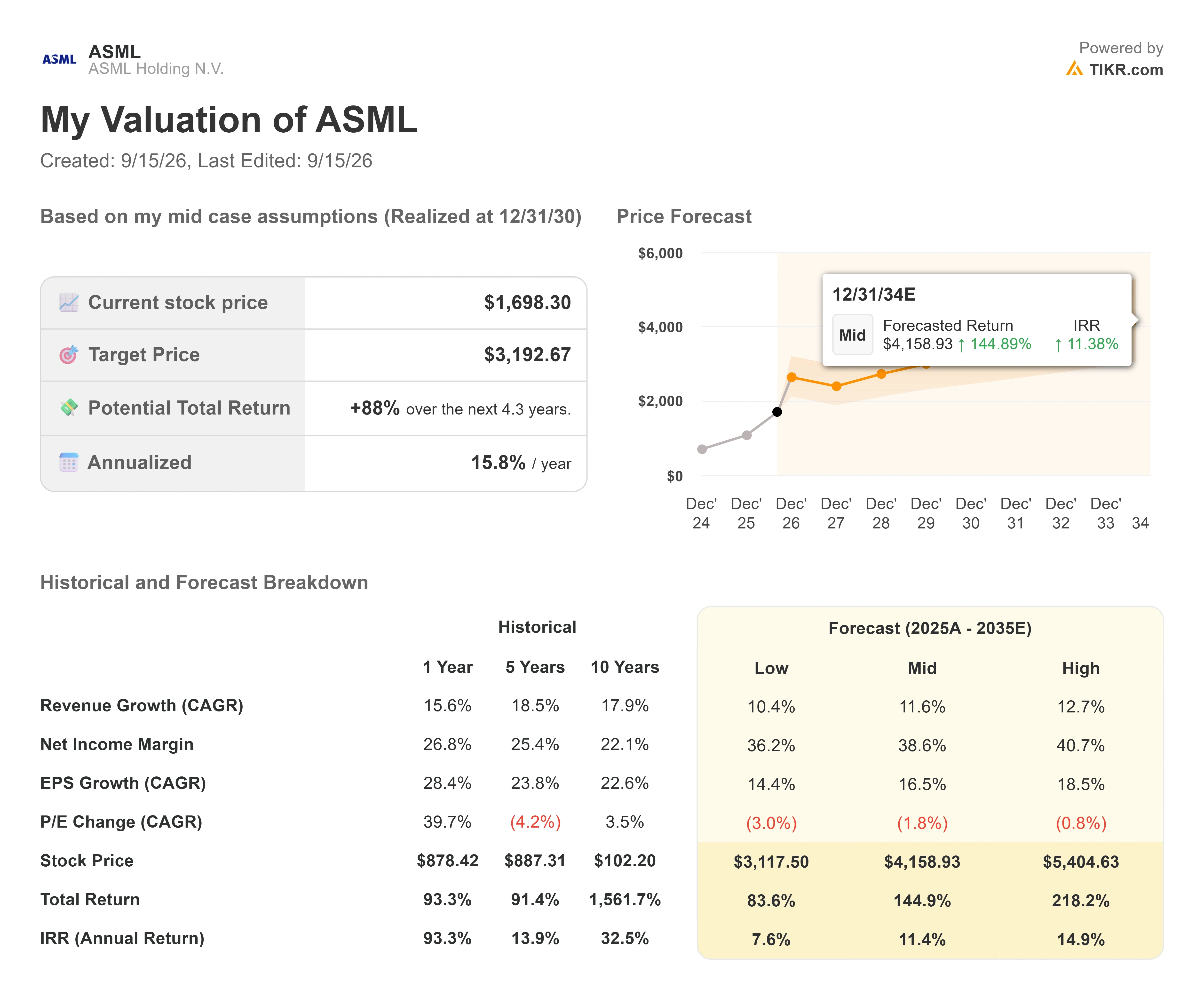
- Current Price: $1,575.15
- Target Price (Mid): ~$3,193
- Potential Total Return: ~88%
- Annualized IRR: ~16% / year
See analysts’ growth forecasts and price targets for ASML stock (It’s free!) >>>
The model uses the mid-case scenario, realized at the end of 2030, anchoring on a target of around $3,193, roughly 88% total return and a 16% annualized return over 4.3 years from the model’s entry price. That entry price of $1,698.30 sits above Monday’s $1,575.15 close, so a buyer at the current price starts with slightly more upside than the model shows.
- Revenue drivers: rising lithography intensity, as advanced logic and DRAM nodes need more EUV and immersion layers per wafer; and the installed-base upgrade cycle, where customers pay to lift the output of tools they already own.
- Margin driver: a richer mix of higher-throughput EUV systems and high-margin service revenue, lifting net income margin toward roughly 39% on an around 12% revenue CAGR.
- Primary risk: if AI capex actually slows, litho intensity decelerates and a premium multiple derates further.
- Upside vs. downside: the monopoly and multi-year backlog let ASML compound through any pause; the downside is a sentiment-driven derating that overwhelms the fundamentals longer than a patient holder expects.
Conclusion
The next real test is October 14, when ASML reports Q3 2026. Management guided to €11 billion to €12 billion in net sales and a 55% to 57% gross margin, so a result within that range confirms the demand story the essay tried to undercut. Watch bookings and any commentary on 2027 and 2028 order coverage most closely. If Dassen still calls 2027 nearly booked and 2028 filling in, the selloff was sentiment. If that language softens, the market’s fear earns a second look.
See what stocks billionaire investors are buying so you can follow the smart money with TIKR.
Should You Invest in ASML?
The only way to really know is to look at the numbers yourself. TIKR gives you free access to the same institutional-quality financial data that professional analysts use to answer exactly that question.
Pull up ASML, and you’ll see years of historical financials, what Wall Street analysts expect for revenue and earnings in the quarters ahead, how valuation multiples have moved over time, and whether price targets are trending up or down.
You can build a free watchlist to track ASML alongside every other stock on your radar. No credit card required. Just the data you need to decide for yourself.
Looking for New Opportunities?
- See what stocks billionaire investors are buying so you can follow the smart money.
- Analyze stocks in as little as 5 minutes with TIKR’s all-in-one, easy-to-use platform.
- The more rocks you overturn… the more opportunities you’ll uncover. Search 100K+ global stocks, global top investor holdings, and more with TIKR.
Disclaimer:
Please note that the articles on TIKR are not intended to serve as investment or financial advice from TIKR or our content team, nor are they recommendations to buy or sell any stocks. We create our content based on TIKR Terminal’s investment data and analysts’ estimates. Our analysis might not include recent company news or important updates. TIKR has no position in any stocks mentioned. Thank you for reading, and happy investing!