
Key Stats for Pfizer Stock
- Current Price: $27.72
- Target Price (Mid): ~$29
- Street Target: ~$29
- Potential Total Return: ~5%
- Annualized IRR: ~1% / year
Now Live: Discover how much upside your favorite stocks could have using TIKR’s new Valuation Model (It’s free) >>>
What Happened?
Pfizer (PFE) trades near $27.72, and its CEO spent his most striking comments on September 14 not on the patent cliff or the dividend, but on a competitor that barely appears in a single analyst model: Chinese pharma. Speaking at the Morgan Stanley Global Healthcare Conference, Chairman and CEO Albert Bourla said Chinese drug developers now move at “3x the speed, half the cost,” and predicted that global Chinese pharma players will emerge by the end of the decade.
For a stock that the market prices as a slow-declining income name, that is an unusual thing to hear from management. The question it raises is whether Bourla is preparing Pfizer for a real structural shift, or narrating a threat that is years from mattering to the numbers.
The China Bet, and the AI Lever Behind It
Bourla was direct about the stakes. He said his future competitor may not be Lilly or Merck but a Chinese multinational, and that “by the end of the decade, I would be surprised if we don’t have global Chinese players.” His response is twofold. Pfizer already sources innovation from China through out-licensing, backed by 1,500 R&D staff on the ground and a due diligence process where teams review patient records and scans one by one before signing. And to compete on cost and speed, he is leaning on artificial intelligence, which he called the biggest lever available to reach “half the cost and 3x the speed.”
The AI use cases he flagged were not the obvious ones. Beyond drug discovery, Bourla pointed to marketing, noting physicians increasingly pull information from large language models, so Pfizer is working to ensure its data sits inside those models. He also cited broader sales-force coverage and manufacturing supply-chain gains. It matters because these are margin levers, not revenue promises: if AI compresses Pfizer’s cost base the way the completed $7.2 billion cost program did, it protects earnings even as the legacy portfolio shrinks.
See historical and forward estimates for Pfizer stock (It’s free!) >>>
Why the Market Still Prices Decline
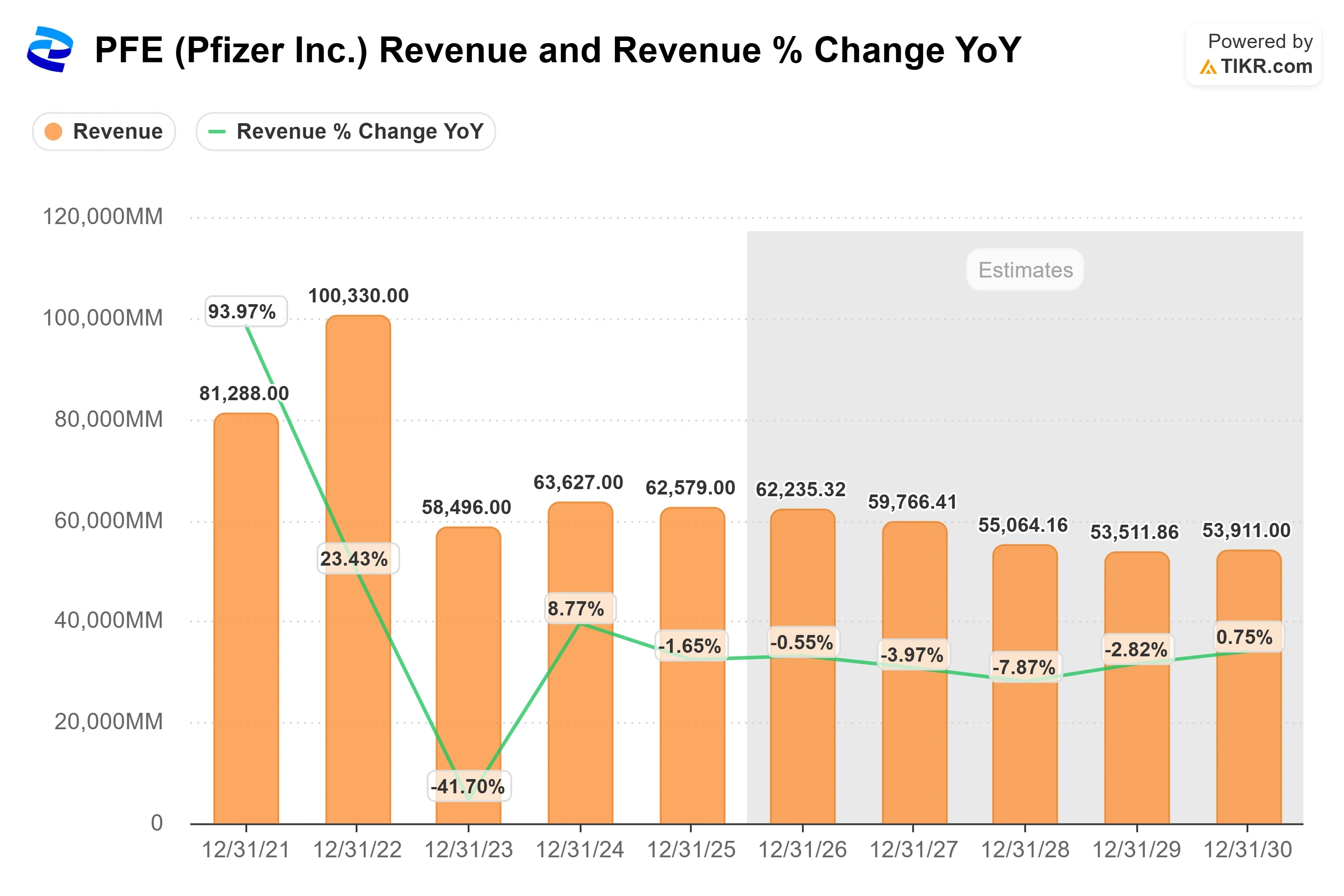
Wall Street models Pfizer’s revenue falling from about $62.6 billion in 2025 to roughly $53.9 billion by 2030, with a forward two-year revenue CAGR of around negative 2%. The near-term business is healthier than that curve suggests: second-quarter revenue of $15.03 billion, reported August 4, beat the $14.39 billion estimate by 4.5%, with adjusted EPS of $0.77 against $0.68, and management says it has beaten revenue estimates in nine of the last ten quarters. Yet the forward line still bends down, driven by COVID runoff and looming patent expirations.
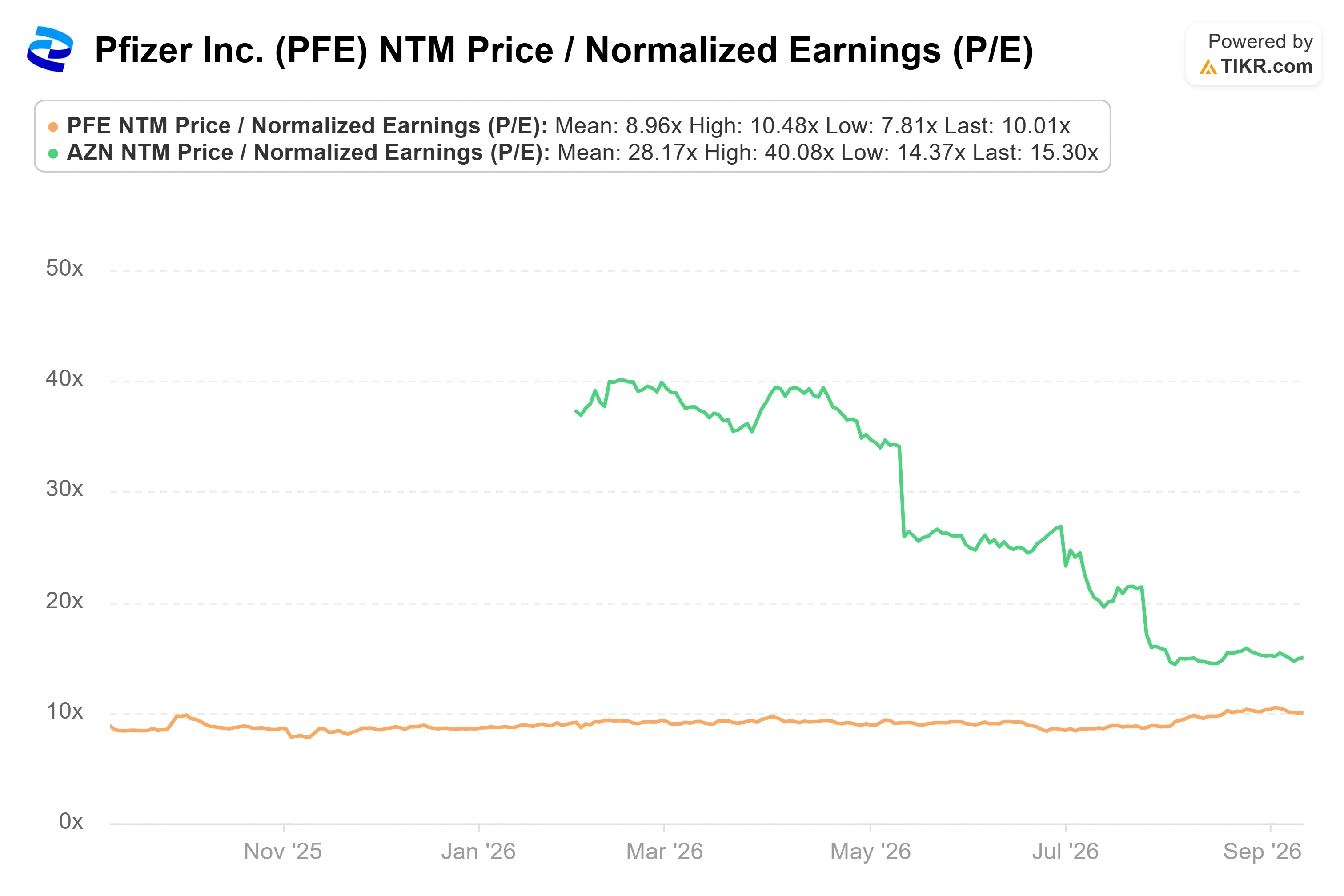
The mean target of $28.88 sits barely above the current quote, ratings skew to 16 Holds against 8 Buys and 2 Outperforms, and the stock trades near 10 times forward earnings versus 14.8x for Novartis and 15.1x for AstraZeneca, though Bristol-Myers Squibb sits close at roughly 10x, per TIKR’s Competitors data. The discount is defensible given the negative growth trajectory. It also means the market pays almost nothing for either the obesity pipeline or the competitive repositioning Bourla is describing. The near-term proof point he flagged is the company’s EZH2 prostate-cancer readout, which he expects before year-end, following June’s Phase 3 lung-cancer trial that missed its primary endpoint.
See how Pfizer performs against its peers in TIKR (It’s free!) >>>
TIKR Advanced Model Analysis
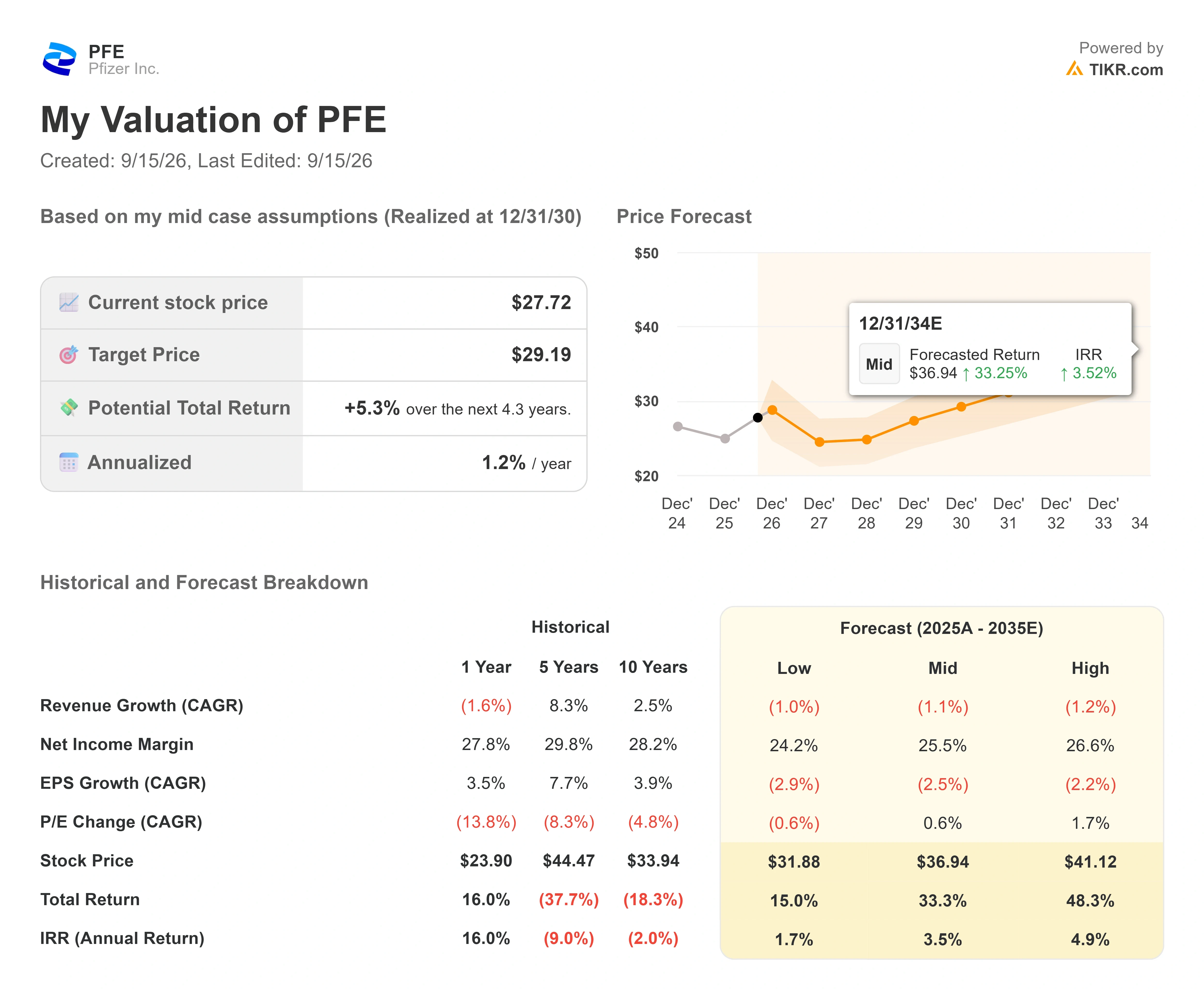
- Current Price: $27.72
- Target Price (Mid): ~$29
- Potential Total Return: ~5%
- Annualized IRR: ~1% / year
See analysts’ growth forecasts and price targets for Pfizer stock (It’s free!) >>>
Using the mid-case scenario, TIKR’s model lands close to the Street, the sober counterweight to Bourla’s ambition. It projects a target near $29 by the end of 2030, about 5% total return, and roughly 1% annualized before the dividend. The two revenue drivers carrying any upside are the Metsera-led obesity portfolio and the Seagen oncology franchises, both of which must grow fast enough to offset the COVID and patent declines. The margin driver is cost discipline, holding a net income margin around 26%, the exact lever Bourla’s AI push aims to extend. The primary risk is that the pipeline readouts disappoint, leaving a shrinking base at a fair multiple.
The upside is that AI-driven cost gains and the new-product engine hold margins while the multiple re-rates off its lows, with a 6.3% dividend paying investors to wait. The downside is that the patent cliff overwhelms the new products, leaving a shrinking business whose reported earnings no longer cover the payout.
Conclusion
Bourla’s China-and-AI framing is a five-year argument, and the market will not settle it soon. The nearer test is clinical: the EZH2 prostate-cancer readout he expects before the end of 2026. A clean win would suggest the pipeline can carry the growth the Street refuses to model. A miss, on the heels of the summer lung-cancer failure, confirms the analysts holding cautious out-year estimates. Watch for that data by year-end. Until then, the model and the Street agree the stock is worth about what it costs, and Bourla is the one who has to prove them wrong.
See what stocks billionaire investors are buying so you can follow the smart money with TIKR.
Should You Invest in Pfizer?
The only way to really know is to look at the numbers yourself. TIKR gives you free access to the same institutional-quality financial data that professional analysts use to answer exactly that question.
Pull up Pfizer, and you’ll see years of historical financials, what Wall Street analysts expect for revenue and earnings in the quarters ahead, how valuation multiples have moved over time, and whether price targets are trending up or down.
You can build a free watchlist to track Pfizer alongside every other stock on your radar. No credit card required. Just the data you need to decide for yourself.
Looking for New Opportunities?
- See what stocks billionaire investors are buying so you can follow the smart money.
- Analyze stocks in as little as 5 minutes with TIKR’s all-in-one, easy-to-use platform.
- The more rocks you overturn… the more opportunities you’ll uncover. Search 100K+ global stocks, global top investor holdings, and more with TIKR.
Disclaimer:
Please note that the articles on TIKR are not intended to serve as investment or financial advice from TIKR or our content team, nor are they recommendations to buy or sell any stocks. We create our content based on TIKR Terminal’s investment data and analysts’ estimates. Our analysis might not include recent company news or important updates. TIKR has no position in any stocks mentioned. Thank you for reading, and happy investing!