Key Stats for PFE Stock
- Past week’s performance: Consolidating
- 52-week range: $23 to $29
- Valuation model target price: $27
- Implied upside: +12.8% over 2.5 years
Value your favorite stocks like Pfizer with TIKR’s Guided Valuation Model (It’s free) >>>
FDA Wins, a Trial Miss, and a CFO Transition at an Uncomfortable Moment
Pfizer Inc. (PFE) delivered a cluster of catalysts in the final two weeks of June 2026, and investors had to digest wins and setbacks almost simultaneously. On June 24 to 25, the FDA approved Pfizer’s Ibrance (palbociclib) regimen for HR-positive, HER2-positive metastatic breast cancer as a frontline maintenance treatment, confirmed in the company’s SEC 8-K filing. Ibrance is already one of Pfizer’s largest oncology products. The expanded label opens a new patient population where the drug had not previously been approved as a first-line therapy.
The good news came just after a meaningful setback. On June 23, Pfizer disclosed that its Phase 3 SigVie-002 trial testing sigvotatug vedotin in metastatic non-small cell lung cancer missed its primary endpoint for overall survival. Non-small cell lung cancer is the most common form of lung cancer. The failure removed a potential blockbuster from Pfizer’s near-term pipeline, though earlier treatment settings for the drug remain under investigation.
CFO Dave Denton announced on June 18 that he would leave on August 15, returning to the consumer goods industry. Cecile Guegan, Senior Vice President of Finance for Pfizer’s global biopharmaceuticals business, was named interim CFO effective August 16.

Pfizer simultaneously reaffirmed its full-year 2026 revenue guidance of $59.5 to $62.5 billion and maintained its adjusted EPS guidance of $2.80 to $3.00. Scotiabank analyst Louise Chen noted the departure raised investor concerns about the 2026 forecast and the timing given Pfizer’s planned entry into the obesity drug market.
CEO Albert Bourla stated that Guegan brings “deep institutional knowledge and financial acumen.” Going forward, the FDA Ibrance approval is a meaningful commercial catalyst, but the lung cancer miss and the CFO change ensure investor sentiment around Pfizer remains cautious rather than broadly bullish.
See analysts’ growth forecasts and price targets for PFE (It’s free) >>>
Is Pfizer Stock a Value Trap or a Genuine Recovery Opportunity?

Under valuation model assumptions realized through 12/31/28, the stock is modeled using:
- Revenue Growth (CAGR): -4.0%
- Operating Margins: 35.1%
- Exit P/E Multiple: 8.8x
The model estimates a target price of $27, implying 12.8% total upside from the current price of $24 and a 4.9% annualized return over the next 2.5 years.
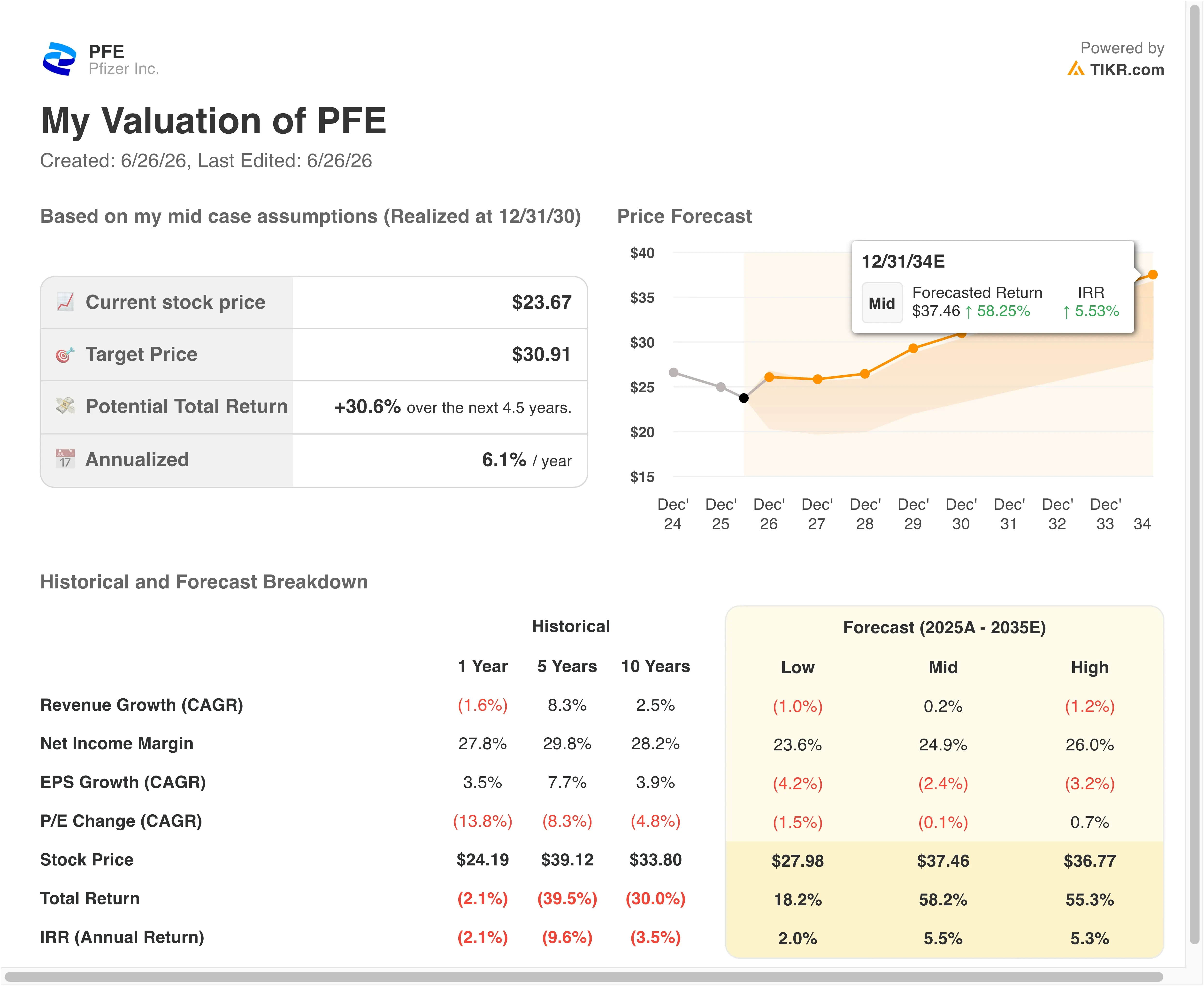
The negative 4% revenue growth assumption reflects the ongoing unwinding of COVID-related product revenue. Pfizer’s Paxlovid antiviral and COVID vaccine together generated tens of billions in peak annual revenue that has since declined sharply. Stripping those products out, the core portfolio has grown modestly, but aggregate reported figures remain in decline. The two-year forward revenue CAGR stands at negative 2.6%, confirming the market does not yet expect a revenue inflection through 2027.
The operating margin target of 35.1% is achievable. Pfizer’s last-twelve-month EBIT margin stands at 29.9%, but the company has historically demonstrated margins above 30% outside of pandemic-era distortions. Continued cost restructuring and divestiture of lower-margin assets support the margin trajectory even without revenue growth.
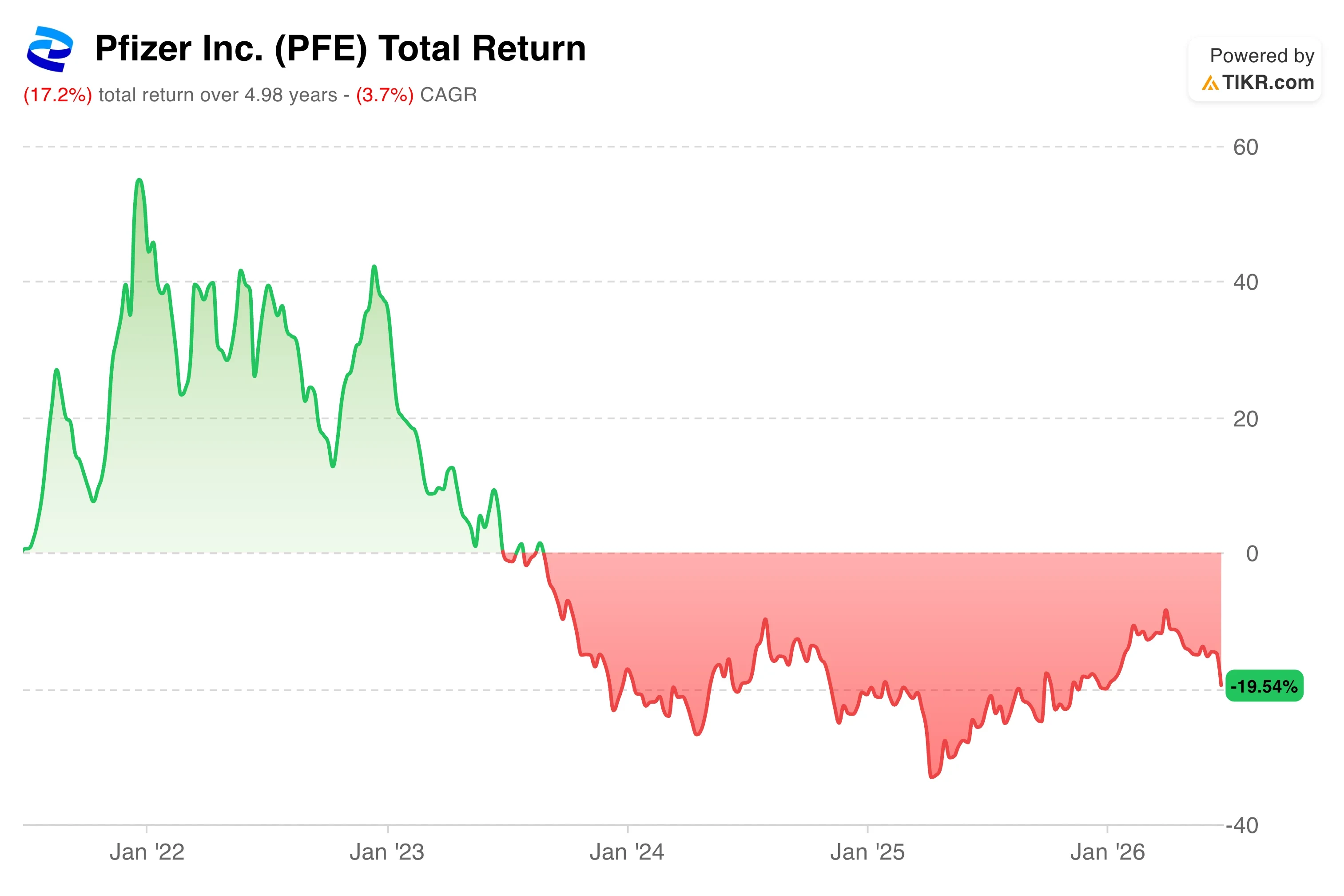
At $24 per share, Pfizer trades at 18x last-twelve-month earnings but only 8.3x NTM P/E. A forward P/E of 8.3x is historically low for a major pharmaceutical company. The dividend yield stands at 7.3%, providing a meaningful income floor while investors wait for the pipeline to rebuild. That income component is the most tangible near-term return driver for PFE shareholders at the current price.
Build your own Pfizer valuation model in under 60 seconds (Free with TIKR) >>>
Pfizer vs. Eli Lilly and AstraZeneca
Pfizer’s challenge is starkest when compared to Eli Lilly (LLY), which is in an entirely different growth phase. Lilly’s tirzepatide, marketed as Zepbound and Mounjaro, is driving annual revenue growth above 30%. Lilly trades at roughly 35x to 40x forward earnings because of that product cycle. Pfizer is specifically trying to access the obesity market through its own GLP-1 program.
In June 2026, Pfizer reported that its monthly obesity injection, berobenatide (Vesper-1), showed nearly 16% weight loss at 32 weeks in mid-stage trials, with a side-effect profile similar to Wegovy, per the company’s conference presentation.
A monthly injection format would differentiate Pfizer from both Novo Nordisk’s weekly Wegovy and Lilly’s tirzepatide. However, a pivotal Phase 3 trial has not yet begun, so any commercial launch remains multiple years away.
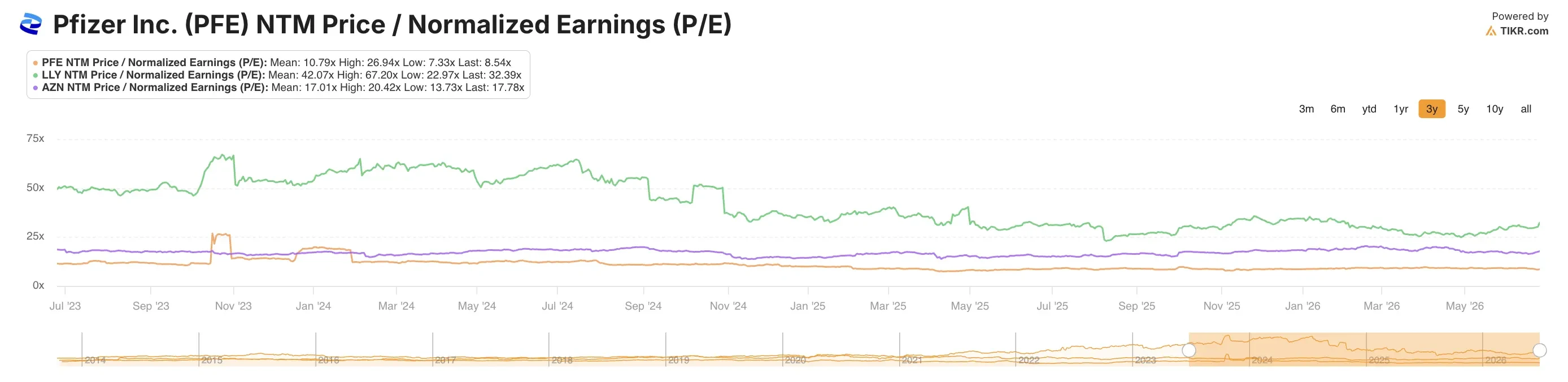
AstraZeneca (AZN) is the more structurally relevant comparison for Pfizer’s oncology strategy. AstraZeneca rebuilt its pipeline successfully through partnerships and acquisitions, posting revenue growth above 15% annually. Its forward P/E sits in the 25x to 30x range. That outcome shows what a successful pipeline rebuild looks like from where Pfizer stands today. Pfizer’s collaborations with Innovent, Arvinas, and Sarah Cannon Research Institute in oncology follow a structurally similar approach, but they are earlier-stage and carry more execution risk.
The gap between Pfizer’s 8.5x forward P/E and AstraZeneca’s 25x multiple reflects the execution gap between a company still mid-rebuild and one that has already delivered results.
Estimate a company’s fair value instantly (Free with TIKR) >>>
What’s Driving PFE Stock Going Forward?
The obesity drug program is the most important pipeline watch item. Vesper-1’s Phase 2b data showed weight loss results competitive with approved GLP-1 drugs. A monthly injection format, if approved, would differentiate Pfizer meaningfully in a crowded obesity market. However, a Phase 3 enrollment timeline has not yet been disclosed, so investors are watching for any management commentary on that next step.
The Innovent oncology collaboration, signed in May 2026, covers 12 programs with a total deal value of up to $10.5 billion, confirmed in company filings. Payments flow to Innovent as milestones are hit across clinical stages, so the near-term cash outlay is modest. But the deal signals Pfizer’s intent to accelerate its cancer portfolio through external licensing rather than internal discovery alone.
Pfizer’s dismissal from a multistate drug price-fixing lawsuit on June 24 removes one specific legal overhang. The company still faces broader pricing pressures in Europe and from U.S. government negotiation mechanisms. Yet the dismissal meaningfully reduces near-term litigation risk.
The Q2 2026 earnings report is expected on August 4, 2026. Investors will assess whether interim CFO Guegan reaffirms the full-year adjusted EPS guidance of $2.80 to $3.00. Any update on the Vesper-1 Phase 3 enrollment timeline could be the single most impactful positive catalyst for PFE stock in the second half of 2026.
Explore Pfizer’s pipeline and valuation on TIKR (It’s free) >>>
Should You Invest in Pfizer?
The only way to really know is to look at the numbers yourself. TIKR gives you free access to the same institutional-quality financial data that professional analysts use to answer exactly that question.
Pull up PFE, and you’ll see years of historical financials, what Wall Street analysts expect for revenue and earnings in the quarters ahead, how valuation multiples have moved over time, and whether price targets are trending up or down.
You can build a free watchlist to track PFE alongside every other stock on your radar. No credit card required. Just the data you need to decide for yourself.
Analyze PFE stock on TIKR Free→
Looking for New Opportunities?
- See what stocks billionaire investors are buying so you can follow the smart money.
- Analyze stocks in as little as 5 minutes with TIKR’s all-in-one, easy-to-use platform.
- The more rocks you overturn… the more opportunities you’ll uncover. Search 100K+ global stocks, global top investor holdings, and more with TIKR.
Disclaimer:
Please note that the articles on TIKR are not intended to serve as investment or financial advice from TIKR or our content team, nor are they recommendations to buy or sell any stocks. We create our content based on TIKR Terminal’s investment data and analysts’ estimates. Our analysis might not include recent company news or important updates. TIKR has no position in any stocks mentioned. Thank you for reading, and happy investing!